Dress Code - Uniforms
Overview of this form
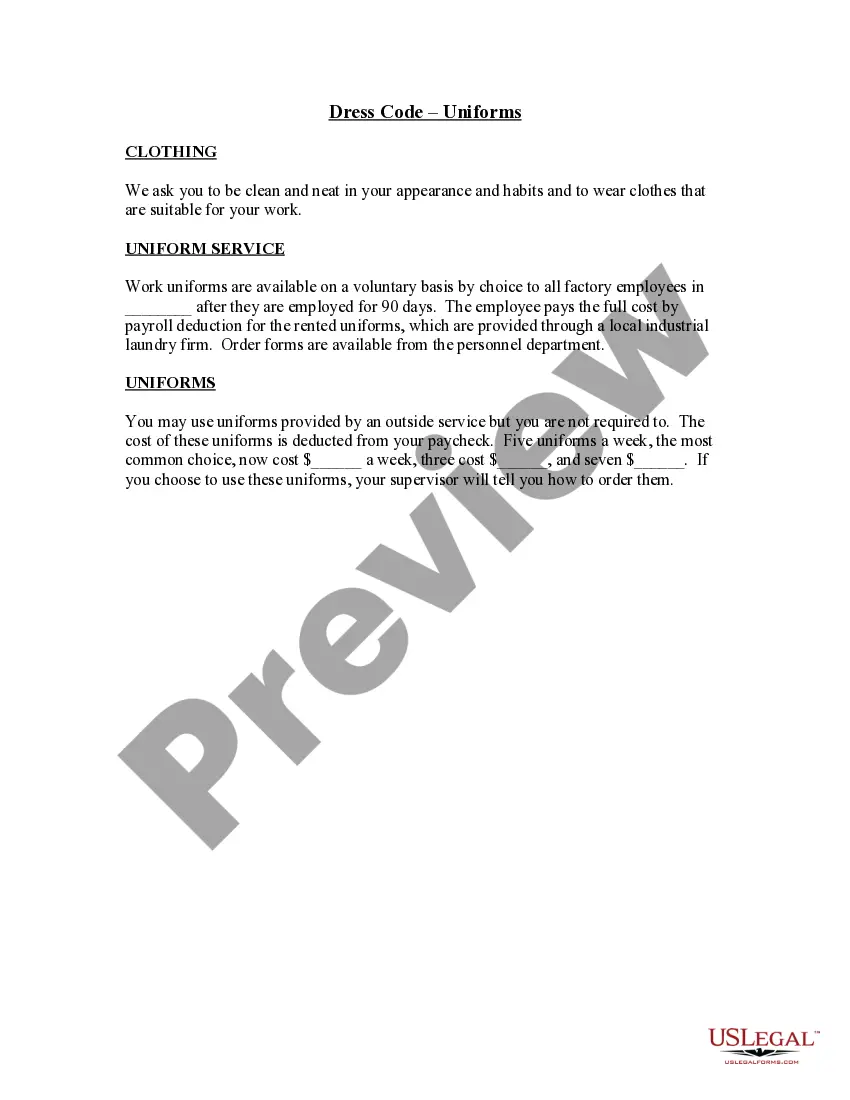
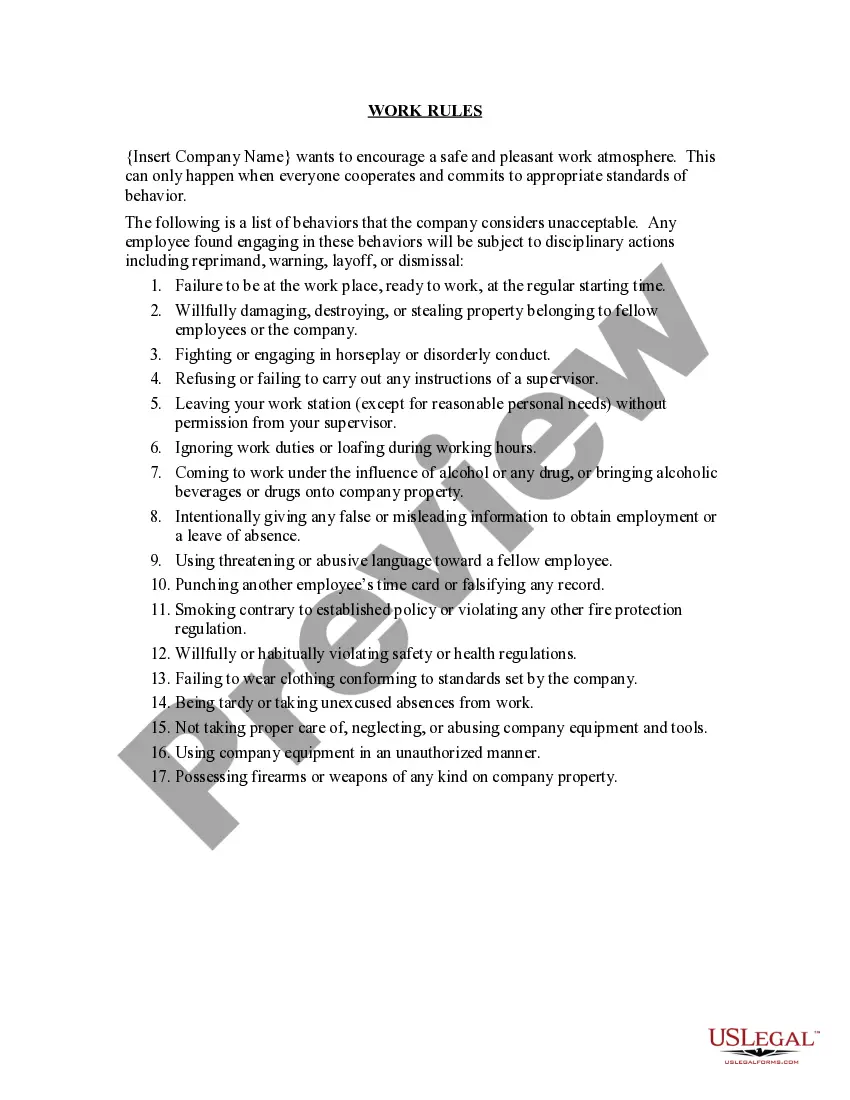
The Dress Code - Uniforms form outlines the expectations for employee appearance in relation to work uniforms. This form distinguishes itself by providing specific guidelines for uniform usage, rental options, and associated payroll deductions, ensuring employees understand their responsibilities regarding dress code compliance in a professional setting.
Key parts of this document
- Clothing Standards: Expectations for general appearance and attire.
- Uniform Service: Details about voluntary uniform rentals for factory employees after 90 days of employment.
- Cost Structure: Weekly rental costs and payment procedures through payroll deductions.
- Ordering Process: Instructions for obtaining uniform order forms from the personnel department.
When this form is needed
This form is essential when a company implements a dress code that includes uniform requirements. It serves as a guide for both new employees and management, clarifying the standards for uniforms and ensuring compliance with corporate policies related to employee appearance.
Who needs this form
- Employers seeking to establish clear dress code policies for employees.
- Human resources personnel responsible for managing employee attire standards.
- Employees in companies that offer uniforms as part of their dress code policy.
How to prepare this document
- Review the clothing standards section and ensure understanding of expectations.
- Complete the uniform rental request if opting to use the company-provided uniforms.
- Determine the rental cost based on the number of uniforms needed per week.
- Provide necessary personal information on the order form obtained from the personnel department.
- Submit the completed form to the designated supervisor or HR representative.
Does this form need to be notarized?
In most cases, this form does not require notarization. However, some jurisdictions or signing circumstances might. US Legal Forms offers online notarization powered by Notarize, accessible 24/7 for a quick, remote process.
Get your form ready online
Our built-in tools help you complete, sign, share, and store your documents in one place.
Make edits, fill in missing information, and update formatting in US Legal Forms—just like you would in MS Word.
Download a copy, print it, send it by email, or mail it via USPS—whatever works best for your next step.
Sign and collect signatures with our SignNow integration. Send to multiple recipients, set reminders, and more. Go Premium to unlock E-Sign.
If this form requires notarization, complete it online through a secure video call—no need to meet a notary in person or wait for an appointment.
We protect your documents and personal data by following strict security and privacy standards.
Make edits, fill in missing information, and update formatting in US Legal Forms—just like you would in MS Word.
Download a copy, print it, send it by email, or mail it via USPS—whatever works best for your next step.
Sign and collect signatures with our SignNow integration. Send to multiple recipients, set reminders, and more. Go Premium to unlock E-Sign.
If this form requires notarization, complete it online through a secure video call—no need to meet a notary in person or wait for an appointment.
We protect your documents and personal data by following strict security and privacy standards.
Common mistakes
- Not adhering to the specified clothing standards, leading to non-compliance with company policy.
- Failing to submit the uniform order form within the required time frame.
- Forgetting to account for the deductions from the paycheck when enrolling in the uniform rental service.
Why complete this form online
- Immediate access to a professionally drafted dress code template.
- Editability allows customization to fit specific workplace needs and regulations.
- Reliability in ensuring all legal and policy requirements are met comprehensively.
Looking for another form?
Form popularity
FAQ
The purpose of a dress code is to set guidelines to ensure a neat and modest appearance that will serve us in representing our Lord, our families and our school well. Another purpose for a dress code is the issue of appropriate apparel for an academic environment.
A school uniform policy defines what clothes must be worn to school. Dress codes limit clothing options while school uniforms define clothing options. Schools claim that when students come in uniforms, it improves discipline and leads to academic gains.
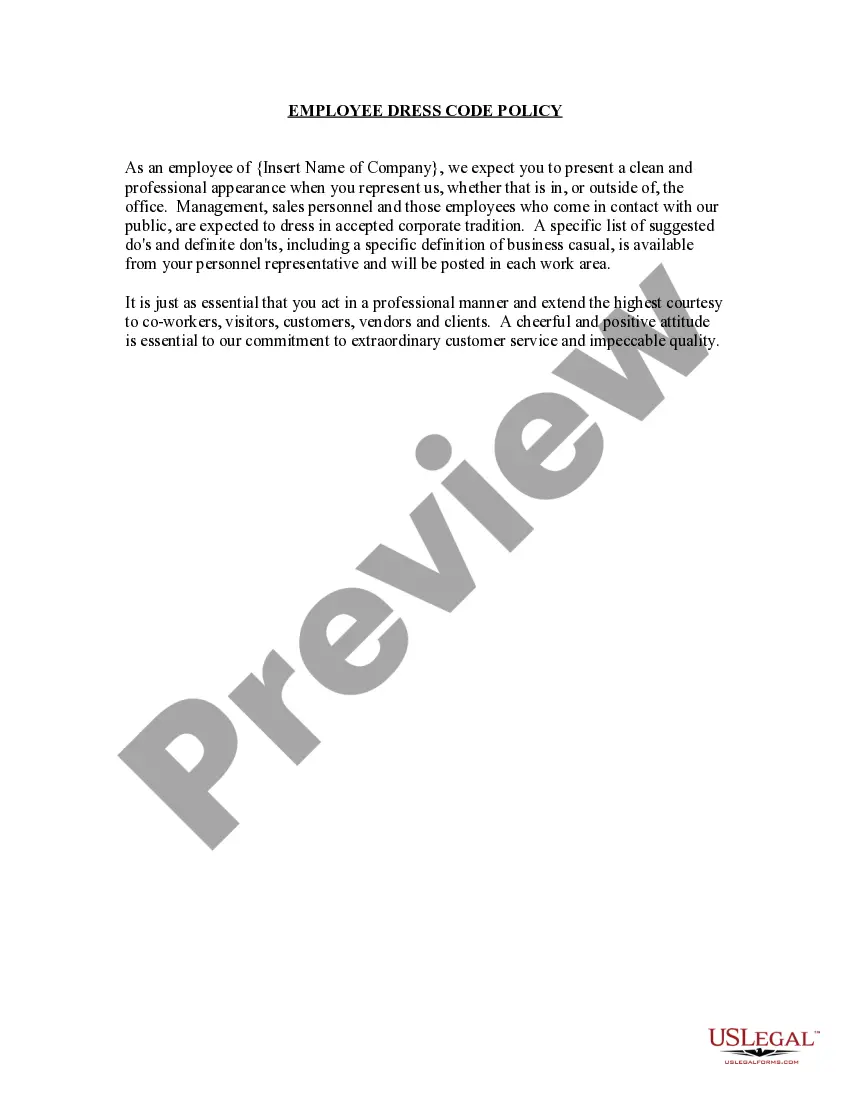
Dress codes are used to communicate to employees what the organization considers appropriate work attire. A dress code or appearance policy allows an employer to set expectations regarding the image it wants the company to convey. Dress codes can be formal or informal and might include the use of uniforms.
Dress codes versus uniforms Generally less restrictive than uniform policies, dress codes tend to prohibit things like lewd or disruptive apparel or anything that promotes violence, harassment, or illegal activity (including alcohol and drug use).
English Language Learners Definition of dress code : a set of rules about what clothing may and may not be worn at a school, office, restaurant, etc.
Your Rights Dress Codes and Grooming. Many employers require their employees to follow a dress code. Employers regulate clothing, piercings, tattoos, makeup, nails, hair, and more. For the most part these dress codes are legal as long as they are not discriminatory.
Examples of appropriate business attire include a polo shirt with pressed khaki pants, a sweater and a shirt with corduroy pants, a jacket with a skirt or slacks and a blouse or a sweater with a skirt or pants. Pantsuits and sports jackets also fit the business casual work environment if they are not too formal.
Dress codes versus uniforms Generally less restrictive than uniform policies, dress codes tend to prohibit things like lewd or disruptive apparel or anything that promotes violence, harassment, or illegal activity (including alcohol and drug use).
Employees must always present a clean, professional appearance. Everyone is expected to be well-groomed and wear clean clothing, free of holes, tears, or other signs of wear. Clothing with offensive or inappropriate designs or stamps are not allowed. Clothing should not be too revealing.