Oregon Revised Uniform Anatomical Gift Act Donation
What is this form?
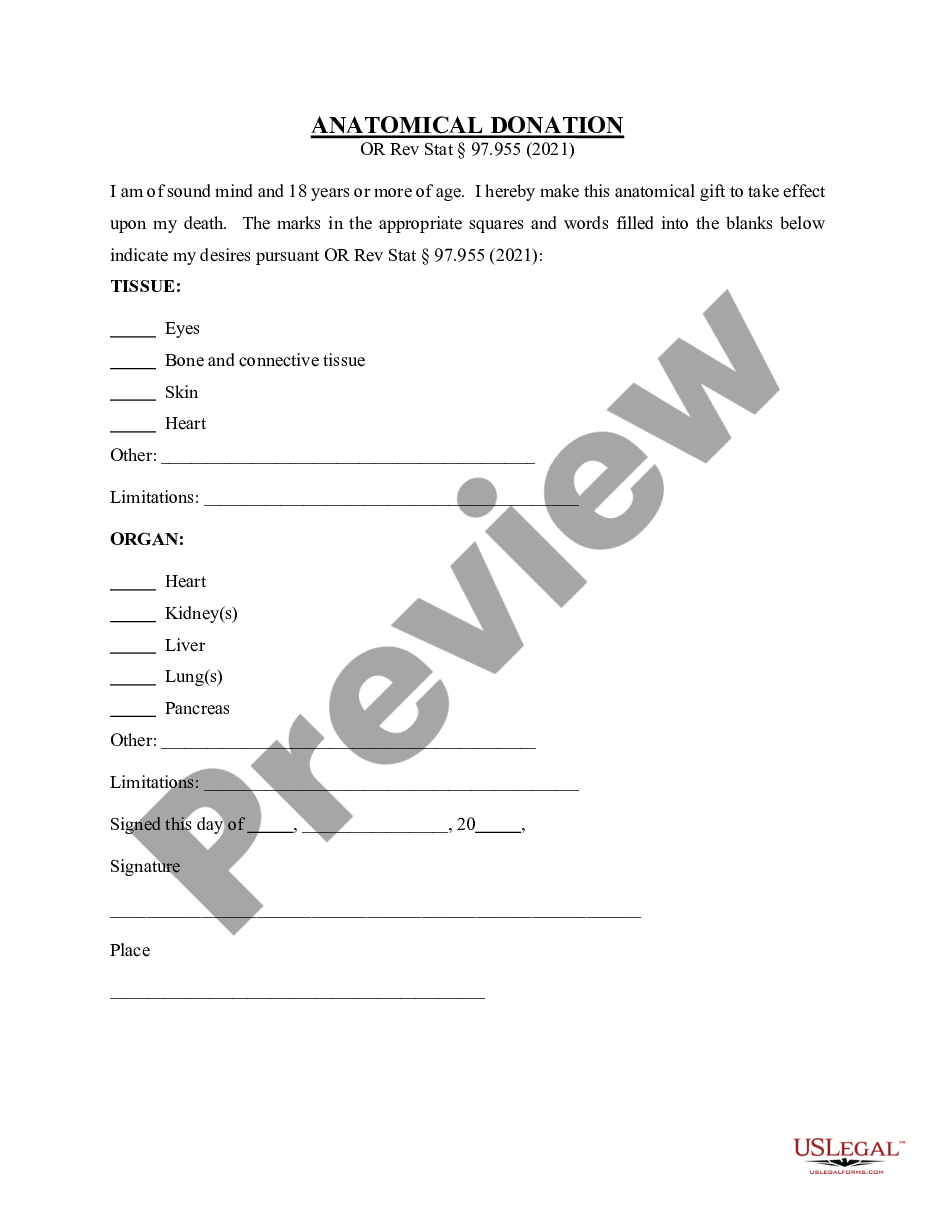
The Revised Uniform Anatomical Gift Act Donation form is a legal document that allows an individual to specify the body parts or organs they wish to donate upon their death. This form facilitates the formal declaration of anatomical gifts in accordance with state laws. Unlike general donation forms, the anatomical gift act focuses specifically on organ and tissue donation, making it crucial for individuals who want to ensure their wishes are respected after death.
Main sections of this form
- Declaration of the donor's intent to make an anatomical gift upon death.
- Identification of specific organs or tissues to be donated.
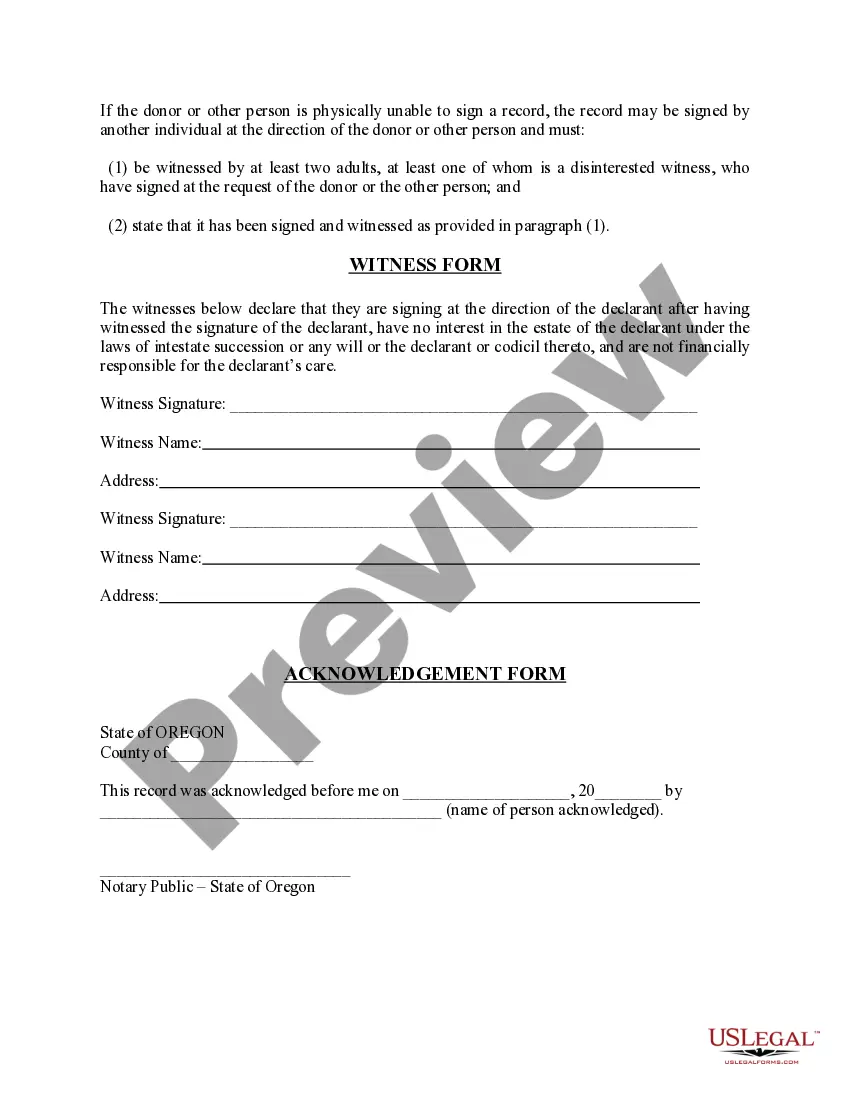
- Signature of the donor, which must be witnessed by at least two adults.
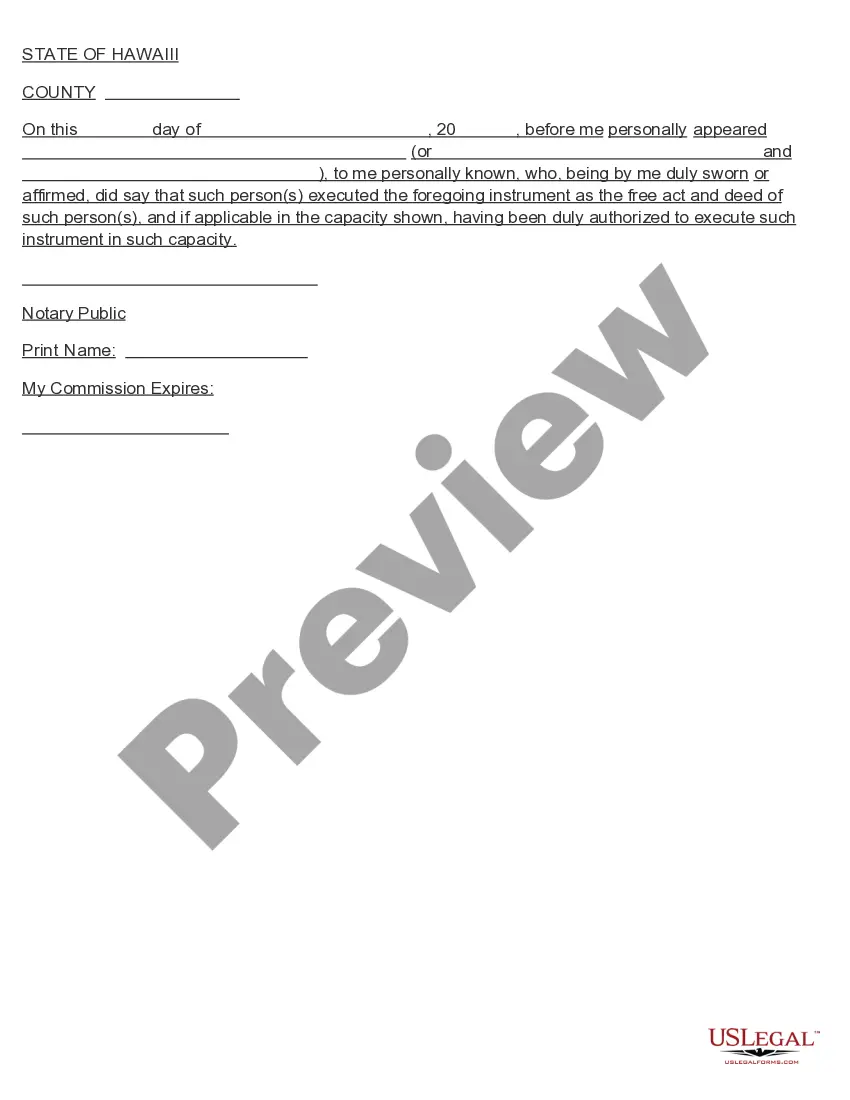
- Acknowledgment section for a notary to certify the form.
- Witnesses must declare they are disinterested and have no interest in the donor's estate.
When to use this document
This form should be used when an individual decides to donate their organs or tissues after passing. It is particularly important to complete this document if the person wants their wishes regarding organ donation to be legally recognized and honored by medical professionals and family members. Using this form ensures that the donor's choices are clearly outlined and legally binding.
Who can use this document
- Individuals who are 18 years or older and wish to donate their organs or tissues after death.
- People with specific wishes regarding which body parts they would like to donate.
- Those who want to ensure their donation decisions are respected and legally documented.
How to complete this form
- Enter your name and confirm that you are of sound mind and at least 18 years of age.
- Clearly indicate the specific organs or tissues you wish to donate by marking the appropriate boxes.
- Sign the form in the presence of at least two adult witnesses.
- Have the witnesses sign, confirming they are disinterested parties.
- Complete the acknowledgment section in front of a notary public to finalize the document.
Notarization guidance
To make this form legally binding, it must be notarized. Our online notarization service, powered by Notarize, lets you verify and sign documents remotely through an encrypted video session.
Get your form ready online
Our built-in tools help you complete, sign, share, and store your documents in one place.
Make edits, fill in missing information, and update formatting in US Legal Forms—just like you would in MS Word.
Download a copy, print it, send it by email, or mail it via USPS—whatever works best for your next step.
Sign and collect signatures with our SignNow integration. Send to multiple recipients, set reminders, and more. Go Premium to unlock E-Sign.
If this form requires notarization, complete it online through a secure video call—no need to meet a notary in person or wait for an appointment.
We protect your documents and personal data by following strict security and privacy standards.

Make edits, fill in missing information, and update formatting in US Legal Forms—just like you would in MS Word.

Download a copy, print it, send it by email, or mail it via USPS—whatever works best for your next step.

Sign and collect signatures with our SignNow integration. Send to multiple recipients, set reminders, and more. Go Premium to unlock E-Sign.

If this form requires notarization, complete it online through a secure video call—no need to meet a notary in person or wait for an appointment.

We protect your documents and personal data by following strict security and privacy standards.
Common mistakes
- Failing to have the document witnessed by the required number of adults.
- Not specifying which organs or tissues are to be donated.
- Neglecting to notarize the document, which may be a requirement for legal validity.
Why use this form online
- Convenient access to a legally vetted form, ensuring compliance with the law.
- Editable to suit individual preferences regarding organ donation.
- Immediate download option for quick completion and mailing to the appropriate parties.
What to keep in mind
- The form allows for clear articulation of organ and tissue donation wishes.
- Proper completion and notarization are essential for the document's validity.
- It is important for individuals aged eighteen or older who are competent to make decisions regarding donations.
Looking for another form?

Form popularity
FAQ
The Uniform Anatomical Gift Act allows individuals older than 18 years of age to donate bodies and body parts for transplantation after death.
The Uniform Anatomical Gift Act (UAGA) has been revised in 2006 to permit the use of life support systems at or near death for the purpose of maximizing procurement opportunities of organs medically suitable for transplantation.
Legal framework for the donation of organs, tissues and other human anatomy parts in the US. Passed in 1968, revised in 1987 and 2006. Ensures/regulates health and safety of American workers through regulations, laws and their enforcement.Formed to regulate food safety in the US.
That was a major first step. The Uniform Anatomical Gift Act was subsequently adopted by all 50 states and the District of Columbia.
The Act sets a regulatory framework for the donation of organs, tissues, and other human body parts in the US. The UAGA helps regulate body donations to science, medicine, and education. The Act has been consulted in discussions about abortion, fetal tissue transplants, and Body Worlds, an anatomy exhibition.
The Uniform Anatomical Gift Act of 1987 The provisions of the UAGA of 1968 would ban the purchase and sale of body parts, facilitate the simplified process of obtaining authorization to retrieve organs, and ensure that medical staff establish procedures and guidelines to identify organ donors while under hospital care.
If the potential donor is not found in the Registry, his or her next of kin or legally authorized representative (usually a spouse, relative or close friend) is offered the opportunity to authorize the donation. Once the donation decision is established, the family is asked to provide a medical and social history.