Oregon Co-Petitioners' (with minor children) Motion for Order Allowing Entry of Judgment on Affidavit in Lieu of Hearing
What this document covers
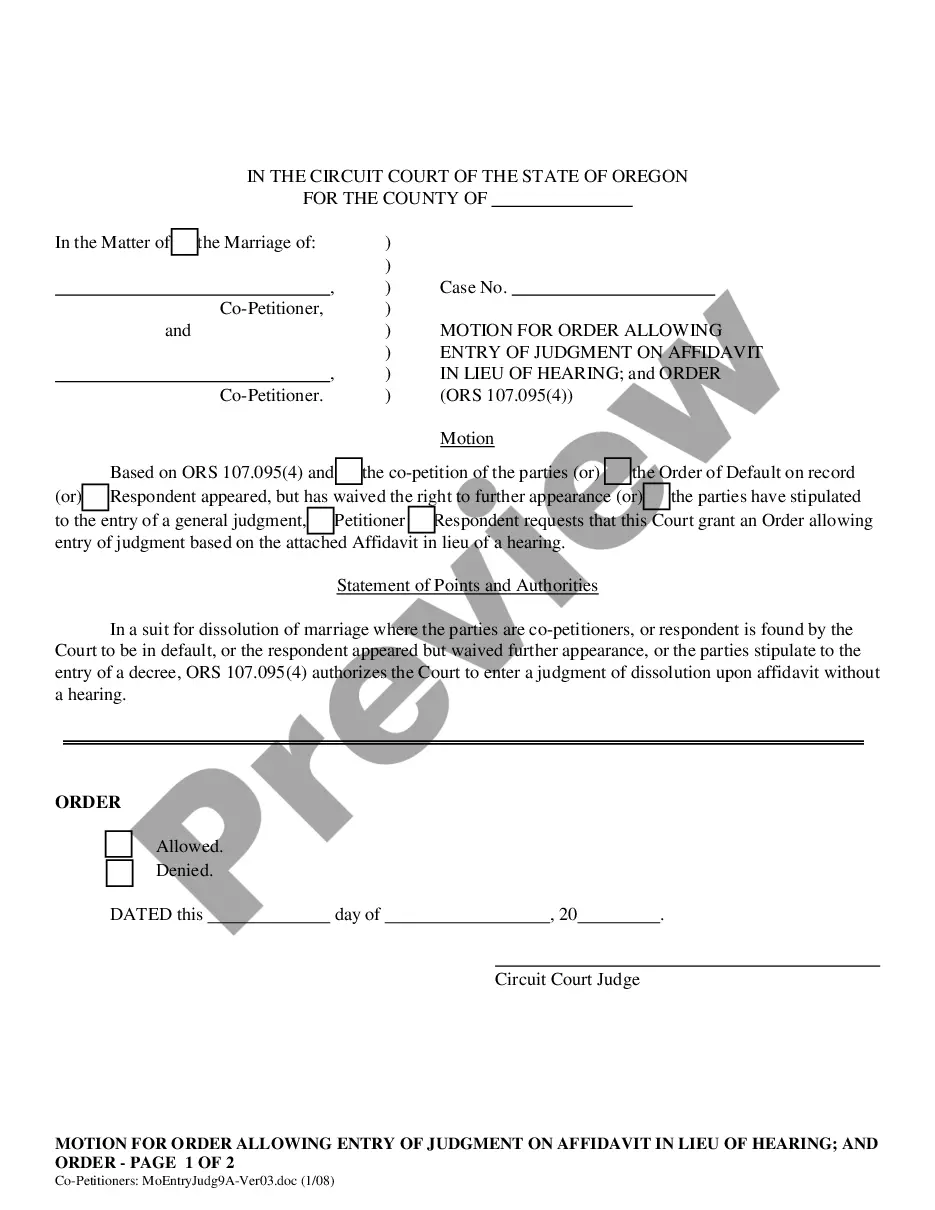
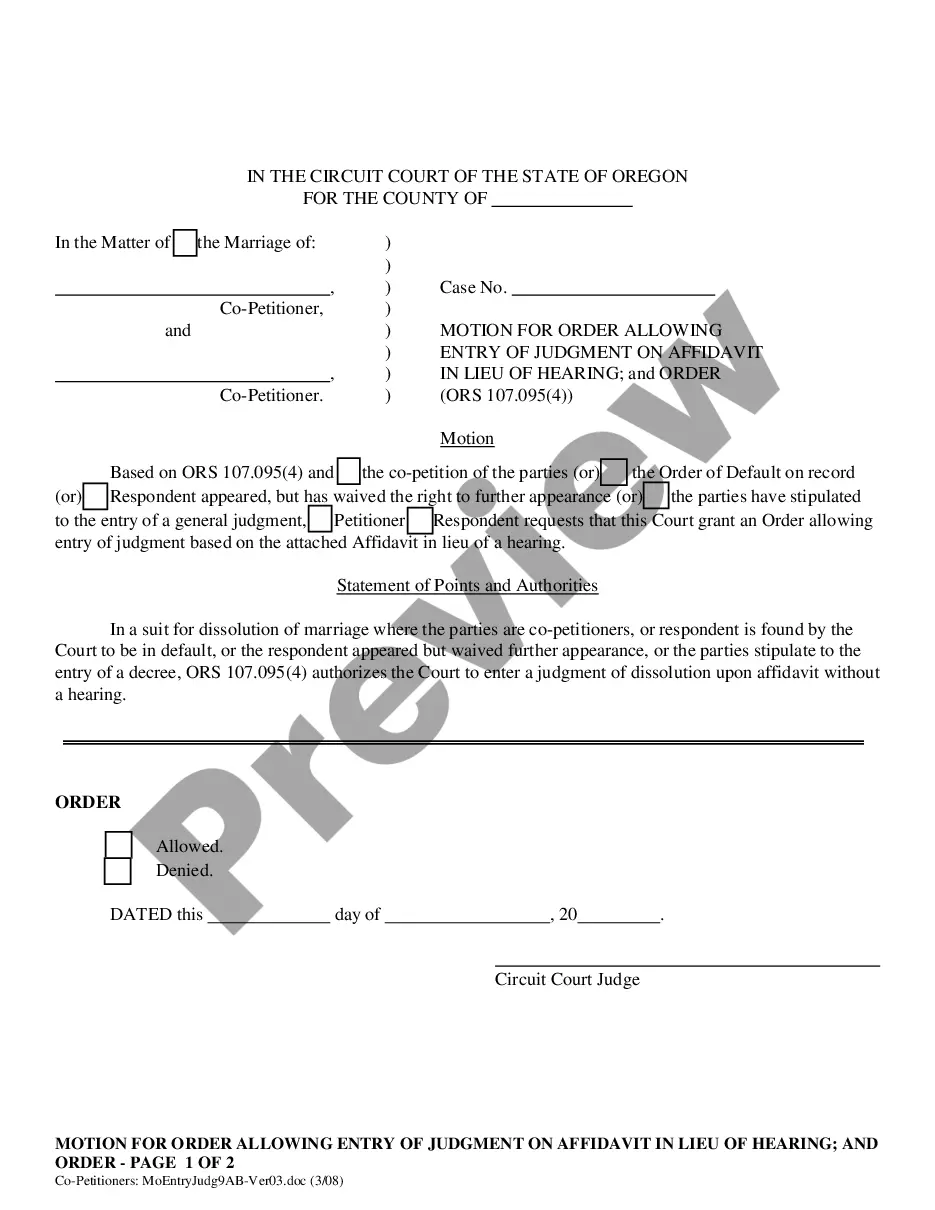
The Co-Petitioners' Motion for Order Allowing Entry of Judgment on Affidavit in Lieu of Hearing is a legal document used in marriage dissolution cases where both parties agree on the terms. This form allows the court to issue a judgment based on the submitted affidavit rather than requiring a hearing. It is particularly useful when one party is in default or has waived further appearances, streamlining the legal process for both co-petitioners.
Main sections of this form
- Identification of the co-petitioners and the case number.
- Selection of grounds for the motion, including co-petition or default status.
- Request for the court to approve the judgment based on the affidavit submitted.
- Statement of legal authority under ORS 107.095(4).
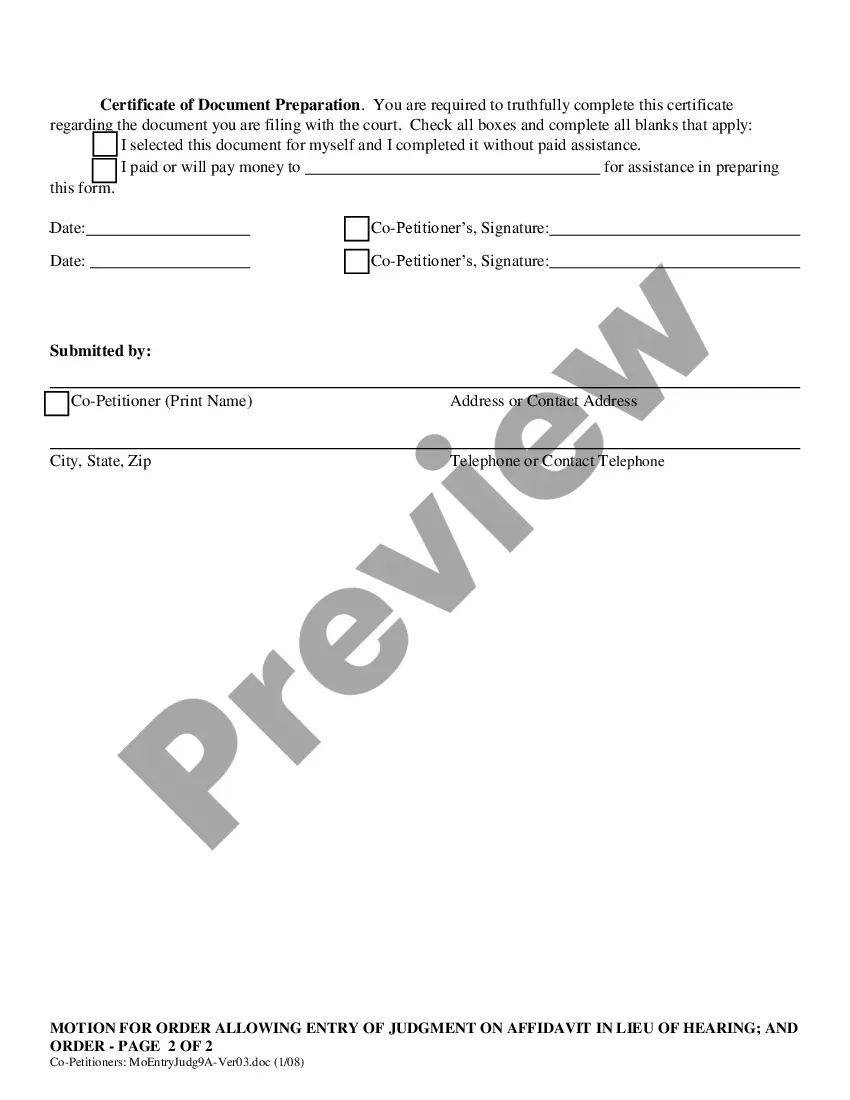
- Certification of document preparation and signatures of both co-petitioners.
When to use this form
This form should be used when both spouses agree to the dissolution of their marriage and wish to avoid a formal court hearing. It is ideal for situations where the respondent has not contested the proceedings, has waived their right to appear, or when both spouses present a mutually agreed upon statement for the court to consider.
Who can use this document
- Couples who are co-petitioners seeking a streamlined dissolution of marriage.
- Individuals whose spouse is in default or has waived their appearance in court.
- Parties who have mutually agreed on the terms of dissolution.
Instructions for completing this form
- Begin by identifying the names of both co-petitioners and the case number at the top of the form.
- Select the appropriate grounds for your motion based on your situation (e.g., co-petition, default, waiver).
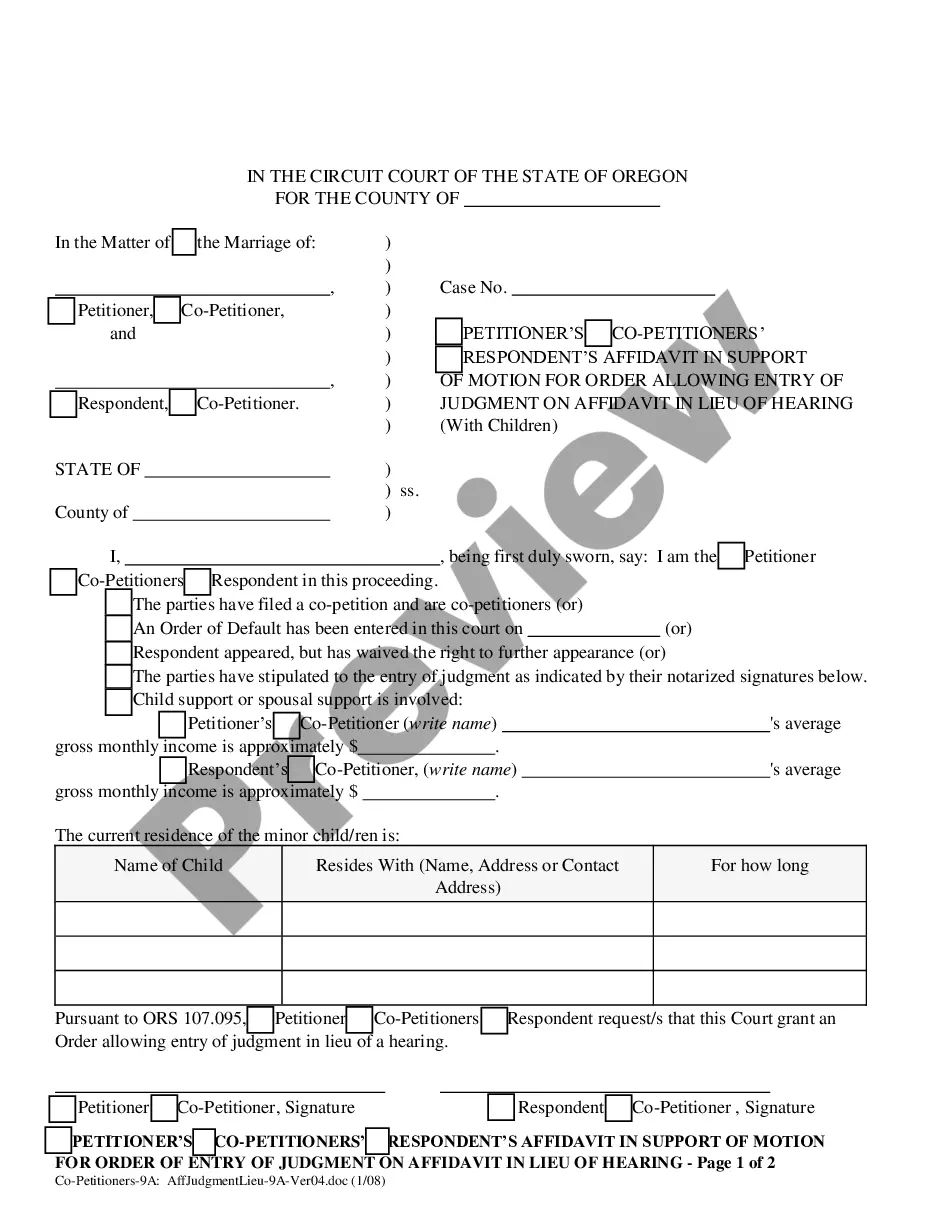
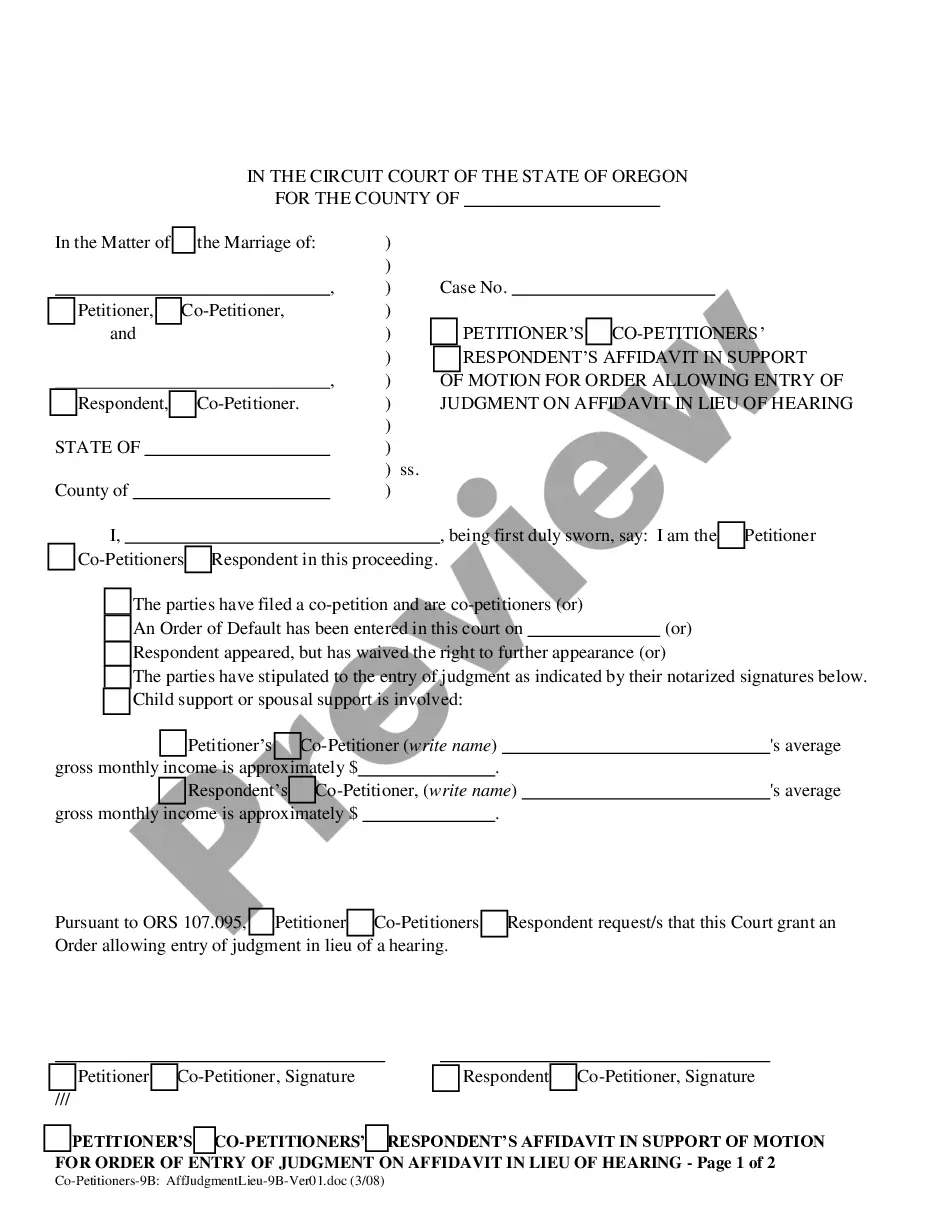
- Attach the necessary affidavit that supports your request for judgment.
- Complete the certification of document preparation section, indicating whether you received assistance.
- Sign and date the form as a co-petitioner and ensure both parties do so.
Does this form need to be notarized?
This form does not typically require notarization unless specified by local law. However, it is advised to check with the court rules of your jurisdiction to ensure compliance.
Get your form ready online
Our built-in tools help you complete, sign, share, and store your documents in one place.
Make edits, fill in missing information, and update formatting in US Legal Forms—just like you would in MS Word.
Download a copy, print it, send it by email, or mail it via USPS—whatever works best for your next step.
Sign and collect signatures with our SignNow integration. Send to multiple recipients, set reminders, and more. Go Premium to unlock E-Sign.
If this form requires notarization, complete it online through a secure video call—no need to meet a notary in person or wait for an appointment.
We protect your documents and personal data by following strict security and privacy standards.

Make edits, fill in missing information, and update formatting in US Legal Forms—just like you would in MS Word.

Download a copy, print it, send it by email, or mail it via USPS—whatever works best for your next step.

Sign and collect signatures with our SignNow integration. Send to multiple recipients, set reminders, and more. Go Premium to unlock E-Sign.

If this form requires notarization, complete it online through a secure video call—no need to meet a notary in person or wait for an appointment.

We protect your documents and personal data by following strict security and privacy standards.
Avoid these common issues
- Failing to properly identify both co-petitioners or the correct case number.
- Not attaching the supporting affidavit required for the motion.
- Neglecting to complete the certificate of document preparation.
- Forgetting to sign and date the document correctly.
Benefits of using this form online
- Convenient access: Download and complete the form from home at any time.
- Editability: Easily fill in your specific information and make any necessary changes.
- Reliable templates: Forms are crafted by licensed attorneys, ensuring legal accuracy and compliance.
Looking for another form?

Form popularity
FAQ
If after filing a divorce petition, the parties decide they want to try and reconcile their marriage, the petition can be dismissed, or simply put on hold (which saves time and expense of refiling) while the parties try to work things out.
The respondent can be either the plaintiff or the defendant from the court below, as either party can appeal the decision thereby making themselves the petitioner and their adversary the respondent. Formerly, in the equity courts of common law, the defendant was always called the respondent.
"Petitioner" refers to the party who petitioned the Supreme Court to review the case. This party is variously known as the petitioner or the appellant. "Respondent" refers to the party being sued or tried and is also known as the appellee.
In a contested divorce the petitioner (plaintiff) petitions the court for a divorce and respondent (defendant) has to respond. When the petition is jointly filed, the spouses are called Co-Petitioners. The husband and wife petition the court together with paperwork that is signed by both parties.
Parties include plaintiff (person filing suit), defendant (person sued or charged with a crime), petitioner (files a petition asking for a court ruling), respondent (usually in opposition to a petition or an appeal), cross-complainant (a defendant who sues someone else in the same lawsuit), or cross-defendant (a person
(In the trial court, the first name listed is the plaintiff, the party bringing the suit. The name following the "v" is the defendant. If the case is appealed, as in this example, the name of the petitioner (appellant) is usually listed first, and the name of the respondent (appellee) is listed second.
The petitioner is merely the spouse who files for divorce. This is a matter of procedure and doesn't imply any sort of legal or moral high ground. One party is always the first to file for divorce, and this can occur for any number of reasons, such as the other party having an affair.
A Notice of Entry of Judgment & Decree of Divorce (Default) is a document that notifies the other party that the Judge has signed a Judgment & Decree of Divorce (Default). This document must be sent to the other party and the Affidavit of Service filed with the Clerk of Courts.