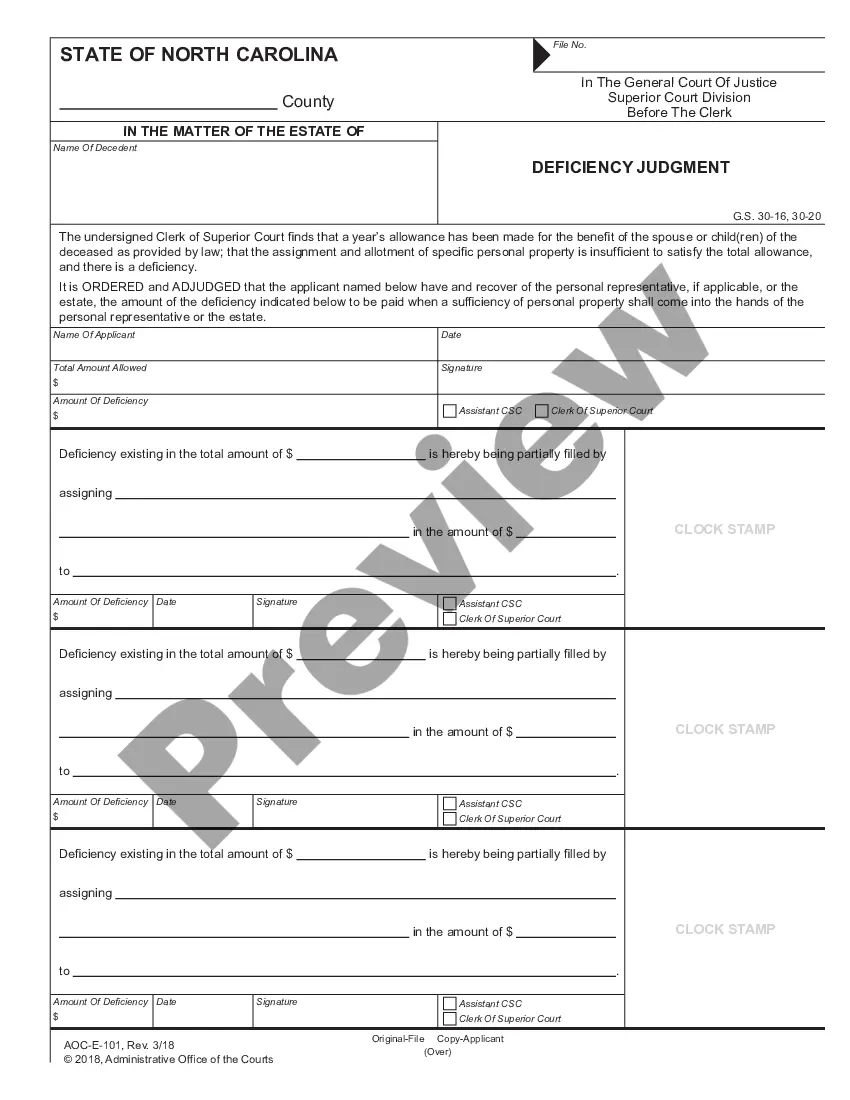
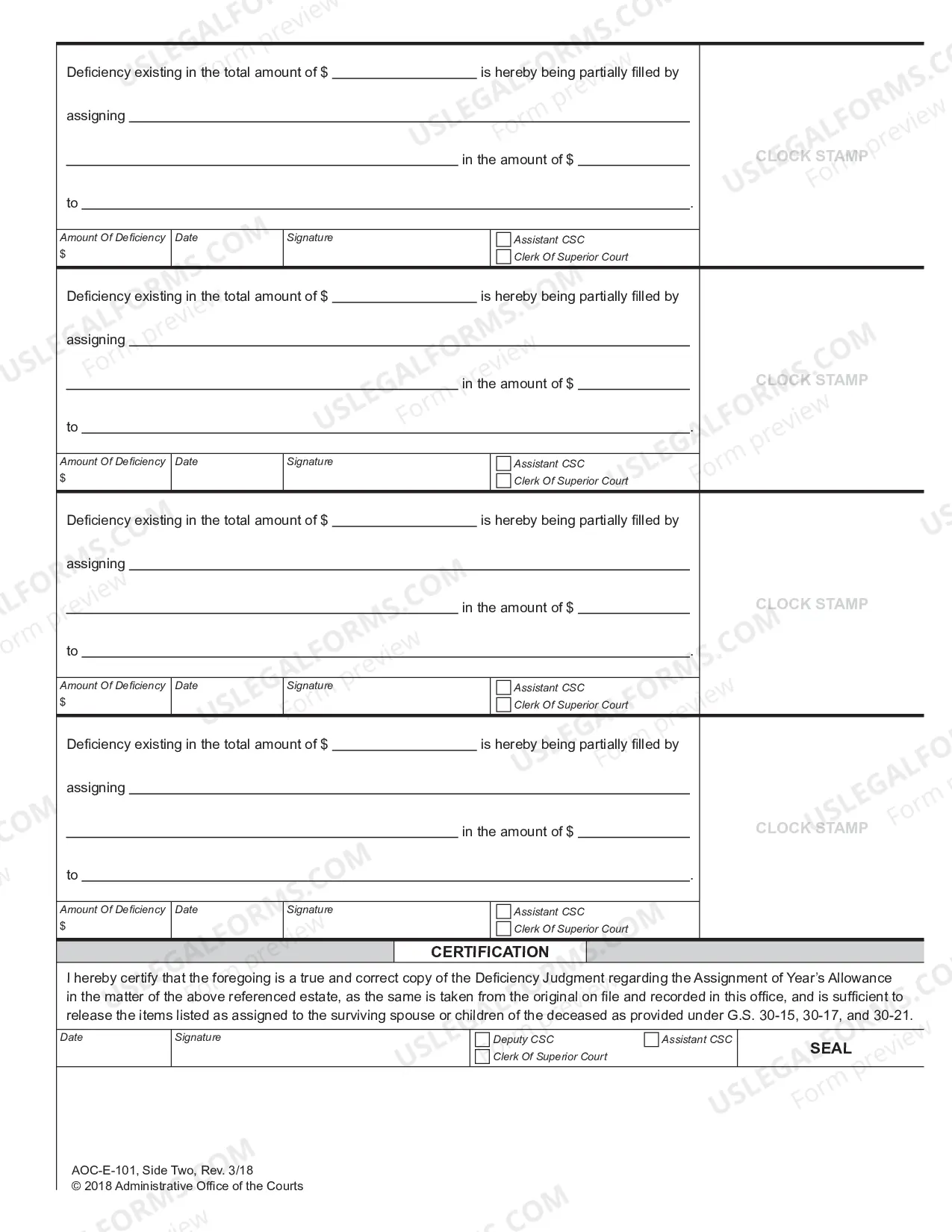
Deficiency Judgment: This is an official form from the North Carolina Administration of the Courts (AOC), which complies with all applicable laws and statutes. USLF amends and updates the forms as is required by North Carolina statutes and law.
North Carolina Deficiency Judgment
Instant download
This website is not affiliated with any governmental entity
Public form
Description
Free preview
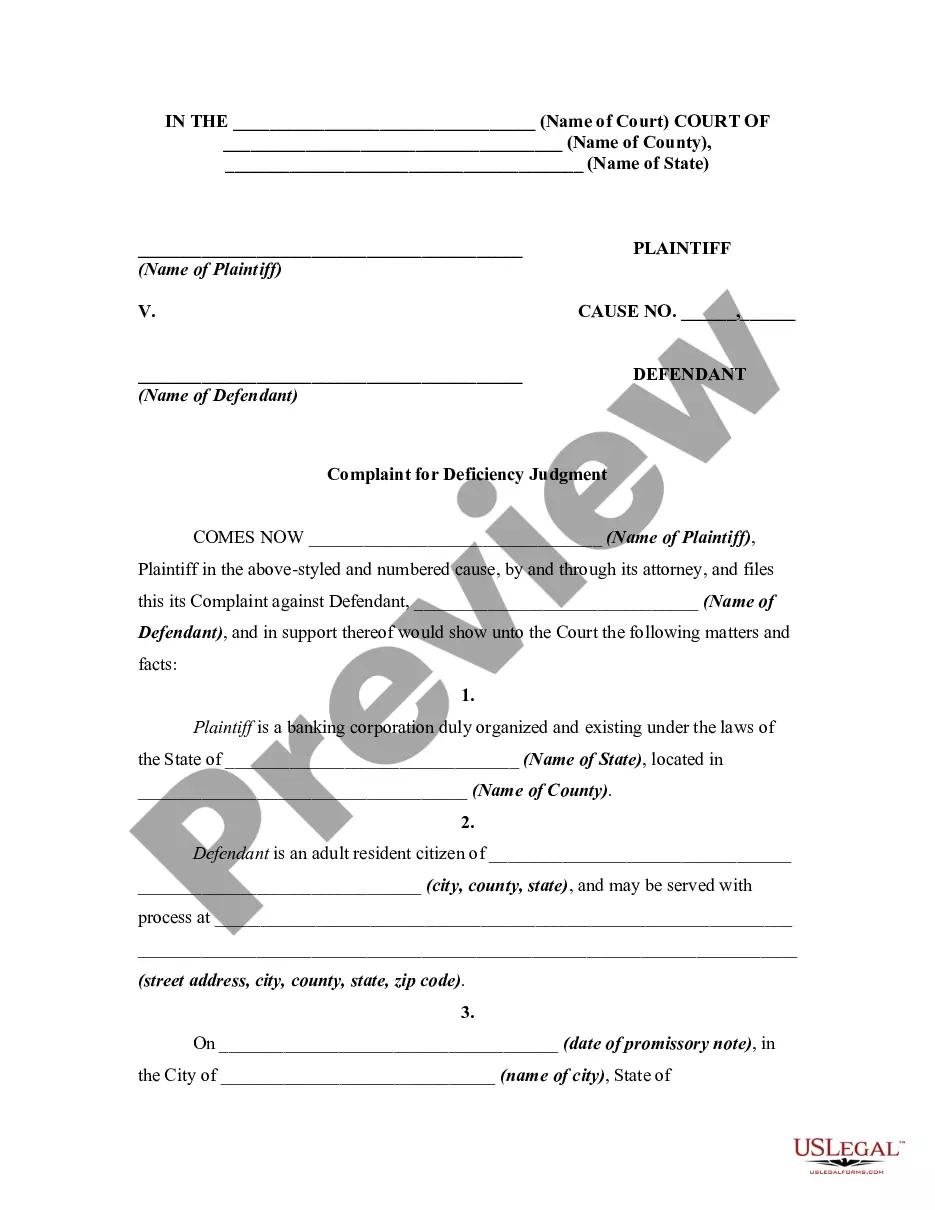
Get your form ready online
Our built-in tools help you complete, sign, share, and store your documents in one place.
Built-in online Word editor
Make edits, fill in missing information, and update formatting in US Legal Forms—just like you would in MS Word.
Export easily
Download a copy, print it, send it by email, or mail it via USPS—whatever works best for your next step.
E-sign your document
Sign and collect signatures with our SignNow integration. Send to multiple recipients, set reminders, and more. Go Premium to unlock E-Sign.
Notarize online 24/7
If this form requires notarization, complete it online through a secure video call—no need to meet a notary in person or wait for an appointment.
Store your document securely
We protect your documents and personal data by following strict security and privacy standards.

Make edits, fill in missing information, and update formatting in US Legal Forms—just like you would in MS Word.

Download a copy, print it, send it by email, or mail it via USPS—whatever works best for your next step.

Sign and collect signatures with our SignNow integration. Send to multiple recipients, set reminders, and more. Go Premium to unlock E-Sign.

If this form requires notarization, complete it online through a secure video call—no need to meet a notary in person or wait for an appointment.

We protect your documents and personal data by following strict security and privacy standards.
Looking for another form?



How to fill out North Carolina Deficiency Judgment?
Steer clear of expensive attorneys and locate the North Carolina Deficiency Judgment you seek at a reasonable cost on the US Legal Forms website.
Utilize our straightforward categorization feature to search for and obtain legal and tax documents. Review their descriptions and preview them prior to downloading.
Choose to download the document in PDF or DOCX format. Simply click Download and locate your template in the My documents section. You are welcome to save the template to your device or print it. After downloading, you can fill out the North Carolina Deficiency Judgment manually or with editing software. Print it out and reuse the form multiple times. Achieve more for less with US Legal Forms!
- Furthermore, US Legal Forms offers users detailed guidance on how to download and complete each form.
- US Legal Forms members just need to sign in and access the exact document they require from their My documents section.
- Individuals who have not subscribed yet should adhere to the instructions outlined below.
- Ensure that the North Carolina Deficiency Judgment is suitable for use in your location.
- If possible, review the details and utilize the Preview feature before downloading the templates.
- If you’re certain the document fits your needs, click on Buy Now.
- If the template is not suitable, employ the search tool to find the correct one.
- Next, set up your account and select a subscription plan.
- Make payment via credit card or PayPal.
Form popularity
FAQ
1Declaring Bankruptcy.2Negotiating a Waiver of the Lender's Right to Seek a Deficiency Judgment.3Making a Settlement Offer.4Taking the Chance that Your Lender Won't Actually Sue You for the Deficiency.
Also, it's possible to negotiate a reduced deficiency or pay a lump-sum settlement regarding any remaining debt associated with the transaction. Be aware that you might have tax consequences if the lender forgives all or some of the deficiency. You might also consider filing for bankruptcy.
If you refuse to pay, the debt will most likely be sold to collections. But either the lender or the collector can choose to file a lawsuit against you, which could result in a wage garnishment, a levy against your bank account or a lien against your other property.
Even after a deficiency judgment is entered, your lender still may work out an agreeable payment plan with you. You can try to negotiate a payment by calling the lender or the lender's attorney. Almost every lender's attorney will take your call, and at least listen to payment offers that you make.
If your lender sues you to recover the deficiency and wins, the court will issue a judgment ordering you to pay off the deficiency. If you ignore this court order, your lender can use the deficiency judgment to place liens on other property that you own, garnish your wages, or freeze your bank accounts.
A deficiency judgment will remain on your credit report for seven years. If the judgment remains unpaid, however, your creditor may apply with the court to have the judgment renewed for another seven-year period.
Judgments in SC last ten years and do not renew.
Declaring Bankruptcy. Negotiating a Waiver of the Lender's Right to Seek a Deficiency Judgment. Making a Settlement Offer. Taking the Chance that Your Lender Won't Actually Sue You for the Deficiency.
Recourse and Non-Recourse Loans: State LawsNon-recourse states include Alaska, Arizona, Washington, Utah, Idaho, Minnesota, California, North Carolina, Connecticut, North Dakota, Texas and Oregon.In other states, you may have either type of loan.