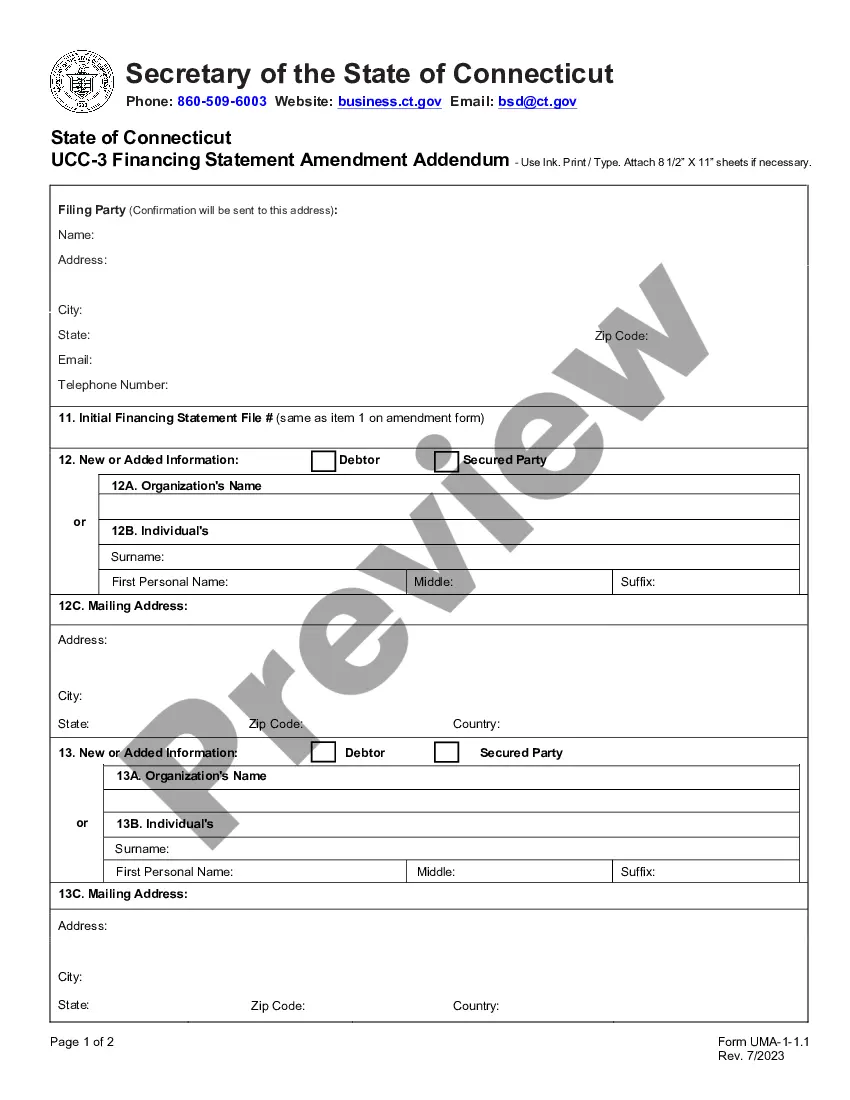
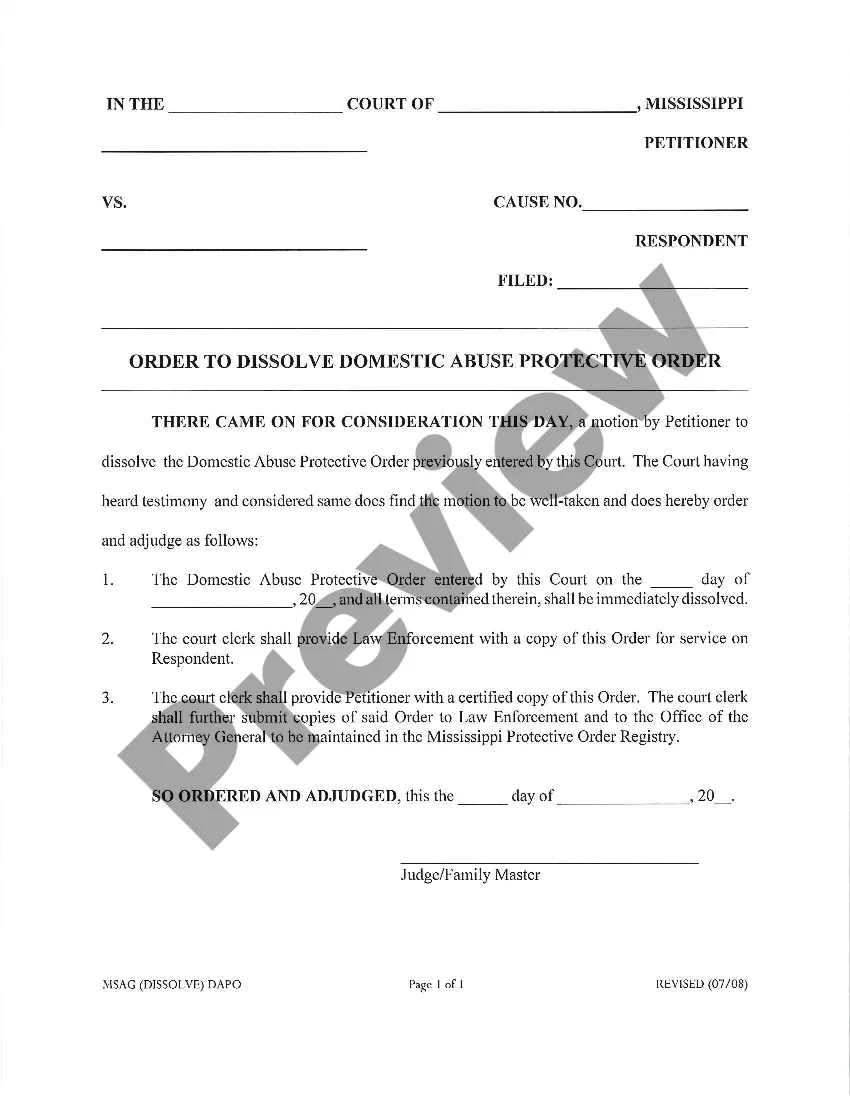
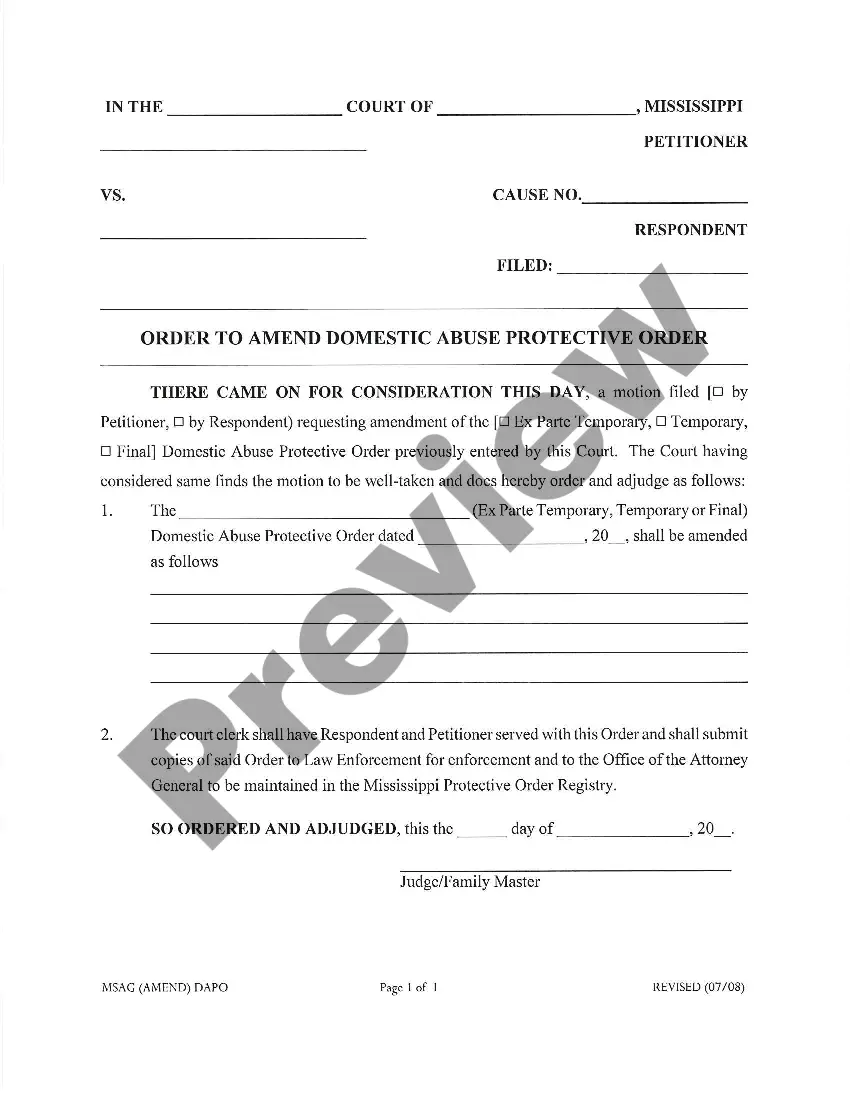
Mississippi Order to Dissolve Domestic Abuse Protective Order
Understanding this form
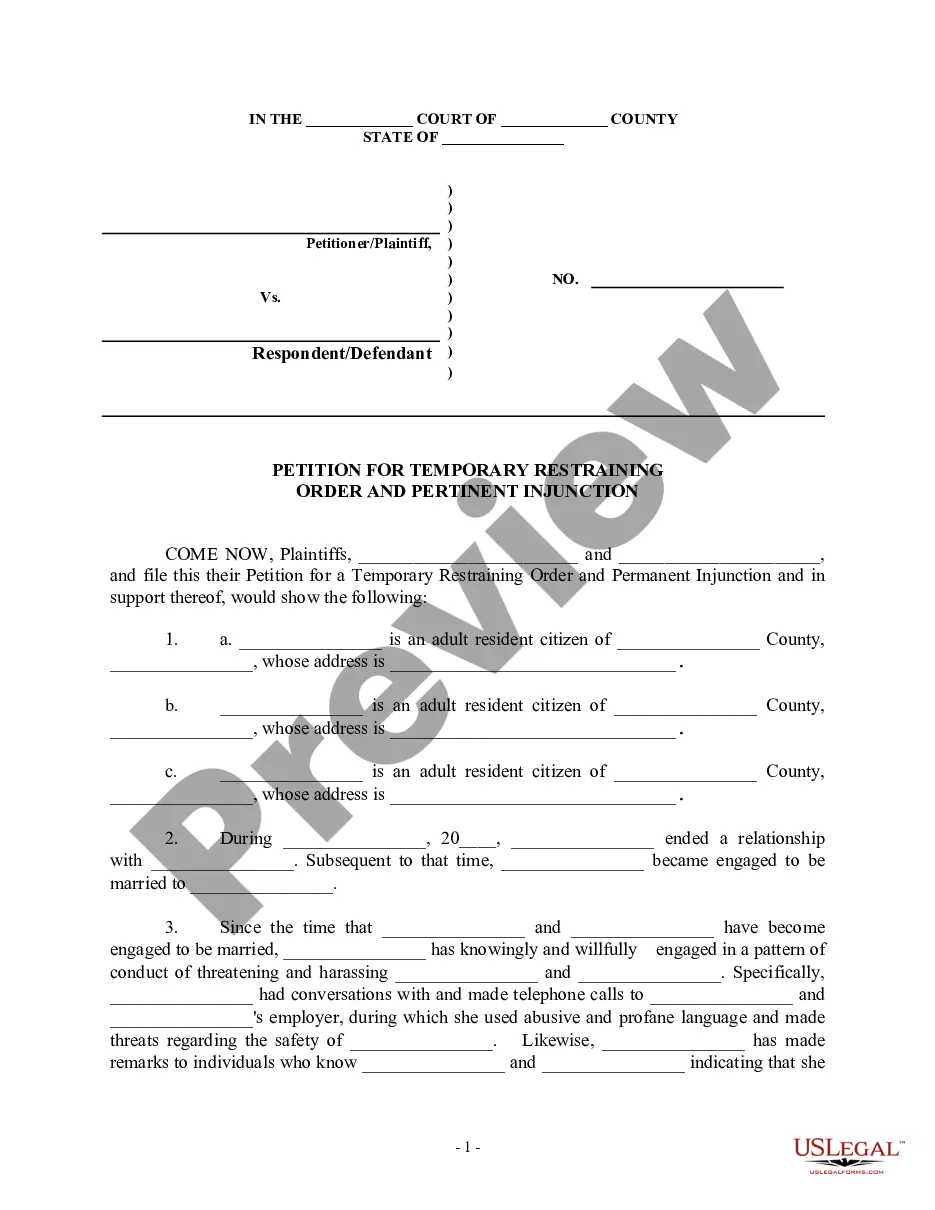
The Order to Dissolve Domestic Abuse Protective Order is a legal document used when a person seeks to have a protective order that was previously issued against them cancelled. This form is essential for individuals who want to restore their legal status once a protective order is no longer deemed necessary. Unlike initial protective orders, this form focuses on the dissolution of existing orders, offering a pathway for individuals to regain their personal freedom and peace of mind.
Form components explained
- Identification of the parties involved in the protective order.
- Details of the original protective order being dissolved.
- Reasons for requesting the dissolution of the protective order.
- Signature and date fields for the requesting party.
Common use cases
This form should be used when an individual who was subject to a domestic abuse protective order believes that the conditions that led to the order no longer exist. Common scenarios include reconciliation between parties, changes in circumstances that reduce the risk of harm, or when the original order is found to be unfair or unjust. It is crucial to ensure that the dissolution is in the best interest of all parties involved.
Who should use this form
- Individuals who have a protective order issued against them and wish to have it revoked.
- Parties seeking to restore their legal rights after a protective order is no longer necessary.
- Those who have undergone changes in circumstances affecting the need for continued protection.
Steps to complete this form
- Identify all parties involved, including the person requesting the dissolution and the protected party.
- Provide details of the original protective order, including the date it was issued and its terms.
- Clearly state the reasons for the request to dissolve the protective order.
- Sign and date the form, ensuring all required fields are completed accurately.
Notarization requirements for this form
This form does not typically require notarization unless specified by local law. If you are unsure about your jurisdiction's requirements, consider consulting a legal professional.
Get your form ready online
Our built-in tools help you complete, sign, share, and store your documents in one place.
Make edits, fill in missing information, and update formatting in US Legal Forms—just like you would in MS Word.
Download a copy, print it, send it by email, or mail it via USPS—whatever works best for your next step.
Sign and collect signatures with our SignNow integration. Send to multiple recipients, set reminders, and more. Go Premium to unlock E-Sign.
If this form requires notarization, complete it online through a secure video call—no need to meet a notary in person or wait for an appointment.
We protect your documents and personal data by following strict security and privacy standards.

Make edits, fill in missing information, and update formatting in US Legal Forms—just like you would in MS Word.

Download a copy, print it, send it by email, or mail it via USPS—whatever works best for your next step.

Sign and collect signatures with our SignNow integration. Send to multiple recipients, set reminders, and more. Go Premium to unlock E-Sign.

If this form requires notarization, complete it online through a secure video call—no need to meet a notary in person or wait for an appointment.

We protect your documents and personal data by following strict security and privacy standards.
Avoid these common issues
- Failing to include complete and accurate information about the original protective order.
- Omitting signatures or dates from the form.
- Not providing a clear rationale for the dissolution request.
Why use this form online
- Convenient access to forms anytime, without the need to visit a physical office.
- Edit and customize the form easily to meet your specific needs.
- Reliable templates drafted by licensed attorneys to ensure legal compliance.
Looking for another form?
Form popularity
FAQ
Reconciliation. Strangers do not perpetrate DV, someone they love does. When someone you love is the perpetrator, leaving for good is the hardest part. Children. Kids miss their parents, and parents miss their kids. There is a constant pressure for a parent to return to being a "family."
If you intend to apply to the court to revoke or vary a restraining order, you will need to prove that a change of circumstances has occurred. If everything has remained the same, then it is unlikely that the court will be willing to adapt or dissolve the order. A change of situation is case-specific.
Consult with a family law attorney experienced in defending people against false restraining orders. You must go to court for the final restraining order hearing and present your evidence proving why the accusations against you are false. The evidence can be police reports, witnesses, text messages and or emails.
A protection order may be varied, withdrawn or set aside if the complainant makes an application for variation or rescission, but only if the court is satisfied that the application is being made freely and voluntarily.The court may refuse to withdraw if it believes that you or your children require protection.
Typically, either the victim or the defendant can ask the court to lift the restraining order. This is usually completed by filing a motion with the court, such as a Motion to Modify Conditions of Pretrial Release or a Motion to Lift Restraining Order. This legal motion must usually identify the parties.
If you're the person who asked for the no contact order, you can ask the judge in your case to drop it. While there's no guarantee that the judge will do so, if you can show that you're not being forced or coerced into doing it, you'll have a better chance of getting it dropped.
The court is looking for a description of your relationship to the respondent, when, where, what happened, and who did what to whom. Using the facts of the incident only, keep your statement brief and to the point. Briefly describe the most recent incident of abuse and/or threats of abuse or other behaviors.