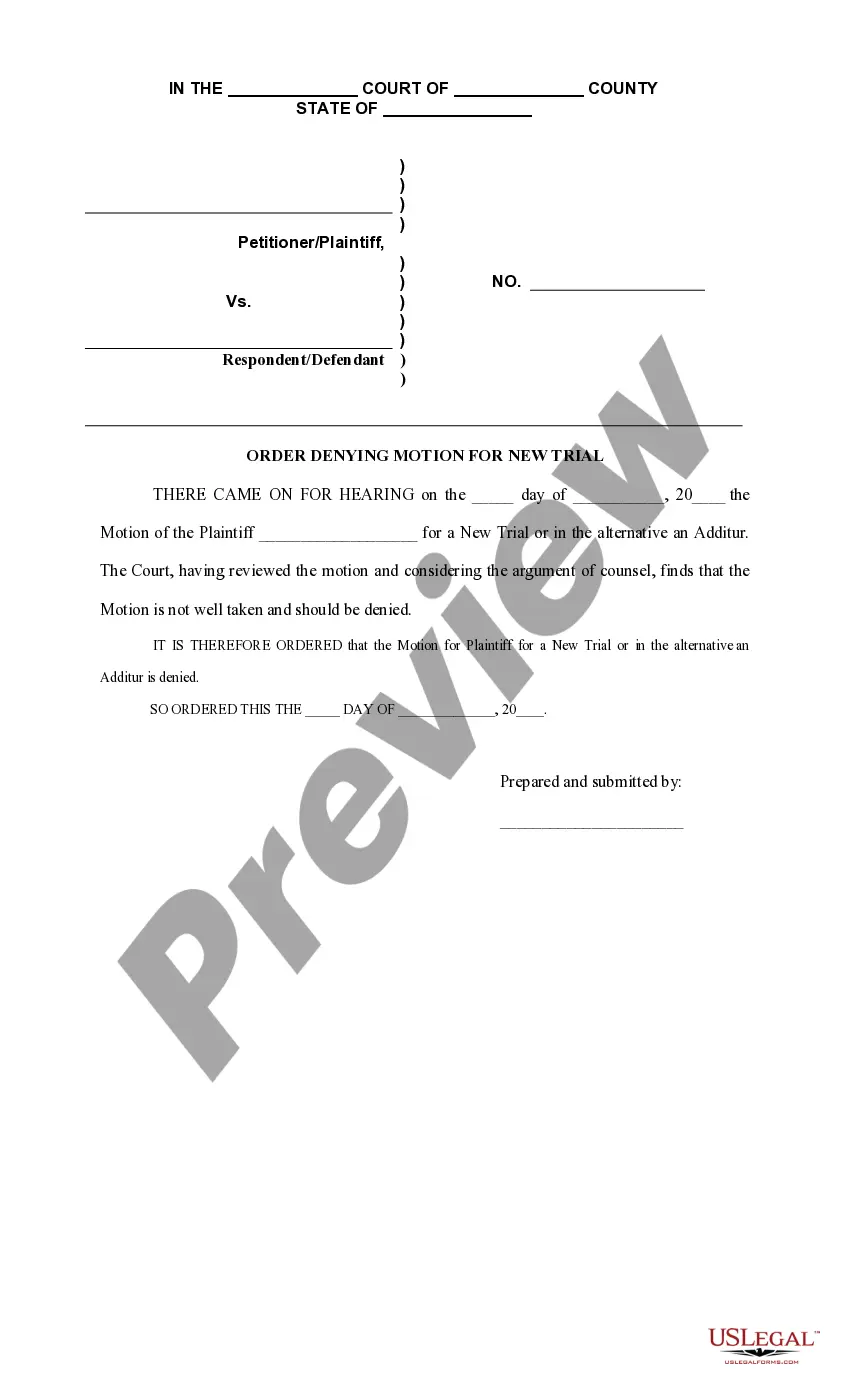
Mississippi Order Denying Motion for New Trial
Understanding this form
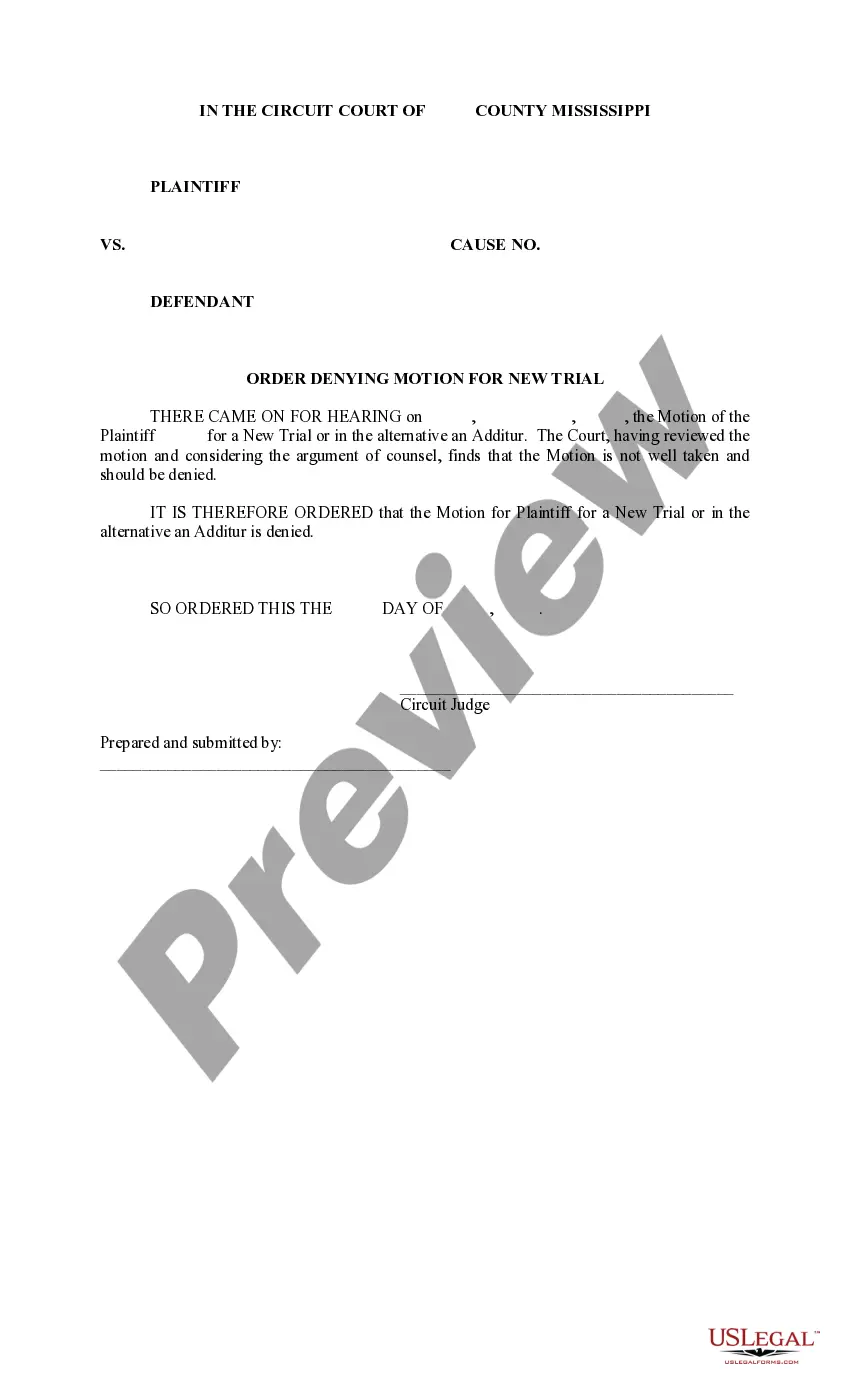
The Order Denying Motion for New Trial is a legal document used to formally notify a party that their request for a new trial has been denied by the court. This form is important for maintaining legal clarity and serves as an official record of the court's decision. Unlike other motions that initiate requests, this order represents the conclusion of such requests regarding a new trial, outlining the reasons for the denial and the implications for the parties involved.
Key parts of this document
- Title of the Document: Clearly states that it is an Order Denying Motion for New Trial.
- Case Information: Includes details about the case, such as the case number, court name, and parties involved.
- Motion Details: Summarizes the motion that was filed and the basis for requesting a new trial.
- Decision Statement: Directly communicates the court's decision to deny the motion.
- Reasoning: Outlines the court's reasoning for denying the motion, providing context for the decision.
- Signature Line: Requires signature of the judge or court official to validate the document.
Situations where this form applies
This form is used when a party has filed a motion requesting a new trial, and the court has concluded its review. If the court denies this request, the Order Denying Motion for New Trial is issued to formally communicate the decision. It is essential in situations where a party believes there was a significant error in the initial trial that affected the outcome and seeks a retrial. This form provides a clear understanding of the court's stance and maintains transparency in the judicial process.
Who needs this form
This form is intended for:
- Parties involved in a legal case who have filed a motion for a new trial.
- Attorneys representing clients in civil or criminal cases seeking clarity on trial decisions.
- Individuals looking to understand the outcomes of their motions and the court's rationale.
How to complete this form
- Identify the case information: Fill in the name of the parties involved and the case number at the top of the form.
- Summarize the motion: Clearly outline the details of the motion that was submitted for a new trial.
- Provide the decision: State the court's decision to deny the motion explicitly.
- Explain the reasoning: Articulate the reasons provided by the court for the denial of the motion.
- Obtain the necessary signatures: Ensure that the form is signed by the judge or court clerk to validate it.
Notarization requirements for this form
This form does not typically require notarization unless specified by local law. However, it's essential to confirm any specific requirements in your jurisdiction regarding the submission of this order.
Get your form ready online
Our built-in tools help you complete, sign, share, and store your documents in one place.
Make edits, fill in missing information, and update formatting in US Legal Forms—just like you would in MS Word.
Download a copy, print it, send it by email, or mail it via USPS—whatever works best for your next step.
Sign and collect signatures with our SignNow integration. Send to multiple recipients, set reminders, and more. Go Premium to unlock E-Sign.
If this form requires notarization, complete it online through a secure video call—no need to meet a notary in person or wait for an appointment.
We protect your documents and personal data by following strict security and privacy standards.

Make edits, fill in missing information, and update formatting in US Legal Forms—just like you would in MS Word.

Download a copy, print it, send it by email, or mail it via USPS—whatever works best for your next step.

Sign and collect signatures with our SignNow integration. Send to multiple recipients, set reminders, and more. Go Premium to unlock E-Sign.

If this form requires notarization, complete it online through a secure video call—no need to meet a notary in person or wait for an appointment.

We protect your documents and personal data by following strict security and privacy standards.
Typical mistakes to avoid
- Failing to include all relevant case information.
- Not clearly stating the courtâs decision.
- Omitting the reasoning behind the denial.
- Not obtaining the required signatures on the form.
Why use this form online
- Convenience of immediate access and download from any location.
- Editable format allowing users to customize the form to fit their specific case details.
- Reliability, as the forms are drafted by licensed attorneys, ensuring legal compliance.
Legal use & context
- This form serves as a formal record of the courtâs decision, which can be important for any further legal proceedings.
- It can be used as a reference in potential appeals depending on the jurisdiction's rules regarding post-trial motions.
- Understanding the legal context of this order helps parties know their options following a denial of a motion for a new trial.
Quick recap
- The Order Denying Motion for New Trial officially communicates the court's decision to deny a retrial.
- It is crucial for transparency and maintaining an accurate legal record.
- Filling out the form correctly is vital for its validity and legal effectiveness.
Looking for another form?

Form popularity
FAQ
Section 1. New trial or reconsideration. At any time before a judgment of conviction becomes final, the court may, on motion of the accused or at its own instance but with the consent of the accused, grant a new trial or reconsideration.
Write a motion for reconsideration. You must explain why you think the ruling is wrong and the reason must be one of the nine reasons listed in Civil Rule 59(a) (on back of page). 2. File the motion within ten calendar days after the judge or court commissioner made the ruling.
When a trial has concluded and a verdict has been rendered by a judge or jury, the judgment must be formalized in writing by the court. Once the judgment has been rendered, either party may file what is called a post trial motion, or motion which is filed after the trial is over.
Defendants typically make motions for new trials after guilty verdicts. In some jurisdictions, the trial judge can order a new trial without a defendant asking.But in some instances the prosecution can appeal a trial judge's grant of a new trial, and it can usually appeal a new trial order by an appellate court.
EFFECTS OF GRANTING NEW TRIAL OR RECONSIDERATION f0b4When new trial is granted on the ground of: 1. Errors of law or irregularities committed during trial, all the proceedings and evidence affected thereby shall beset aside and take a new. f0b4The court may in the interest of justice, allow the introduction of new evidence.
Fraud, accident, mistake or excusable negligence. Newly discovered evidence. Damages awarded were excessive. Insufficient evidence to support.
A motion asking the court to enter judgment as a matter of law. This motion is made before a case is submitted to the jury, and argues that no reasonable jury could find for the opposing party (i.e., whatever evidence exists for such ruling is legally insufficient).
A "motion" is simply a formal request to a court that it do something or decide an issue in favor of the party that asks for it. "Granted" means the court agreed with the request, and did or decided in favor of the requester.
At any time before a judgment of conviction becomes final, the court may, on motion of the accused or at its own instance but with the consent of the accused, grant a new trial or reconsideration.