California Note Secured By Deed of Trust
What is this form?
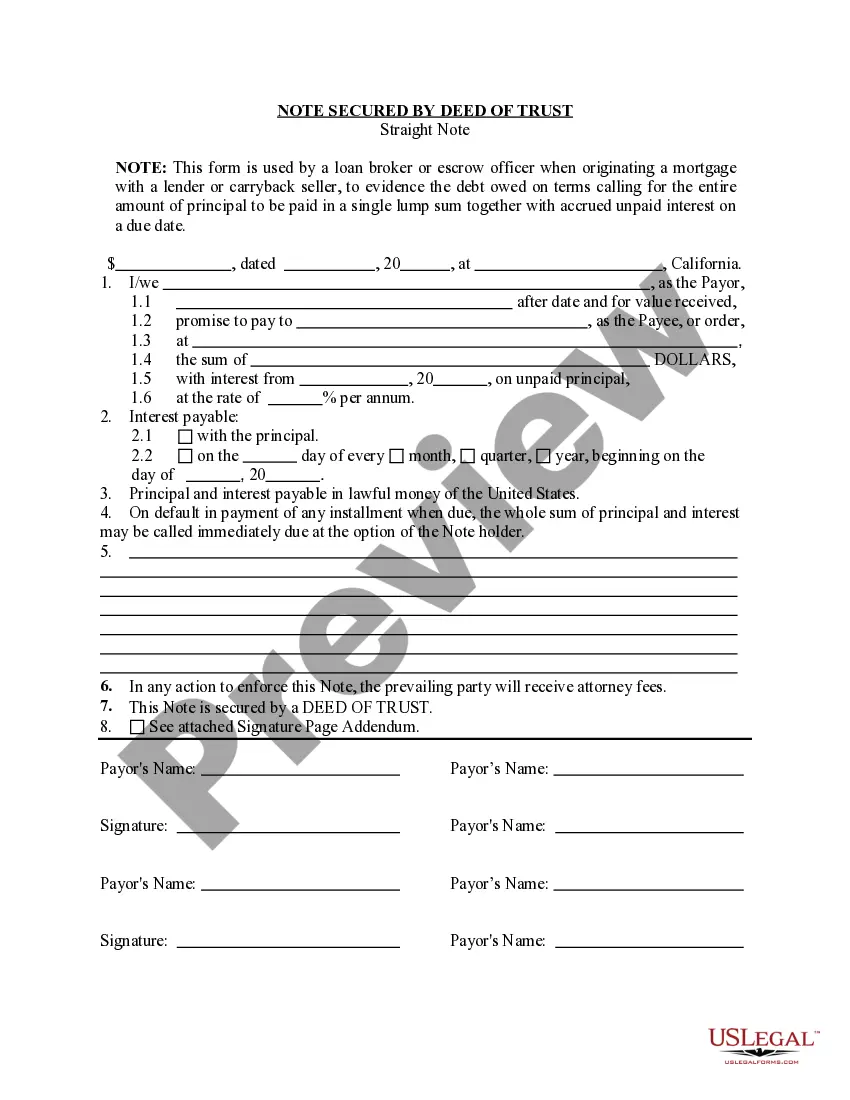
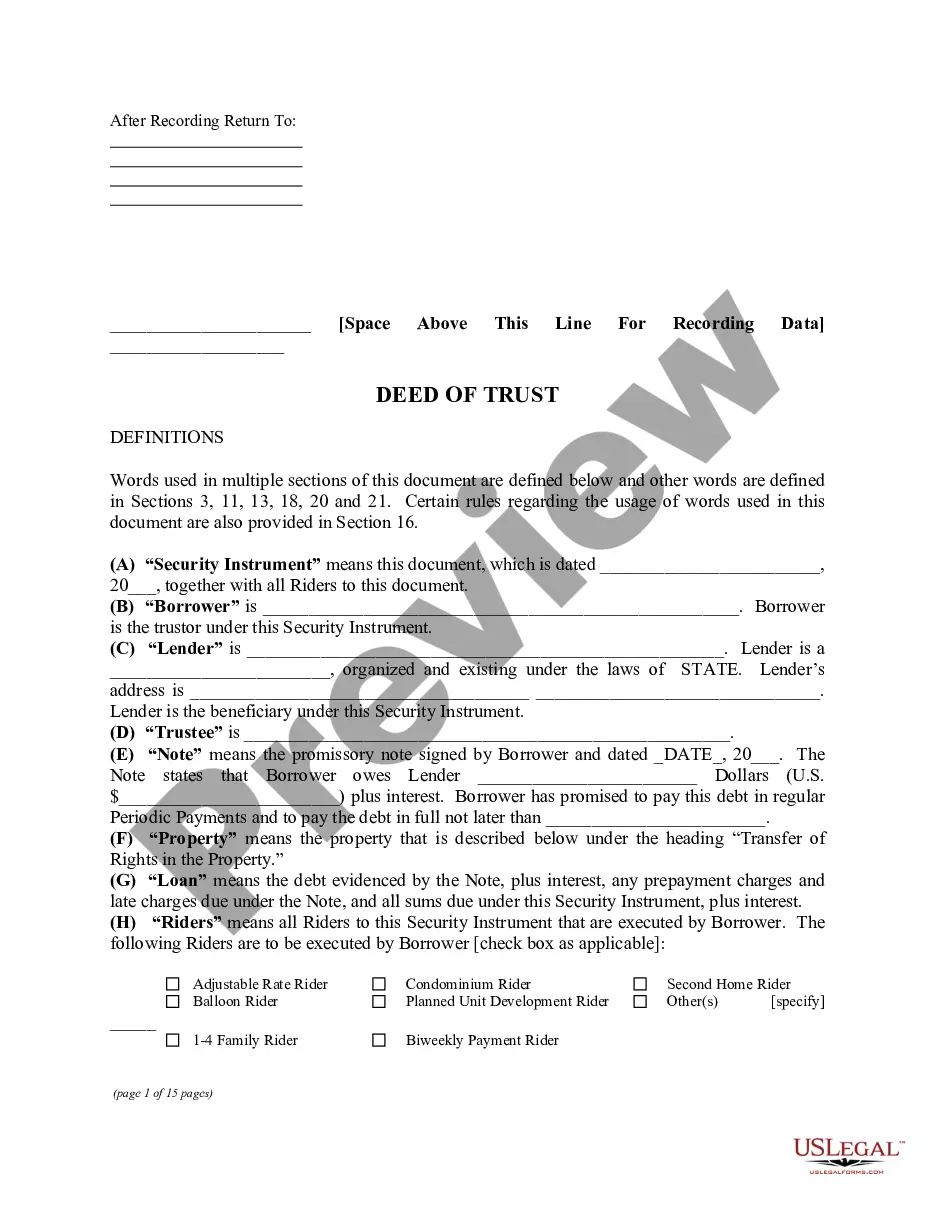
The Note Secured By Deed of Trust is a legal document that outlines the terms of a loan, serving as a promissory note. This form differs from other loan documents by explicitly stating that the note is secured by real property, allowing lenders to hold a claim on the property if the borrower defaults. It is commonly used in real estate transactions where a borrower needs to secure financing and agrees to repay the entire principal amount plus interest by a specified due date.
Form components explained
- Payor and Payee information: Identifies the borrower and lender involved in the loan.
- Loan amount: Specifies the total amount borrowed in dollars.
- Interest rate: Outlines the percentage applied to the outstanding principal.
- Payment schedule: Details how and when payments are to be made.
- Default clause: Explains the consequences of failing to make payments on time.
- Security provision: Confirms that the loan is secured by a deed of trust on real property.

When to use this form
This form should be used when a borrower is obtaining a loan secured by real property, such as when purchasing a home or refinancing an existing mortgage. It is necessary when the borrower and lender agree to the terms of the loan, including the repayment schedule and conditions of default.
Who should use this form
- Borrowers seeking to finance real estate investments.
- Lenders providing mortgage or personal loans secured by property.
- Loan brokers or escrow officers managing loan agreements.
- Individuals or entities involved in real estate transactions requiring formal loan documentation.
How to complete this form
- Identify the parties: Fill in the names of the Payor and Payee as applicable.
- Specify the loan amount: Enter the total sum to be borrowed in dollars.
- Set the interest rate: Indicate the annual interest rate to be applied.
- Outline the payment schedule: Choose how often payments will be made and specify the initial payment date.
- Include signatures: Ensure all parties involved in the agreement sign the document at the end.
Does this document require notarization?
This form does not typically require notarization unless specified by local law. However, having a notary witness the signatures can enhance the document's validity and enforceability in certain situations.
Get your form ready online
Our built-in tools help you complete, sign, share, and store your documents in one place.
Make edits, fill in missing information, and update formatting in US Legal Forms—just like you would in MS Word.
Download a copy, print it, send it by email, or mail it via USPS—whatever works best for your next step.
Sign and collect signatures with our SignNow integration. Send to multiple recipients, set reminders, and more. Go Premium to unlock E-Sign.
If this form requires notarization, complete it online through a secure video call—no need to meet a notary in person or wait for an appointment.
We protect your documents and personal data by following strict security and privacy standards.

Make edits, fill in missing information, and update formatting in US Legal Forms—just like you would in MS Word.

Download a copy, print it, send it by email, or mail it via USPS—whatever works best for your next step.

Sign and collect signatures with our SignNow integration. Send to multiple recipients, set reminders, and more. Go Premium to unlock E-Sign.

If this form requires notarization, complete it online through a secure video call—no need to meet a notary in person or wait for an appointment.

We protect your documents and personal data by following strict security and privacy standards.
Common mistakes
- Not providing complete information for both the Payor and Payee.
- Failing to specify the correct interest rate or payment schedule.
- Incomplete signatures from all parties involved.
- Overlooking the default clause, which may affect the enforcement of the loan.
Why use this form online
- Convenience: Access and download the form anytime from your device.
- Editability: Customize the document to fit your specific loan agreement.
- Reliability: The form is drafted by licensed attorneys, ensuring legal compliance.
Looking for another form?

Form popularity
FAQ
The deed of trust acts as a promise from the borrower to repay the loan. A promissory note secured by deed of trust allows the lender to foreclose on the borrower's home if the borrower stops making payments.
The deed of trust secures the loan by holding the commercial property as security. The deed of trust outlines the terms of the loan. The borrower accepts the deed of trust by signing the promissory note.
A promissory note secured by deed of trust is a type of loan document that details how and when a borrower will repay money to a lender. A promissory note is a kind of IOU that's secured by property, often property that the borrower owns.
A deed of trust is a legal agreement that's similar to a mortgage, which is used in real estate transactions. Whereas a mortgage only involves the lender and a borrower, a deed of trust adds a neutral third party that holds rights to the real estate until the loan is paid or the borrower defaults.
A deed of trust can be used to secure more than one note. In California, the trustee and beneficiary may be the same entity. The lender does not need to be named in a deed of trust. The statute of limitations might bar action on a note with a deed of trust that has power of sale.
For a Deed of Trust, the parties involved are the lender, the borrower, and a neutral third party who will serve as a trustee. The title of the property is held as security for the loan and held by the trustee for the benefit of the lender. The title is released from the trust once the loan is paid.
While the statute of limitations on an action in an obligation, liability, or contract is four years, Commercial Code Section 3118(a) gives a statute of limitations of six years for an action to be enforced on the party to pay their promissory note.
A deed of trust often requires a promissory note, but the promissory note is a specific document type. While a deed of trust describes the terms of debt as secured by a property, a promissory note acts as a promise that the borrower will pay the debt. A borrower signs the promissory note in favor of a lender.