Responsibility For Water Systems
Description
Get your form ready online
Our built-in tools help you complete, sign, share, and store your documents in one place.
Make edits, fill in missing information, and update formatting in US Legal Forms—just like you would in MS Word.
Download a copy, print it, send it by email, or mail it via USPS—whatever works best for your next step.
Sign and collect signatures with our SignNow integration. Send to multiple recipients, set reminders, and more. Go Premium to unlock E-Sign.
If this form requires notarization, complete it online through a secure video call—no need to meet a notary in person or wait for an appointment.
We protect your documents and personal data by following strict security and privacy standards.

Make edits, fill in missing information, and update formatting in US Legal Forms—just like you would in MS Word.

Download a copy, print it, send it by email, or mail it via USPS—whatever works best for your next step.

Sign and collect signatures with our SignNow integration. Send to multiple recipients, set reminders, and more. Go Premium to unlock E-Sign.

If this form requires notarization, complete it online through a secure video call—no need to meet a notary in person or wait for an appointment.

We protect your documents and personal data by following strict security and privacy standards.
Looking for another form?








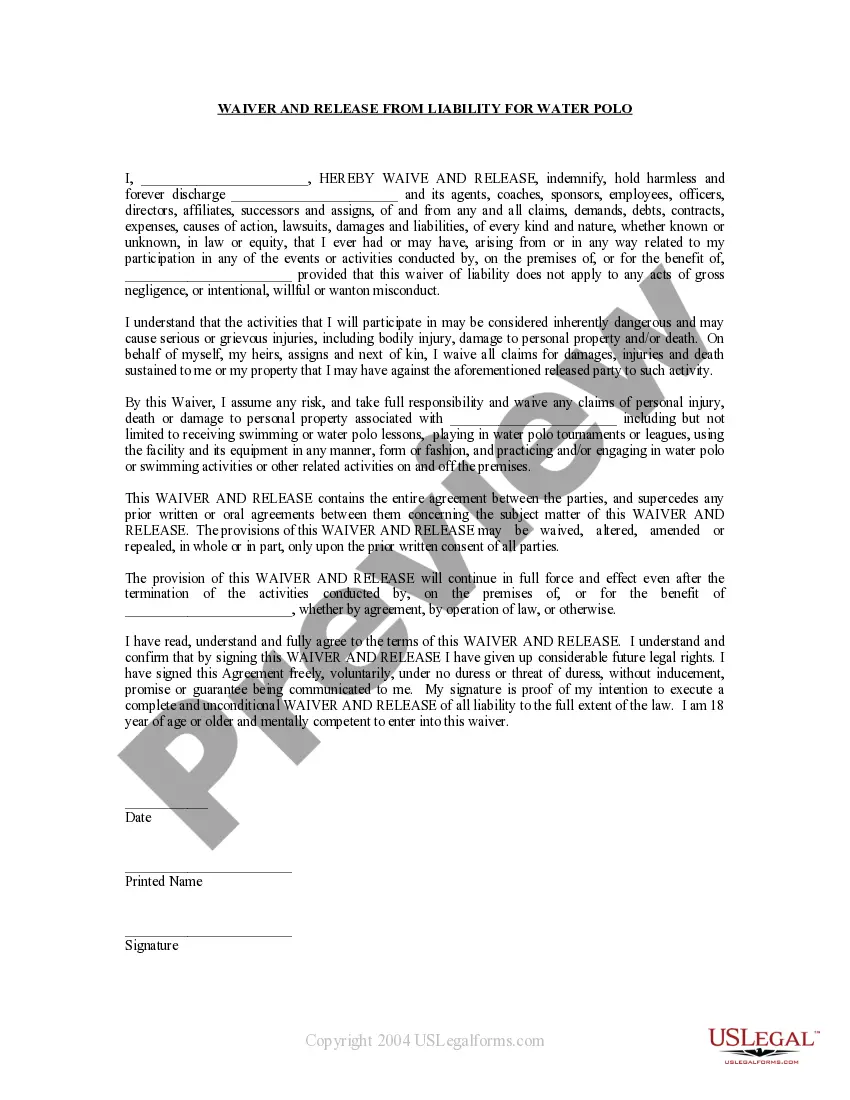
How to fill out Waiver And Release From Liability For Adult For Water Polo?
It’s widely acknowledged that you cannot transform into a legal expert instantly, nor can you swiftly learn how to effectively prepare Responsibility For Water Systems without a dedicated educational foundation.
Drafting legal documents is a labor-intensive process that demands specific knowledge and competencies. Therefore, why not entrust the creation of the Responsibility For Water Systems to the experienced professionals.
With US Legal Forms, which boasts one of the most comprehensive libraries of legal documents, you can find everything from court filings to templates for internal business correspondence. We understand the importance of compliance with federal and state laws and regulations.
You can regain access to your documents from the My documents section at any time. If you’re already a customer, simply Log In and find and download the template from the same section.
Whether your documents are for financial, legal, or personal purposes, our website is here to assist you. Experience US Legal Forms now!
- Locate the form you require using the search feature at the top of the page.
- Preview it (if this option is available) and review the accompanying description to ascertain whether Responsibility For Water Systems is what you are seeking.
- Restart your search if you require a different form.
- Create a free account and choose a subscription plan to acquire the template.
- Select Buy now. Once the purchase is processed, you can download the Responsibility For Water Systems, complete it, print it, and send or forward it by mail to the relevant parties or organizations.
Form popularity
FAQ
The responsibility to provide clean water is shared between governments, utility companies, and environmental agencies. They work together to enforce quality standards and monitor water sources. Individuals also play a role in ensuring clean water by advocating for proper maintenance and reporting issues. Understanding the collective responsibility for water systems is crucial for fostering a healthy community.
The responsibility for water supply usually falls on local water authorities or utility companies. These entities ensure that reliable water is supplied to households and businesses. Consumers rely on these organizations to provide a safe and consistent water supply. Understanding the responsibility for water systems can empower residents to advocate for their needs.
Local governments usually manage and maintain public water systems. They ensure the delivery of safe drinking water to homes and businesses within their jurisdiction. Additionally, local governments monitor water quality and enforce regulations. Understanding the government’s responsibility for water systems can help residents address concerns related to water supply.
Homeowners are typically responsible for the water line that runs from the street to their house. This responsibility includes maintenance and repair of the line, as well as any associated costs. Knowing your responsibility for water systems helps in preventing future issues and costs. Understanding these responsibilities is essential for effective home ownership.
For small water system operators, the primary responsibility for water systems lies in ensuring the safety and quality of the water supplied to consumers. This includes regular testing for contaminants and addressing any issues promptly. Operators must also maintain the equipment and infrastructure to prevent leaks and breaks. By prioritizing safety, they preserve community trust and comply with regulations.
Water companies have a critical role in maintaining the responsibility for water systems. Their duties include ensuring safe drinking water, maintaining infrastructure, and managing wastewater processes. They also engage with the public to provide education about water conservation and responsible usage. By fulfilling these responsibilities, they help protect public health and the environment.
Effective water management is the responsibility of a network of professionals, including governmental agencies and water utility companies. These entities ensure that water resources are used efficiently and sustainably. They develop policies, monitor water quality, and implement conservation measures to secure the water supply for future generations. Remember, understanding the responsibility for water systems helps communities plan for challenges related to water scarcity and quality.
Responsibility for water systems typically falls on local water authorities and municipalities. These organizations oversee the sourcing, treatment, and distribution of water to ensure it reaches your home or business. They manage the infrastructure that supports water systems, including pipelines and treatment facilities. When issues arise, these authorities are accountable for providing timely information and solutions.
Various entities contribute to keeping our water safe, with the EPA playing a leading role at the federal level. Local governments and water utility companies also share this responsibility, implementing measures to ensure clean water is available. Together, these organizations reflect a collective commitment to the responsibility for water systems, promoting safe and healthy water for all.
Responsibility for water systems falls under the executive branch, primarily through the Environmental Protection Agency and state-level agencies. These entities implement laws and regulations designed to protect water quality and manage water resources effectively. By doing so, they uphold their duty to society and the environment.