Copyright Statement For Video
Description
Get your form ready online
Our built-in tools help you complete, sign, share, and store your documents in one place.
Make edits, fill in missing information, and update formatting in US Legal Forms—just like you would in MS Word.
Download a copy, print it, send it by email, or mail it via USPS—whatever works best for your next step.
Sign and collect signatures with our SignNow integration. Send to multiple recipients, set reminders, and more. Go Premium to unlock E-Sign.
If this form requires notarization, complete it online through a secure video call—no need to meet a notary in person or wait for an appointment.
We protect your documents and personal data by following strict security and privacy standards.

Make edits, fill in missing information, and update formatting in US Legal Forms—just like you would in MS Word.

Download a copy, print it, send it by email, or mail it via USPS—whatever works best for your next step.

Sign and collect signatures with our SignNow integration. Send to multiple recipients, set reminders, and more. Go Premium to unlock E-Sign.

If this form requires notarization, complete it online through a secure video call—no need to meet a notary in person or wait for an appointment.

We protect your documents and personal data by following strict security and privacy standards.
Looking for another form?
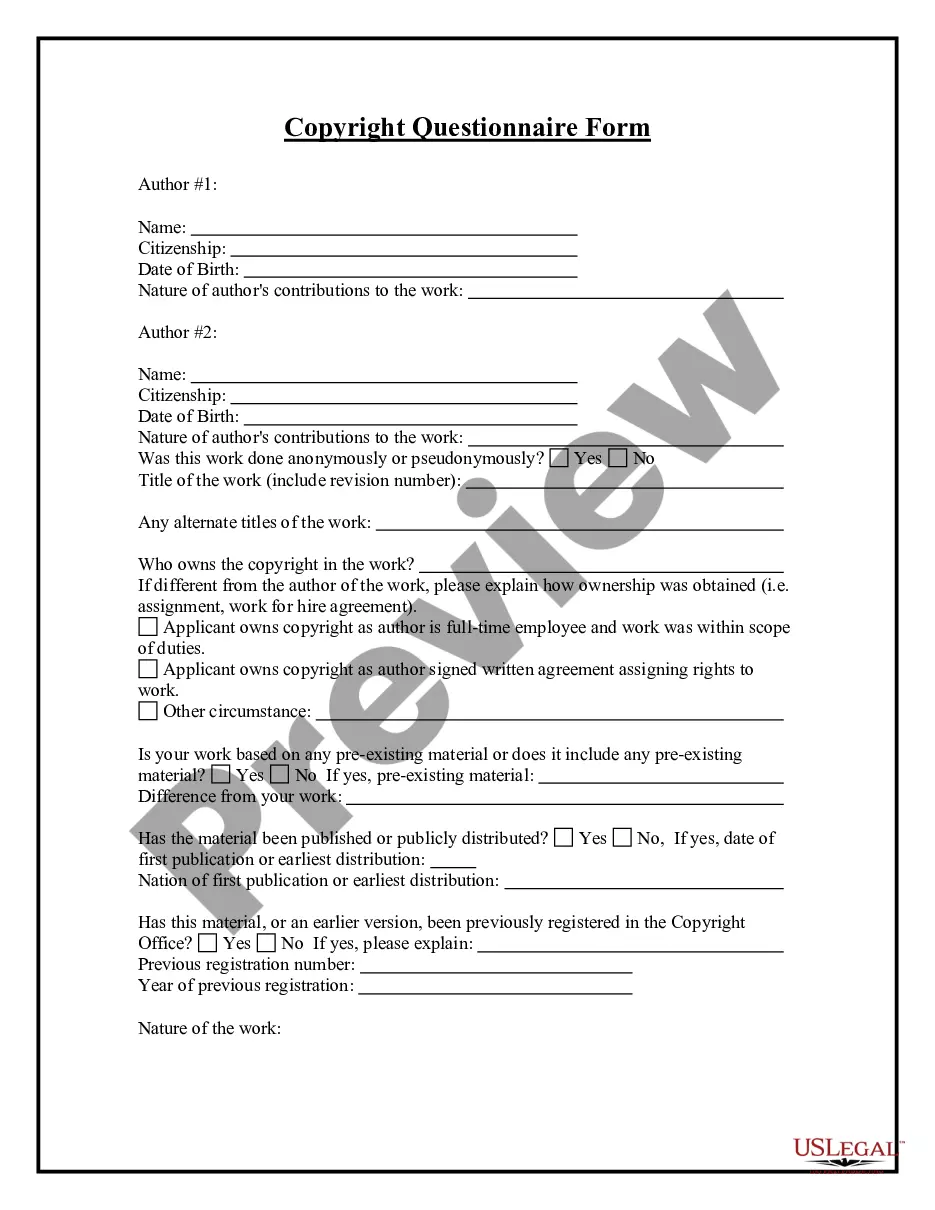
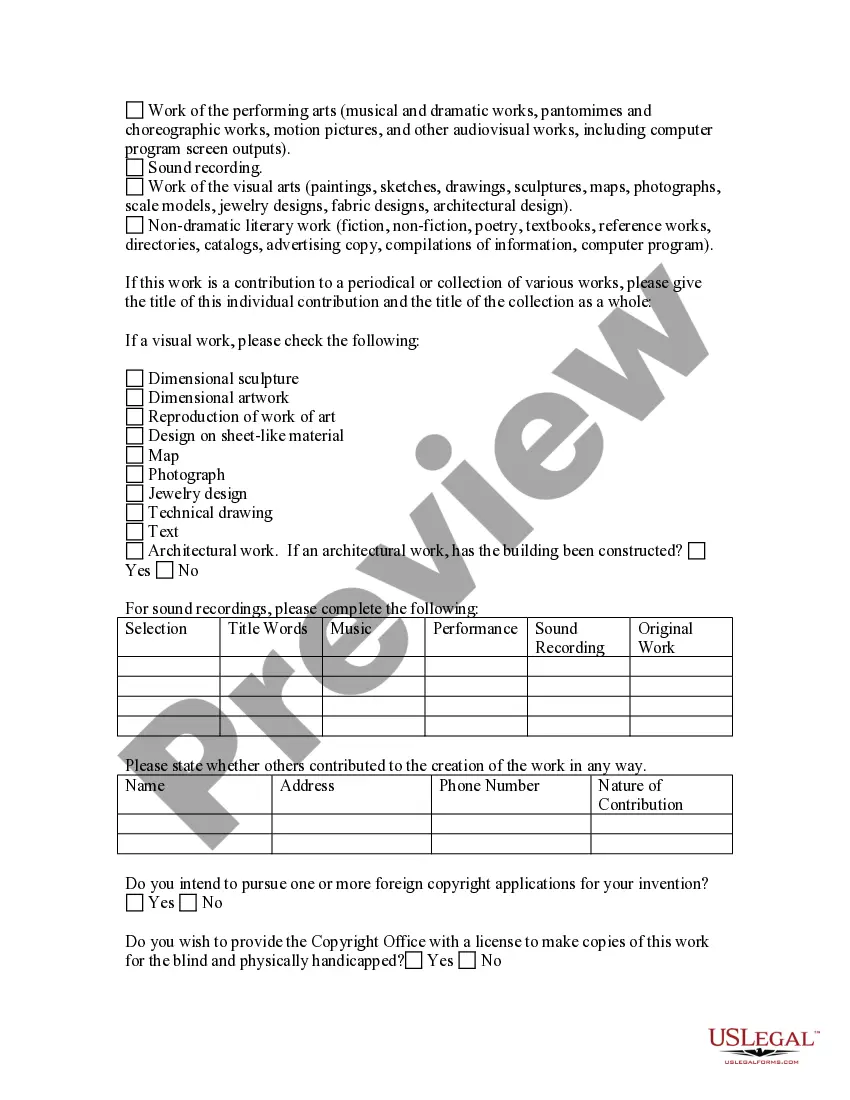
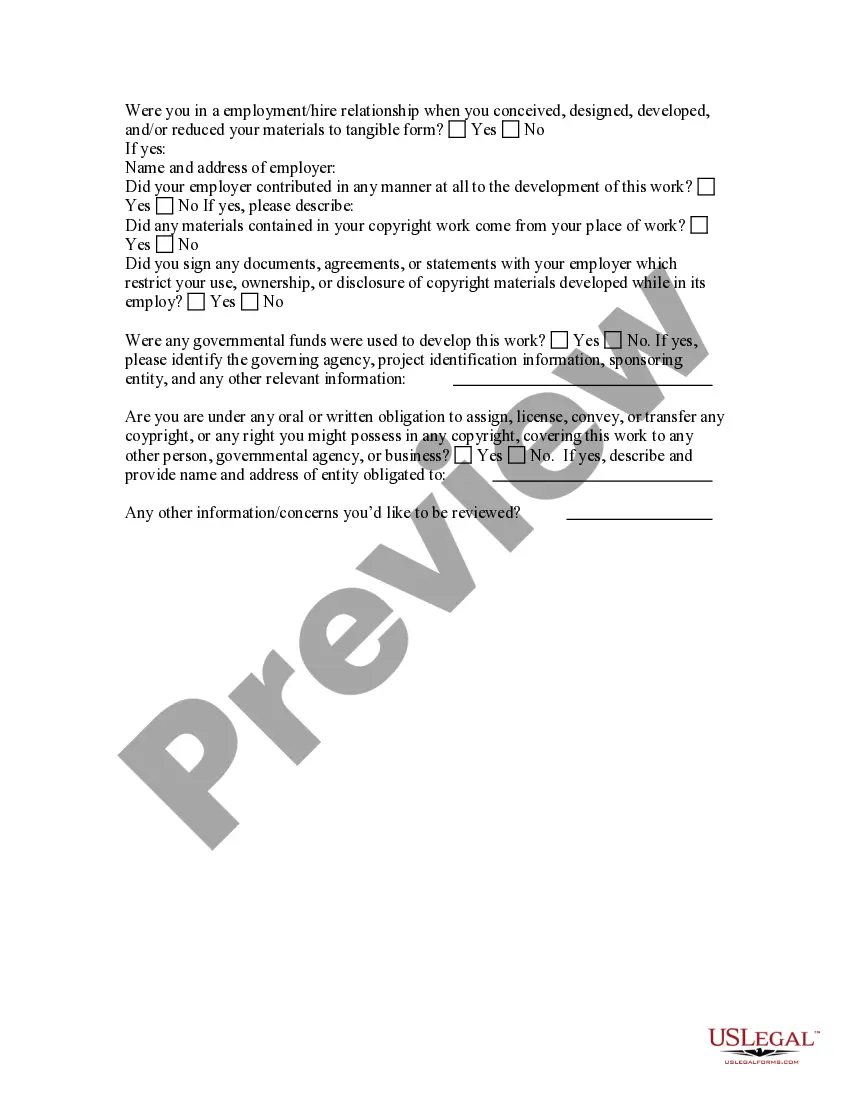
How to fill out Copyright Questionnaire?
Securing a reliable source for accessing the latest and suitable legal templates is a significant part of navigating bureaucracy.
Locating the correct legal documents necessitates precision and meticulousness, which highlights the importance of sourcing Copyright Statement For Video samples exclusively from reputable providers, such as US Legal Forms. An incorrect template could consume your time and delay your current situation.
Once you have the form on your device, you can edit it using the editor or print it out to complete it manually. Eliminate the hassle associated with your legal documentation. Browse the extensive US Legal Forms catalog to find legal templates, evaluate their relevance to your situation, and download them instantly.
- Utilize the library navigation or search feature to locate your template.
- Examine the form’s details to ensure it meets the standards of your state and locale.
- Preview the form, if available, to confirm that it is indeed the one you require.
- Continue searching and find the suitable template if the Copyright Statement For Video does not fulfill your needs.
- If you are confident in the form’s applicability, proceed to download it.
- If you are an existing user, click Log in to verify and access your selected templates in My documents.
- If you do not yet possess an account, click Buy now to obtain the form.
- Choose the pricing option that meets your requirements.
- Proceed with the registration to finalize your transaction.
- Complete your purchase by selecting a payment method (credit card or PayPal).
- Pick the document format for downloading the Copyright Statement For Video.
Form popularity
FAQ
A good copyright statement for video is clear and straightforward, such as '© 2023 Your Name. All rights reserved.' This statement informs others that your video is protected and that you hold the rights to it. Additionally, you may include terms about how your content can be used, giving guidance to viewers on obtaining permission for use.
Examples of copyright include videos, music, written content, software programs, and artwork. Each of these items is protected under copyright law, meaning the creator has exclusive rights to use and distribute their work. By including a copyright statement for video, you assert your ownership and gain legal protection against unauthorized use of your media.
To write a copyright statement for video, begin with the copyright symbol © followed by the year of creation and the name of the copyright owner. This format clearly indicates the ownership of the video content. For example, you could write: © 2023 Your Name. Including a copyright statement for video not only protects your work but also informs viewers of the rights associated with it.
To obtain copyright permission for a video, you need to identify the rights holder of the content you wish to use and request permission directly. This process typically involves informing them about how you plan to use the material and possibly negotiating terms. Using a clear copyright statement for video in your communication can help articulate your intent and demonstrate your respect for their rights.
A typical copyright notice on a video might read, 'Copyright © 2023 Your Name/Company. All rights reserved.' Including this copyright statement for video solidifies ownership and informs viewers that your content is protected. This simple declaration can deter unauthorized use and promote awareness of copyright laws.
To write a disclaimer that helps avoid copyright issues, be specific about the content ownership and use. Include a statement like, 'All content used in this video is either owned by us or used under fair use.' Such a copyright statement for video indicates your intention to respect others' rights while clearly defining your limits.
An example of a disclaimer for a video could state, 'The content in this video is for educational purposes only, and all rights belong to their respective owners.' This type of copyright statement for video clarifies your intent and the boundaries of use. This approach helps inform viewers and protects your rights as the creator.
Checking your video for copyright involves reviewing all the content used, including music, images, and footage. You can use online copyright check tools or services that can help identify copyrighted materials. This process is crucial to ensure your video complies with copyright laws and avoids conflicts, and incorporating a proper copyright statement for video can further safeguard your work.
To add a disclaimer to your video, you can include it directly in the video's description or overlay it as text during the video itself. Ensure that the disclaimer clearly states the rights associated with the content. A well-structured copyright statement for video will inform viewers about the ownership and usage terms, helping you protect your intellectual property.
A good copyright disclaimer should be straightforward and clearly articulate the rights associated with your content. For instance: 'All content in this video is copyrighted. Any reproduction or republication without the owner's consent is forbidden.' This clarity can deter potential misuse and protect your work effectively.