Fmla Eligibility For Rehired Employees
Description
Get your form ready online
Our built-in tools help you complete, sign, share, and store your documents in one place.
Make edits, fill in missing information, and update formatting in US Legal Forms—just like you would in MS Word.
Download a copy, print it, send it by email, or mail it via USPS—whatever works best for your next step.
Sign and collect signatures with our SignNow integration. Send to multiple recipients, set reminders, and more. Go Premium to unlock E-Sign.
If this form requires notarization, complete it online through a secure video call—no need to meet a notary in person or wait for an appointment.
We protect your documents and personal data by following strict security and privacy standards.

Make edits, fill in missing information, and update formatting in US Legal Forms—just like you would in MS Word.

Download a copy, print it, send it by email, or mail it via USPS—whatever works best for your next step.

Sign and collect signatures with our SignNow integration. Send to multiple recipients, set reminders, and more. Go Premium to unlock E-Sign.

If this form requires notarization, complete it online through a secure video call—no need to meet a notary in person or wait for an appointment.

We protect your documents and personal data by following strict security and privacy standards.
Looking for another form?

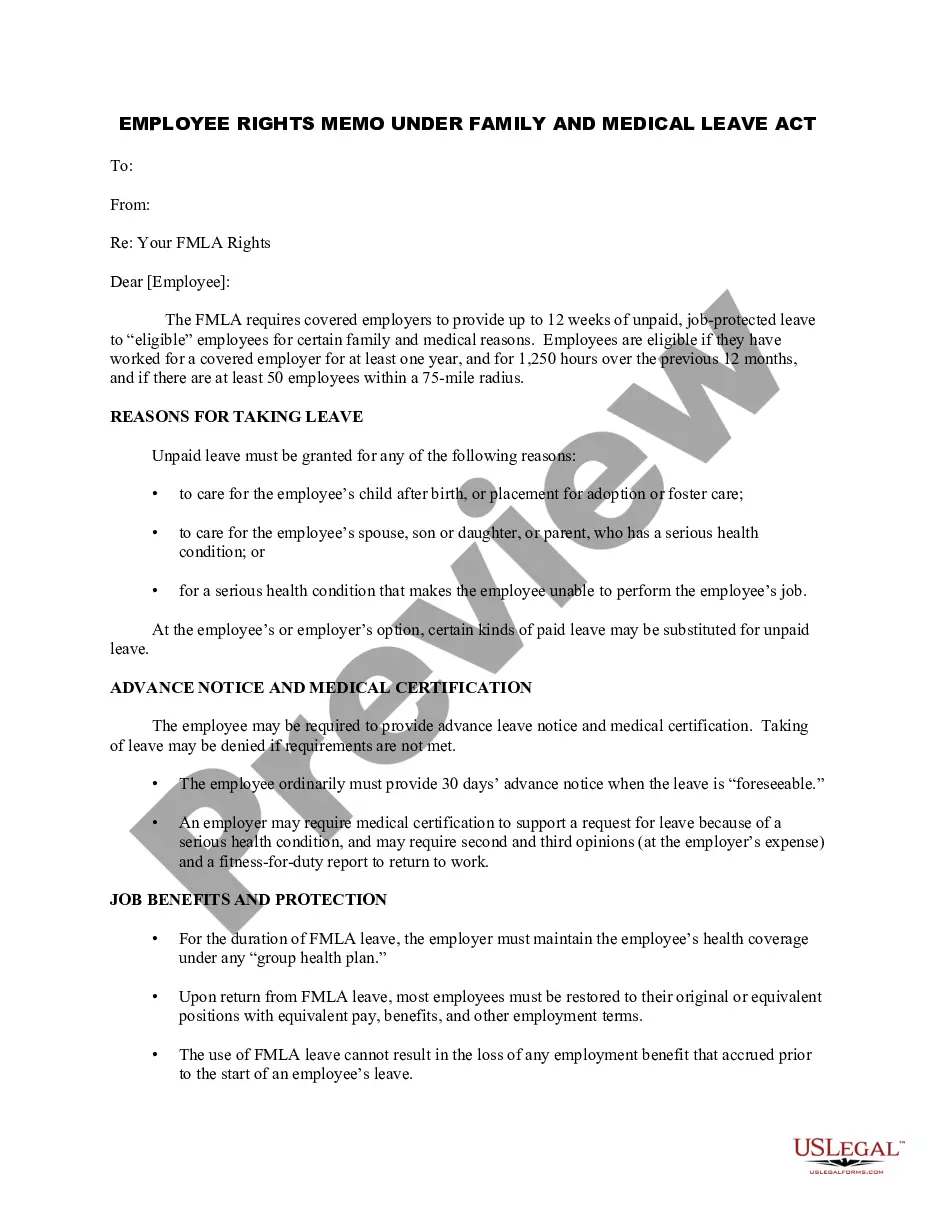
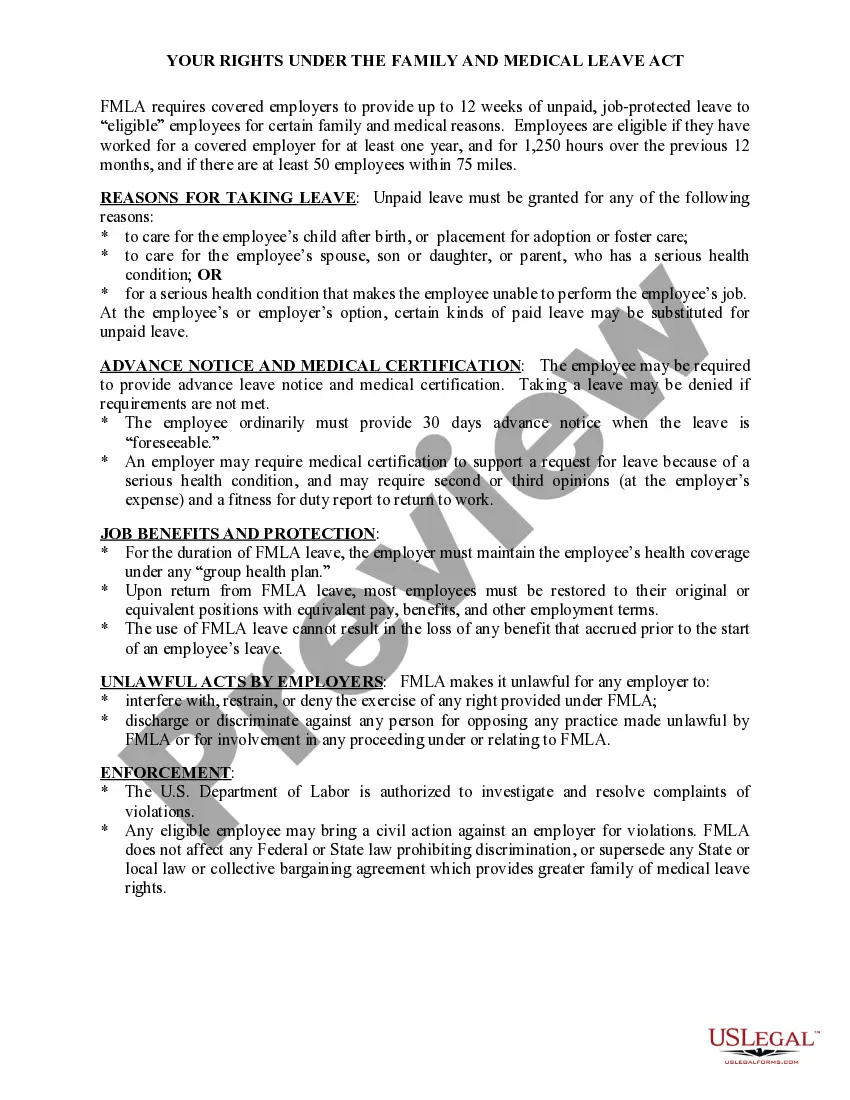
How to fill out Employee Rights Memo Under The Family And Medical Leave Act?
Whether for corporate purposes or personal affairs, everyone must handle legal matters at some point in their life.
Filling out legal documents demands meticulous attention, beginning with choosing the correct form template. For example, if you select an incorrect version of the Fmla Eligibility For Rehired Employees, it will be rejected after submission.
With a comprehensive US Legal Forms library available, you never need to waste time searching for the correct sample online. Utilize the library’s user-friendly navigation to locate the right template for any circumstance.
- Obtain the form you require using the search bar or catalog navigation.
- Review the form’s details to ensure it aligns with your situation, jurisdiction, and county.
- Click on the form’s preview to check its contents.
- If it is the incorrect form, go back to the search feature to find the Fmla Eligibility For Rehired Employees document you need.
- Acquire the template once it satisfies your specifications.
- If you already possess a US Legal Forms account, simply click Log in to access previously stored documents in My documents.
- Should you not have an account yet, you can get the form by clicking Buy now.
- Select the suitable payment option.
- Fill out the account sign-up form.
- Choose your payment method: either a credit card or PayPal account.
- Select the file format you desire and download the Fmla Eligibility For Rehired Employees.
- Once saved, you can complete the form using editing software or print it out and fill it in by hand.
Form popularity
FAQ
Yes, you can take FMLA and PFL back to back, as long as you meet the FMLA eligibility for rehired employees. It is important to understand that taking these leaves consecutively can provide additional support during challenging times. To ensure a smooth process, familiarize yourself with your employer's policies and any documentation required. Utilizing resources like USLegalForms can help clarify your rights and obligations regarding FMLA and PFL.
You can take FMLA leave while maintaining a second job, as FMLA protects your primary job position. However, it is essential to understand that your FMLA eligibility for rehired employees applies only to your primary employer under the guidelines set forth by the FMLA. Additionally, if your second job interferes with your ability to take leave or impacts your primary employer’s requirements, it could complicate matters. For accurate advice tailored to your situation, considering resources like USLegalForms can provide the necessary documentation and support.
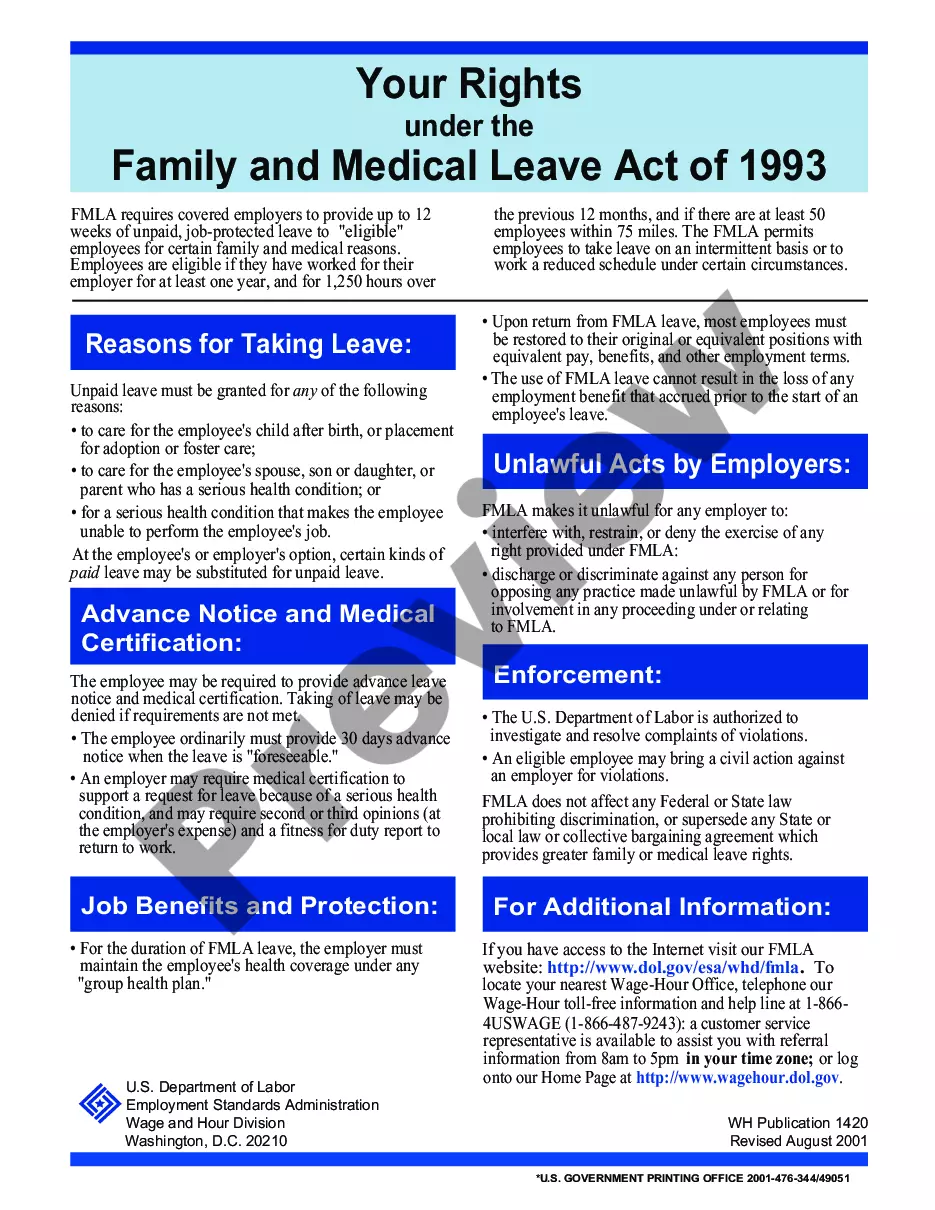
The 50 75 rule for FMLA relates to how eligibility is determined for employees, specifically focusing on the number of employees and the hours worked. Under this rule, to qualify for FMLA benefits, an employee must work at least 1,250 hours within the last 12 months and be employed at a location with at least 50 employees within a 75-mile radius. Understanding this rule is crucial for rehired employees assessing their FMLA eligibility for rehired employees. If you're unsure about your eligibility under this rule, you can consult resources, such as USLegalForms, for clear guidance and documents.
Yes, you can potentially qualify for FMLA if you need time off for back issues, provided those issues meet the definition of a serious health condition. This means it must involve medical treatment or lasting problems that hinder your daily activities. It is essential to communicate with your employer about your health situation and to ensure understanding of FMLA eligibility for rehired employees. Consulting resources like US Legal Forms can provide clarity on your options.
There are specific exceptions to job restoration under FMLA that employees need to know. Employers are not required to restore employees if they would have been laid off or if they performed poorly prior to the leave. In rare cases, employers may deny reinstatement due to significant changes in job title or responsibilities. Understanding these nuances aids employees in evaluating their FMLA eligibility for rehired employees.
An employer may deny FMLA for various reasons, such as insufficient employee tenure or inadequate hours worked. Sometimes, an employer might state that the leave purpose does not meet FMLA criteria. Always review your situation carefully, as understanding your rights under FMLA can empower you to address denials proactively. Resources, like those from US Legal Forms, can help clarify FMLA eligibility for rehired employees.
Several types of employers are exempt from FMLA requirements. This includes businesses with fewer than 50 employees and certain private sector employers focused on specific industries. Government entities and religious organizations may also have exemptions. Identifying these regulations can assist employees in understanding their rights and FMLA eligibility for rehired employees.
Employees who do not meet specific criteria are not eligible for FMLA. This includes those who work part-time, those who have not been employed for a minimum of 12 months, and those who do not work for a company with the necessary employee count. Awareness of FMLA eligibility for rehired employees can help you navigate these qualifications.
Yes, you may qualify for FMLA if you are rehired, depending on your previous employment period. If your previous job counts towards the 12 months of service needed for eligibility, you can take FMLA leave. However, your current employer must still fulfill the FMLA's other requirements. It's vital to review your situation or consult with a professional if unsure about FMLA eligibility for rehired employees.
Certain employees do not qualify for FMLA. For instance, those who work for an employer with fewer than 50 employees within a 75-mile radius are typically ineligible. Additionally, employees who have not worked for their employer for at least 12 months or have not clocked 1,250 hours in the previous year do not meet the requirements. Understanding FMLA eligibility for rehired employees can clarify your options.