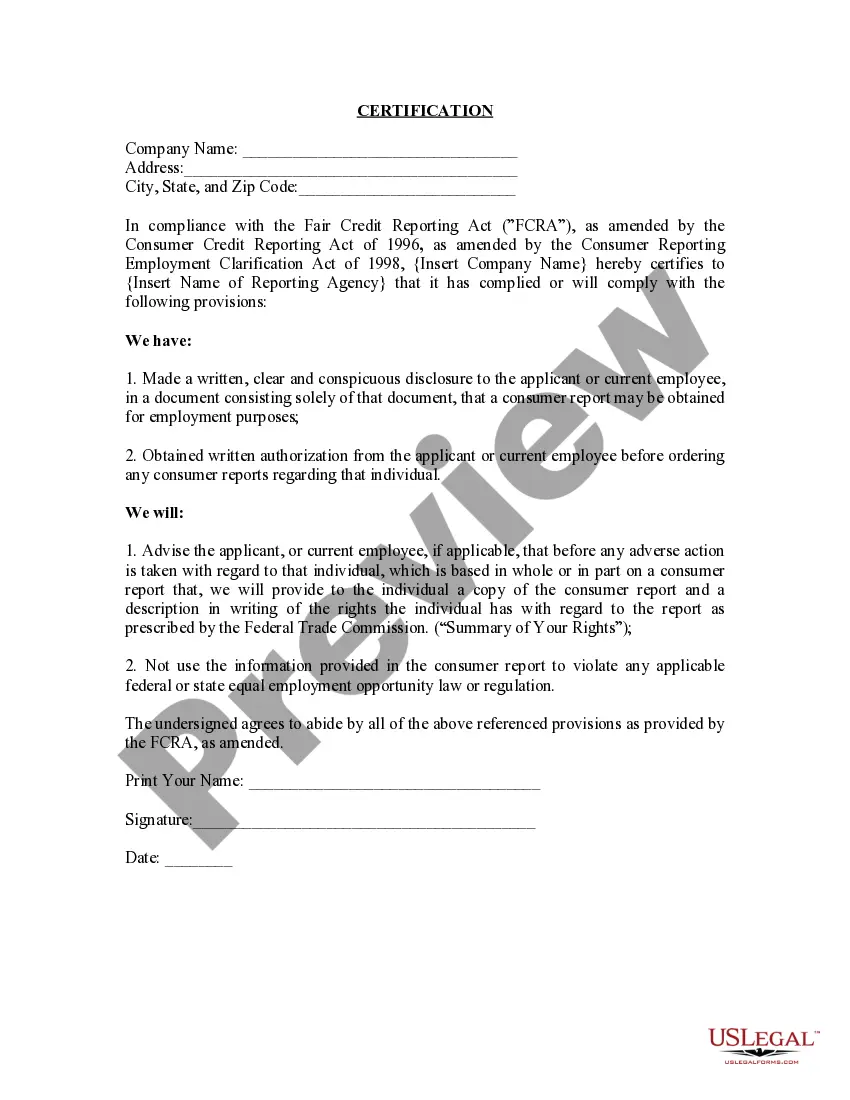
Consumer Reporting Agency Under Fcra
Description
Get your form ready online
Our built-in tools help you complete, sign, share, and store your documents in one place.
Make edits, fill in missing information, and update formatting in US Legal Forms—just like you would in MS Word.
Download a copy, print it, send it by email, or mail it via USPS—whatever works best for your next step.
Sign and collect signatures with our SignNow integration. Send to multiple recipients, set reminders, and more. Go Premium to unlock E-Sign.
If this form requires notarization, complete it online through a secure video call—no need to meet a notary in person or wait for an appointment.
We protect your documents and personal data by following strict security and privacy standards.

Make edits, fill in missing information, and update formatting in US Legal Forms—just like you would in MS Word.

Download a copy, print it, send it by email, or mail it via USPS—whatever works best for your next step.

Sign and collect signatures with our SignNow integration. Send to multiple recipients, set reminders, and more. Go Premium to unlock E-Sign.

If this form requires notarization, complete it online through a secure video call—no need to meet a notary in person or wait for an appointment.

We protect your documents and personal data by following strict security and privacy standards.
Looking for another form?

How to fill out FCRA Certification Letter To Consumer Reporting Agency?
Regardless of whether it pertains to business needs or personal issues, everyone will need to handle legal matters at some stage in life.
Filling out legal documents requires meticulous care, starting with selecting the appropriate form template.
With a vast catalog from US Legal Forms at your disposal, you do not need to waste time searching online for the suitable template for any circumstance.
- For instance, if you select an incorrect version of a Consumer Reporting Agency Under Fcra, it will be rejected once submitted.
- Consequently, it is crucial to obtain a trustworthy source of legal documents such as US Legal Forms.
- Should you need a sample of a Consumer Reporting Agency Under Fcra, adhere to these straightforward steps.
- Acquire the sample you require by using the search bar or browsing the catalog.
- Review the form’s details to ensure it meets your needs, jurisdiction, and county.
- Click on the form’s preview to view it.
- If it is the wrong document, return to the search option to find the appropriate Consumer Reporting Agency Under Fcra sample.
- Download the file when it aligns with your requirements.
- If you possess a US Legal Forms account, simply click Log in for access to documents you have already saved in My documents.
- In case you do not have an account yet, you may acquire the form by clicking Buy now.
- Choose the appropriate pricing option.
- Complete the registration form for your profile.
- Select your payment method: utilize a credit card or PayPal account.
- Choose the document format you prefer and download the Consumer Reporting Agency Under Fcra.
- Once it is saved, you can fill out the form using editing software or print it and complete it by hand.
Form popularity
FAQ
Under the FCRA, a consumer reporting agency is defined as any entity that routinely engages in the practice of collecting information on consumers for credit or insurance purposes. This includes credit bureaus and similar organizations that issue reports used by lenders and insurers. To comply with the FCRA, they must provide accurate information and allow consumers to dispute errors in their reports.
A consumer reporting agency under FCRA is an organization that gathers, analyzes, and sells consumer information, primarily related to creditworthiness. These agencies play a crucial role in evaluating a consumer's financial reliability. The FCRA sets forth guidelines that these agencies must follow to promote fair and accurate reporting, ensuring your rights as a consumer are protected.
The four major consumer reporting agencies are Equifax, Experian, TransUnion, and Innovis. Each agency collects and compiles consumer data on credit histories, payment behavior, and more. Understanding these agencies helps you monitor your credit reports effectively and take advantage of the protections offered under the FCRA.
Consumer reporting agencies are organizations that collect and maintain information about consumers' credit histories and financial behavior. They provide this information to businesses for various purposes, including credit applications and insurance underwriting. Under the Fair Credit Reporting Act (FCRA), these agencies must ensure the accuracy and confidentiality of your information, allowing you to make informed decisions.
Consumers can leverage the FCRA to challenge and potentially remove incorrect collections from their credit reports by submitting a dispute to the consumer reporting agency under FCRA. Gather evidence to support your claim and file the dispute, prompting the agency to investigate. This approach ensures that only accurate, verified information stays on your credit report, improving your overall credit score.
FCRA requirements on credit reports mandate that consumer reporting agencies under FCRA maintain accuracy and confidentiality in reporting. It requires agencies to verify the information they provide to ensure it is correct. Furthermore, consumers have the right to dispute inaccurate entries, ensuring their credit reports reflect true financial behavior.
The FCRA disclosure is a requirement for consumer reporting agencies under FCRA to inform consumers about their rights regarding their credit information. It outlines how to access their reports, the importance of accuracy, and the procedure for disputing errors. Being informed through proper disclosure empowers consumers to manage their financial health effectively.
A consumer report generated by a consumer reporting agency under FCRA contains information such as your credit history, accounts, payment patterns, and any public records like bankruptcies. It reflects how you manage your finances and is used by lenders to evaluate creditworthiness. Understanding what’s in your report can help you take control of your financial future.
To report FCRA violations, you can file a complaint with the Federal Trade Commission (FTC) or the Consumer Financial Protection Bureau (CFPB). These agencies oversee consumer protection laws and can address violations related to credit reporting. Additionally, you can reach out directly to the consumer reporting agency involved. If you need guidance on how to proceed, USLegalForms provides tools and templates to effectively report and document these violations.
You can file a complaint with a credit reporting agency for reasons such as inaccurate information on your credit report, failure to investigate a dispute, or if they did not provide a report after a request. These complaints are essential for maintaining accurate credit records. Ensure you document all interactions for clarity. If you need assistance, USLegalForms can help you with the complaint process and other consumer rights matters.