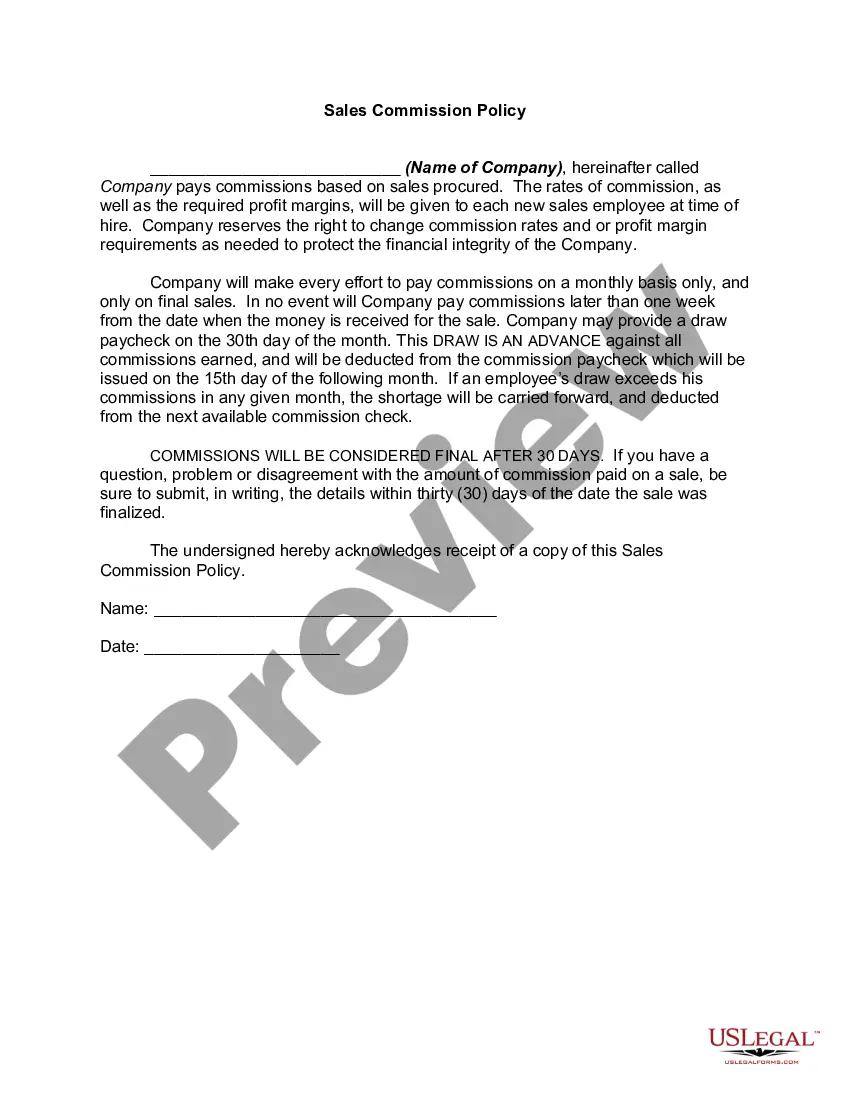
Employee Commission Policy
Description
Get your form ready online
Our built-in tools help you complete, sign, share, and store your documents in one place.
Make edits, fill in missing information, and update formatting in US Legal Forms—just like you would in MS Word.
Download a copy, print it, send it by email, or mail it via USPS—whatever works best for your next step.
Sign and collect signatures with our SignNow integration. Send to multiple recipients, set reminders, and more. Go Premium to unlock E-Sign.
If this form requires notarization, complete it online through a secure video call—no need to meet a notary in person or wait for an appointment.
We protect your documents and personal data by following strict security and privacy standards.

Make edits, fill in missing information, and update formatting in US Legal Forms—just like you would in MS Word.

Download a copy, print it, send it by email, or mail it via USPS—whatever works best for your next step.

Sign and collect signatures with our SignNow integration. Send to multiple recipients, set reminders, and more. Go Premium to unlock E-Sign.

If this form requires notarization, complete it online through a secure video call—no need to meet a notary in person or wait for an appointment.

We protect your documents and personal data by following strict security and privacy standards.
Looking for another form?









How to fill out Sales Commission Policy?
It’s clear that you cannot transform into a legal expert in a single night, nor can you comprehend how to swiftly draft an Employee Commission Policy without possessing a tailored skill set.
Formulating legal documents is a lengthy endeavor that necessitates specific training and expertise. Therefore, why not entrust the creation of the Employee Commission Policy to the specialists.
With US Legal Forms, one of the most extensive legal document libraries, you can obtain anything from court forms to templates for internal corporate communication. We recognize how vital compliance and adherence to federal and state laws and regulations are. That’s why, on our site, all templates are location-specific and current.
You can access your forms again from the My documents tab at any time. If you’re a current client, you can simply Log In, and locate and download the template from the same tab.
Regardless of the reason for your documentation—be it financial, legal, or personal—our platform has you covered. Give US Legal Forms a try today!
- Identify the document you require using the search bar at the top of the webpage.
- Preview it (if this feature is available) and read the accompanying description to ascertain whether the Employee Commission Policy aligns with your needs.
- Initiate a new search if you need another template.
- Sign up for a free account and choose a subscription plan to purchase the template.
- Click Buy now. Once the payment is processed, you can acquire the Employee Commission Policy, complete it, print it, and send or mail it to the required individuals or entities.
Form popularity
FAQ
A good commission plan aligns with the company's goals while motivating employees to achieve higher sales. It often includes clear targets, a competitive commission rate, and bonuses for exceeding targets. An employee commission policy like this not only drives performance but also fosters a culture of achievement within the organization. Additionally, the right plan can help retain top talent.
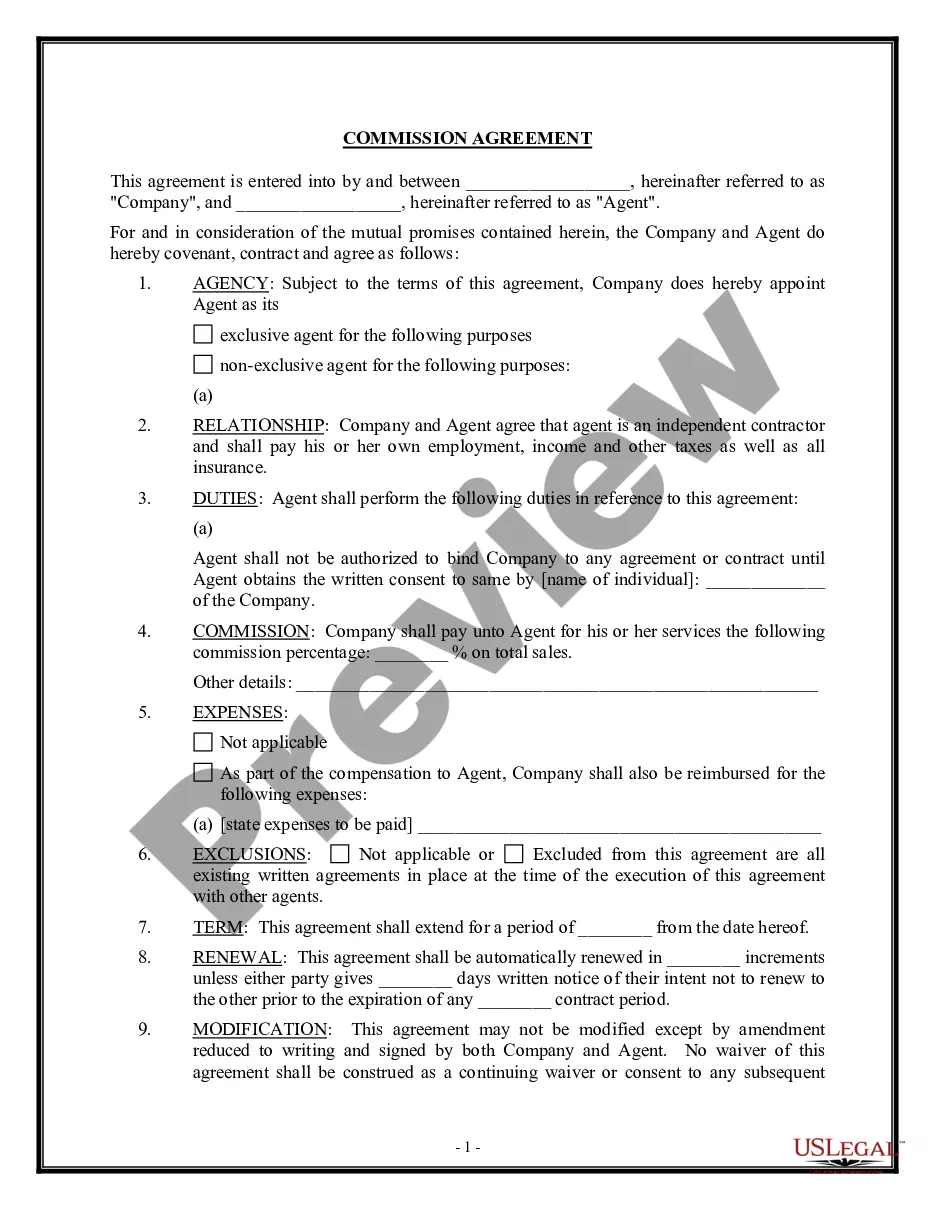
An example of a commission policy could be a tiered structure, where employees earn different commission rates based on their sales volume. For example, an employee might earn a 5% commission on sales up to $10,000 and a 7% commission on any sales exceeding that amount. This encourages employees to surpass their targets. A clear employee commission policy ensures everyone understands how their performance translates into rewards.
A sales commission policy typically outlines how sales professionals earn compensation based on their sales performance. For instance, a company may offer a commission rate of 10% on all sales generated by an employee. This policy motivates employees to sell more, as their earnings directly relate to their efforts. A well-defined employee commission policy helps clarify expectations and incentivizes higher sales.
To set up a commission for employees, first define the sales targets and commission rates clearly. Next, consider factors like market standards and your budget. Implementing an employee commission policy through platforms like uslegalforms ensures that you document these terms professionally and legally, reducing misunderstandings.
Yes, a W-2 employee can be classified as 100% commission if their earnings solely depend on sales made. However, it is important to comply with labor laws regarding minimum wage and employee classifications. An effective employee commission policy will clarify these aspects to prevent any legal complications.
For instance, if an employee sells a product worth $1,000 and the commission rate is 5%, the employee earns $50. This simple example demonstrates how sales commission works in practice. It's crucial to detail such examples in your employee commission policy so all team members have clear expectations.
A commission policy outlines how employees earn commissions based on their performance, sales targets, or other criteria. It defines the percentage rates, payment timelines, and any applicable conditions. Having a solid employee commission policy can motivate your sales team while ensuring transparency about earnings.
A sales commission clause often specifies the percentage of sales that employees will earn as commission, along with any conditions that must be met. For example, a clause might state that employees earn a 10% commission on sales exceeding $50,000. Clarity in these clauses strengthens the employee commission policy, benefiting both the employer and employee.
To calculate a 6% commission on $300,000, simply multiply 300,000 by 0.06. This results in a commission of $18,000. Understanding this kind of calculation is essential for any employee commission policy, as it helps you set clear earning expectations.
Writing a commission plan involves outlining the employee commission policy that aligns with your business goals. Begin by specifying objectives, commission structures, and any bonuses for exceeding targets. Transparently communicate how the commission will be calculated and distributed. US Legal Forms offers resources that can assist you in drafting a comprehensive commission plan tailored to your business needs.