Adverse Possession Section For Land Law
Description
Get your form ready online
Our built-in tools help you complete, sign, share, and store your documents in one place.
Make edits, fill in missing information, and update formatting in US Legal Forms—just like you would in MS Word.
Download a copy, print it, send it by email, or mail it via USPS—whatever works best for your next step.
Sign and collect signatures with our SignNow integration. Send to multiple recipients, set reminders, and more. Go Premium to unlock E-Sign.
If this form requires notarization, complete it online through a secure video call—no need to meet a notary in person or wait for an appointment.
We protect your documents and personal data by following strict security and privacy standards.

Make edits, fill in missing information, and update formatting in US Legal Forms—just like you would in MS Word.

Download a copy, print it, send it by email, or mail it via USPS—whatever works best for your next step.

Sign and collect signatures with our SignNow integration. Send to multiple recipients, set reminders, and more. Go Premium to unlock E-Sign.

If this form requires notarization, complete it online through a secure video call—no need to meet a notary in person or wait for an appointment.

We protect your documents and personal data by following strict security and privacy standards.
Looking for another form?



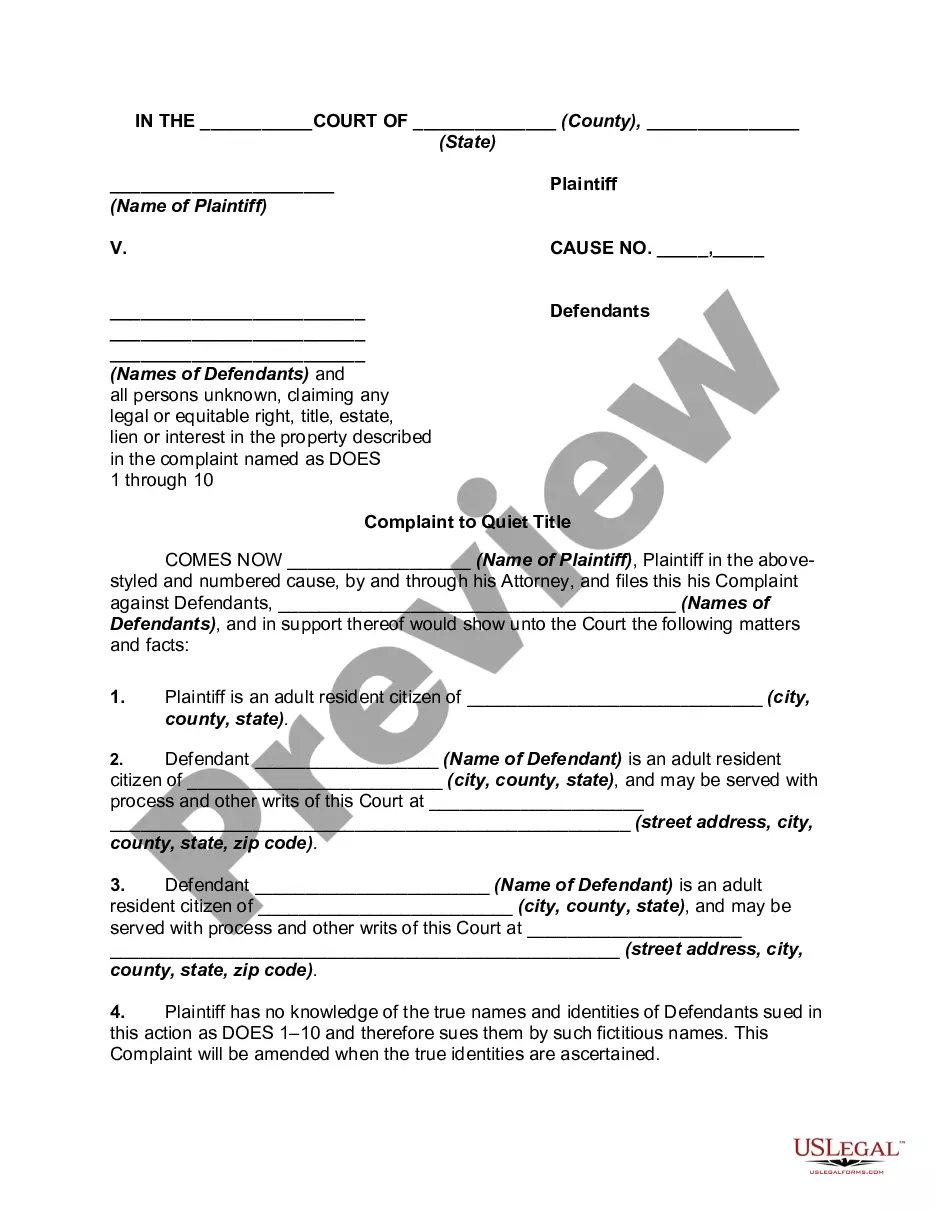
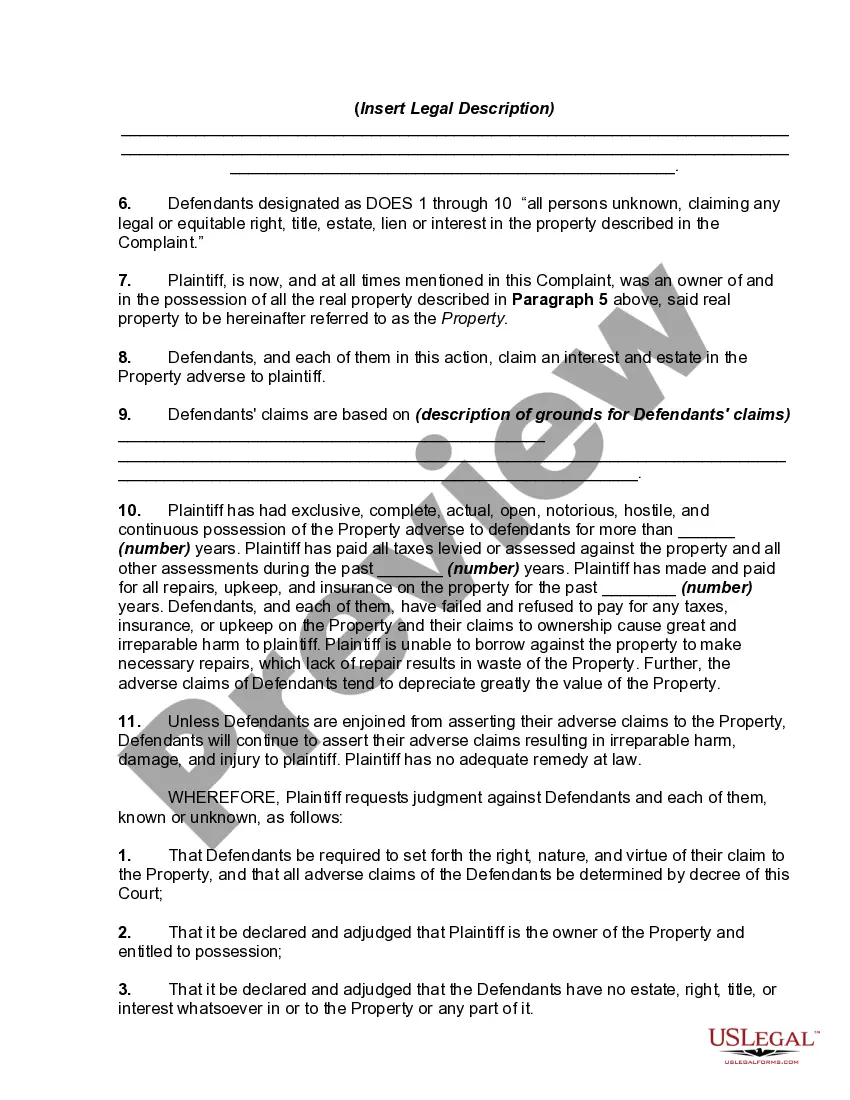
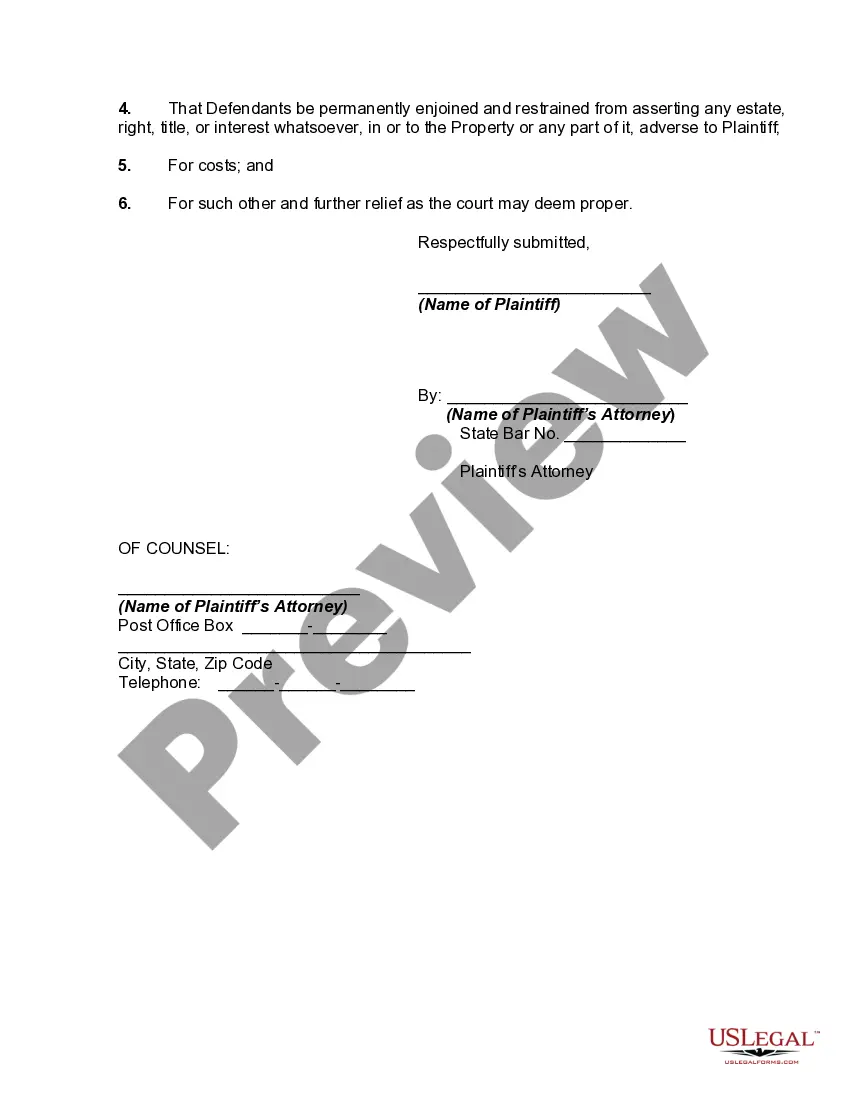
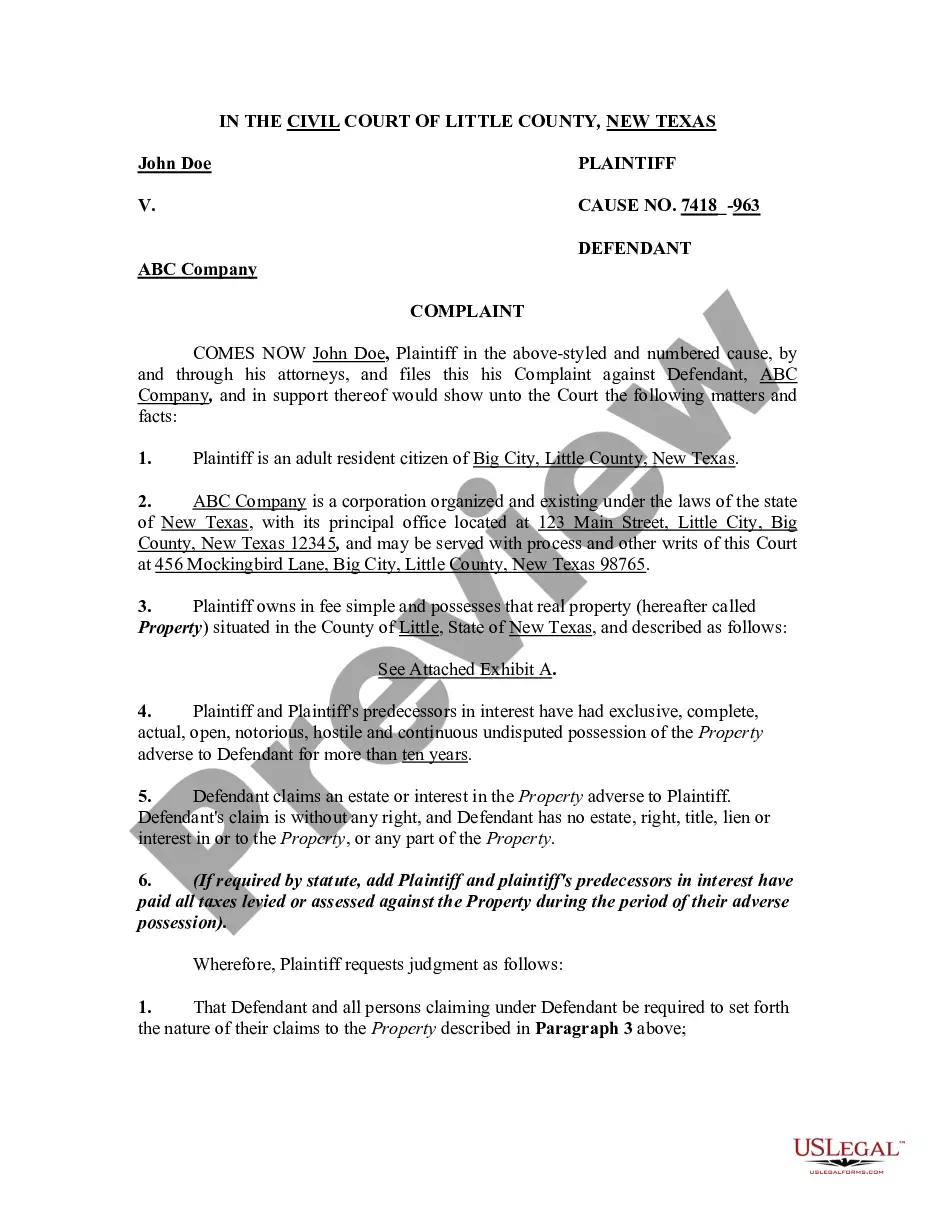
How to fill out Complaint To Quiet Title By Adverse Possessor With Unknown Defendants?
- If you're a returning user, simply log in and download your desired form template. Ensure your subscription is active, and renew if required.
- For first-time users, begin by reviewing the Preview mode and form description to ensure alignment with your local jurisdiction's requirements.
- If you need a different template, use the Search feature to find the correct form that meets your needs.
- Select the document you need by clicking the Buy Now button and choose your preferred subscription plan, creating an account for full access.
- Complete your purchase using your credit card or PayPal, then download the form to your device.
- Access your downloaded forms anytime within the My Forms section of your profile.
By leveraging US Legal Forms’ extensive library of over 85,000 legal documents, users can ensure they have access to accurate, professionally vetted forms that simplify legal processes.
Take advantage of US Legal Forms today to confidently navigate the adverse possession section for land law. Start your journey by accessing our resources and obtaining the forms you need!
Form popularity
FAQ
In New York, the requirements for adverse possession are somewhat similar but differ in duration and conditions. You must possess the property continuously for 10 years, demonstrate open and notorious use, and exclude the rights of the true owner. Paying property taxes is crucial to strengthen your claim. Making sense of the adverse possession section for land law can help clarify your path in New York.
In Texas, the five requirements for adverse possession include actual possession, open and notorious use, exclusive possession, hostile claim, and continuous use for ten years. Each element must be clearly established to successfully claim adverse possession. Familiarizing yourself with the adverse possession section for land law will equip you with the knowledge needed to ensure your claim meets these criteria.
Defeating a claim of adverse possession involves proving that the claimant's use of the property was not exclusive, not open, or with consent. It's crucial to gather evidence showing rightful ownership and maintain possession while challenging the claim. Understanding the nuances of the adverse possession section for land law can significantly assist you in navigating these legal matters.
To prove adverse possession in Texas, you need to demonstrate five key elements: actual possession, open and notorious use, exclusive possession, hostile claim, and continuous use for the statutory period. Documenting your use of the property can help substantiate your claim. Working with resources that detail the adverse possession section for land law can provide valuable guidance through this process.
In Connecticut, the rules for adverse possession differ slightly from Texas. You must possess the property continuously for 15 years, and your possession must be visible and without permission from the original owner. Paying property taxes can strengthen your claim. Understanding the adverse possession section for land law in Connecticut can help you navigate these requirements.
In Texas, you must possess the property continuously for a minimum of 10 years to acquire it through adverse possession. This period allows you to establish ownership rights over the property in question. It's essential that your possession is actual, open, and notorious, signifying your exclusive use of the land. Understanding the adverse possession section for land law can help clarify your rights in such cases.
To record adverse possession, one typically needs to file a legal claim with the appropriate local court or land office. This often involves providing evidence of continuous and exclusive occupation, in line with the adverse possession section for land law. Consulting with a legal expert or using resources from platforms like US Legal Forms can significantly streamline this process. Proper documentation is crucial to protect your claim and ensure your ownership rights.
The Indiana code regarding adverse possession is outlined in Indiana Code 32-30-1. It states that a person can claim ownership through adverse possession after occupying the property for at least 10 years. This law emphasizes the importance of continuous and uninterrupted possession. Being aware of this code is crucial for property owners and those considering a claim under the adverse possession section for land law.
In Minnesota, the required period for adverse possession is 15 years, according to the adverse possession section for land law. During this time, the possessor must demonstrate continuous, open, and exclusive use of the property without the owner's consent. This rule provides clarity on how long someone can occupy land before making a claim. Understanding this timeframe is essential for both property owners and potential claimants alike.
An example of adverse possession occurs when someone openly occupies a property without the permission of the owner, treating it as their own. For instance, if a person maintains a lawn and builds a fence on a vacant lot for several years, they may eventually claim legal ownership through the adverse possession section for land law. This highlights how long-term use can lead to ownership rights. Such situations often arise when landowners are unaware of their rights or fail to monitor their properties.