Suppress Arrest For
Description

Get your form ready online
Our built-in tools help you complete, sign, share, and store your documents in one place.
Make edits, fill in missing information, and update formatting in US Legal Forms—just like you would in MS Word.
Download a copy, print it, send it by email, or mail it via USPS—whatever works best for your next step.
Sign and collect signatures with our SignNow integration. Send to multiple recipients, set reminders, and more. Go Premium to unlock E-Sign.
If this form requires notarization, complete it online through a secure video call—no need to meet a notary in person or wait for an appointment.
We protect your documents and personal data by following strict security and privacy standards.

Make edits, fill in missing information, and update formatting in US Legal Forms—just like you would in MS Word.

Download a copy, print it, send it by email, or mail it via USPS—whatever works best for your next step.

Sign and collect signatures with our SignNow integration. Send to multiple recipients, set reminders, and more. Go Premium to unlock E-Sign.

If this form requires notarization, complete it online through a secure video call—no need to meet a notary in person or wait for an appointment.

We protect your documents and personal data by following strict security and privacy standards.
Looking for another form?
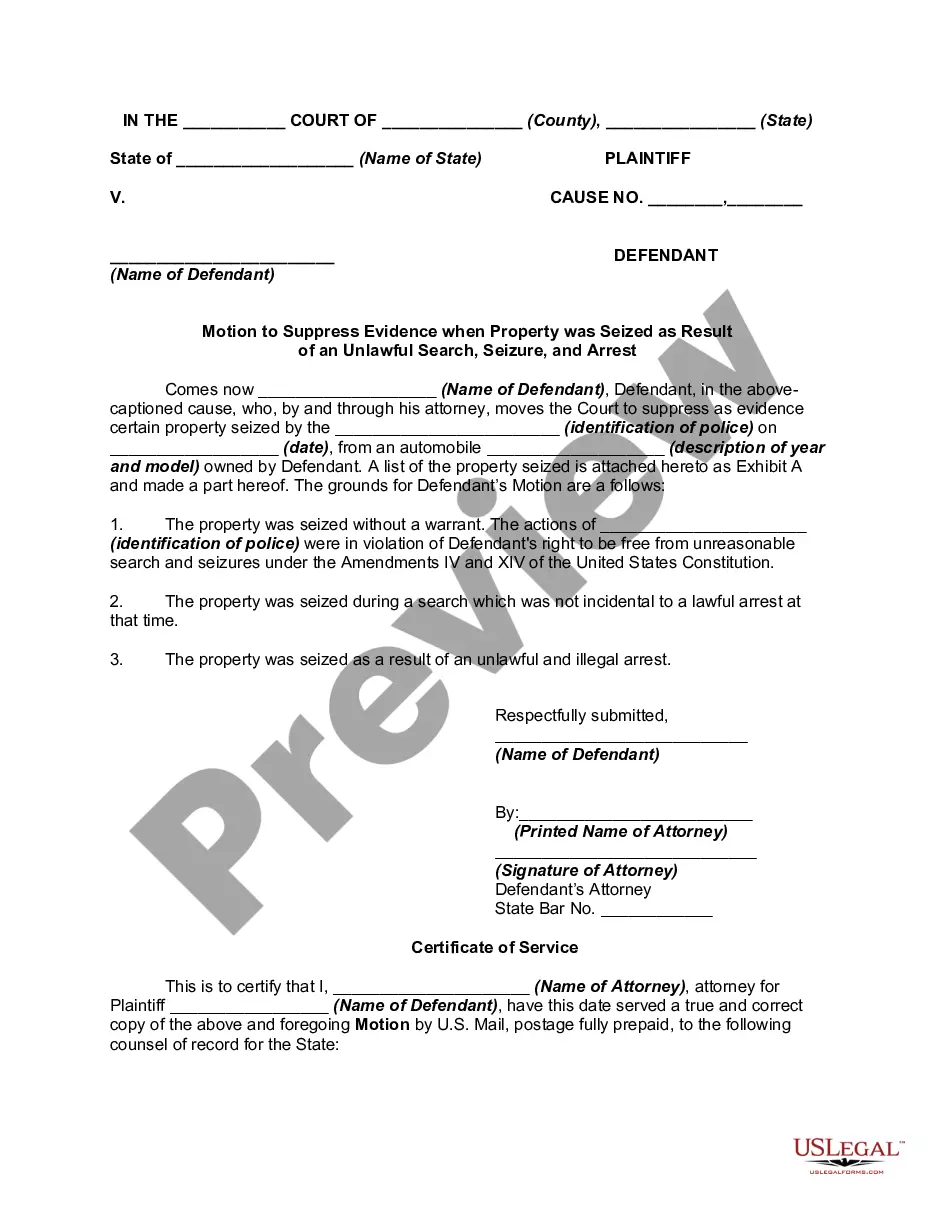
How to fill out Motion To Suppress Evidence When Property Was Seized As Result Of An Unlawful Search, Seizure, And Arrest?
Whether for commercial objectives or personal matters, everyone must navigate legal scenarios at some point in their lives.
Filling out legal paperwork requires meticulous care, starting with choosing the correct form template.
With a vast US Legal Forms library available, you need not waste time searching for the right template online. Take advantage of the library’s straightforward navigation to find the ideal template for any situation.
- For instance, if you choose an incorrect version of the Suppress Arrest For, it will be rejected upon submission.
- Thus, it is vital to find a reliable source for legal documents like US Legal Forms.
- If you need to acquire a sample of Suppress Arrest For, follow these straightforward steps.
- Retrieve the template you require by utilizing the search bar or browsing through the catalog.
- Examine the form’s details to ensure it aligns with your circumstances, state, and county.
- Click on the form’s preview to review its content.
- If it is not the correct document, return to the search option to locate the Suppress Arrest For sample that you need.
- Obtain the file once it satisfies your requirements.
- If you possess a US Legal Forms account, click Log in to access templates that you have saved in My documents.
- If you don’t have an account yet, you can acquire the form by clicking Buy now.
- Choose the appropriate pricing option.
- Fill out the profile registration form.
- Select your payment method: utilize a credit card or PayPal account.
- Choose the document format you desire and download the Suppress Arrest For.
- After it is saved, you can complete the form using editing software or print it and fill it out manually.
Form popularity
FAQ
To win a motion to suppress, you need to present compelling evidence showing that your rights were violated during the evidence collection process. This involves gathering documentation, witness statements, and other relevant information that supports your position. Working with experienced legal professionals can significantly strengthen your case, especially in matters involving how to suppress arrest for illegal procedures. They can guide you through the complex legal landscape effectively.
To suppress means to limit or restrict something. In legal terms, it often involves preventing certain evidence from being presented in court. Understanding how to suppress arrest for certain evidence can significantly influence the outcome of a case. This is crucial for ensuring a fair trial.
Your attorney can help file the motion at the federal or state court, depending on where you are being arraigned. Upon filing the motion, the court will schedule a hearing. At the suppression hearing, both parties would be allowed to present arguments supporting their case.
A motion to suppress is a formal request to have certain pieces of evidence excluded from your criminal trial. There are two grounds for filing a motion to suppress, which can be found in Penal Code 15398.5 PC. Both involve unreasonable searches and violations of your Constitutional rights.
An example of a motion to suppress is where a defendant requests the court to suppress a confession by the defendant to the police that was obtained as a result of a Miranda violation.
For example, a woman involved in a car crash has her blood drawn (with a warrant) to see if she was intoxicated while driving. But the police mislabel or mix up the blood evidence with others at the lab. This evidence may be suppressed because the chain of custody was improper.
Motions to Suppress Evidence - California Penal Code Section 1538.5. A Penal Code 1538.5 motion to suppress evidence is a pretrial motion asking the court to exclude evidence obtained by illegal search and seizure. In the United States, everyone is subject to the rule of law, including law enforcement.