Will R Probate Foreign
Description

Get your form ready online
Our built-in tools help you complete, sign, share, and store your documents in one place.
Make edits, fill in missing information, and update formatting in US Legal Forms—just like you would in MS Word.
Download a copy, print it, send it by email, or mail it via USPS—whatever works best for your next step.
Sign and collect signatures with our SignNow integration. Send to multiple recipients, set reminders, and more. Go Premium to unlock E-Sign.
If this form requires notarization, complete it online through a secure video call—no need to meet a notary in person or wait for an appointment.
We protect your documents and personal data by following strict security and privacy standards.

Make edits, fill in missing information, and update formatting in US Legal Forms—just like you would in MS Word.

Download a copy, print it, send it by email, or mail it via USPS—whatever works best for your next step.

Sign and collect signatures with our SignNow integration. Send to multiple recipients, set reminders, and more. Go Premium to unlock E-Sign.

If this form requires notarization, complete it online through a secure video call—no need to meet a notary in person or wait for an appointment.

We protect your documents and personal data by following strict security and privacy standards.
Looking for another form?



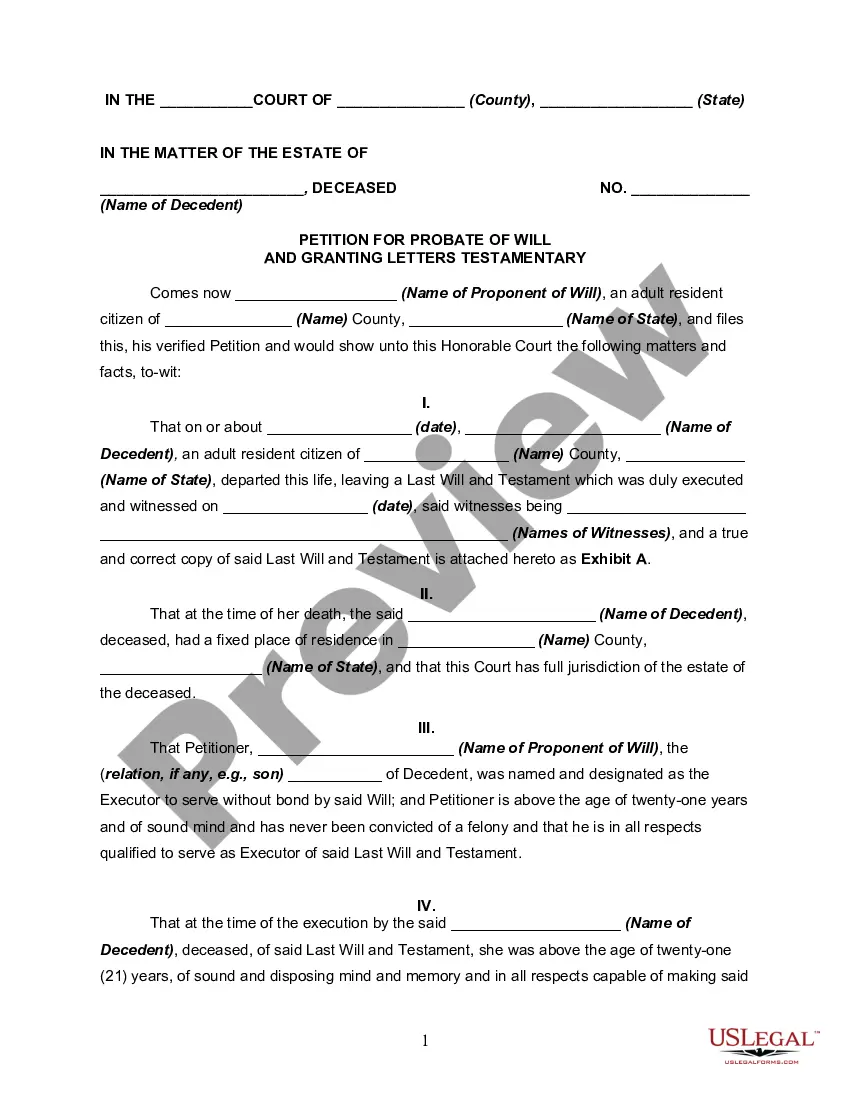
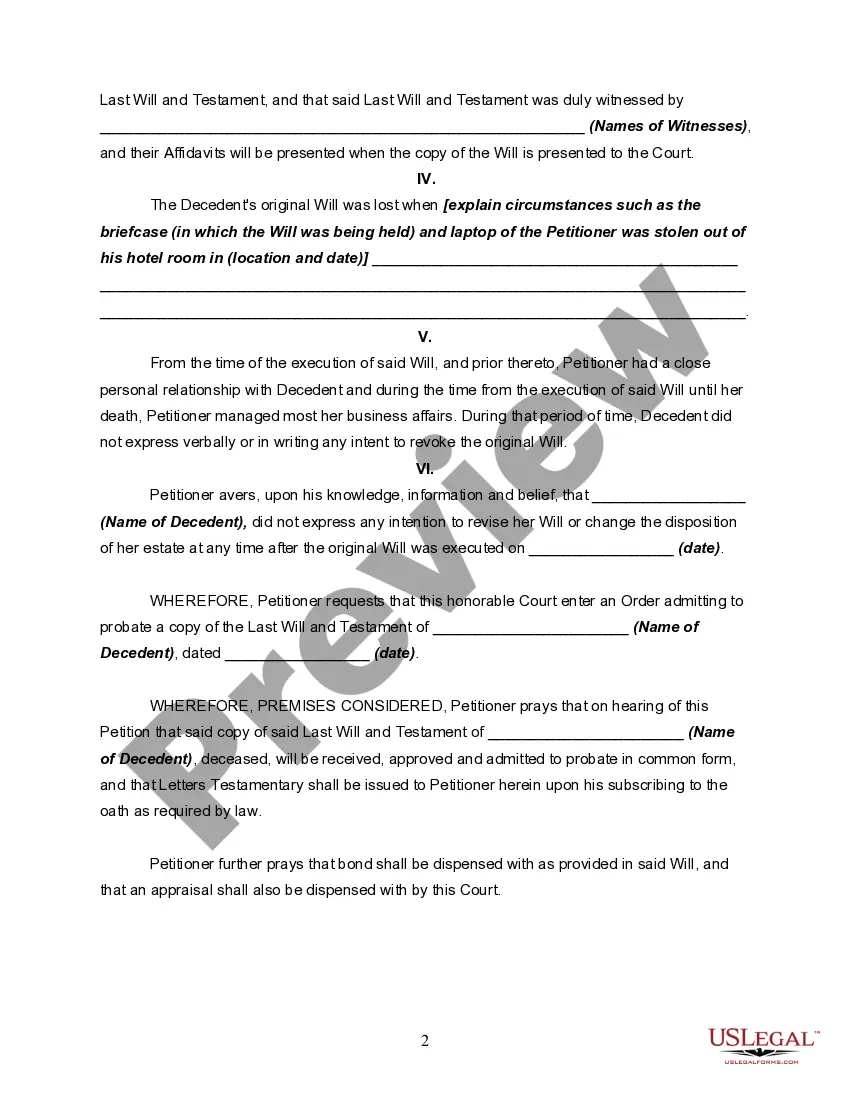
How to fill out Petition To Probate Lost Will?
Whether for corporate objectives or personal affairs, everyone must handle legal matters at some point in their lives.
Filling out legal documents requires meticulous attention, starting with selecting the appropriate form template.
With a comprehensive US Legal Forms collection available, you no longer need to waste time searching for the right template online. Utilize the library’s user-friendly navigation to find the appropriate template for any situation.
- Locate the template you require by utilizing the search box or catalog browsing.
- Review the form’s details to ensure it aligns with your circumstances, jurisdiction, and region.
- Click on the form’s preview to inspect it.
- If it is not the correct form, return to the search feature to find the Will R Probate Foreign example you need.
- Obtain the template when it fulfills your requirements.
- If you already possess a US Legal Forms account, simply click Log in to access previously saved forms in My documents.
- If you do not have an account yet, you can acquire the form by clicking Buy now.
- Select the suitable pricing option.
- Fill out the account registration form.
- Choose your payment method: use a credit card or PayPal account.
- Select the document format you prefer and download the Will R Probate Foreign.
- Once downloaded, you can complete the form using editing software or print it out to fill it in manually.
Form popularity
FAQ
Technically under California law, you could name a non-resident of the United States as your executor and then that person could request that the court appoint him or her to perform executor duties. (Probate Code §§ 8465(a)(2), 8402(a)(4).) Non-citizens who are U.S. residents can be executors too.
An executor for a nonresident, not a citizen of the U.S. must file an estate tax return, Form 706-NA, United States Estate (and Generation-Skipping) Tax Return, Estate of a nonresident not a citizen of the United StatesPDF, if the fair market value at death of the decedent's U.S.-situated assets exceeds $60,000.
If you're a U.S. citizen, you're subject to federal gift and estate taxes on all your worldwide assets, regardless of where you live or where your assets are located.
Understanding International Wills The documents likely need to be in writing; The documents need to unambiguously describe your assets; The documents need to describe how you wish your assets to be distributed; and. The documents need to be signed by two or more witnesses.
In such cases, courts will generally accept the validity of a foreign will if it was successfully probated without contest in the decedent's domicile.