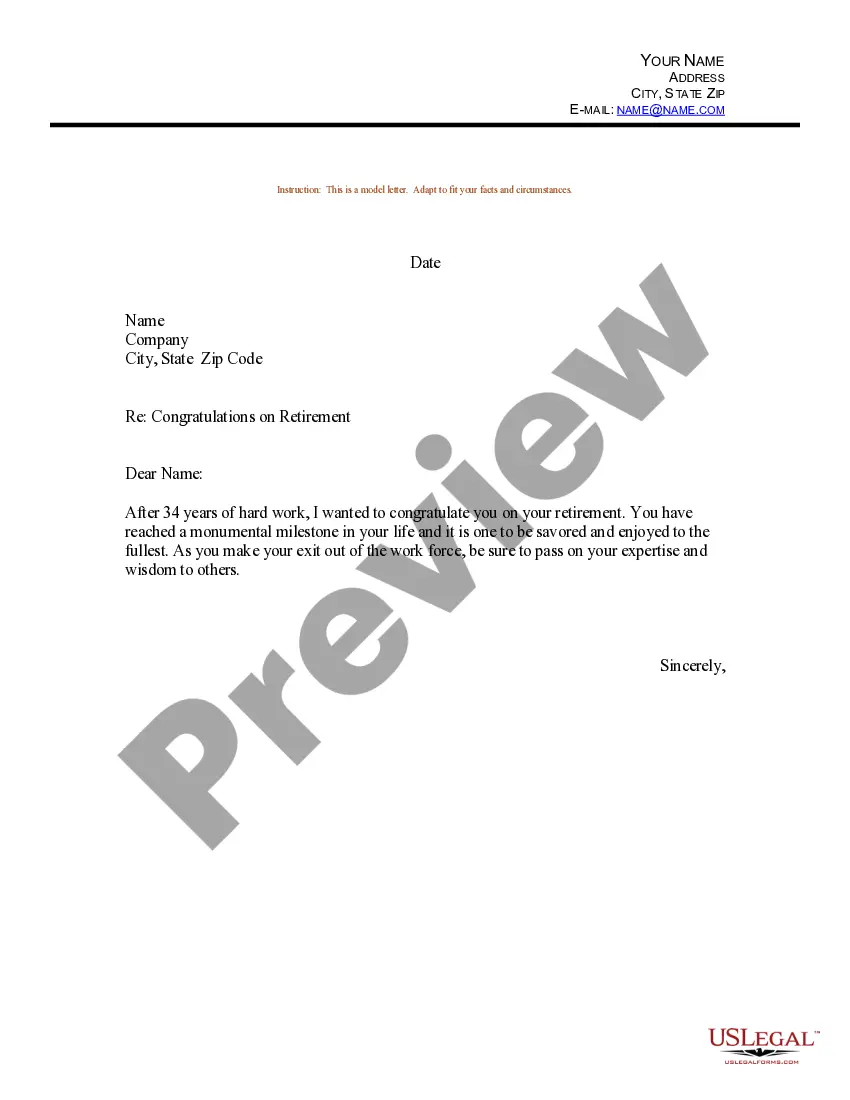
Sample Retirement Letter For Government Employee
Description
Get your form ready online
Our built-in tools help you complete, sign, share, and store your documents in one place.
Make edits, fill in missing information, and update formatting in US Legal Forms—just like you would in MS Word.
Download a copy, print it, send it by email, or mail it via USPS—whatever works best for your next step.
Sign and collect signatures with our SignNow integration. Send to multiple recipients, set reminders, and more. Go Premium to unlock E-Sign.
If this form requires notarization, complete it online through a secure video call—no need to meet a notary in person or wait for an appointment.
We protect your documents and personal data by following strict security and privacy standards.

Make edits, fill in missing information, and update formatting in US Legal Forms—just like you would in MS Word.

Download a copy, print it, send it by email, or mail it via USPS—whatever works best for your next step.

Sign and collect signatures with our SignNow integration. Send to multiple recipients, set reminders, and more. Go Premium to unlock E-Sign.

If this form requires notarization, complete it online through a secure video call—no need to meet a notary in person or wait for an appointment.

We protect your documents and personal data by following strict security and privacy standards.
Looking for another form?





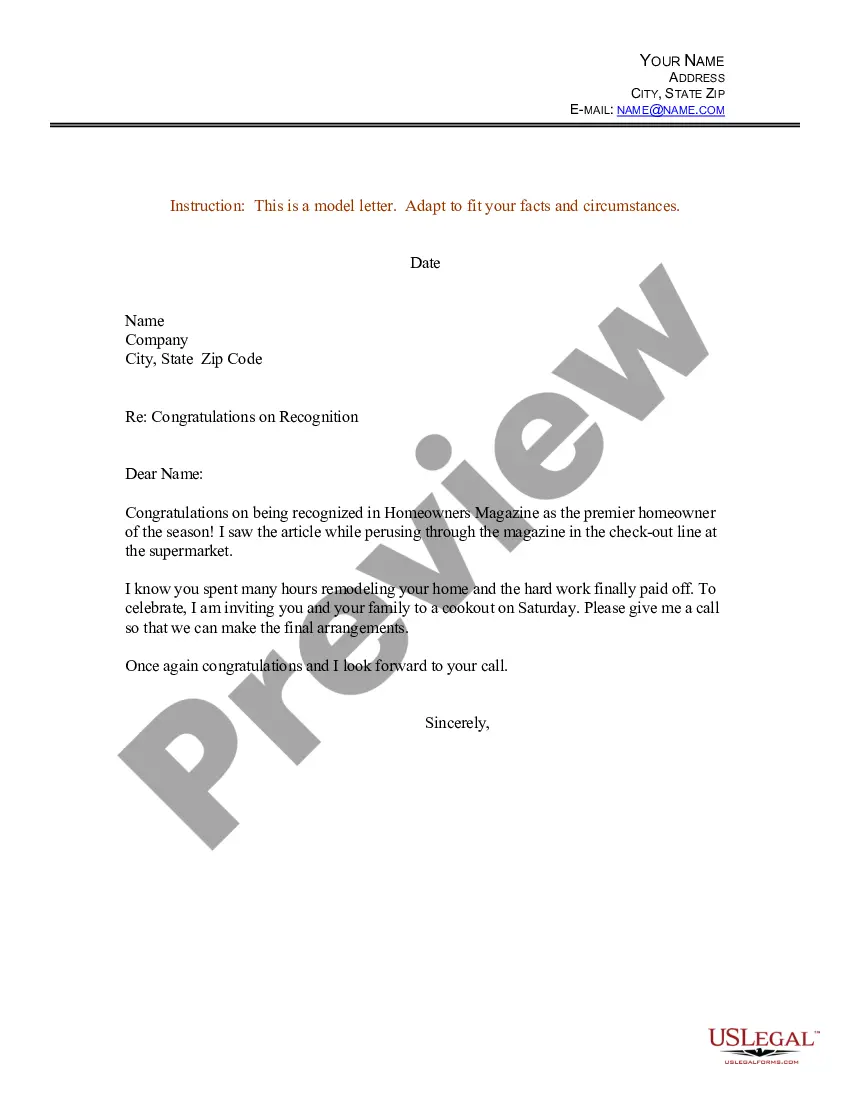
How to fill out Sample Letter For Congratulations On Retirement?
The Example Retirement Document for Government Worker you observe on this site is a reusable official format composed by skilled attorneys in accordance with federal and regional laws and guidelines.
For over 25 years, US Legal Forms has supplied individuals, businesses, and lawyers with more than 85,000 validated, state-specific documents for any corporate and personal occasion.
Register for US Legal Forms to have authenticated legal templates for all of life's situations readily available.
- Search for the document you require and examine it.
- Browse through the example you sought and preview it or review the form description to confirm it meets your needs. If it does not, use the search feature to find the right one. Click Buy Now after you have identified the template you need.
- Register and sign in.
- Select the pricing plan that fits you and create an account. Use PayPal or a credit card for a speedy payment. If you already possess an account, Log In and review your subscription to continue.
- Acquire the editable template.
- Choose the format you desire for your Example Retirement Document for Government Worker (PDF, DOCX, RTF) and download the specimen onto your device.
- Complete and authorize the documentation.
- Print the template to fill it out by hand. Alternatively, utilize an online multi-functional PDF editor to swiftly and accurately complete and sign your form with an eSignature.
- Download your documents once more.
- Reutilize the same file whenever necessary. Access the My documents tab in your profile to redownload any previously acquired forms.
Form popularity
FAQ
One significant disadvantage of a resignation letter is that it might limit your eligibility for certain retirement benefits, depending on company policies. Unlike a retirement letter, a resignation letter can sometimes create a perception of abrupt departure, which may affect your professional reputation. When considering your retirement, using a sample retirement letter for government employee can alleviate these concerns by providing a clear and appropriate way to announce your career transition.
The most common types of advance directives are the living will and the durable power of attorney for health care (sometimes known as the medical power of attorney). There are many advance directive formats.
This form lets you choose the kind of health care you want. This way, those who care for you will not have to guess what you want if you are not able to tell them yourself. The form must be signed before it can be used. This is a legal form that lets you have a voice in your health care.
The Kentucky Living Will Directive Act of 1994 was passed to ensure that citizens have the right to make decisions regarding their own medical care, including the right to accept or refuse treatment.
If no court-appointed guardian or durable power of attorney exists, a spouse is responsible for medical decisions related to end-of-life care. If there is no spouse or that person is unwilling or unable to make the decisions, adult children are consulted, then parents, and, finally, any nearest relative.
The Kentucky Office of the Attorney General provides a PDF of an Advance Health Care Directive form in both English and Spanish on their website, linked below. Note that the terminology they use for a Healthcare Proxy is a "Health Care Surrogate". The form should be signed by two witnesses or notarized.
This is a legal form that lets you have a voice in your health care. It will let your family, friends, and medical providers know how you want to be cared for if you cannot speak for yourself. Share this form and your choices with your family, friends, and medical providers.
INTRODUCTION TO YOUR KENTUCKY ADVANCE HEALTH CARE DIRECTIVE This packet contains a Kentucky Living Will Directive (or ?Advance Directive?), which protects your right to refuse medical treatment you do not want or to request treatment you do want in the event you lose the ability to make decisions yourself.
The Health Care Directives Act allows you to express your wishes about the amount and type of health care and treatment you want to receive should you become unable to speak or otherwise communicate this yourself.