Writing Fight
Description



Get your form ready online
Our built-in tools help you complete, sign, share, and store your documents in one place.
Make edits, fill in missing information, and update formatting in US Legal Forms—just like you would in MS Word.
Download a copy, print it, send it by email, or mail it via USPS—whatever works best for your next step.
Sign and collect signatures with our SignNow integration. Send to multiple recipients, set reminders, and more. Go Premium to unlock E-Sign.
If this form requires notarization, complete it online through a secure video call—no need to meet a notary in person or wait for an appointment.
We protect your documents and personal data by following strict security and privacy standards.

Make edits, fill in missing information, and update formatting in US Legal Forms—just like you would in MS Word.

Download a copy, print it, send it by email, or mail it via USPS—whatever works best for your next step.

Sign and collect signatures with our SignNow integration. Send to multiple recipients, set reminders, and more. Go Premium to unlock E-Sign.

If this form requires notarization, complete it online through a secure video call—no need to meet a notary in person or wait for an appointment.

We protect your documents and personal data by following strict security and privacy standards.
Looking for another form?




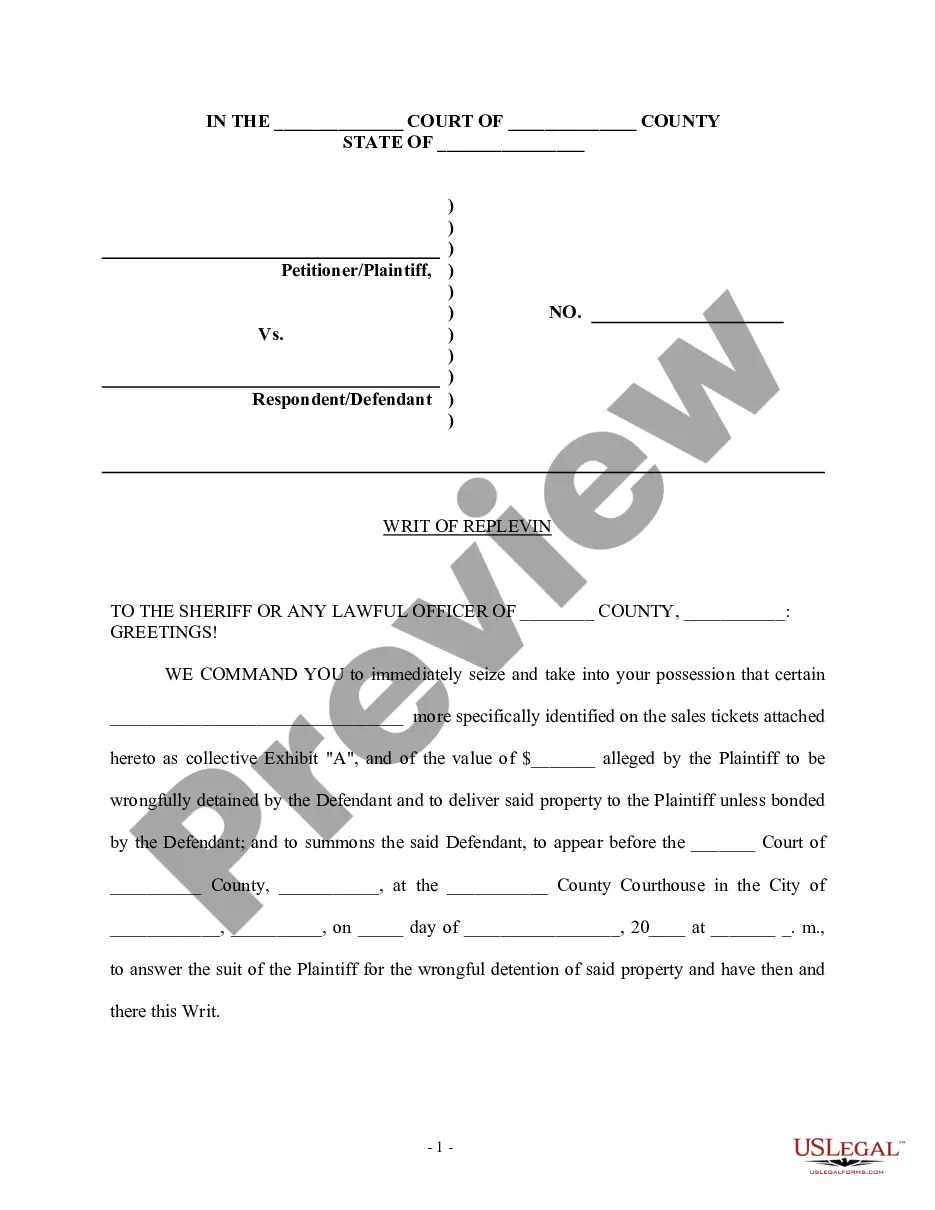
How to fill out Writ Of Replevin Or Repossession?
- Log in to your US Legal Forms account. Ensure your subscription is active to access the necessary document.
- Preview your desired form template. Confirm that it fits your requirements and complies with your local jurisdiction before proceeding.
- Utilize the search function if you need different templates. Finding the correct form is crucial for accuracy.
- Purchase the document by selecting the 'Buy Now' option and choosing a subscription plan that suits your needs. Create an account to unlock full access.
- Complete your transaction using your credit card details or PayPal for a seamless purchase process.
- Download your selected form. Save it on your device to complete it later or access it anytime from the 'My Forms' section in your account.
With these straightforward steps, you can take advantage of US Legal Forms' extensive library, which offers over 85,000 fillable and editable legal documents. It empowers you and your legal practice to ensure that every form is executed with precision.
Start your journey now with US Legal Forms and experience the ease of legal documentation at your fingertips!
Form popularity
FAQ
The length of a fight scene can vary widely, generally ranging from one to five pages. Factors that influence this include the complexity of the fight, its importance to the plot, and character development. Focus on keeping the scene concise, ensuring each action serves the story while maintaining reader interest.
Fight scenes can be challenging because they require a balance of action, emotion, and clarity. Writers must depict not only the physical movements but also the psychological stakes involved. Crafting a fight scene effectively demands skill in maintaining tension and ensuring that the scene aligns with character development.
Writing better fight scenes involves clear choreography and pacing. Describe the action vividly, focusing on the physical movements and the impact of each blow. Additionally, using varied sentence structures and a fast pace can create a sense of urgency that pulls your readers into the moment.
To write a realistic fight, focus on the motivations and emotions of the characters involved. Consider their physical abilities, backgrounds, and the environment where the fight occurs. Authenticity in writing fight scenes helps enhance reader engagement, making it vital to depict believable circumstances and interactions.
Improving your skills in writing fight scenes requires practice and observation. Start by studying well-crafted fight sequences in books, movies, and plays. Note how tension builds and how characters react during conflict. You can also use the US Legal Forms platform for resources that help structure your scenes effectively.
Writing fight scenes in a light novel requires capturing the blend of action and narrative. Focus on character dynamics and utilize quick, impactful dialogue to convey tension and urgency. Given the illustrative nature of light novels, consider how visual elements can complement your writing fight. This combination will engage readers and enrich their experience throughout the story.
To write combat in a novel effectively, it is vital to establish stakes from the beginning. Build up the lead-up to the combat, ensuring characters have clear motivations that drive their actions. Use concise descriptions to keep the pace quick, while also integrating character emotions for depth. This balance will create a compelling fight that resonates with readers, enhancing their connection to the narrative.
Describing a fighting scene in a novel involves a careful balance between action and emotion. Use strong verbs to depict movements, while also capturing the internal conflicts of the characters involved. Highlight sensory details like sounds and sights to make the scene more immersive. A well-described fighting scene can enhance your story's tension and keep readers on the edge of their seats.
To express fighting in writing, focus on the emotions and motivations behind each character's actions. Convey their thoughts as they engage in combat to add layers of complexity to the scene. Use vivid imagery to immerse readers in the physicality of the fight, giving them a sense of immediacy. This approach will ensure your writing fight is both engaging and descriptive.
Writing a fight sequence requires strategic organization to maintain clarity and momentum. Start by identifying the purpose of the fight within your story, then break it down into manageable parts: setup, action, and resolution. As you write, vary the pace to create suspense, and focus on character interactions to deepen the reader's connection. Ultimately, ensure that the sequence aligns with your overall narrative flow.