Writ Of Execution For Eviction
Description




Get your form ready online
Our built-in tools help you complete, sign, share, and store your documents in one place.
Make edits, fill in missing information, and update formatting in US Legal Forms—just like you would in MS Word.
Download a copy, print it, send it by email, or mail it via USPS—whatever works best for your next step.
Sign and collect signatures with our SignNow integration. Send to multiple recipients, set reminders, and more. Go Premium to unlock E-Sign.
If this form requires notarization, complete it online through a secure video call—no need to meet a notary in person or wait for an appointment.
We protect your documents and personal data by following strict security and privacy standards.

Make edits, fill in missing information, and update formatting in US Legal Forms—just like you would in MS Word.

Download a copy, print it, send it by email, or mail it via USPS—whatever works best for your next step.

Sign and collect signatures with our SignNow integration. Send to multiple recipients, set reminders, and more. Go Premium to unlock E-Sign.

If this form requires notarization, complete it online through a secure video call—no need to meet a notary in person or wait for an appointment.

We protect your documents and personal data by following strict security and privacy standards.
Looking for another form?



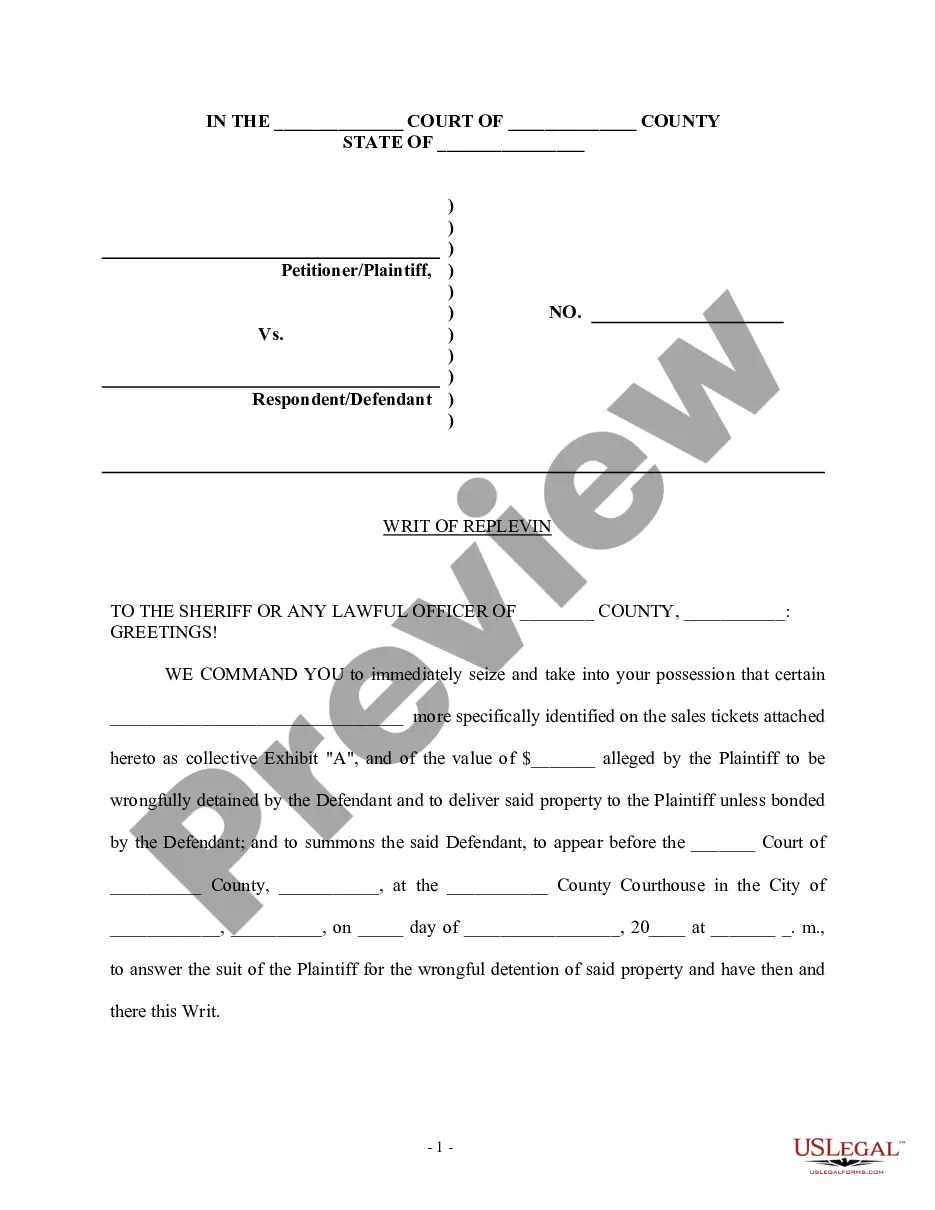
How to fill out Writ Of Replevin Or Repossession?
Finding a primary source for obtaining the latest and pertinent legal documents is a significant part of navigating bureaucracy.
Identifying the correct legal paperwork requires precision and carefulness, which is why it's crucial to acquire Writ Of Execution For Eviction samples solely from trustworthy providers, such as US Legal Forms.
Eliminate the stress associated with your legal paperwork. Explore the comprehensive US Legal Forms catalog to locate legal templates, assess their suitability for your situation, and download them right away.
- Utilize the catalog navigation or search feature to find your document.
- Review the form’s description to verify its compliance with your state and county requirements.
- Examine the form preview, if available, to ensure it is indeed the document you need.
- Return to the search and locate the appropriate document if the Writ Of Execution For Eviction does not fulfill your criteria.
- If you are confident in the form’s relevance, proceed to download it.
- As an authorized user, click Log in to verify your identity and access your selected forms in My documents.
- If you have yet to create an account, click Buy now to obtain the form.
- Select the pricing option that suits your needs.
- Continue with the registration process to complete your purchase.
- Complete your transaction by choosing a payment method (credit card or PayPal).
- Choose the file format for downloading the Writ Of Execution For Eviction.
- Once you have the document on your device, you can modify it using the editor or print it out to fill in by hand.
Form popularity
FAQ
The purpose of a writ of execution for eviction is to legally authorize the removal of a tenant from a property. It grants landlords the right to take back possession of their property when tenants fail to comply with eviction orders. This legal tool ensures that the eviction process follows due course and protects the rights of landlords. Familiarizing yourself with this process can empower you to make informed decisions.
Yes, in North Carolina, you might be able to stop an eviction by paying any outstanding rent or fees before the eviction process goes into effect. Paying what is owed can lead to a resolution with your landlord, allowing you to stay in your home. However, this option is less viable after a writ of execution for eviction is in place. Understanding your rights and communicating with your landlord can be beneficial.
Once a writ of possession is executed, stopping the eviction process becomes quite difficult. That said, there may still be avenues to explore, such as negotiating with your landlord or filing an appeal. It’s crucial to act quickly and seek guidance on your legal rights and options. Resources like our platform, US Legal Forms, can help you navigate this complex situation.
In North Carolina, once a writ of possession is issued, the landlord can request law enforcement to oversee the eviction. You will be given a notice period to vacate the property, usually within a week. If you remain on the premises after this period, legal authorities may physically remove you. Understanding this process can help you prepare and possibly seek assistance to resolve the situation.
Stopping an eviction after a writ of execution for eviction can be challenging but not impossible. Typically, once the court issues the writ, the eviction process moves forward swiftly. However, you may have options like filing for a stay of execution or appealing the court's decision. Consulting with a legal professional can provide clarity on your specific situation.
Yes, you can appeal a writ of execution, but the process can be complex. Typically, you must demonstrate valid legal grounds for the appeal, which can include procedural errors or issues with the original judgment. It is advisable to consult with a legal expert to guide you through the appeals process. Understanding how writ of execution for eviction impacts your case can help you make informed decisions.
You may stop a writ of execution in Texas by filing a motion to quash the writ or seeking a stay. Engaging an attorney can provide guidance on the best approach to take based on your situation. Providing adequate reasoning or evidence can help convince the court to halt the execution process. Using platforms like US Legal Forms can assist in understanding how to navigate this legal challenge.
You can challenge an eviction notice in New York by filing a defense in housing court. Common defenses might include a lack of proper notice or expired lease terms. It's crucial to gather evidence and build your case to present in court. Understanding the legal landscape surrounding eviction and writ of execution for eviction is beneficial in defending your case.
Once a writ of execution is served in Texas, law enforcement can proceed with the eviction process. The tenant receives an official notification and must vacate the property by a specified date. Failure to leave may result in immediate removal by law enforcement. This can be a daunting process, so having resources like US Legal Forms can help you navigate your options effectively.
After a writ of possession is granted in Texas, the sheriff or constable can schedule a date to enforce the eviction. The landlord can take possession of the property after the tenant is lawfully removed. Tenants are usually given a brief period to gather their belongings before the eviction occurs. Understanding the timeline of what comes next is important when facing a writ of execution for eviction.