Writ State Garnishment Withholding
Description
Get your form ready online
Our built-in tools help you complete, sign, share, and store your documents in one place.
Make edits, fill in missing information, and update formatting in US Legal Forms—just like you would in MS Word.
Download a copy, print it, send it by email, or mail it via USPS—whatever works best for your next step.
Sign and collect signatures with our SignNow integration. Send to multiple recipients, set reminders, and more. Go Premium to unlock E-Sign.
If this form requires notarization, complete it online through a secure video call—no need to meet a notary in person or wait for an appointment.
We protect your documents and personal data by following strict security and privacy standards.

Make edits, fill in missing information, and update formatting in US Legal Forms—just like you would in MS Word.

Download a copy, print it, send it by email, or mail it via USPS—whatever works best for your next step.

Sign and collect signatures with our SignNow integration. Send to multiple recipients, set reminders, and more. Go Premium to unlock E-Sign.

If this form requires notarization, complete it online through a secure video call—no need to meet a notary in person or wait for an appointment.

We protect your documents and personal data by following strict security and privacy standards.
Looking for another form?

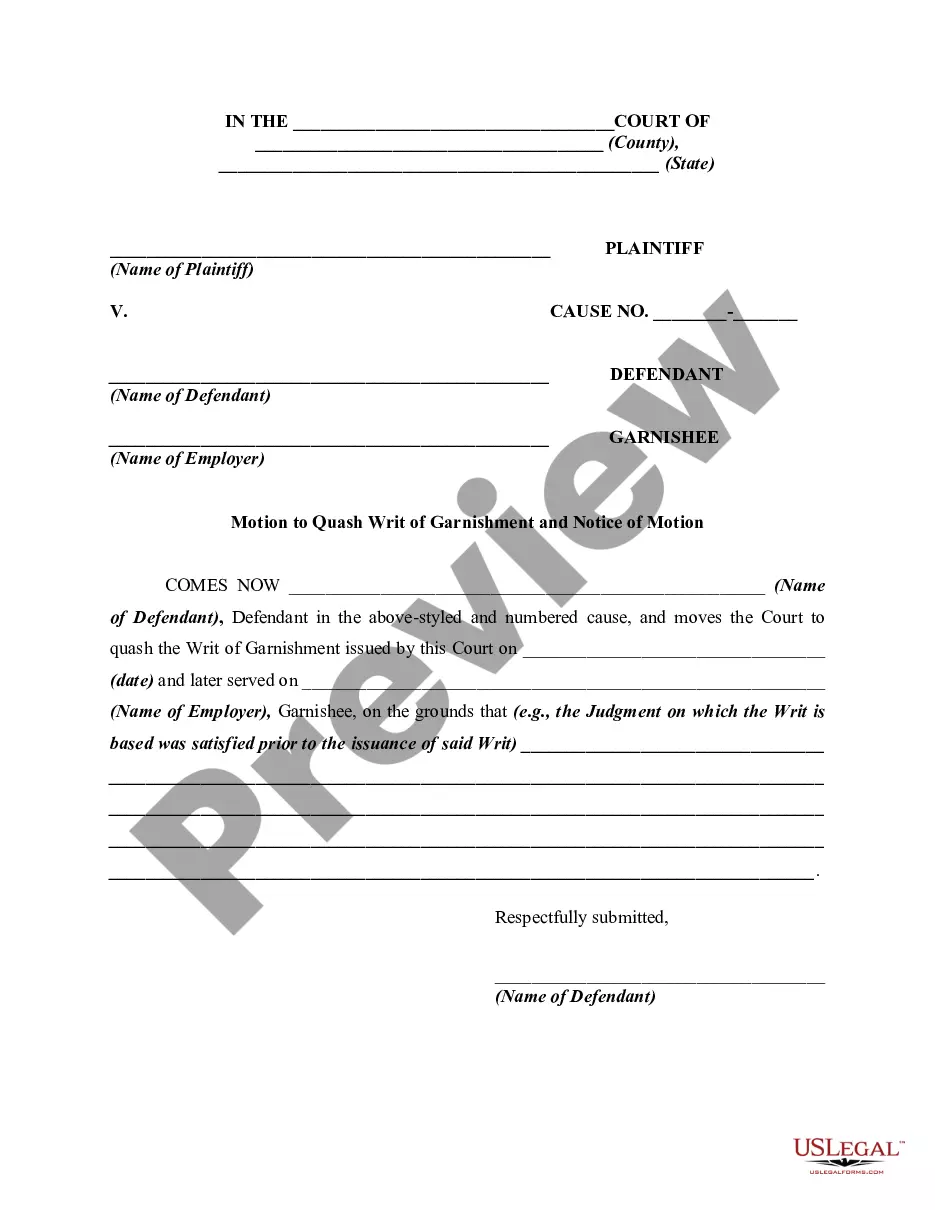
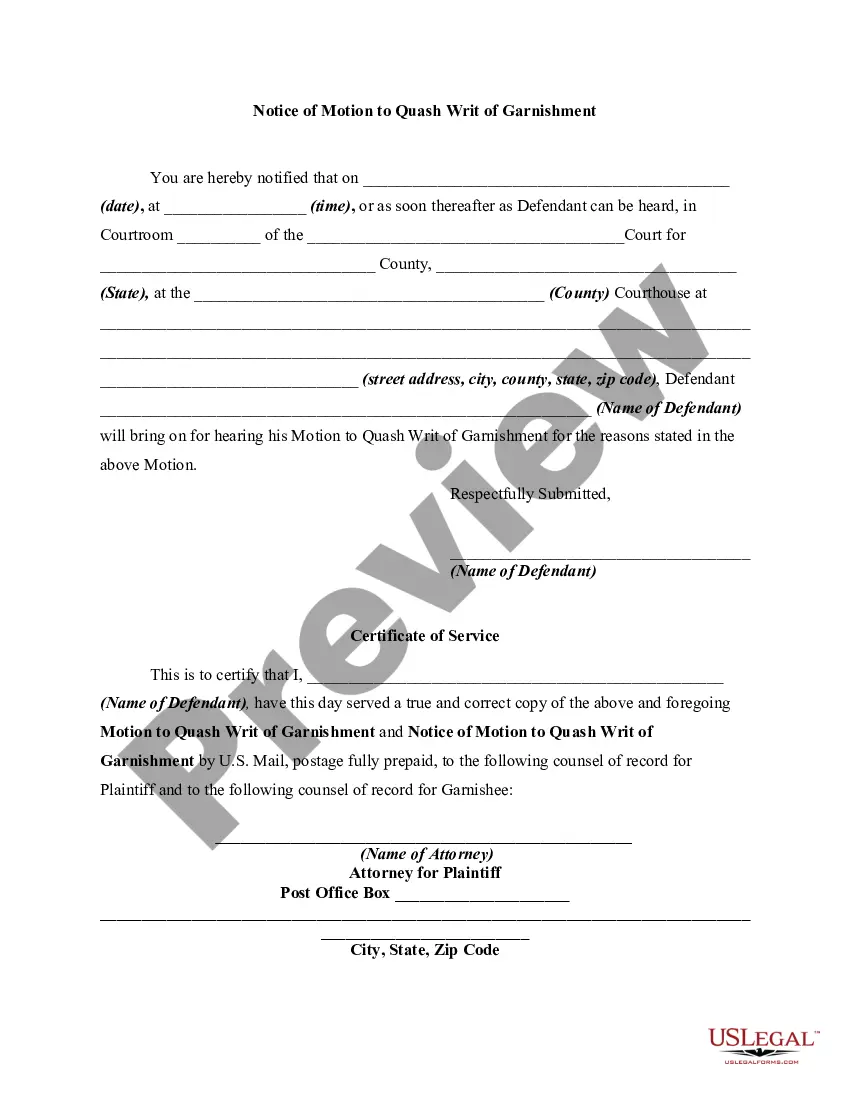
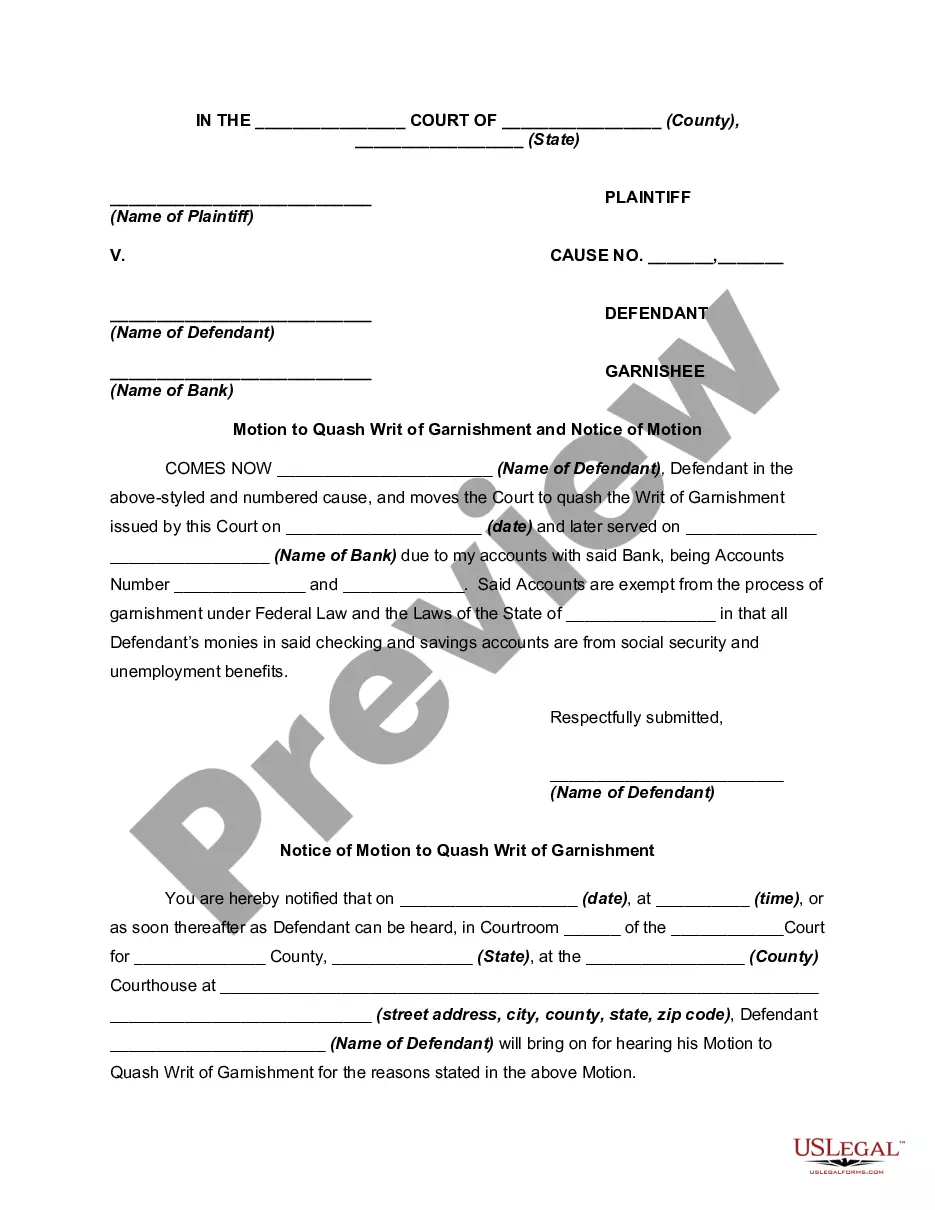
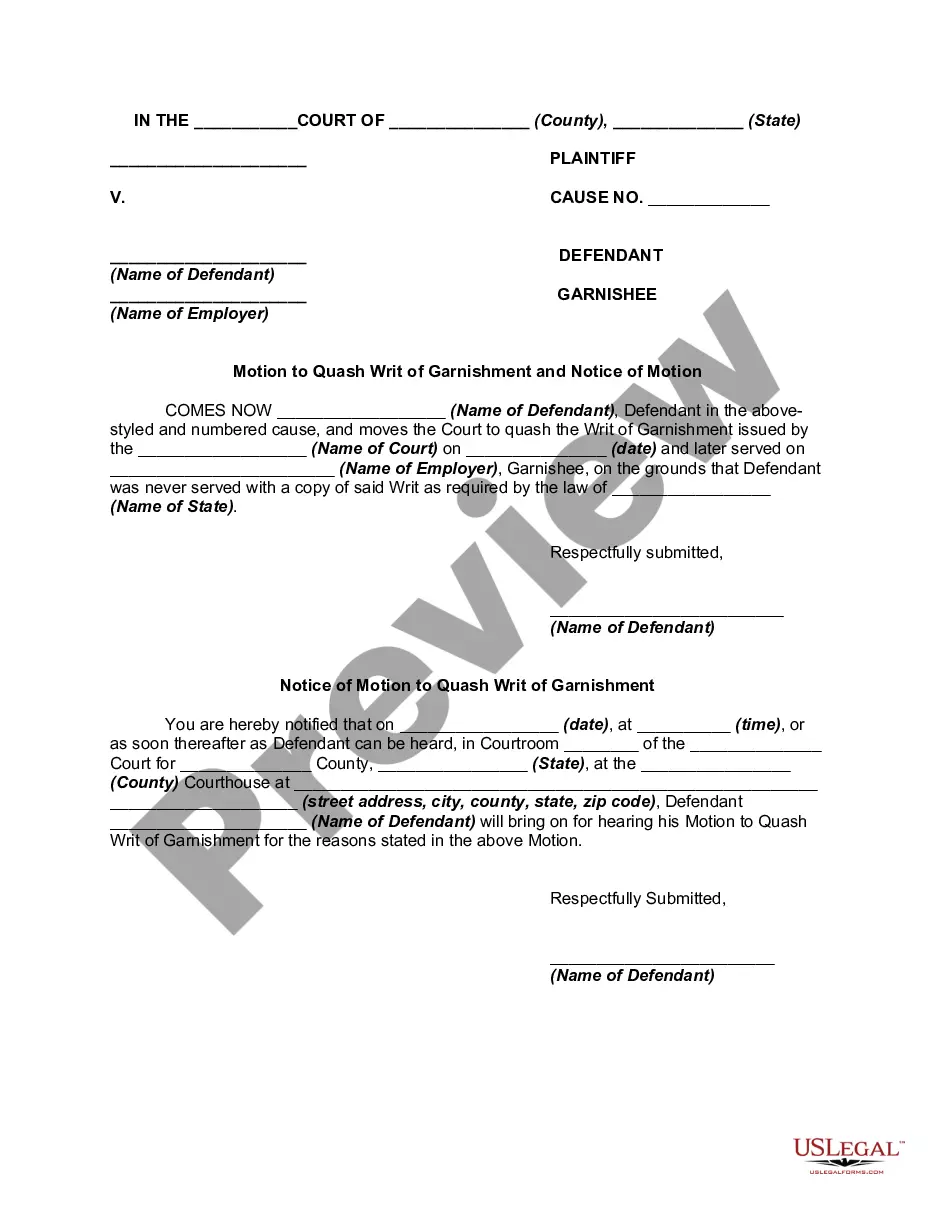
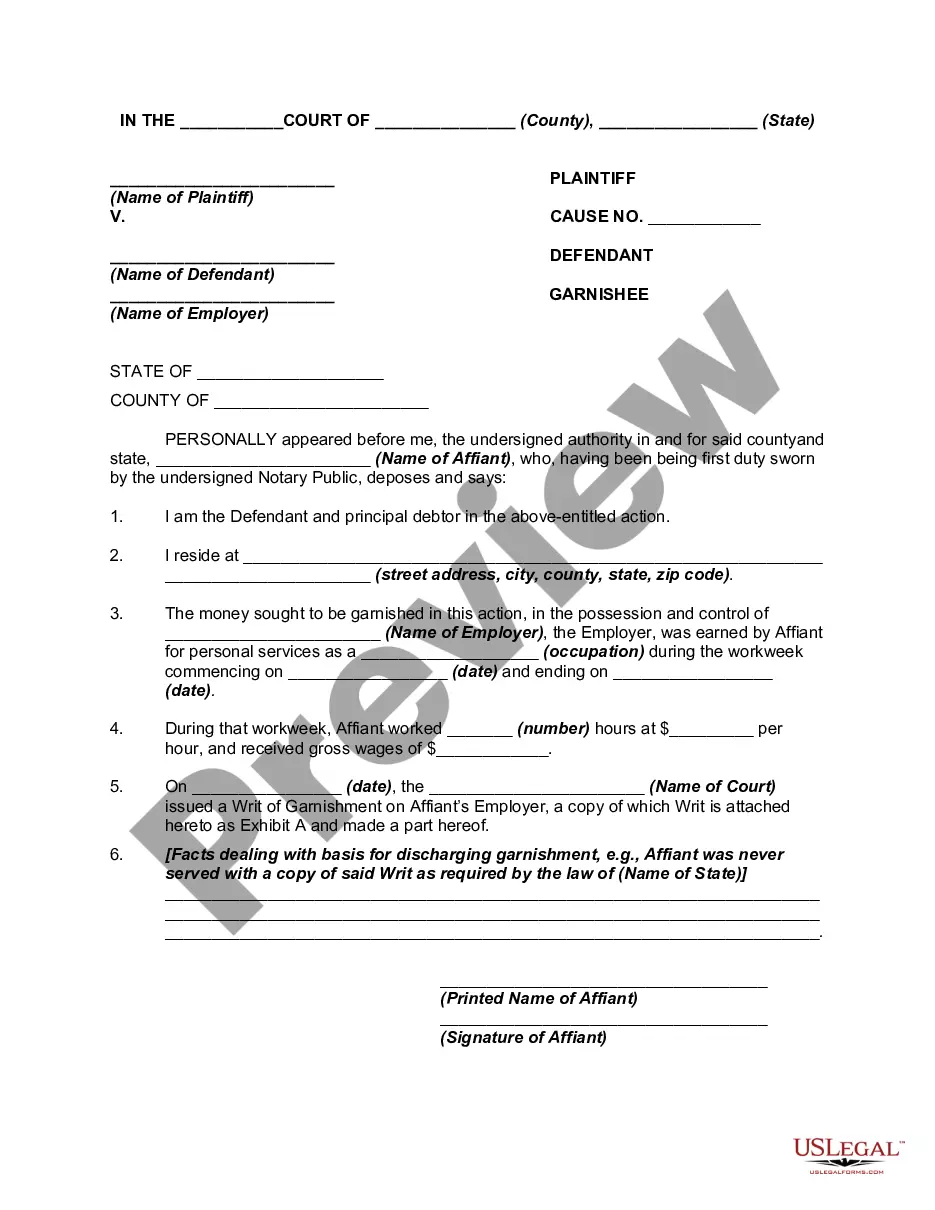
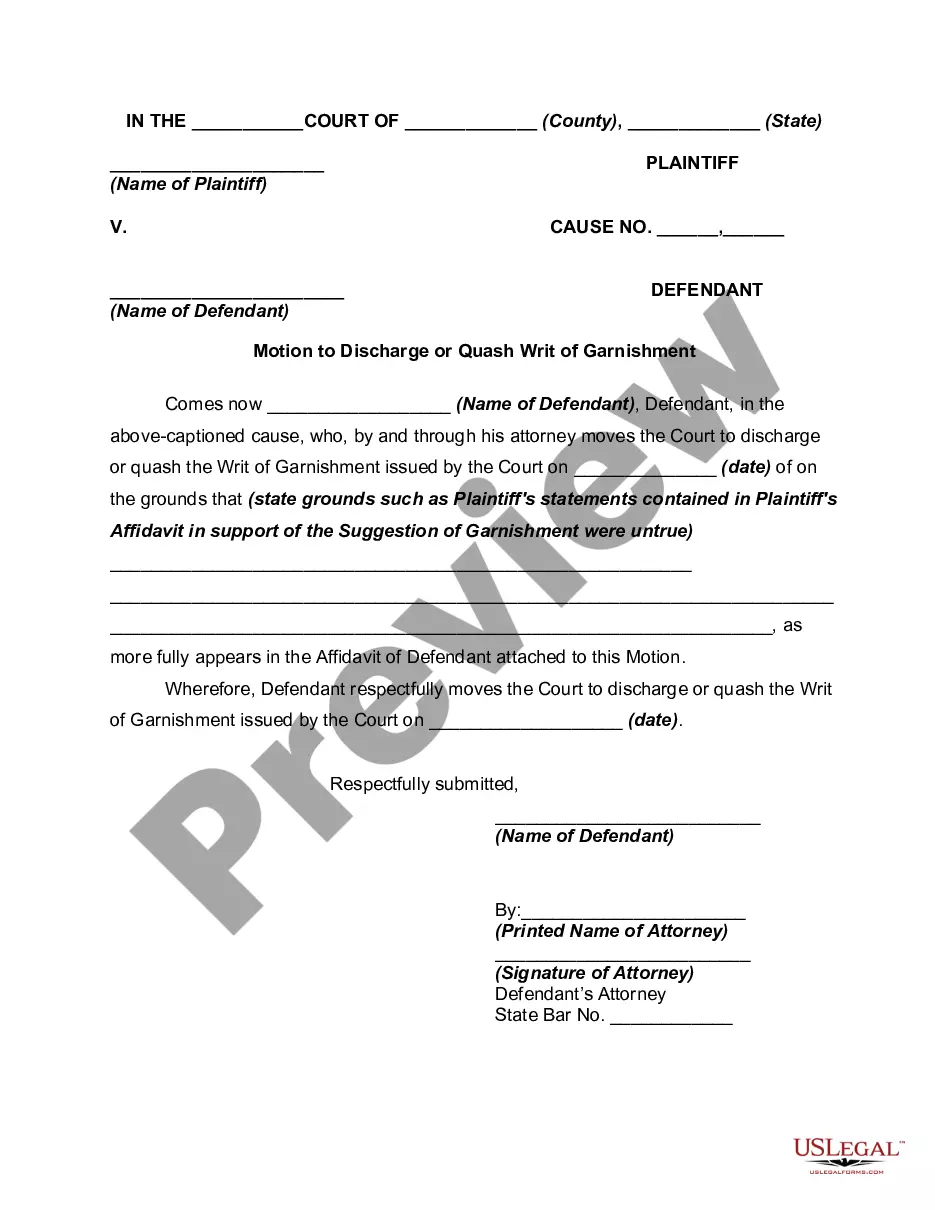
How to fill out Motion Of Defendant To Discharge Or Quash Writ Of Garnishment And Notice Of Motion?
Finding a reliable source to obtain the most up-to-date and suitable legal templates is a significant part of dealing with bureaucracy.
Identifying the correct legal documents requires accuracy and carefulness, which is why it’s crucial to obtain samples of Writ State Garnishment Withholding solely from trustworthy providers, such as US Legal Forms. An incorrect template can drain your time and stall your current situation. With US Legal Forms, you have minimal concerns. You can access and review all the details about the document’s applicability and significance for your circumstances and within your state or county.
Eliminate the frustration associated with your legal documents. Explore the extensive US Legal Forms catalog to discover legal templates, assess their applicability to your situation, and download them instantly.
- Utilize the catalog navigation or search box to locate your template.
- Examine the form’s details to ensure it meets the criteria of your state and region.
- View the form preview, if available, to confirm that the template is what you require.
- Continue searching and find the appropriate template if the Writ State Garnishment Withholding does not fulfill your needs.
- When you are certain about the form’s applicability, download it.
- If you are a registered user, click Log in to verify your identity and access your chosen forms in My documents.
- If you do not have an account yet, click Buy now to purchase the template.
- Select the pricing plan that best fits your requirements.
- Proceed to the registration process to finalize your purchase.
- Complete your transaction by selecting a payment method (credit card or PayPal).
- Choose the file format for downloading Writ State Garnishment Withholding.
- After you have the form on your device, you can modify it using the editor or print it out and fill it in by hand.
Form popularity
FAQ
An earnings withholding order is a court-ordered legal document. It requires an employer to withhold up to 25 percent of an employee's wages. This money is paid to a creditor until the employee pays off their debt.
Ordinary garnishments Under Title III, the amount that an employer may garnish from an employee in any workweek or pay period is the lesser of: 25% of disposable earnings -or- The amount by which disposable earnings are 30 times greater than the federal minimum wage.
You may request an exemption to the garnishment. You must make your request within 30 days of when the garnishment was served on the bank. Use the form Motion for Release of Property from Levy/Garnishment (DC-CV-036).
?The writ shall require the garnishee to serve an answer on the plaintiff within 20 days after service of the writ stating whether the garnishee is indebted to the defendant at the time of the answer, or was indebted at the time of service of the writ, plus up to 1 business day for the garnishee to act expeditiously on ...
Because the FTB is not classified as a creditor under federal law, it does not have the authority to directly levy taxpayer income from social security disability. However, the FTB may utilize other levies to collect an outstanding tax debt, including levies on personal bank accounts.