Corporate Dividend Policy For Banks
Description
Get your form ready online
Our built-in tools help you complete, sign, share, and store your documents in one place.
Make edits, fill in missing information, and update formatting in US Legal Forms—just like you would in MS Word.
Download a copy, print it, send it by email, or mail it via USPS—whatever works best for your next step.
Sign and collect signatures with our SignNow integration. Send to multiple recipients, set reminders, and more. Go Premium to unlock E-Sign.
If this form requires notarization, complete it online through a secure video call—no need to meet a notary in person or wait for an appointment.
We protect your documents and personal data by following strict security and privacy standards.

Make edits, fill in missing information, and update formatting in US Legal Forms—just like you would in MS Word.

Download a copy, print it, send it by email, or mail it via USPS—whatever works best for your next step.

Sign and collect signatures with our SignNow integration. Send to multiple recipients, set reminders, and more. Go Premium to unlock E-Sign.

If this form requires notarization, complete it online through a secure video call—no need to meet a notary in person or wait for an appointment.

We protect your documents and personal data by following strict security and privacy standards.
Looking for another form?



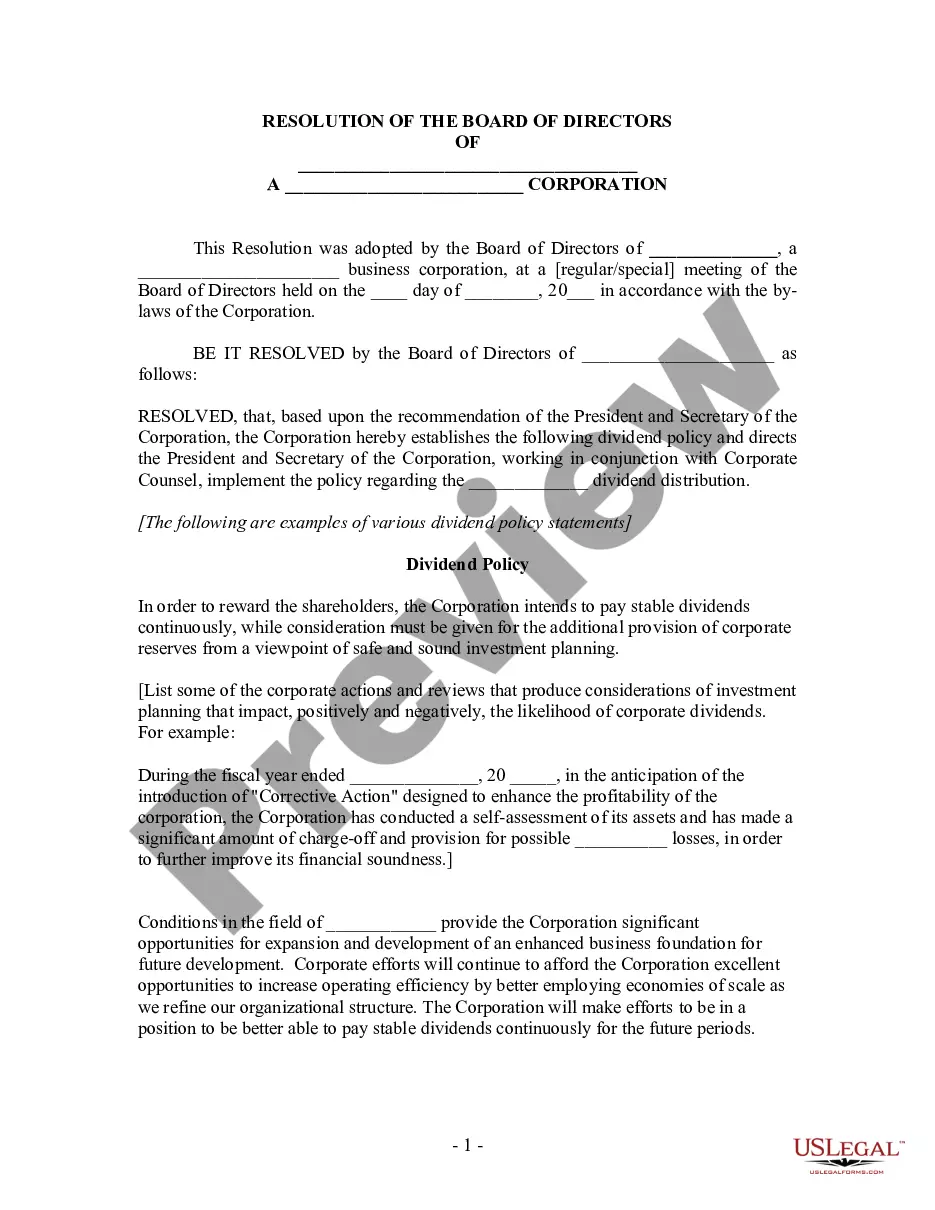
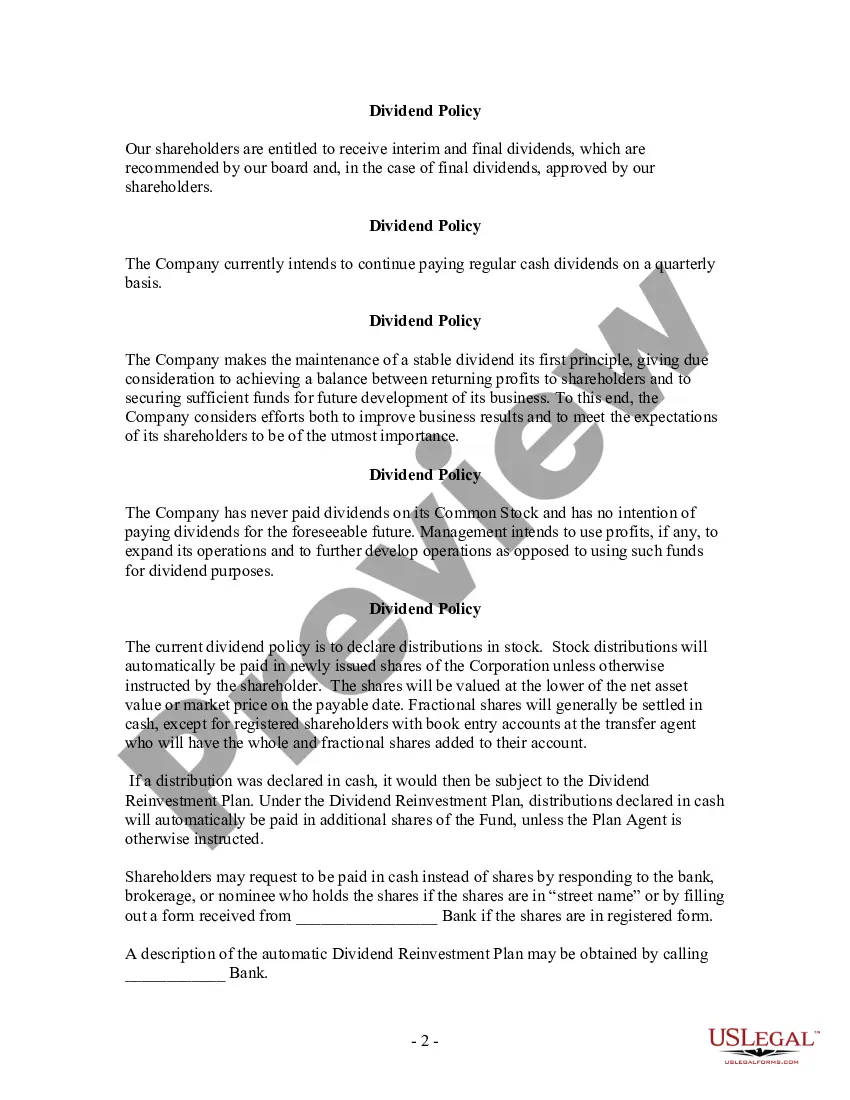
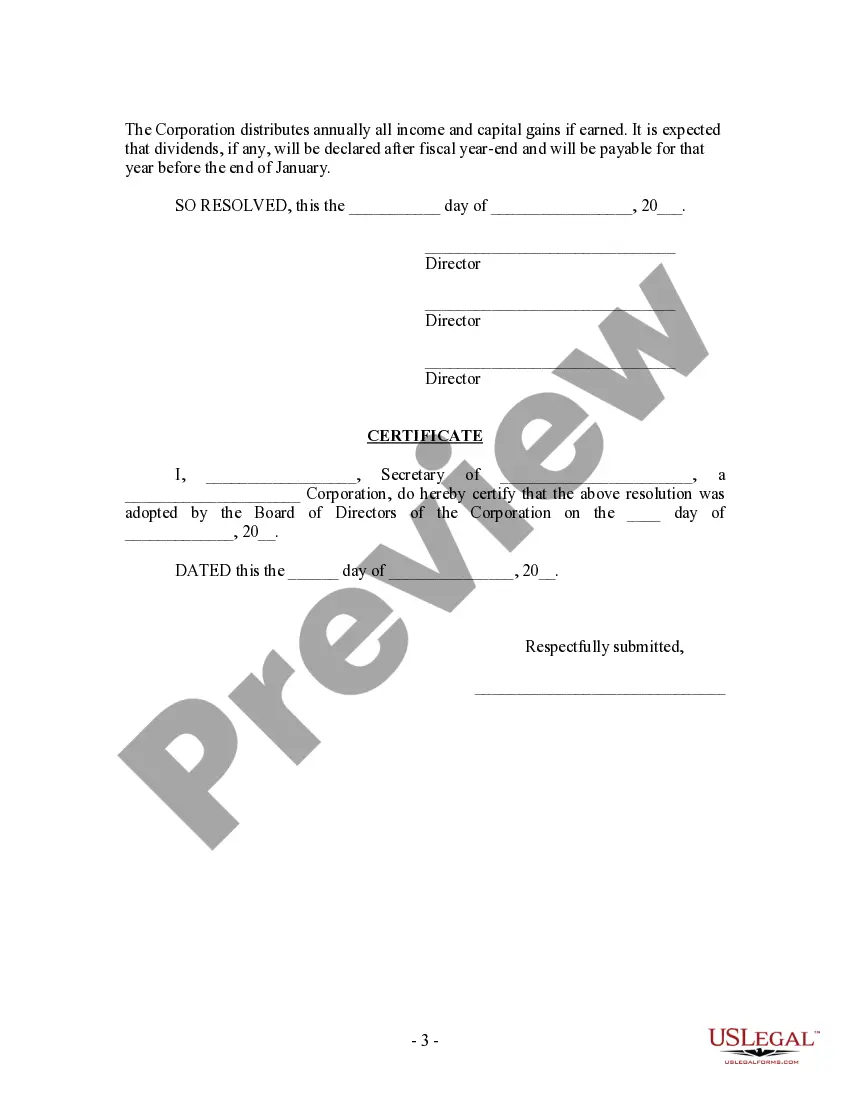
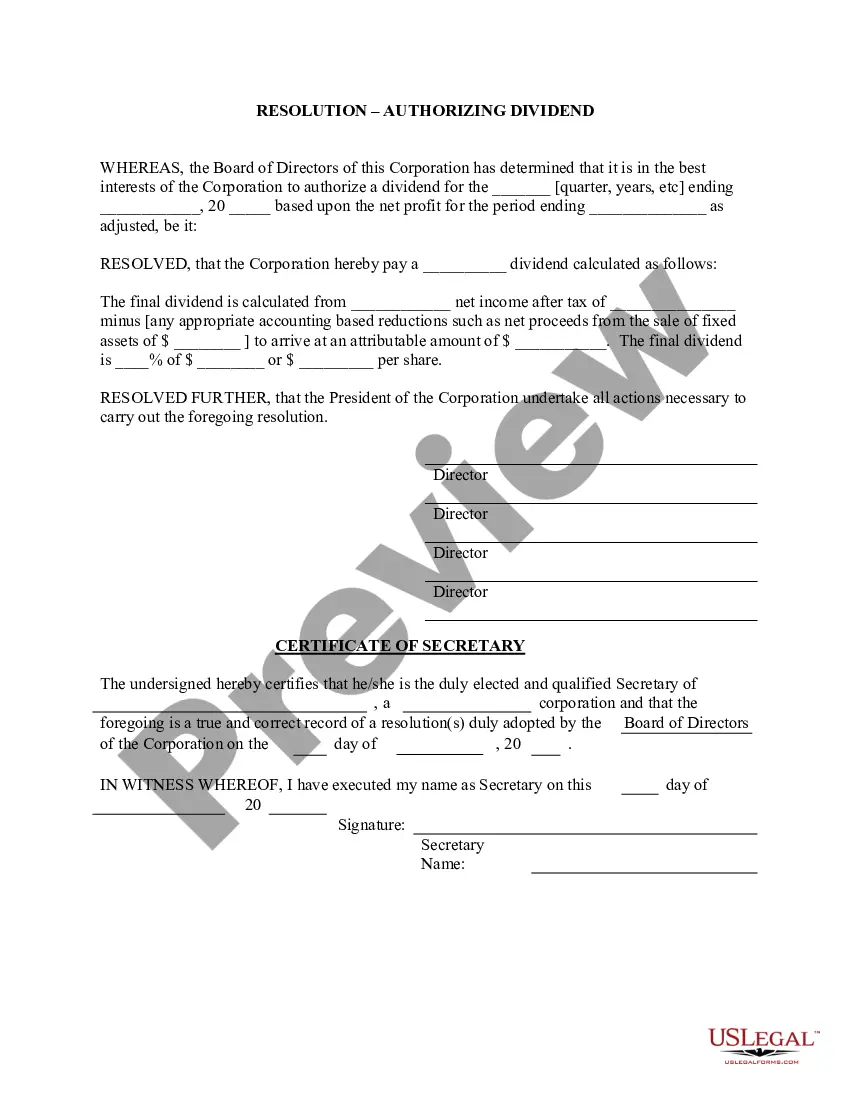
How to fill out Dividend Policy - Resolution Form - Corporate Resolutions?
Dealing with legal paperwork and procedures could be a time-consuming addition to your entire day. Corporate Dividend Policy For Banks and forms like it often require you to look for them and navigate the way to complete them correctly. As a result, if you are taking care of financial, legal, or personal matters, using a thorough and practical online library of forms close at hand will greatly assist.
US Legal Forms is the top online platform of legal templates, offering over 85,000 state-specific forms and a variety of tools to help you complete your paperwork quickly. Explore the library of pertinent documents available with just one click.
US Legal Forms gives you state- and county-specific forms available at any time for downloading. Protect your papers administration processes by using a top-notch support that allows you to put together any form within a few minutes without extra or hidden cost. Just log in to the account, identify Corporate Dividend Policy For Banks and acquire it immediately in the My Forms tab. You can also access formerly saved forms.
Is it your first time using US Legal Forms? Register and set up up an account in a few minutes and you’ll have access to the form library and Corporate Dividend Policy For Banks. Then, stick to the steps listed below to complete your form:
- Make sure you have discovered the correct form by using the Preview feature and looking at the form description.
- Select Buy Now when ready, and choose the subscription plan that fits your needs.
- Select Download then complete, sign, and print out the form.
US Legal Forms has twenty five years of expertise assisting consumers deal with their legal paperwork. Obtain the form you want today and improve any operation without having to break a sweat.
Form popularity
FAQ
Under the constant dividend policy, a company pays a percentage of its earnings as dividends every year. In this way, investors experience the full volatility of company earnings. If earnings are up, investors get a larger dividend and if earnings are down, investors may not receive a dividend.
2. Stable dividend policy. Under the stable dividend policy, the percentage of profits paid out as dividends is fixed. For example, if a company sets the payout rate at 6%, it is the percentage of profits that will be paid out regardless of the amount of profits earned for the financial year.
Dividend of 20% of its equity (i.e. paid up capital) or 20% of its post ?tax profits, whichever is higher. In case, Bank decides to pay interim dividend, the total dividend to be paid by the bank based on the annual results should be as per the guidelines.
Developing a dividend policy requires balancing the interests of shareholders, who want to maximize their investment returns, with those of the company itself, which must remain solvent while also ensuring its future financial success and growth.
For all other accounts, dividends are calculated by the Average Daily Balance method, in which dividends are calculated by applying a periodic rate to the average daily balance in the account for the dividend period.