Rescission Vs Rescind
Description
Get your form ready online
Our built-in tools help you complete, sign, share, and store your documents in one place.
Make edits, fill in missing information, and update formatting in US Legal Forms—just like you would in MS Word.
Download a copy, print it, send it by email, or mail it via USPS—whatever works best for your next step.
Sign and collect signatures with our SignNow integration. Send to multiple recipients, set reminders, and more. Go Premium to unlock E-Sign.
If this form requires notarization, complete it online through a secure video call—no need to meet a notary in person or wait for an appointment.
We protect your documents and personal data by following strict security and privacy standards.

Make edits, fill in missing information, and update formatting in US Legal Forms—just like you would in MS Word.

Download a copy, print it, send it by email, or mail it via USPS—whatever works best for your next step.

Sign and collect signatures with our SignNow integration. Send to multiple recipients, set reminders, and more. Go Premium to unlock E-Sign.

If this form requires notarization, complete it online through a secure video call—no need to meet a notary in person or wait for an appointment.

We protect your documents and personal data by following strict security and privacy standards.
Looking for another form?
How to fill out Notice Of Rescission Of Release?
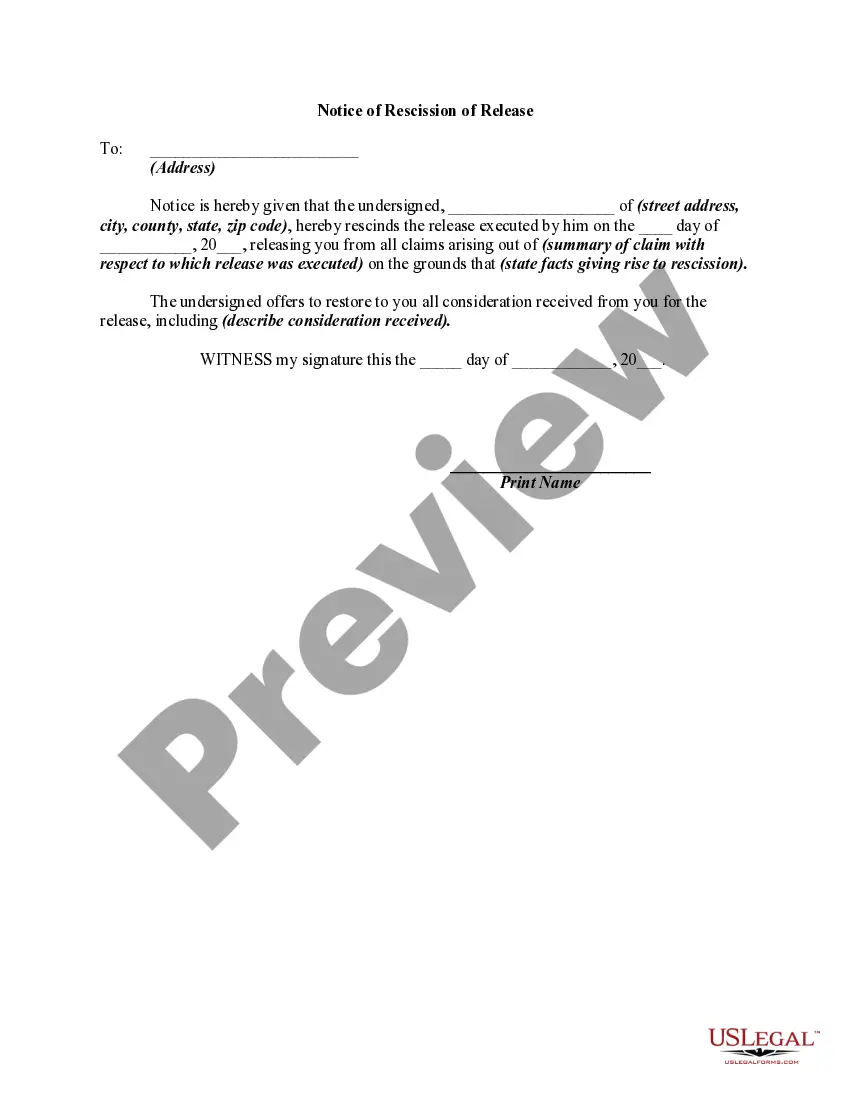
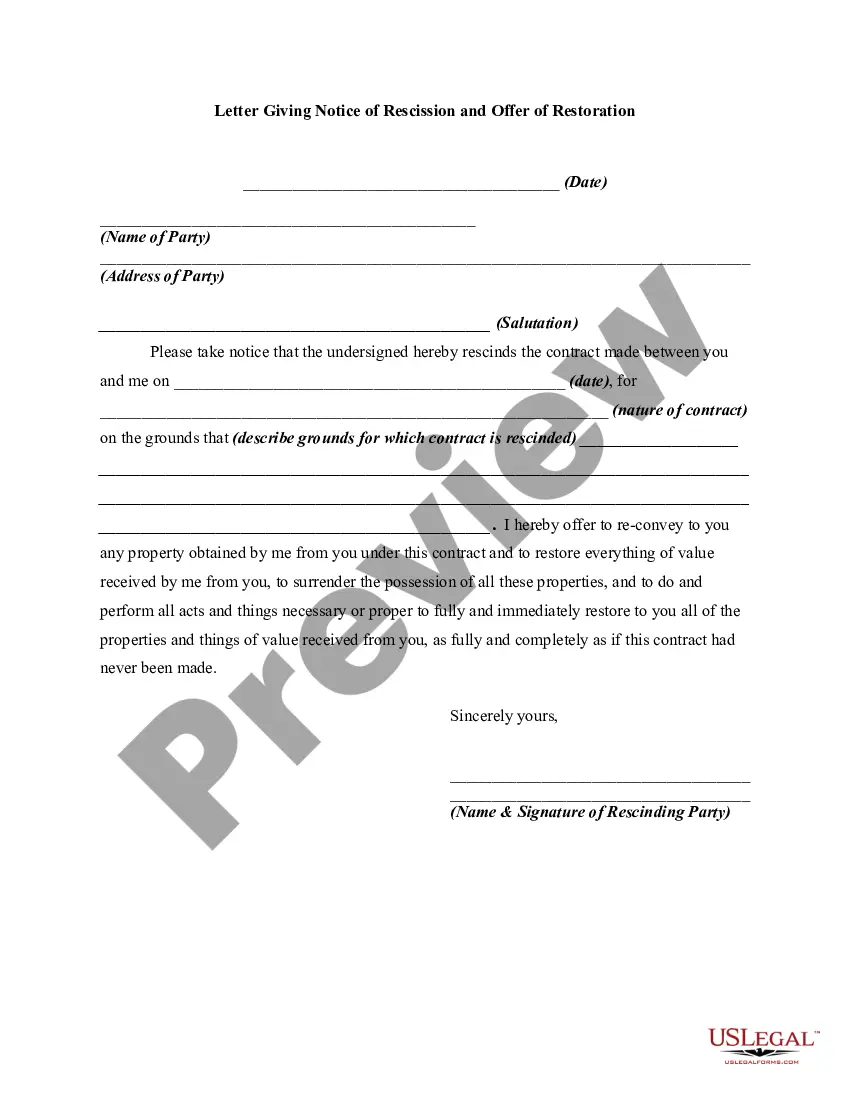
The Cancellation Vs Revoke you observe on this page is an adaptable legal template formulated by experienced attorneys in accordance with national and local laws.
For over 25 years, US Legal Forms has furnished individuals, entities, and legal practitioners with more than 85,000 authenticated, state-specific forms for any business and personal situation. It’s the fastest, most straightforward, and most dependable method to acquire the documents you require, as the service ensures bank-level data protection and anti-malware security.
Register for US Legal Forms to have authenticated legal templates for all of life’s circumstances at your fingertips.
- Examine the document you require and verify it.
- Review the sample you searched and preview it or read the form description to confirm it meets your needs. If it doesn’t, utilize the search tool to discover the suitable one. Click Buy Now when you have located the template you require.
- Register and Log In.
- Choose the pricing plan that accommodates you and sign up for an account. Use PayPal or a credit card to make a swift payment. If you already hold an account, Log In and verify your subscription to proceed.
- Acquire the editable template.
- Select the format you desire for your Cancellation Vs Revoke (PDF, Word, RTF) and save the sample to your device.
- Complete and sign the document.
- Print the template to fill it out manually. Alternatively, make use of an online multi-functional PDF editor to quickly and accurately fill out and sign your form with a valid signature.
- Download your documents one more time.
- Utilize the same document again whenever necessary. Access the My documents tab in your profile to redownload any previously downloaded forms.
Form popularity
FAQ
A classic example of rescission involves a seller who misrepresents the value of a property. If the buyer discovers this deception, they can rescind the contract and reclaim any deposits made. This situation exemplifies the significant difference between rescission vs rescind, highlighting how one leads the other. USLegalForms provides templates and guidance that can help you navigate such scenarios effectively.
The term 'rescind' is spelled R-E-S-C-I-N-D. It is a verb that means to revoke, cancel, or invalidate a contract or agreement. Knowing the correct spelling of this term is crucial for legal documents. When exploring rescission vs rescind, proper terminology can significantly impact your legal outcomes.
Rescission of a contract occurs under specific conditions. Common grounds include fraud, misrepresentation, undue influence, or mutual mistake. When a party feels wronged, they may seek to rescind the contract to restore themselves to the state before the agreement. Understanding rescission vs rescind helps clarify your rights and responsibilities in these situations.
In essence, rescission does mean cancellation, but with a specific nuance. Rescission entails annulling a contract, often due to misrepresentation or fraud, while cancellation generally indicates halting the contract’s effect moving forward. Thus, while they both lead to the ending of agreements, the context and circumstances may vary significantly.
Another example of a rescission could involve a situation where a consumer buys a car based on fraudulent information about its history. If the truth comes out, the consumer can seek to rescind the contract, allowing them to return the vehicle and receive a refund. Such examples illustrate how rescission serves to protect consumers and uphold justice.
The difference between rescission and cancellation lies in their implications for the parties involved. Rescission effectively voids the contract, treating it as if it never existed, while cancellation terminates the contract moving forward but acknowledges its previous existence. Recognizing this difference can guide how you address disputes or contractual issues.
Yes, rescission is indeed the noun form of the verb rescind. When you rescind a contract, you are enacting rescission. This relationship emphasizes the importance of understanding both terms, especially when navigating legal discussions or preparing documents related to legal agreements.
Cancellation or rescission of a contract occurs when one or both parties decide to annul the agreement. This legal action can arise from various reasons, such as breach of terms or misunderstandings. Remember that rescission often involves returning parties to their pre-contractual status, whereas cancellation simply ends the contract terms going forward.
Rescind and cancel have different implications in the context of insurance. Rescinding insurance means nullifying the policy from the beginning, often due to misrepresentation by the insured. Canceling insurance, however, involves ending the policy at a specified point in time. Understanding these differences can impact your coverage and rights.
The two types of rescission are mutual rescission and unilateral rescission. Mutual rescission occurs when both parties agree to cancel the contract, while unilateral rescission happens when one party voids the contract due to specific circumstances, like failure to meet terms. Knowing these types helps in choosing the right approach for your situation.