Domicile With Meaning In Minnesota
Description
Get your form ready online
Our built-in tools help you complete, sign, share, and store your documents in one place.
Make edits, fill in missing information, and update formatting in US Legal Forms—just like you would in MS Word.
Download a copy, print it, send it by email, or mail it via USPS—whatever works best for your next step.
Sign and collect signatures with our SignNow integration. Send to multiple recipients, set reminders, and more. Go Premium to unlock E-Sign.
If this form requires notarization, complete it online through a secure video call—no need to meet a notary in person or wait for an appointment.
We protect your documents and personal data by following strict security and privacy standards.

Make edits, fill in missing information, and update formatting in US Legal Forms—just like you would in MS Word.

Download a copy, print it, send it by email, or mail it via USPS—whatever works best for your next step.

Sign and collect signatures with our SignNow integration. Send to multiple recipients, set reminders, and more. Go Premium to unlock E-Sign.

If this form requires notarization, complete it online through a secure video call—no need to meet a notary in person or wait for an appointment.

We protect your documents and personal data by following strict security and privacy standards.
Looking for another form?
Form popularity
FAQ
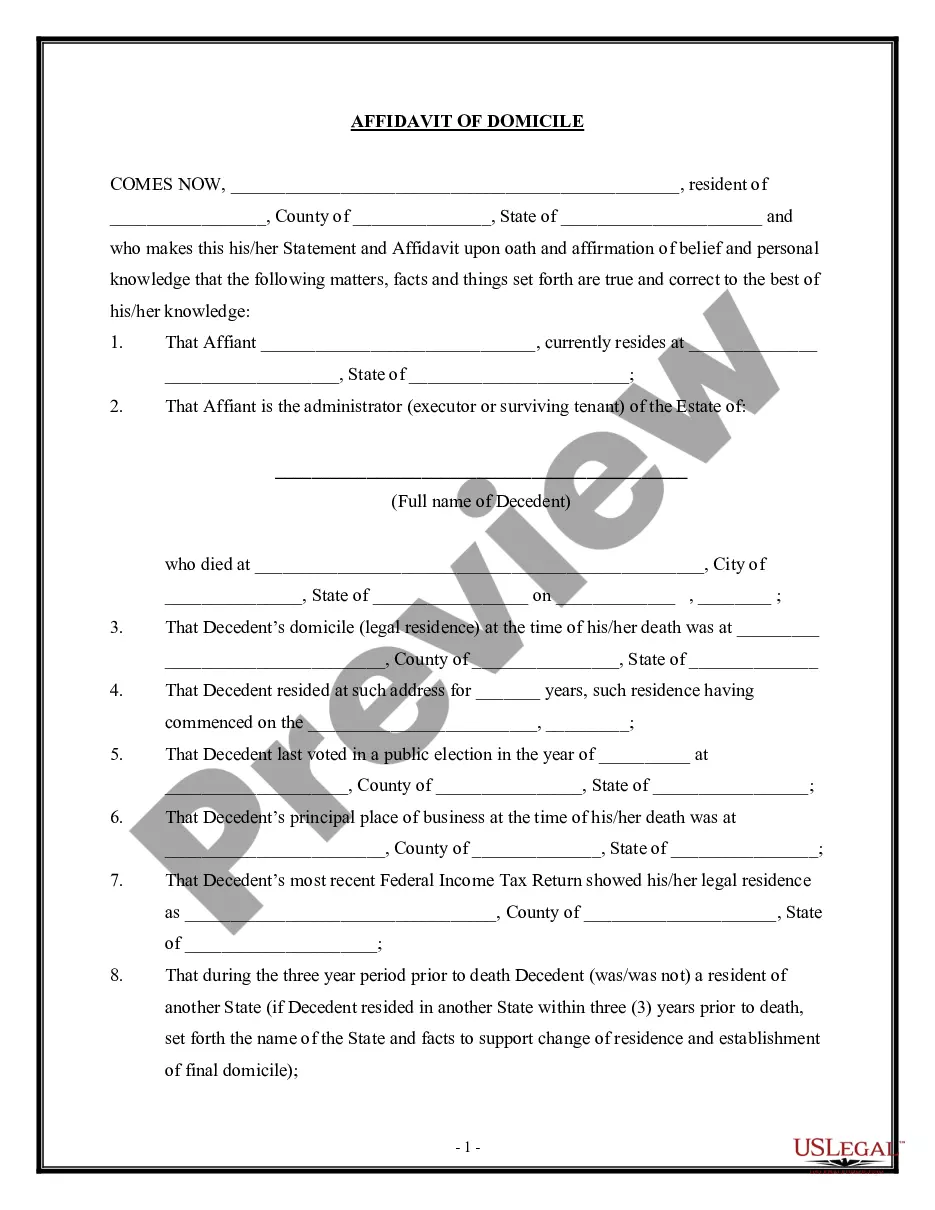
What does domicile mean? Domicile is the place where a sponsor has his or her principal “residence” with the intention to maintain that residence for the foreseeable future.
Domicile is not directly related to an individual's nationality, residence or ethnicity.
A "residence" is a permanent building or part of a building and may include a house, apartment, inium, room in a house, or mobile home. You must have a residence to register vote. A mailing address is location where mail is received. Many in San Miguel County have a separate PO Box from their residence.
A domicile is a very formal/old-fashioned word for home: The structure where one lives. One's address is the index to the location of one's domicile: A description of where it is in terms of community, street name, and street number.
Domicile refers to the place you call home permanently. Your domicile is important for legal purposes such as paying taxes, voting, and claiming benefits. Residence and domicile have different legal definitions and are differentiated primarily by the length of time you plan to live in a specific location.
A person is “domiciled” in Minnesota if they are physically present in the state, and they intend for Minnesota to be their home. Even if you are not physically present in Minnesota for 183 days of the year, you are still a resident of Minnesota if you are found to be domiciled in Minnesota.
Domicile • \DAH-muh-syle\ • noun. 1 : a dwelling place : place of residence : home 2 a : a person's fixed, permanent, and principal home for legal purposes b : the place where a corporation is actually or officially established.
Address printed on card or document). property tax notice for the current year that shows the applicant's principal residential address both on the mailing portion and portion stating what the property is being taxed. Minnesota vehicle certificate of title issued. Filed property deed or title for current resident.
Even if you have established a new domicile in another state, you will be considered a resident of Minnesota if have an abode (home) in Minnesota and you spend more than half the year (183 days or more) in Minnesota.
Valid, unexpired Minnesota ID card. (Current address must be listed). Home utility services bill issued no more than 3 months from date of renewal.

