State Specific Employment Laws Within Hospitality In North Carolina
Description
















Get your form ready online
Our built-in tools help you complete, sign, share, and store your documents in one place.
Make edits, fill in missing information, and update formatting in US Legal Forms—just like you would in MS Word.
Download a copy, print it, send it by email, or mail it via USPS—whatever works best for your next step.
Sign and collect signatures with our SignNow integration. Send to multiple recipients, set reminders, and more. Go Premium to unlock E-Sign.
If this form requires notarization, complete it online through a secure video call—no need to meet a notary in person or wait for an appointment.
We protect your documents and personal data by following strict security and privacy standards.
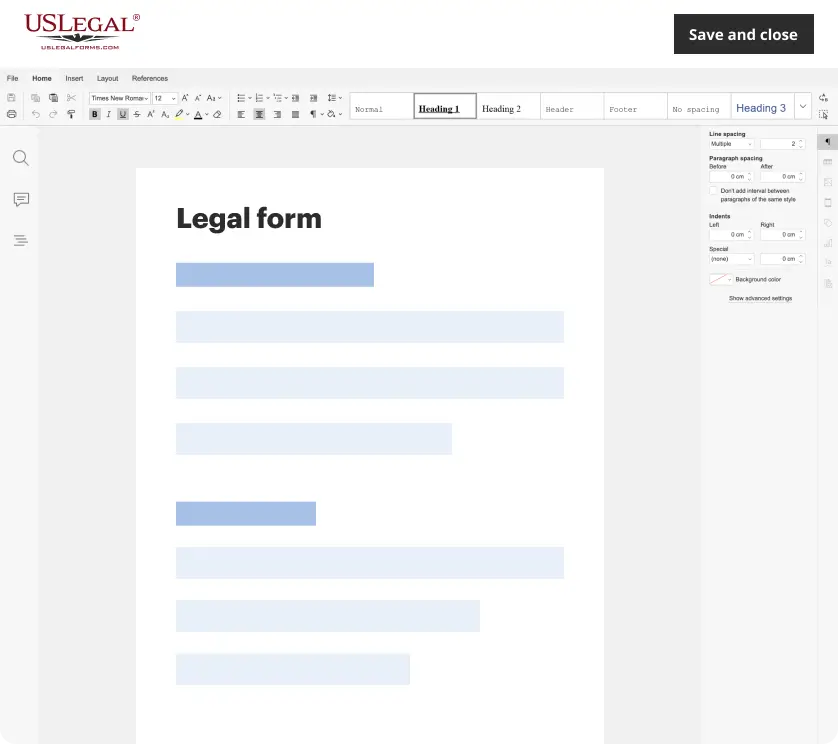
Make edits, fill in missing information, and update formatting in US Legal Forms—just like you would in MS Word.
Download a copy, print it, send it by email, or mail it via USPS—whatever works best for your next step.
Sign and collect signatures with our SignNow integration. Send to multiple recipients, set reminders, and more. Go Premium to unlock E-Sign.
If this form requires notarization, complete it online through a secure video call—no need to meet a notary in person or wait for an appointment.
We protect your documents and personal data by following strict security and privacy standards.
Looking for another form?


Form popularity
FAQ
North Carolina is an employment-at-will state. The term “employment-at-will” simply means that either the employee or the employer can end the employment relationship at any time for any reason—good, bad or no reason at all. The employer is not required to give the employee a reason.
The Occupational Safety and Health (OSH) Act is administered by the Occupational Safety and Health Administration (OSHA). Safety and health conditions in most private industries are regulated by OSHA or OSHA-approved state programs, which also cover public sector employers.
Understanding At Will Employment in North Carolina Being late once, a personality clash or a simple mistake are all legally acceptable reasons to terminate an employee in the eyes of the law, and there doesn't need to be a "paper trail" or warning beforehand.
Youths under 16 years of age have to be given at least a 30-minute break after 5 hours, and no break of less than 30 minutes shall be deemed to interrupt a continuous period of work. Again, there are no required rest breaks or meal breaks at all for employees 16 years of age or older.
The $7.25 per hour state minimum wage also applies to the state of North Carolina, to county and local governments and to instrumentalities of government.
The U.S. Department of Labor (DOL) administers and enforces most federal employment laws, including those covering wages and hours of work, safety and health standards, employee health and retirement benefits, and federal contracts. Several other federal agencies also administer laws affecting employment issues.
Each state sets laws related to fair employment and workplace safety. In most cases, state laws offer more protections than the federal ones. Contact your state department of labor to learn about the labor laws in your state.
North Carolina is an at-will-employment state, which means that an employer may end the employment relationship at any time and for any reason as long as it is not an otherwise unlawful reason. Kurtzman v. Applied Analytical Industries, Inc., 347 N.C. 329, 331, 493 S.E.2d 420, 423 (1997).
North Carolina does not require employees to give notice before resignation. However, providing a two-week notice period is considered a professional courtesy and can help ensure a smoother transition.
No person shall be required by an employer to become or remain a member of any labor union or labor organization as a condition of employment or continuation of employment by such employer.” As such, North Carolinians have the “right to work” at any employer in the state, even if they are not a member of a union that ...