State Specific Employment Laws Within Hospitality In Dallas
Description
















Get your form ready online
Our built-in tools help you complete, sign, share, and store your documents in one place.
Make edits, fill in missing information, and update formatting in US Legal Forms—just like you would in MS Word.
Download a copy, print it, send it by email, or mail it via USPS—whatever works best for your next step.
Sign and collect signatures with our SignNow integration. Send to multiple recipients, set reminders, and more. Go Premium to unlock E-Sign.
If this form requires notarization, complete it online through a secure video call—no need to meet a notary in person or wait for an appointment.
We protect your documents and personal data by following strict security and privacy standards.
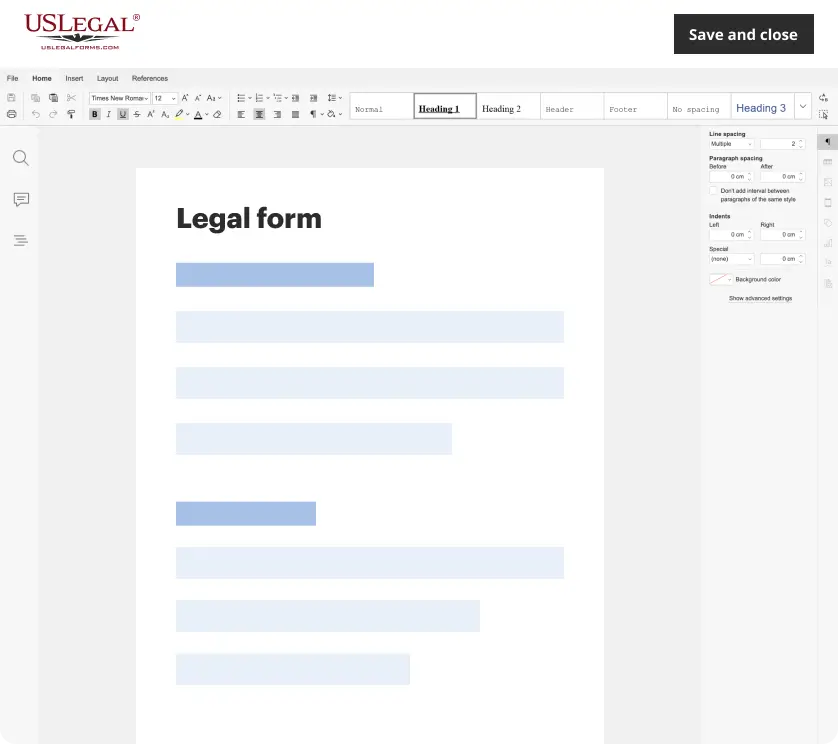
Make edits, fill in missing information, and update formatting in US Legal Forms—just like you would in MS Word.
Download a copy, print it, send it by email, or mail it via USPS—whatever works best for your next step.
Sign and collect signatures with our SignNow integration. Send to multiple recipients, set reminders, and more. Go Premium to unlock E-Sign.

If this form requires notarization, complete it online through a secure video call—no need to meet a notary in person or wait for an appointment.
We protect your documents and personal data by following strict security and privacy standards.
Looking for another form?




Form popularity
FAQ
For example, if you decide to quit, you can do so without giving advance notice, unless your work contract or employee handbook says you should. Even though Texas law doesn't require you to give two weeks' notice, doing so can show professionalism and help you leave on good terms with your current employer.
How does state or federal law impact the process of terminating an employee in Texas? In Texas, employment is generally at-will, meaning an employee can be dismissed at any time and for any reason, as long as that reason isn't illegal under state or federal law.
52.001. RETAIL EMPLOYER. (a) A person who is an employer may not require an employee to work seven consecutive days in an establishment, the business of which is selling merchandise at retail.
The basic rule of Texas employment law is employment at will, which applies to all phases of the employment relationship - it means that absent a statute or an express agreement (such as an employment contract) to the contrary, either party in an employment relationship may modify any of the terms or conditions of ...
Texas is also a right to work state - under the Texas right to work laws (§§101.052-. 053, Texas Labor Code), employment may not be conditioned or denied on the basis of membership or non-membership in a union.
Texas has right-to-work laws prohibiting any contract requiring union membership (or nonmembership). Texas is an at-will employment state, meaning that under state law, an employer or an employee can end employment at any time.
The basic rule of Texas employment law is employment at will, which applies to all phases of the employment relationship - it means that absent a statute or an express agreement (such as an employment contract) to the contrary, either party in an employment relationship may modify any of the terms or conditions of ...
Because Texas is an “employment at-will” state, an employer can fire an employee at any time for any lawful reason. Any lawful reason for termination may include a bad reason or no reason at all.
Right-to-work laws by year StateYear enactedParty of governorship Texas 1947 Democrat Utah 1955 Republican Virginia 1947 Democrat West Virginia 2016 Democrat22 more rows