Annual Meeting Corporate For The Future
Description



Get your form ready online
Our built-in tools help you complete, sign, share, and store your documents in one place.
Make edits, fill in missing information, and update formatting in US Legal Forms—just like you would in MS Word.
Download a copy, print it, send it by email, or mail it via USPS—whatever works best for your next step.
Sign and collect signatures with our SignNow integration. Send to multiple recipients, set reminders, and more. Go Premium to unlock E-Sign.
If this form requires notarization, complete it online through a secure video call—no need to meet a notary in person or wait for an appointment.
We protect your documents and personal data by following strict security and privacy standards.

Make edits, fill in missing information, and update formatting in US Legal Forms—just like you would in MS Word.

Download a copy, print it, send it by email, or mail it via USPS—whatever works best for your next step.

Sign and collect signatures with our SignNow integration. Send to multiple recipients, set reminders, and more. Go Premium to unlock E-Sign.

If this form requires notarization, complete it online through a secure video call—no need to meet a notary in person or wait for an appointment.

We protect your documents and personal data by following strict security and privacy standards.
Looking for another form?

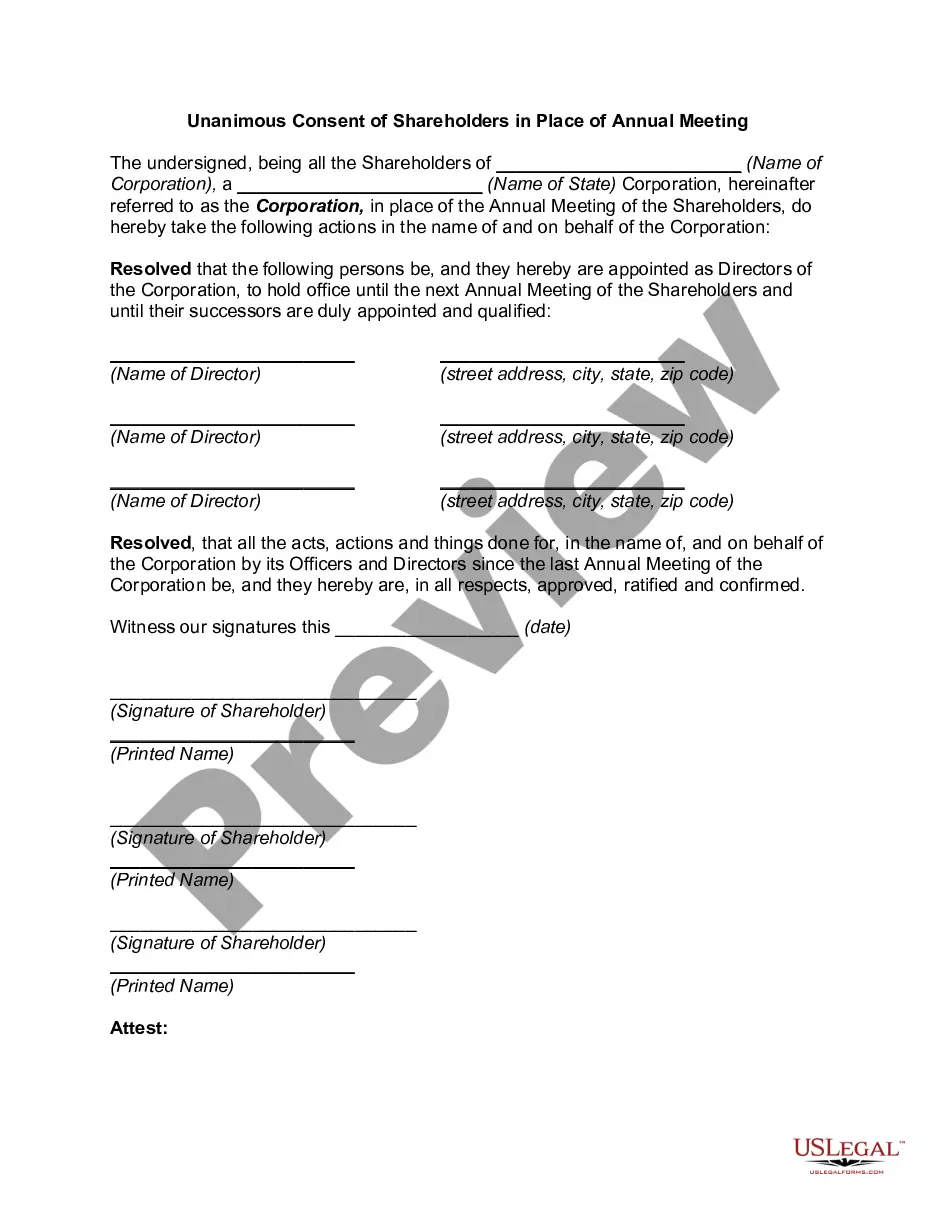
How to fill out Waiver Of Annual Meeting Of Stockholders - Corporate Resolutions?
- If you are a returning user, log in to your account and access your necessary form templates by clicking the Download button. Make sure your subscription is current; if not, renew it.
- For first-time users, begin by reviewing the Preview mode and the form description to ensure it fits your needs and aligns with your local jurisdiction.
- If you find any discrepancies or need a different template, utilize the Search tab to identify the right form.
- Once you’ve selected the correct document, click the Buy Now button to choose a suitable subscription plan, and register for an account for full access.
- Proceed with the payment by entering your credit card information or using your PayPal account to complete the transaction.
- Finally, download your form and save it for completion. You can also access it anytime through the My Forms section of your profile.
By utilizing US Legal Forms, you ensure that your documents are not only easy to obtain but also crafted with the utmost accuracy.
Ready to take the next step? Explore the extensive collection of legal forms on US Legal Forms today for a seamless legal experience!
Form popularity
FAQ
According to Robert's Rules of Order, annual meeting minutes must be read and approved by the attendees during the next meeting. Attendees can propose amendments before the approval process. Once everyone agrees on the minutes, they are officially recorded as a crucial part of the company’s documentation. Keeping clear records enhances the integrity of your annual meeting corporate for the future.
Corporations typically need annual meetings to comply with state laws and foster shareholder engagement. These meetings provide a structured opportunity for discussion regarding the company’s performance and strategic direction. Missing this meeting can have both legal and operational repercussions. For effective organization, consider incorporating tools that facilitate an annual meeting corporate for the future.
Not adhering to corporate formalities can lead to severe consequences, including piercing the corporate veil and losing limited liability protection. This situation can expose shareholders to personal liability for corporate debts. Furthermore, failure to follow necessary protocols can damage the company’s reputation. Prioritizing these formalities is essential for a sustainable annual meeting corporate for the future.
If a corporation does not hold an annual meeting, it risks losing its legal status and may face lawsuits from shareholders. The company may also encounter difficulties in decision-making processes, leading to potential instability in operations. It is crucial to prioritize this event to avoid complications and ensure a successful annual meeting corporate for the future.
To organize an annual meeting, start by setting a date and notifying shareholders well in advance. Prepare an agenda that includes key topics such as financial performance and board elections. Ensure all necessary documents are available and accessible to attendees. Utilizing a platform like uslegalforms can help streamline the process, making your annual meeting corporate for the future more efficient and effective.
Yes, most companies are required to hold an annual general meeting (AGM) as mandated by state laws. This meeting serves as a vital platform for shareholders to discuss corporate performance and elect board members. Not holding an AGM can lead to disenfranchisement of shareholders and regulatory penalties. It is essential for a successful annual meeting corporate for the future.
If a corporation fails to hold an annual shareholders meeting, it can face legal consequences. Shareholders may lose their right to vote on key issues, and the corporation could face penalties from state regulators. Additionally, the absence of this meeting may hinder the company’s ability to fulfill its corporate obligations. Ensuring the annual meeting corporate for the future is crucial for maintaining transparency and good governance.
The 5 P's of communication include Purpose, Precision, Passion, Patience, and Persistence. These principles guide effective communication strategies, especially during an annual meeting corporate for the future. Establishing a clear purpose keeps conversations focused, while precision ensures the message is conveyed accurately. By incorporating passion, patience, and persistence, organizations can enhance dialogue and foster a collaborative environment where ideas flourish.
The 5 P's agenda outlines key elements for a successful meeting: Purpose, Participants, Process, Place, and Product. Incorporating these elements into an annual meeting corporate for the future creates a structured and engaging experience. Each point of the agenda should be clear and defined to ensure participants understand their roles and objectives. This approach helps in achieving meeting goals while fostering collaboration and innovation.
The 5 P's rules refer to a framework that ensures meetings are efficient and successful. These rules encompass following the purpose, engaging the participants effectively, adhering to the process, selecting an appropriate place, and aiming for a valuable product. By applying these principles during an annual meeting corporate for the future, organizations can achieve their objectives and enhance participant satisfaction. Utilizing a solid plan can greatly improve the meeting's outcomes.
