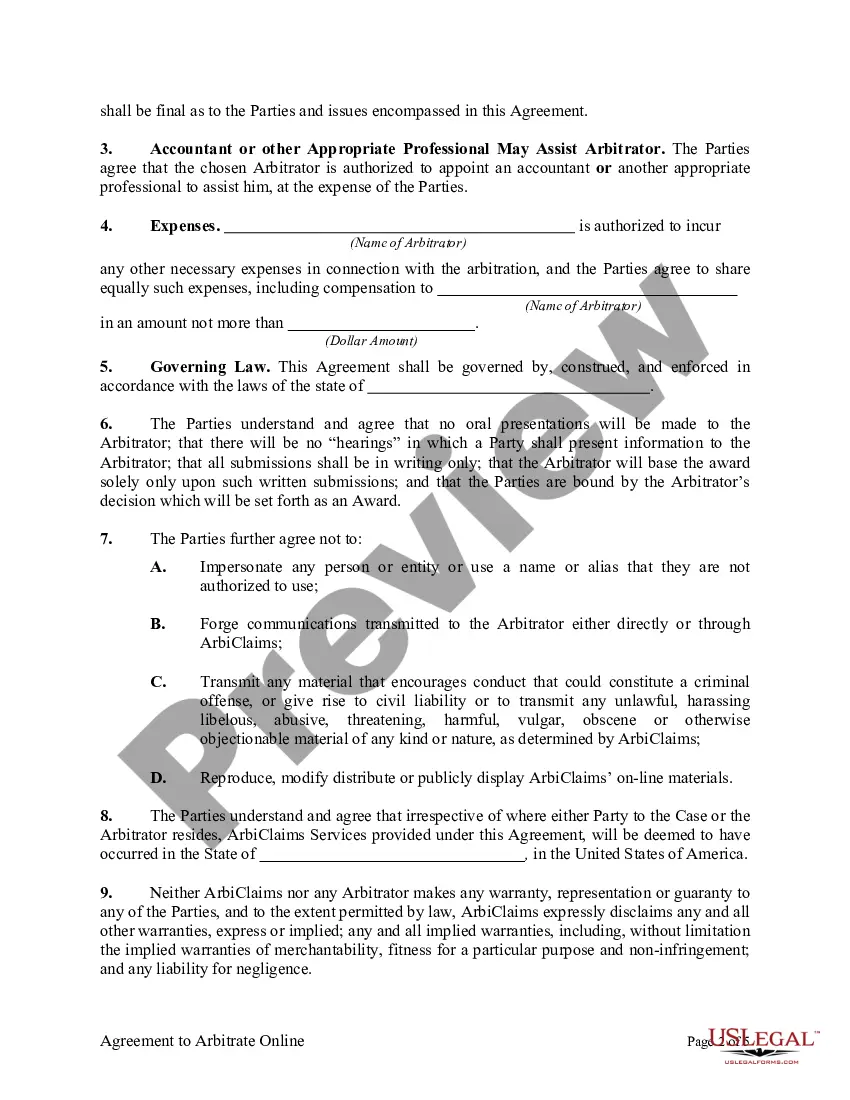
Agreement Arbitrate Sample For Claim In Bronx
Description













Form popularity
FAQ
After 30 days, if not settled, start your case in Small Claims Court. Deadline! You have 1 year + 90 days to file. Count from the date you were injured or your items were damaged.
To begin an action in Small Claims Court, a person, or someone acting on his or her behalf, must come to the Small Claims Court Clerk's office in the proper county and fill out a statement of claim. To find out where the clerk's office is located in your county, click on Locations.
Small claims court is worth it when you know you are deterring someone from potentially harming others the same way they harmed you. You may also want to help others determine whether to do business with that person or corporation in the future, as court decisions are part of the public record.
A claimant or defendant may hire an attorney if they choose to do so, but it is not necessary. The Small Claims Court has monetary jurisdiction up to $10,000.00. Claims for more than $10,000.00 may not be brought in Small Claims Court.
4) What is a Notice of Intention to File a Claim? A Notice of Intention to File a Claim is an optional document that a potential claimant may serve upon the defendant to extend the time period to serve and file a claim.
Summary. The time limit for filing a civil suit in India is generally 3 years, although some specific suits may have different periods, such as 12 years for property recovery. Understanding these limits is crucial to ensuring that legal rights are protected within the prescribed time frame.
To begin an action in Small Claims Court, a person, or someone acting on his or her behalf, must come to the Small Claims Court Clerk's office in the proper county and fill out a statement of claim. To find out where the clerk's office is located in your county, click on Locations.
If you are an individual and want to file a lawsuit for $12,500 or less, you have the option to file either a small claims case or a limited civil case. If you are a business entity, like a corporation, you can file in small claims court for $6,250 or less.
There is no limit to how much you can sue for in a civil case.
Whether you represent yourself or hire an attorney, there are things you can do to ensure a good result in your case. Find the Right Court. Litigate for the Right Reasons. Mediate Instead of Litigate. Communicate With Your Attorney. Be Willing to Negotiate. Follow Court Procedures. You'll Need a Good Lawyer.
