Amendment In Us Constitution In Maryland
Description






Get your form ready online
Our built-in tools help you complete, sign, share, and store your documents in one place.
Make edits, fill in missing information, and update formatting in US Legal Forms—just like you would in MS Word.
Download a copy, print it, send it by email, or mail it via USPS—whatever works best for your next step.
Sign and collect signatures with our SignNow integration. Send to multiple recipients, set reminders, and more. Go Premium to unlock E-Sign.
If this form requires notarization, complete it online through a secure video call—no need to meet a notary in person or wait for an appointment.
We protect your documents and personal data by following strict security and privacy standards.
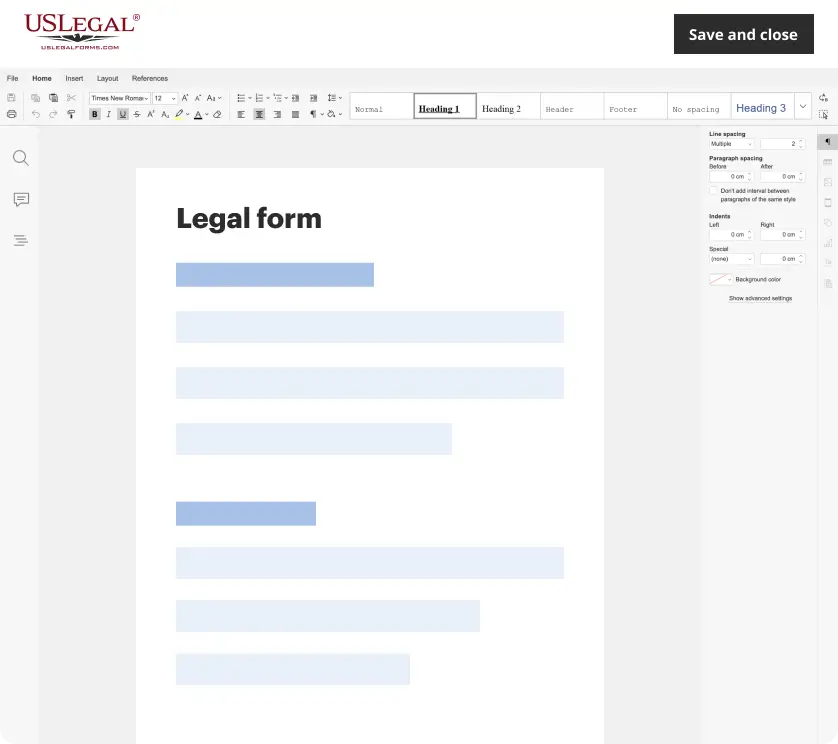
Make edits, fill in missing information, and update formatting in US Legal Forms—just like you would in MS Word.
Download a copy, print it, send it by email, or mail it via USPS—whatever works best for your next step.
Sign and collect signatures with our SignNow integration. Send to multiple recipients, set reminders, and more. Go Premium to unlock E-Sign.

If this form requires notarization, complete it online through a secure video call—no need to meet a notary in person or wait for an appointment.
We protect your documents and personal data by following strict security and privacy standards.
Looking for another form?
Form popularity
FAQ
The due process clause of the Fourteenth amendment holds that there is a fundamental, constitutional guarantee that all legal proceedings will be fair and that one will be given notice of the proceedings and an opportunity to be heard before the government acts to take away one's life, liberty, or property.
Article 36. Nothing shall prohibit or require the making reference to belief in, reliance upon, or invoking the aid of God or a Supreme Being in any governmental or public document, proceeding, activity, ceremony, school, institution, or place. Nothing in this article shall constitute an establishment of religion.
§47. (a) A victim of crime shall be treated by agents of the State with dignity, respect, and sensitivity during all phases of the criminal justice process.
Art. 37. That no religious test ought ever to be required as a qualification for any office of profit or trust in this State, other than a declaration of belief in the existence of God; nor shall the Legislature prescribe any other oath of office than the oath prescribed by this Constitution.
State requirements for political office were not entirely abolished until 1961, when the Supreme Court of the United States rejected a provision of the Maryland State Constitution requiring all public officeholders to declare a belief in God in the case of Torcaso v. Watkins.
Maryland has had four state constitutions. The current state constitution has 20 articles. The current Maryland Constitution has been amended 240 times.
The proposed amendment confirms an individual's fundamental right to reproductive freedom, including but not limited to the ability to make and effectuate decisions to prevent, continue, or end the individual's pregnancy, and provides the State may not, directly or indirectly, deny, burden, or abridge, the right unless ...
The Constitution provides that an amendment may be proposed either by the Congress with a two-thirds majority vote in both the House of Representatives and the Senate or by a constitutional convention called for by two-thirds of the State legislatures.
Art. V ( The Congress, whenever two thirds of both Houses shall deem it necessary, shall propose Amendments to this Constitution, or, on the Application of the Legislatures of two thirds of the several States, shall call a Convention for proposing Amendments. . .. ).
It would be a rare person indeed who would accurately respond that the guarantee to each state of equal suffrage in the Senate is the only constitutional provision that is now expressly unamendable under the Constitution's own terms.
