Record Deed Texas Withdrawal
Description

Get your form ready online
Our built-in tools help you complete, sign, share, and store your documents in one place.
Make edits, fill in missing information, and update formatting in US Legal Forms—just like you would in MS Word.
Download a copy, print it, send it by email, or mail it via USPS—whatever works best for your next step.
Sign and collect signatures with our SignNow integration. Send to multiple recipients, set reminders, and more. Go Premium to unlock E-Sign.
If this form requires notarization, complete it online through a secure video call—no need to meet a notary in person or wait for an appointment.
We protect your documents and personal data by following strict security and privacy standards.

Make edits, fill in missing information, and update formatting in US Legal Forms—just like you would in MS Word.

Download a copy, print it, send it by email, or mail it via USPS—whatever works best for your next step.

Sign and collect signatures with our SignNow integration. Send to multiple recipients, set reminders, and more. Go Premium to unlock E-Sign.

If this form requires notarization, complete it online through a secure video call—no need to meet a notary in person or wait for an appointment.

We protect your documents and personal data by following strict security and privacy standards.
Looking for another form?




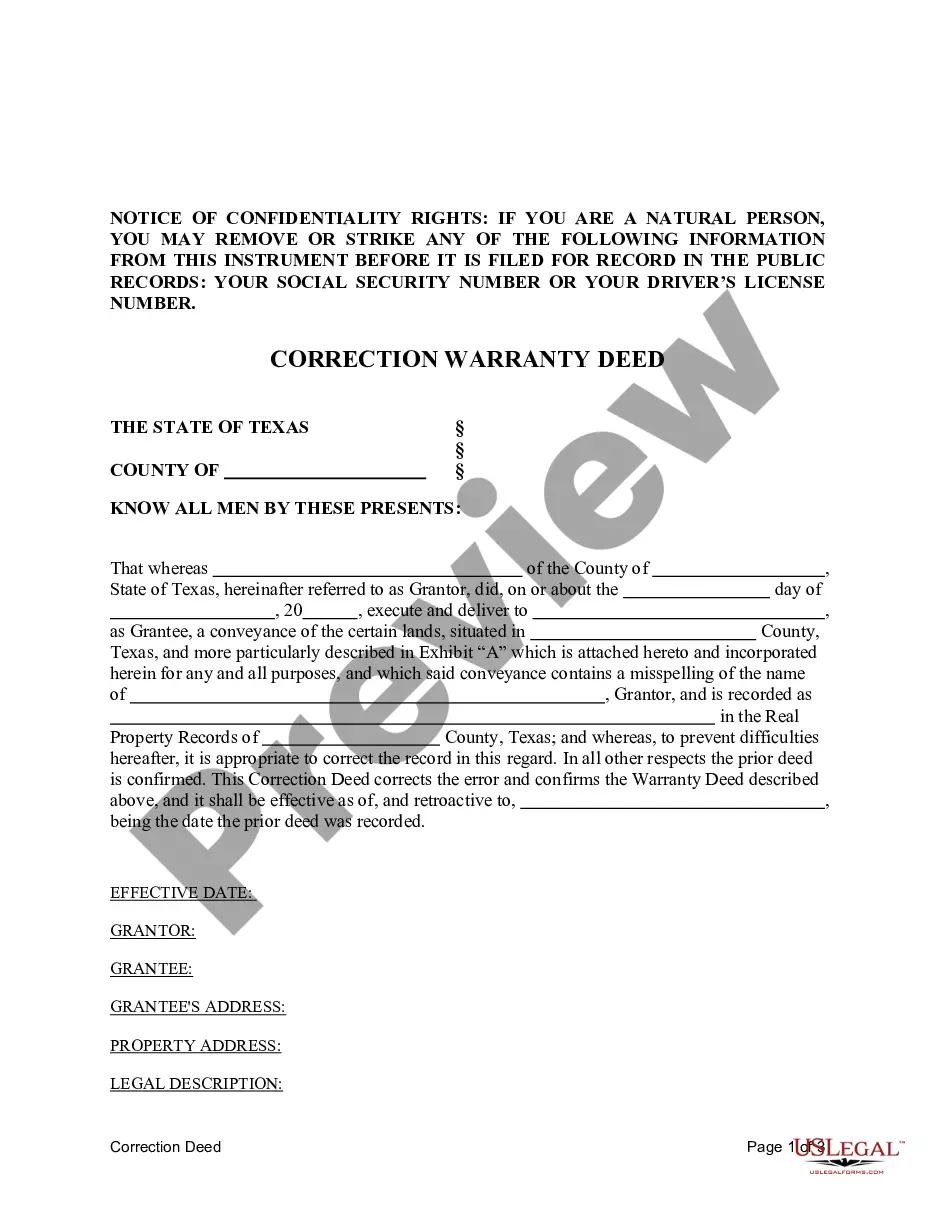
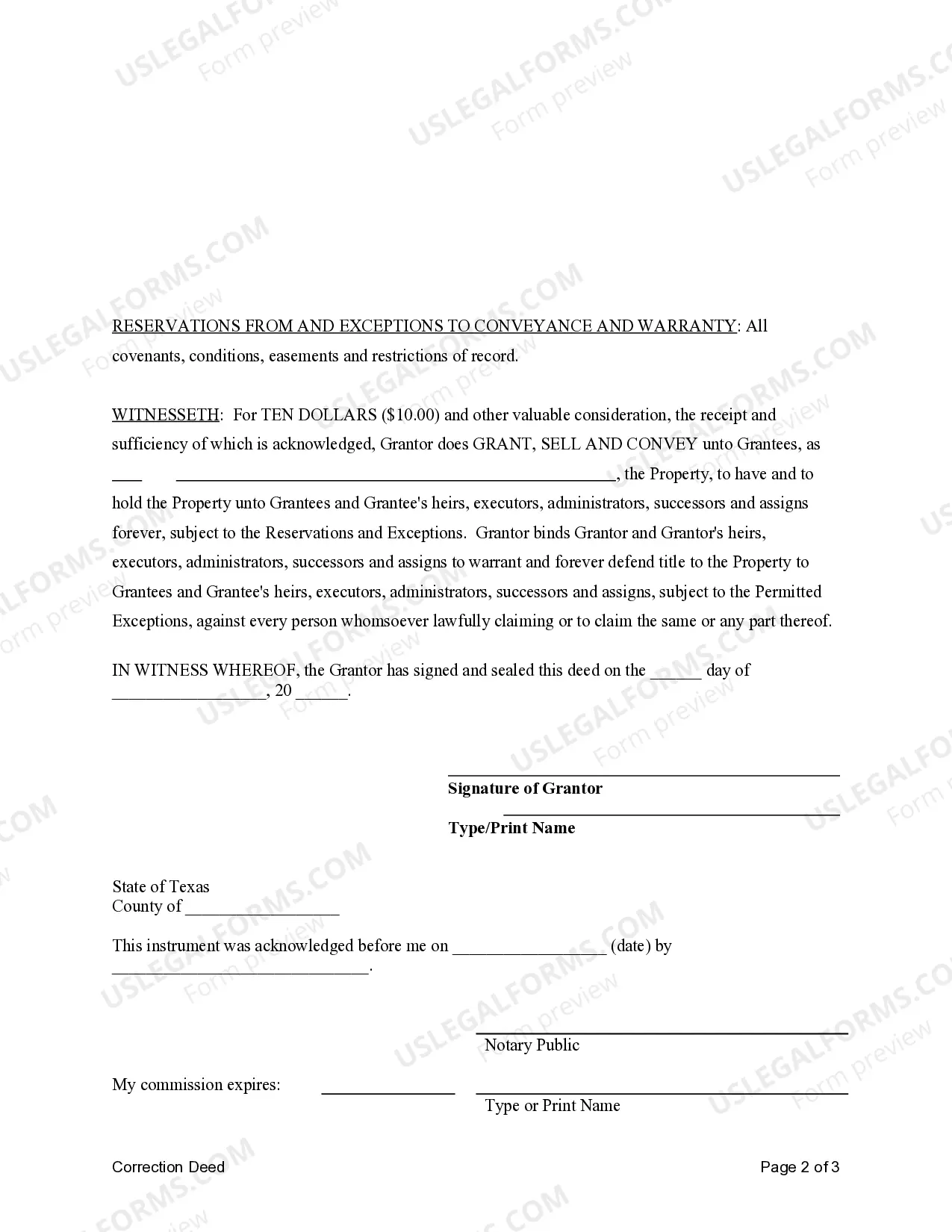
How to fill out Texas Correction Warranty Deed?
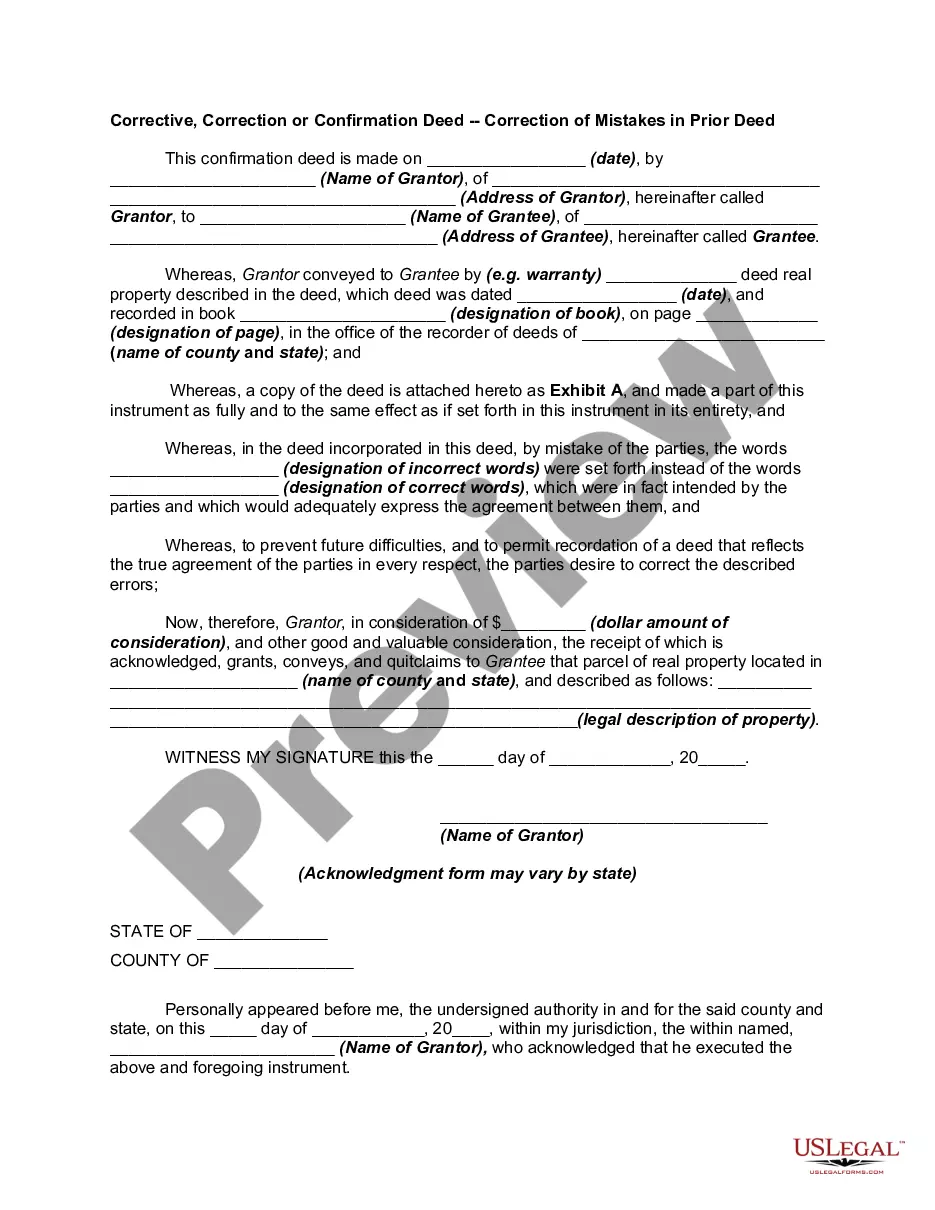
The Record Deed Texas Withdrawal displayed on this page is a versatile official template crafted by experienced attorneys in accordance with federal and state statutes.
For over 25 years, US Legal Forms has assisted individuals, companies, and legal professionals with more than 85,000 authenticated, state-specific documents for any business or personal circumstance. It’s the quickest, easiest, and most dependable method to acquire the documentation you require, as the service assures the utmost level of data protection and anti-malware safeguards.
Register with US Legal Forms to gain access to authenticated legal templates for every situation in life.
- Search for the document you need and review it.
- Look through the sample you searched and preview it or check the form description to confirm it suits your needs. If it doesn’t, utilize the search feature to find the correct one. Click Buy Now when you have found the form you require.
- Sign up and Log In.
- Choose the pricing plan that meets your needs and create an account. Use PayPal or a credit card to make a swift payment. If you already possess an account, Log In and verify your subscription to continue.
- Obtain the editable template.
- Select the format you prefer for your Record Deed Texas Withdrawal (PDF, DOCX, RTF) and download the template onto your device.
- Fill out and sign the document.
- Print the template to fill it out by hand. Alternatively, use an online multifunctional PDF editor to promptly and accurately complete and sign your form with a legally binding electronic signature.
- Download your paperwork again.
- Use the same document anytime it’s needed. Open the My documents tab in your profile to redownload any previously saved templates.
Form popularity
FAQ
Rule 10-712 - REMOVAL FOR CAUSE OR OTHER SANCTIONS (a) On Court's Initiative. The court that has already assumed jurisdiction over the guardianship or estate may order a fiduciary to show cause why the fiduciary should not be removed or be subject to other sanctions for failure to perform the duties of that office.
On motion of any party filed more than 30 days after entry of a judgment dismissing an appeal, the court may reinstate the appeal only upon a finding of fraud, mistake, or irregularity.
10-112 (Petition for Guardianship of Alleged Disabled Person). Factors to consider when determining whether to appoint a guardian who has been convicted of a disqualifying offense under Md. Code, Estates and Trusts Article § 11-114.
Appointing a Temporary Guardian in Maryland The court conducts a hearing where evidence is presented to establish whether guardianship is necessary and whether the proposed guardian is capable of serving in this role. The court may ultimately appoint a legal guardianship for the person, property, or both.
A standby guardian is a person appointed by a parent of a child to take care of the child in the event that the parent becomes: Deceased or mentally incapacitated. Debilitated by an illness or injury. Subject to an adverse immigration action.
Guardianship is a legal process where the court appoints a person to manage a minor's personal affairs (non-financial decisions), financial affairs, or both. The court can appoint one person to manage the minor's personal affairs and another person to manage the minor's financial affairs.
As of , the average hourly pay for a Public Guardian in Maryland is $58.21 an hour.
In Maryland, guardianship determinations are made by a judge, and depending on the nature of the petition, the petitioning process can take somewhere from a few months to a year before an individual is appointed.
(Md. Rule 10-111) INSTRUCTIONS 1. Use this form of petition when a guardianship of a minor is sought, even if the minor also is disabled. 2. If the subject of the petition is not a minor, use the form petition set forth in Rule 10-112.
The length of the temporary guardianship varies by state, but usually ranges from 60 days to 6 months depending on the individual's unique situation. A living will or a power of attorney document can also set this time period.