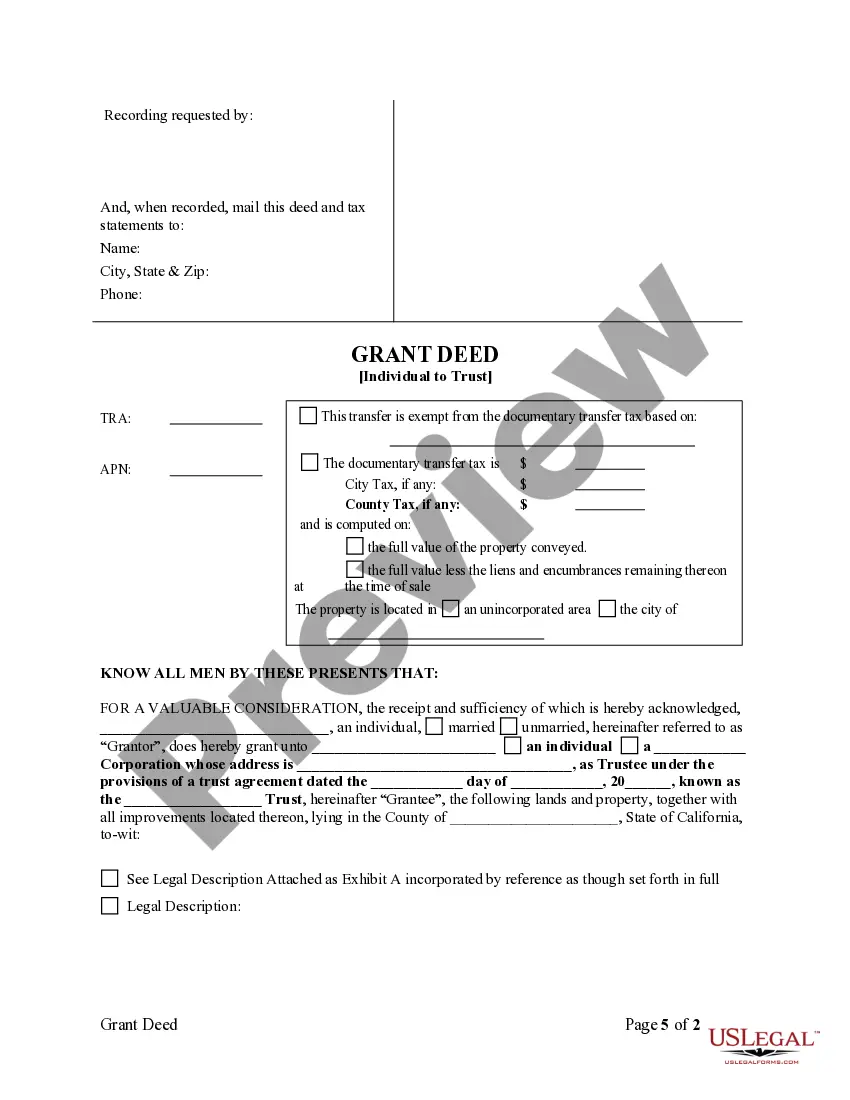
Trust Transfer Deed With Retained Life Estate
Description

Get your form ready online
Our built-in tools help you complete, sign, share, and store your documents in one place.
Make edits, fill in missing information, and update formatting in US Legal Forms—just like you would in MS Word.
Download a copy, print it, send it by email, or mail it via USPS—whatever works best for your next step.
Sign and collect signatures with our SignNow integration. Send to multiple recipients, set reminders, and more. Go Premium to unlock E-Sign.
If this form requires notarization, complete it online through a secure video call—no need to meet a notary in person or wait for an appointment.
We protect your documents and personal data by following strict security and privacy standards.

Make edits, fill in missing information, and update formatting in US Legal Forms—just like you would in MS Word.

Download a copy, print it, send it by email, or mail it via USPS—whatever works best for your next step.

Sign and collect signatures with our SignNow integration. Send to multiple recipients, set reminders, and more. Go Premium to unlock E-Sign.

If this form requires notarization, complete it online through a secure video call—no need to meet a notary in person or wait for an appointment.

We protect your documents and personal data by following strict security and privacy standards.
Looking for another form?
How to fill out California Grant Deed From Individual To Trust?
Locating a reliable destination to obtain the latest and pertinent legal samples constitutes a significant portion of the challenge associated with navigating bureaucracy.
Selecting the appropriate legal documents demands precision and carefulness, which is why it is essential to source samples of Trust Transfer Deed With Retained Life Estate exclusively from trustworthy providers, such as US Legal Forms. An incorrect template will squander your time and delay your current situation.
Remove the frustration associated with your legal documentation. Explore the extensive US Legal Forms catalog to find legal samples, verify their applicability to your situation, and download them instantly.
- Utilize the catalog navigation or search bar to locate your sample.
- Review the form’s description to ensure it meets the requirements of your jurisdiction.
- Preview the form, if available, to confirm it is the document you seek.
- Return to your search and find the appropriate document if the Trust Transfer Deed With Retained Life Estate does not correspond with your needs.
- Once you are confident about the document’s suitability, download it.
- If you are a registered user, click Log in to verify and access your selected forms in My documents.
- If you have not yet created an account, click Buy now to acquire the template.
- Choose the pricing option that suits your requirements.
- Proceed to registration to finalize your purchase.
- Complete your transaction by selecting a payment method (credit card or PayPal).
- Select the file format for downloading Trust Transfer Deed With Retained Life Estate.
- Once you have the document on your device, you can edit it using the editor or print it and fill it out manually.
Form popularity
FAQ
To transfer trust assets to a beneficiary, you typically follow the instructions outlined in the trust document. The trust transfer deed with a retained life estate is a valuable tool for facilitating this process, ensuring that assets are distributed according to your wishes. Engaging a legal professional can help navigate the details and ensure that the transfer is executed correctly.
The main drawback to the Life Estate Deed is that once it is executed, you only have the right to live on the property: you cannot mortgage, lease, rent, or sell the property unless you obtain the consent of the remaindermen (i.e., the future interest holder).
An irrevocable trust is a separate legal entity that takes ownership of your assets and manages them on behalf of beneficiaries. A life estate is simply a deed of ownership that lets you retain partial ownership of a property during your lifetime before passing the property on to another after you pass.
For a revocable living trust to take effect, it should be funded by transferring certain assets into the trust. Often people fund a living trust with real estate, financial accounts, life insurance, annuity certificates, personal property, business interests, and other assets.
An additional potential problem with a Life Estate is that it does not offer creditor protection to the beneficiary, so if the heir has a debt or is sued, the creditor or court can come after the house. As you can see, a traditional Life Estate has the potential to create major conflict within a family.
Assets that should not be used to fund your living trust include: Qualified retirement accounts ? 401ks, IRAs, 403(b)s, qualified annuities. Health saving accounts (HSAs) Medical saving accounts (MSAs) Uniform Transfers to Minors (UTMAs) Uniform Gifts to Minors (UGMAs) Life insurance. Motor vehicles.