Alabama Involuntary Commitment Forms With Miniatures
Description
Get your form ready online
Our built-in tools help you complete, sign, share, and store your documents in one place.
Make edits, fill in missing information, and update formatting in US Legal Forms—just like you would in MS Word.
Download a copy, print it, send it by email, or mail it via USPS—whatever works best for your next step.
Sign and collect signatures with our SignNow integration. Send to multiple recipients, set reminders, and more. Go Premium to unlock E-Sign.
If this form requires notarization, complete it online through a secure video call—no need to meet a notary in person or wait for an appointment.
We protect your documents and personal data by following strict security and privacy standards.

Make edits, fill in missing information, and update formatting in US Legal Forms—just like you would in MS Word.

Download a copy, print it, send it by email, or mail it via USPS—whatever works best for your next step.

Sign and collect signatures with our SignNow integration. Send to multiple recipients, set reminders, and more. Go Premium to unlock E-Sign.

If this form requires notarization, complete it online through a secure video call—no need to meet a notary in person or wait for an appointment.

We protect your documents and personal data by following strict security and privacy standards.
Looking for another form?

How to fill out Alabama Petition For Mental Health Commitment?
Obtaining legal templates that comply with federal and state laws is crucial, and the internet provides numerous choices to select from.
However, why squander time searching for the suitable Alabama Involuntary Commitment Forms With Miniatures sample online when the US Legal Forms digital repository already consolidates such templates in one location.
US Legal Forms is the premier online legal repository with more than 85,000 editable templates created by attorneys for various business and personal situations. They are easy to navigate with all documents organized by state and intended use. Our experts stay informed on legislative changes, ensuring your documentation is always current and compliant when acquiring an Alabama Involuntary Commitment Forms With Miniatures from our site.
Click Buy Now once you’ve identified the correct form and select a subscription option. Create an account or Log In and process a payment using PayPal or a credit card. Choose the desired format for your Alabama Involuntary Commitment Forms With Miniatures and download it. All templates you find through US Legal Forms are reusable. To re-download and complete previously saved forms, access the My documents section in your account. Experience the most comprehensive and user-friendly legal documentation service!
- Acquiring an Alabama Involuntary Commitment Forms With Miniatures is straightforward for both existing and new users.
- If you already possess an account with an active subscription, Log In and save the document template you require in your preferred format.
- If you are a new visitor to our site, follow the steps outlined below.
- Review the template using the Preview feature or the text outline to confirm it fulfills your needs.
- Utilize the search function at the top of the page to locate another sample if necessary.
Form popularity
FAQ
The petitioner is usually a family member, but any person may file a petition seeking the commitment of another, provided that all the elements are met. Once the petition is filed and probable cause is determined, the patient may be involuntarily confined in a designated mental health facility.
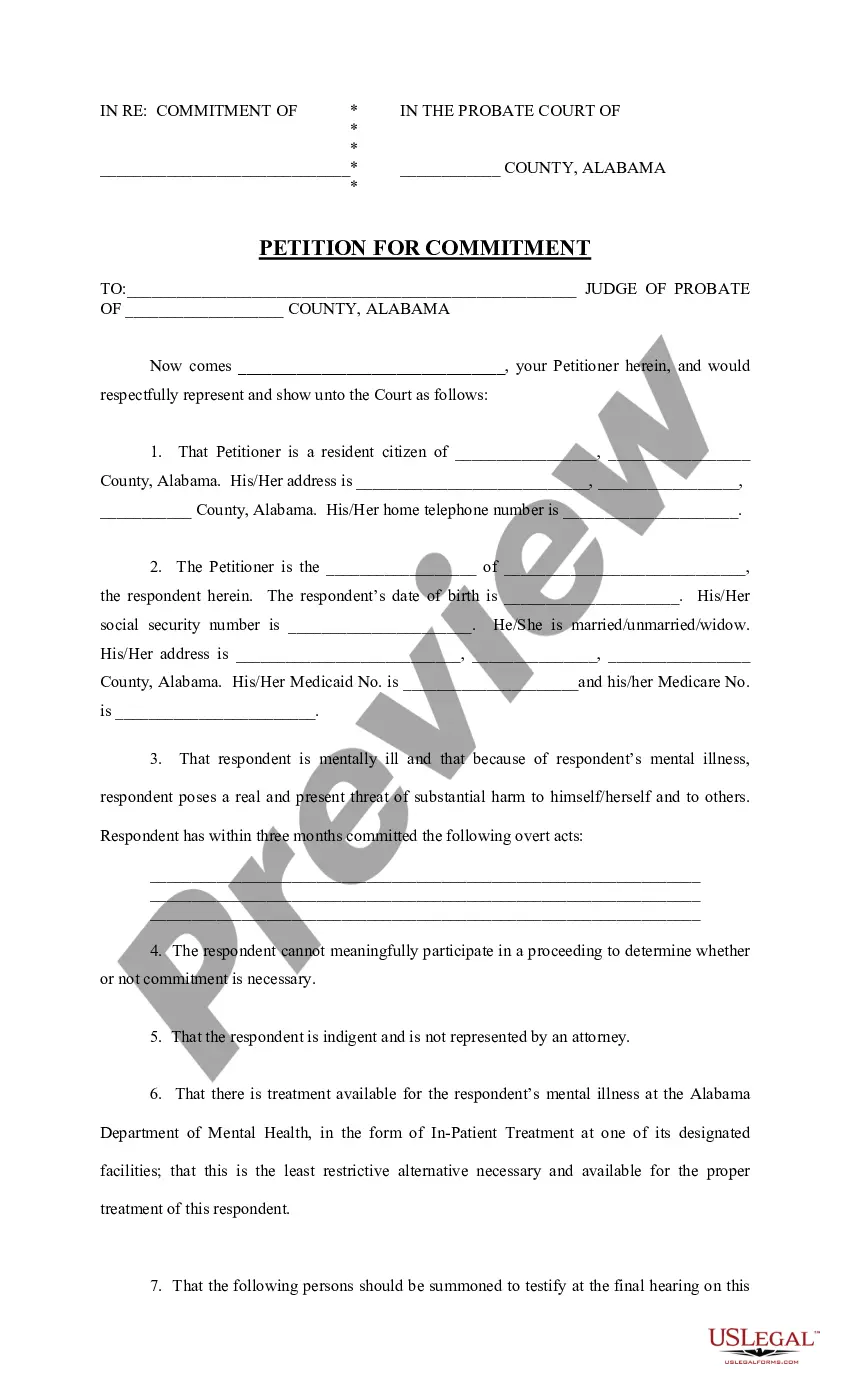
Any person may seek to have another person committed by filing a petition with the Probate Court. WHAT MUST THE PETITION CONTAIN? Names and addresses of the other people with knowledge of the defendant's illness or who observed the person's overt acts and who may be called as his witnesses.
To get a court-ordered commitment, there must be some evidence to show that the person poses an imminent threat to him/herself or others. Evidence that suggests need for involuntary commitment include a threat of suicide, overt threats against another individual, or actions that might put people in danger.
House Bill 70 also expands the definition of ?real and present danger? for involuntary commitments to include the risk that the individual may ?cause, allow, or inflict serious bodily harm upon himself, herself, or another individual,? and ?be unable to satisfy his or her need for nourishment, medical care, shelter, or ...
The court or jury shall determine that the respondent is in need of care and treatment only if the court or jury finds by clear and convincing evidence that the person has a mental illness and, as a result of such mental illness, is a danger to others or to himself or herself or is gravely disabled.