Delaware Quitclaim Deed from Corporation to Husband and Wife
Understanding this form
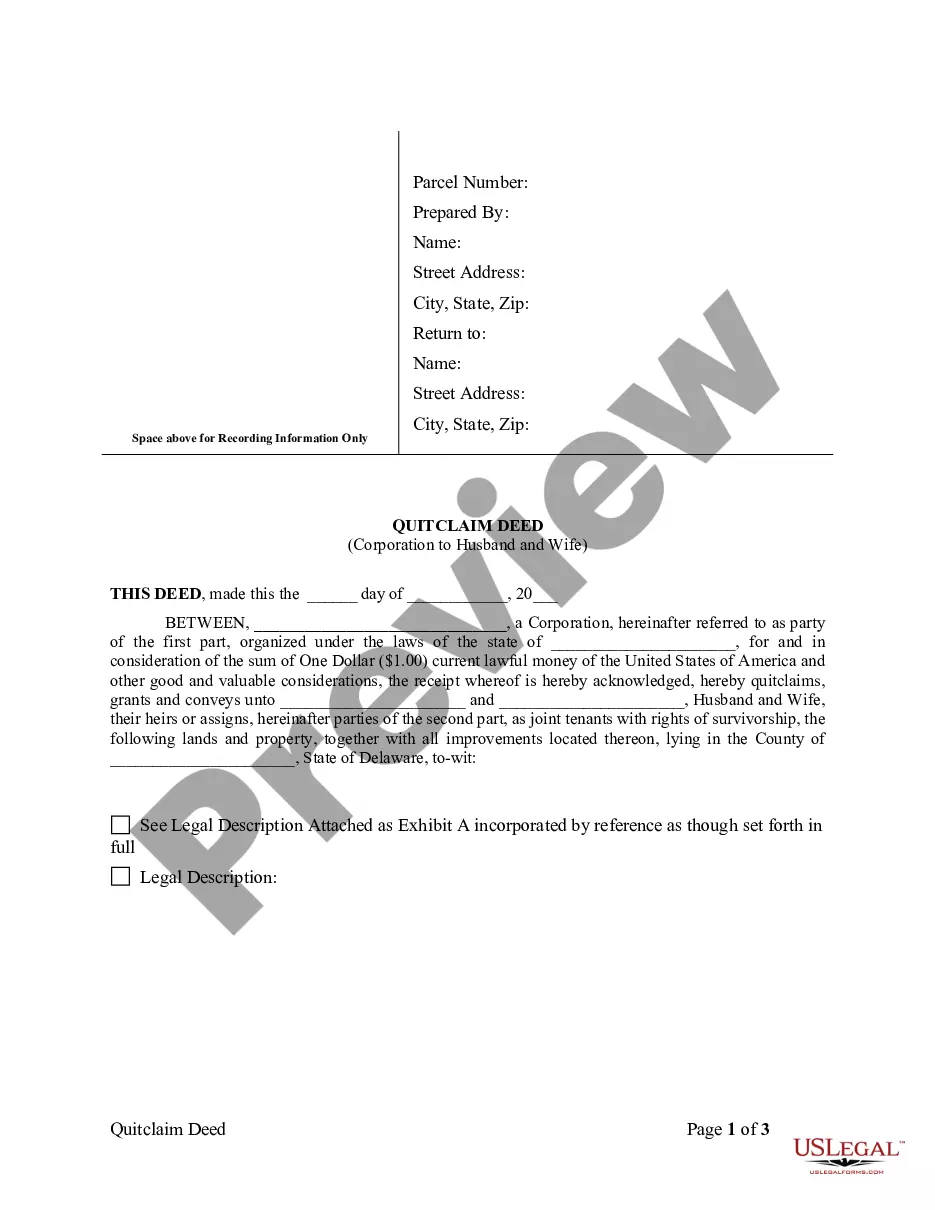
The Quitclaim Deed from Corporation to Husband and Wife is a legal document that allows a corporation (the grantor) to transfer its interest in real property to a husband and wife (the grantees). This form effectively relinquishes any claim the corporation has over the specified property but does not include the transfer of rights to oil, gas, or minerals beneath the surface, if applicable. This quitclaim deed is essential for ensuring clear title and property ownership without the need for a warranty of the grantor's interest in the property, setting it apart from a warranty deed.
Main sections of this form
- Identification of the parties involved: Grantor (corporation) and Grantees (husband and wife).
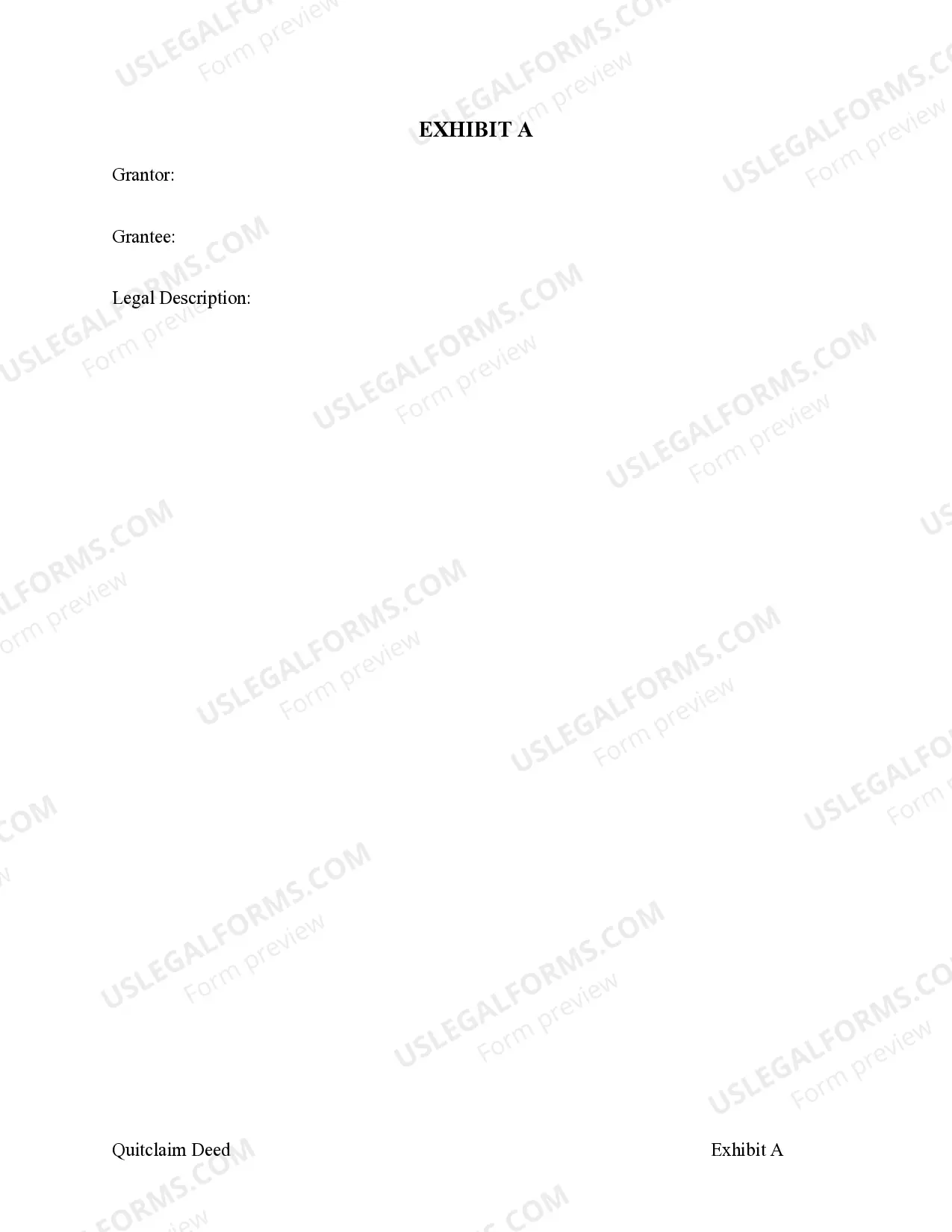
- Legal description of the property being transferred, typically detailed as Exhibit A.
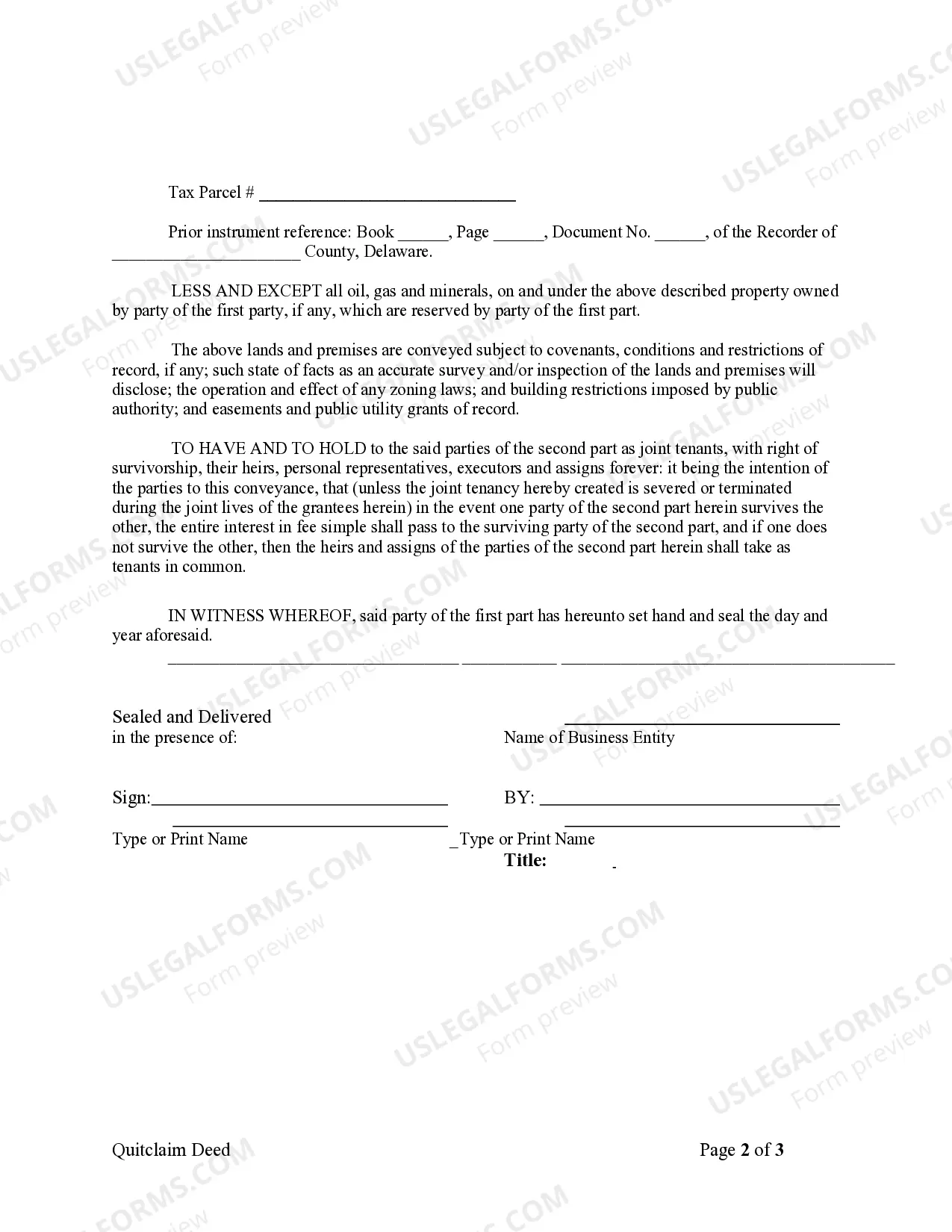
- Statement of reservation for oil, gas, and minerals owned by the grantor.
- Details about joint tenancy with right of survivorship.
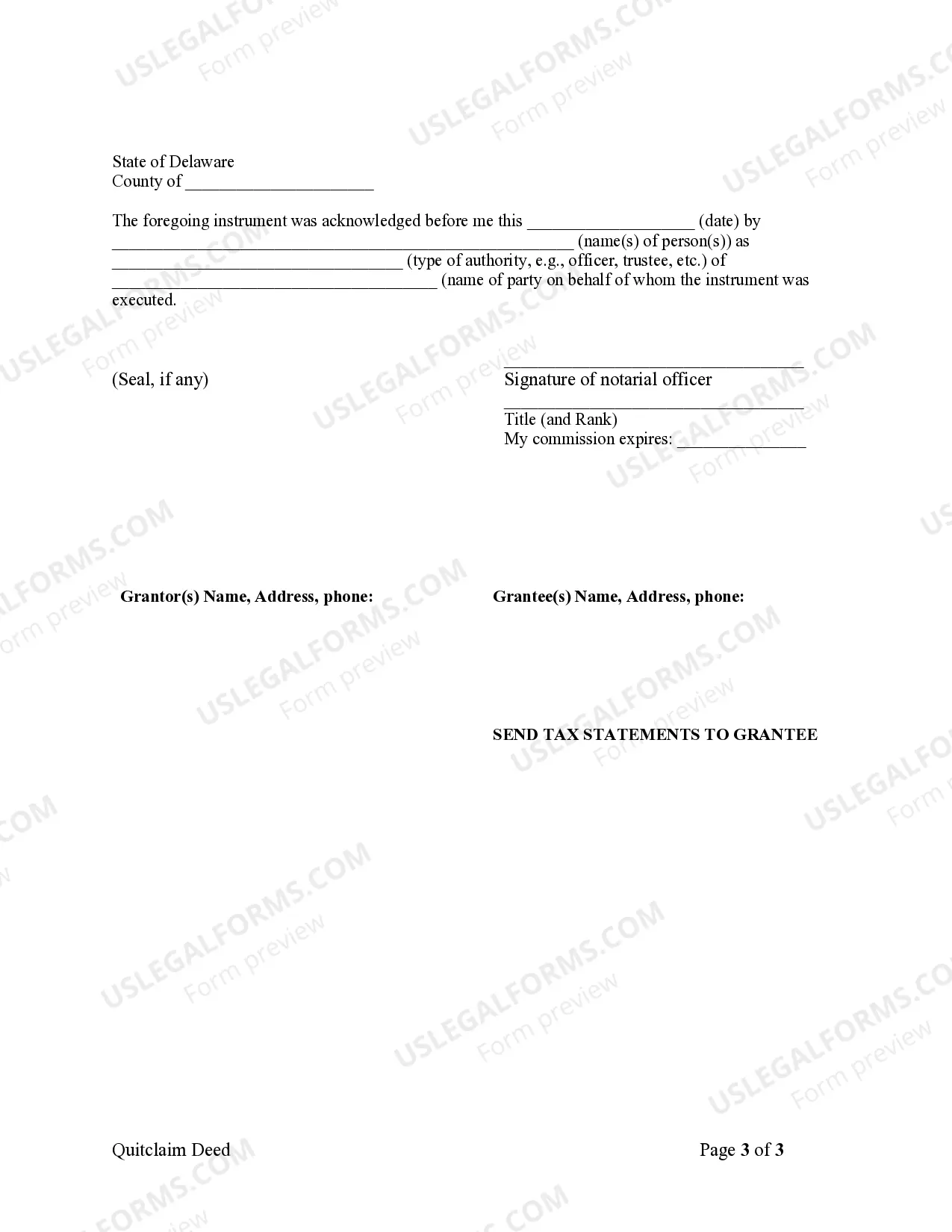
- Notary acknowledgment section for legal validation.




When to use this document
This form is used when a corporation wishes to transfer ownership of a property to a married couple without providing any warranties about the title. It is particularly useful in situations such as property consolidation into a single family unit, estate planning, or in transactions where the corporation no longer requires ownership of the property.
Who this form is for
- Corporations looking to transfer real estate to individual parties.
- Married couples who are receiving property from a corporate entity.
- Individuals involved in estate planning where property needs to be conveyed among family members.
- Business owners wanting to simplify property ownership and reduce liability.
Completing this form step by step
- Identify the parties by entering the corporation's name as the grantor and the names of the husband and wife as grantees.
- Provide the legal description of the property in detail as stated in Exhibit A.
- Specify any reservations for oil, gas, and minerals included in the transfer.
- Indicate the date of the transfer and the signatories' names.
- Ensure that the deed is signed in front of a notary public for legal compliance.
Is notarization required?
This form needs to be notarized to ensure legal validity. US Legal Forms provides secure online notarization powered by Notarize, allowing you to complete the process through a verified video call, available anytime.
Get your form ready online
Our built-in tools help you complete, sign, share, and store your documents in one place.
Make edits, fill in missing information, and update formatting in US Legal Forms—just like you would in MS Word.
Download a copy, print it, send it by email, or mail it via USPS—whatever works best for your next step.
Sign and collect signatures with our SignNow integration. Send to multiple recipients, set reminders, and more. Go Premium to unlock E-Sign.
If this form requires notarization, complete it online through a secure video call—no need to meet a notary in person or wait for an appointment.
We protect your documents and personal data by following strict security and privacy standards.

Make edits, fill in missing information, and update formatting in US Legal Forms—just like you would in MS Word.

Download a copy, print it, send it by email, or mail it via USPS—whatever works best for your next step.

Sign and collect signatures with our SignNow integration. Send to multiple recipients, set reminders, and more. Go Premium to unlock E-Sign.

If this form requires notarization, complete it online through a secure video call—no need to meet a notary in person or wait for an appointment.

We protect your documents and personal data by following strict security and privacy standards.
Typical mistakes to avoid
- Failing to provide a complete legal description of the property.
- Not including the necessary reservations for oil, gas, and minerals.
- Omitting the notarization, which can render the deed invalid.
- Not clearly identifying the parties, leading to potential legal disputes.
Advantages of online completion
- Convenience of downloading and customizing the deed from anywhere.
- Immediate access to legal forms drafted by licensed attorneys.
- Simple step-by-step guidance for completing the form accurately.
- Reduced wait time compared to visiting a legal office.
Main things to remember
- The Quitclaim Deed from Corporation to Husband and Wife transfers property without warranty.
- It must be notarized to ensure legality and can be used in various jurisdictions.
- It is ideal for simplifying the transfer of property ownership to a married couple.
Looking for another form?

Form popularity
FAQ
The best way to add your wife to your deed is to execute a Delaware Quitclaim Deed from Corporation to Husband and Wife. This process is straightforward and typically requires filling out the appropriate forms and recording them with your local county office. Make sure to provide all necessary information accurately, as this reduces errors and helps in maintaining clear property ownership.
Yes, you can add your spouse to the deed without refinancing by using a Delaware Quitclaim Deed from Corporation to Husband and Wife. This process allows you to transfer property ownership without altering your current mortgage terms. However, consider consulting a legal professional to understand how this may affect your mortgage agreements and ensure a smooth transition.
Adding a name to a deed can create complications such as potential tax implications or affecting your liability for existing debts. If the property is sold or mortgaged, both names may need to cooperate in the transaction, which can complicate matters if relationships change. Furthermore, in the case of divorce or separation, disputes over property rights may arise, especially with a Delaware Quitclaim Deed from Corporation to Husband and Wife, where intentions may not always remain clear.
To add someone to a deed in Delaware, you can use a Delaware Quitclaim Deed from Corporation to Husband and Wife. This deed allows you to transfer property ownership without needing to re-fund or alter any existing mortgage. You will need to fill out the deed form, have it notarized, and file it with the county recorder’s office. This process ensures a legal transfer of property rights and establishes joint ownership.
Adding a spouse to a deed is typically a straightforward process, often achieved by executing a quitclaim deed. This involves creating a new deed that lists both spouses as owners. Utilizing a Delaware Quitclaim Deed from Corporation to Husband and Wife simplifies this process, as our platform can provide the necessary forms and instructions to ensure a smooth addition to the deed.
The primary disadvantage of using a quitclaim deed is the lack of warranty or guarantees regarding the property title. This means the recipient may inherit title issues or debts attached to the property. While a Delaware Quitclaim Deed from Corporation to Husband and Wife can facilitate easy transfers, it's essential to weigh these disadvantages against your specific needs and situation.
The strongest form of deed is a warranty deed, which provides the highest level of protection for the buyer. A warranty deed guarantees the grantor holds clear title to the property and offers a warranty against any defects. In contrast, a Delaware Quitclaim Deed from Corporation to Husband and Wife provides no such guarantees, making it crucial to understand the differences before transferring property.
One problem with a quitclaim deed is that it does not guarantee that the grantor has clear ownership of the property, which can lead to disputes. Additionally, a quitclaim deed does not protect against any liens or debts associated with the property. Therefore, when using a Delaware Quitclaim Deed from Corporation to Husband and Wife, it's wise to conduct due diligence to ensure clear title before proceeding.
To file a quitclaim deed in Delaware, you must complete the deed form and ensure it is signed by the grantor. Then, record the completed form with the appropriate county recorder’s office. Using a Delaware Quitclaim Deed from Corporation to Husband and Wife can simplify this process, as our platform provides templates and guidance to assist you in filing accurately and efficiently.
Quitclaim deeds are most often used for transferring ownership of property between family members, especially in situations like divorce, marriage, or when adding a spouse to the title. They are also suitable for transferring property into a trust or from a business entity, like a corporation, to personal ownership. This is especially useful when filing a Delaware Quitclaim Deed from Corporation to Husband and Wife.