District of Columbia Last Will and Testament for Single Person with No Children

Understanding this form
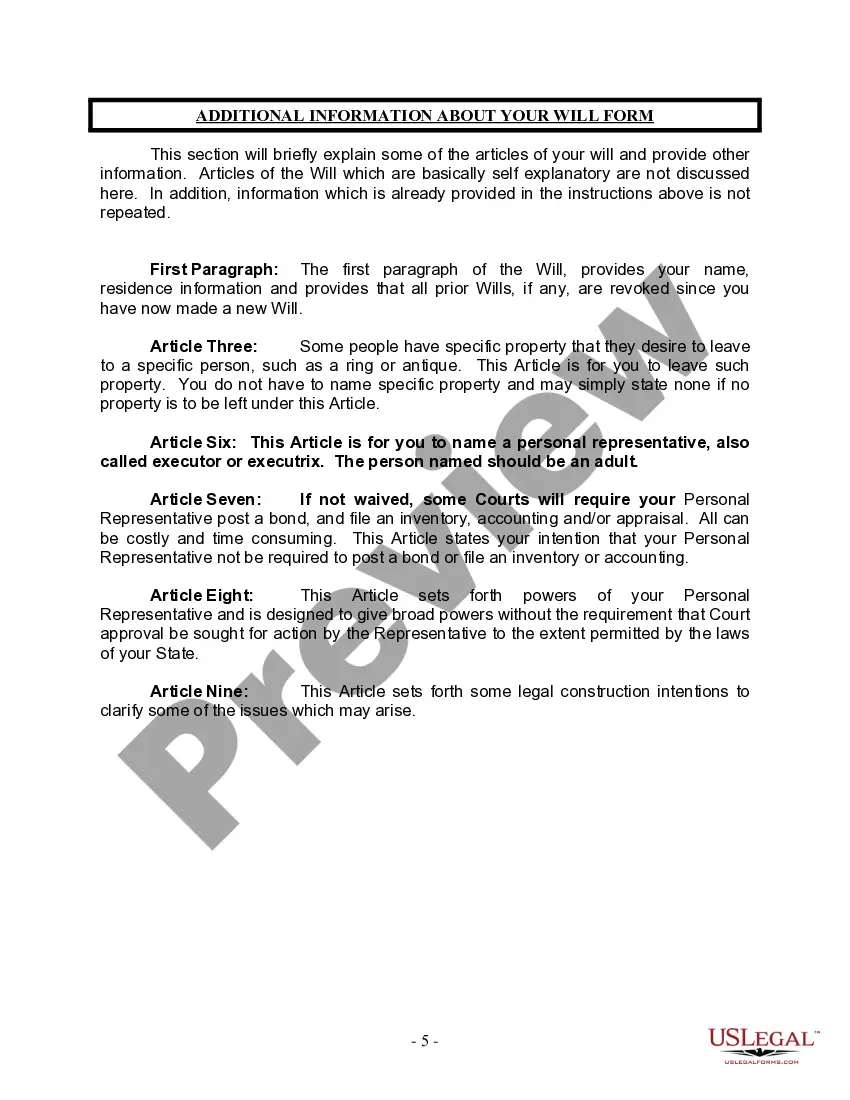
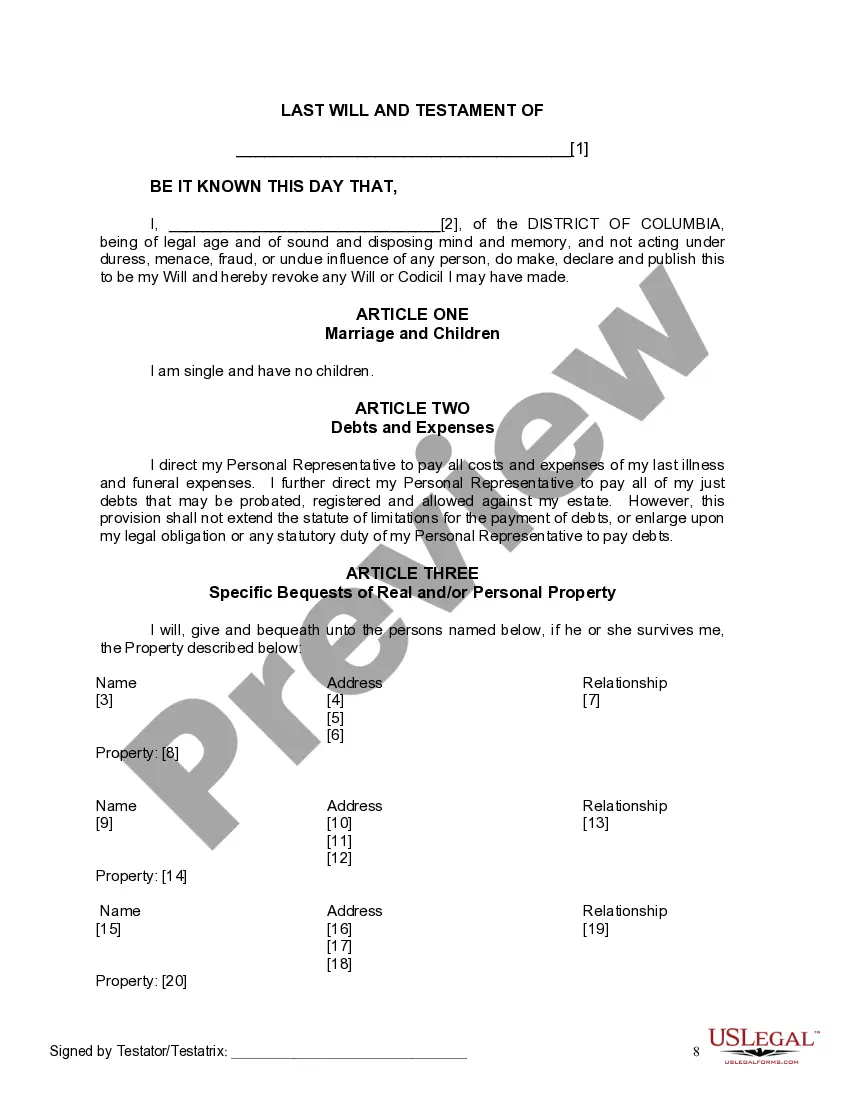
This Last Will and Testament is designed specifically for single individuals without children. It outlines how a person's assets will be distributed upon their death, appoints a personal representative to manage the estate, and includes specific provisions for the desired allocation of property. Unlike other wills, this form simplifies the process for those who do not have dependent children, focusing solely on the distribution of their personal assets.
Main sections of this form
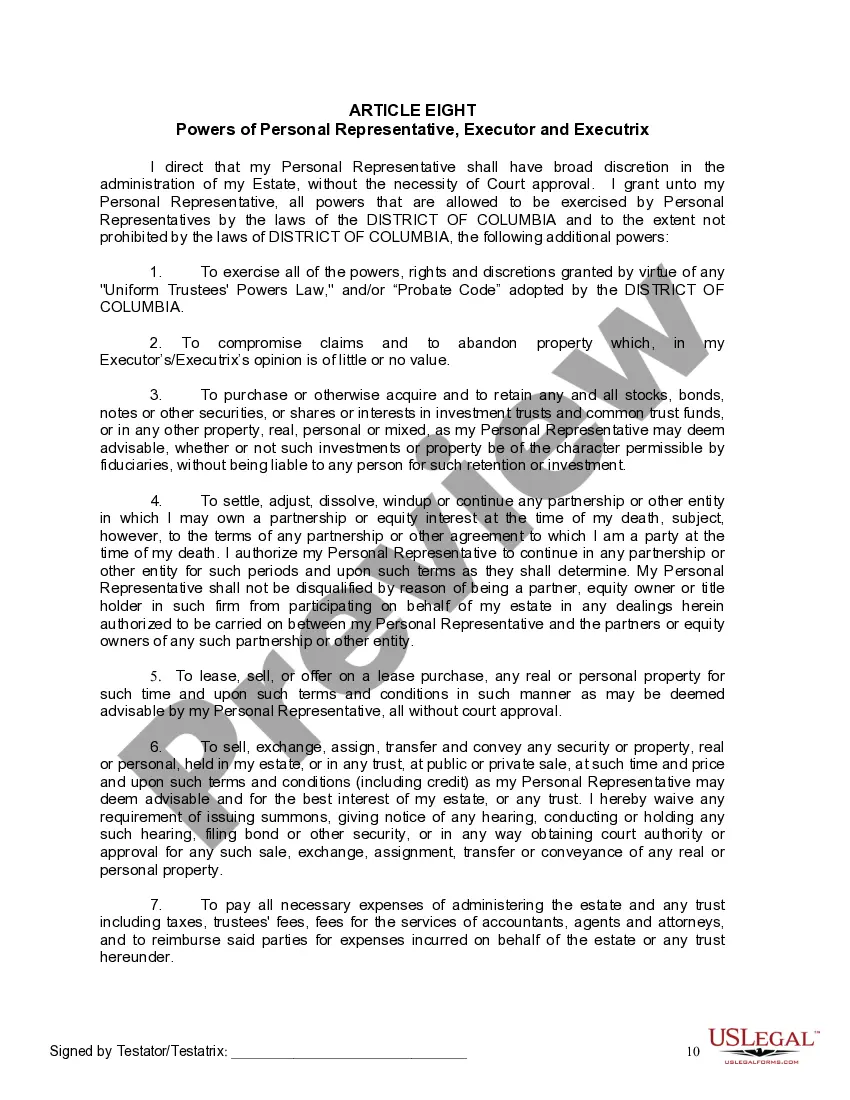
- Appointment of a personal representative to manage the estate.
- Specification of beneficiaries who will receive property and assets.
- Provisions for any debts and funeral expenses to be paid by the estate.
- Details on the handling of a homestead or primary residence.
- Residuary clause that covers any remaining property not specifically bequeathed.
- Options to waive bond requirements for the personal representative.





Situations where this form applies
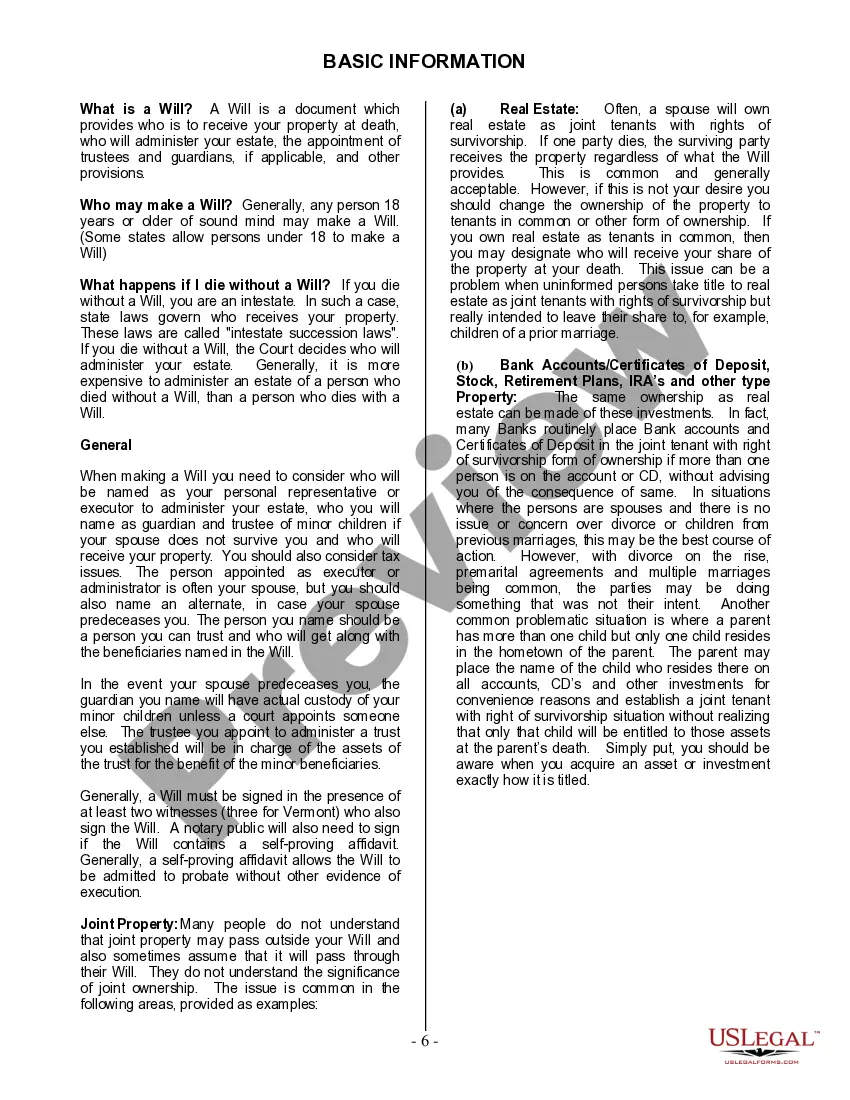
This form is suitable for individuals who are single and have no children, seeking to ensure their assets are distributed according to their wishes. It is particularly useful for those who want to avoid the complexities of intestate succession laws, which dictate asset distribution when someone dies without a will. By completing this document, you can specify who receives your belongings, thereby providing clarity and reducing potential conflicts among heirs.
Who should use this form
- Single individuals with no children.
- People who own property or have personal assets they wish to distribute after death.
- Individuals looking to appoint someone to manage their estate.
- Those seeking to ensure their wishes regarding their estate are legally documented.
Steps to complete this form
- Enter your full name and address at the top of the document.
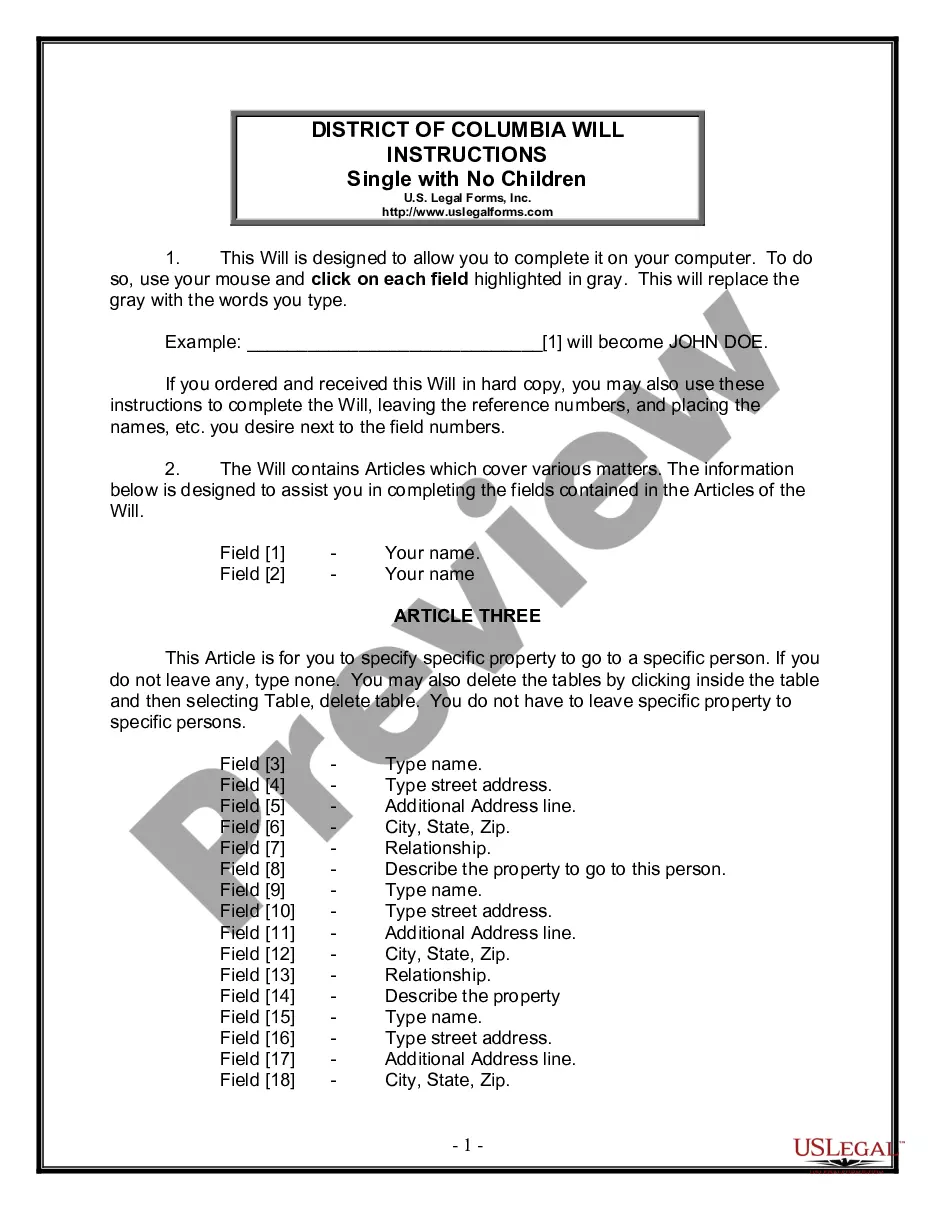
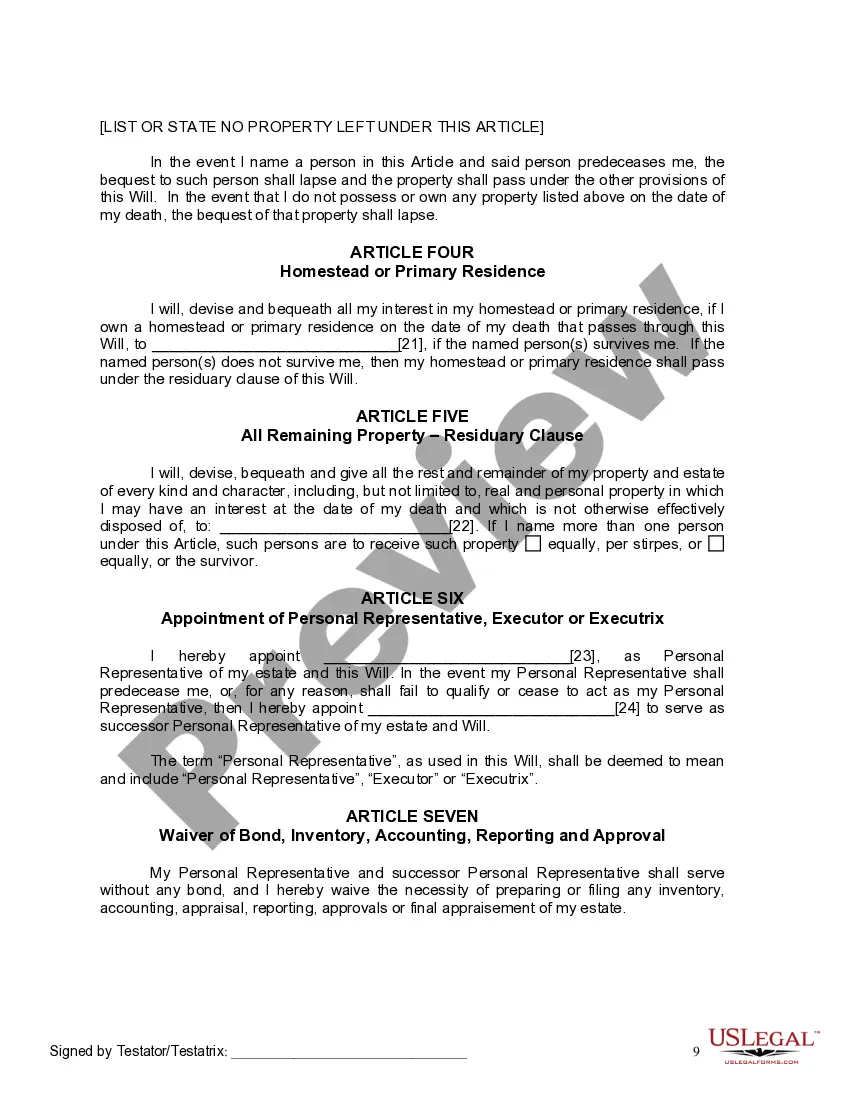
- Specify the beneficiaries for your assets in Article Three, detailing their names and the property they will receive.
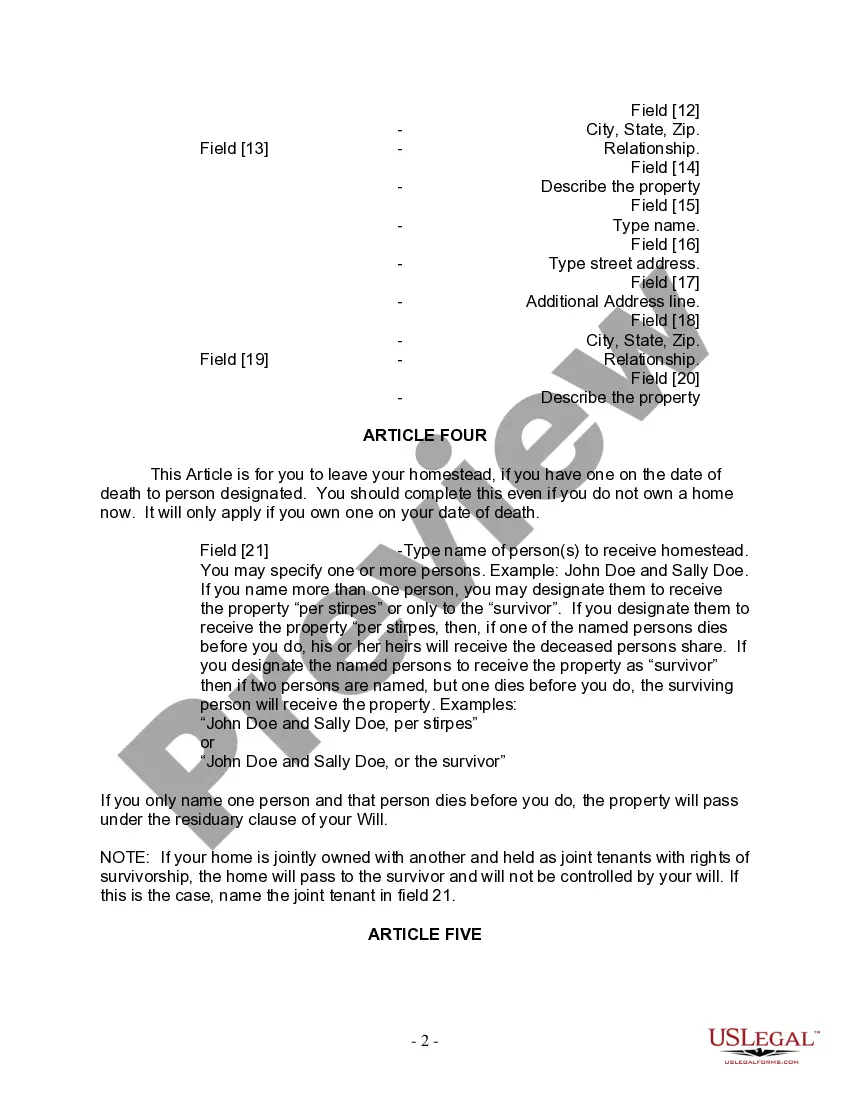
- Indicate your homestead designation in Article Four if applicable, stating who will inherit it.
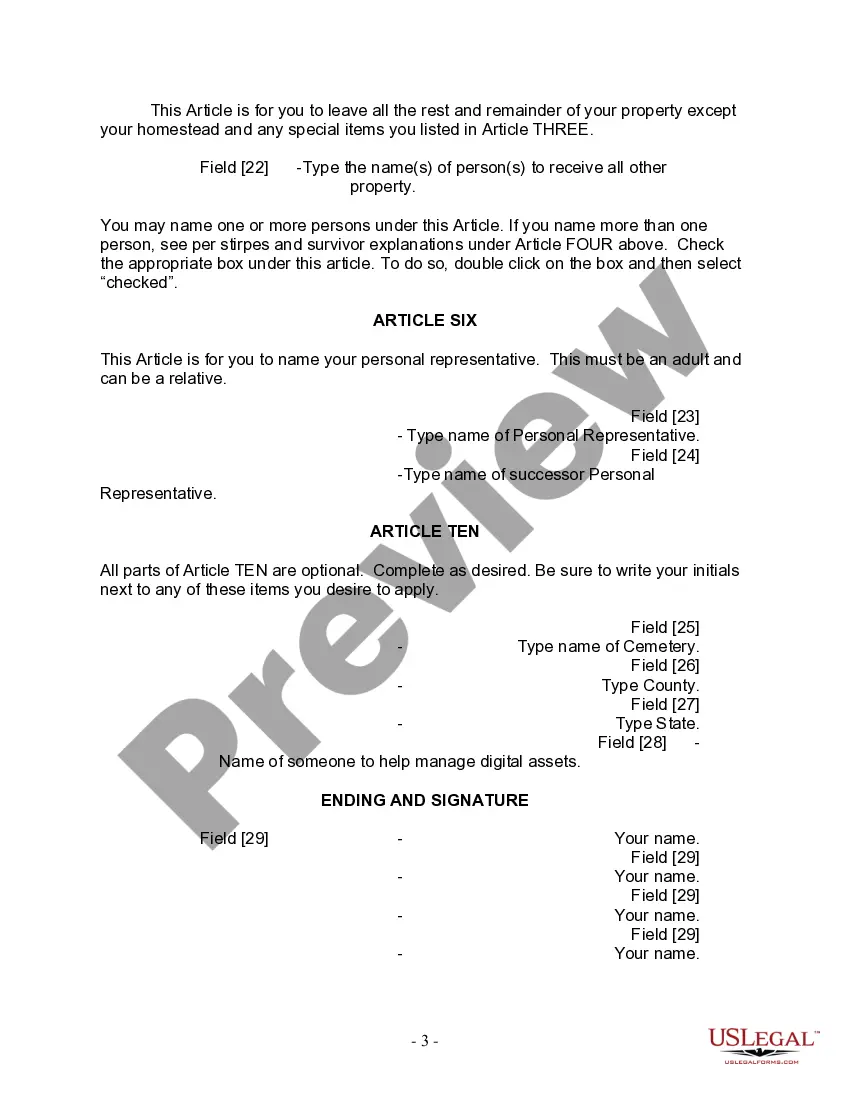
- Identify a personal representative in Article Six, as well as any successors to that role.
- Sign the will in the presence of two witnesses who are not named as beneficiaries.
- Keep a signed copy of your will in a safe place and consider giving a copy to your executor.
Does this form need to be notarized?
This form does not typically require notarization unless specified by local law. However, if your state has adopted a self-proving affidavit statute, notarization may be needed for the will to be admitted to probate without additional evidence of execution.
Get your form ready online
Our built-in tools help you complete, sign, share, and store your documents in one place.
Make edits, fill in missing information, and update formatting in US Legal Forms—just like you would in MS Word.
Download a copy, print it, send it by email, or mail it via USPS—whatever works best for your next step.
Sign and collect signatures with our SignNow integration. Send to multiple recipients, set reminders, and more. Go Premium to unlock E-Sign.
If this form requires notarization, complete it online through a secure video call—no need to meet a notary in person or wait for an appointment.
We protect your documents and personal data by following strict security and privacy standards.

Make edits, fill in missing information, and update formatting in US Legal Forms—just like you would in MS Word.

Download a copy, print it, send it by email, or mail it via USPS—whatever works best for your next step.

Sign and collect signatures with our SignNow integration. Send to multiple recipients, set reminders, and more. Go Premium to unlock E-Sign.

If this form requires notarization, complete it online through a secure video call—no need to meet a notary in person or wait for an appointment.

We protect your documents and personal data by following strict security and privacy standards.
Avoid these common issues
- Failing to sign the will in the presence of two witnesses.
- Not specifying who should receive specific property.
- Forgetting to name an alternate personal representative.
- Neglecting to update the will after major life changes.
Why complete this form online
- Convenience of filling out the form from anywhere and at any time.
- Editable fields allow for easy updates to your will.
- Legal assurance that the document is drafted by licensed attorneys.
- Accessibility to additional legal resources if needed.
Legal use & context
- This will serves as a legally binding document once properly executed according to state laws.
- It provides clarity on asset distribution, which can help prevent disputes among potential heirs.
- Using a proper will can expedite the probate process and reduce legal costs associated with administering an estate without a will.
What to keep in mind
- The Last Will and Testament for a single person without children is crucial for outlining asset distribution.
- It's necessary to follow state-specific legal requirements for validity.
- Proper execution, including signatures from witnesses, is vital to enforceability.
Looking for another form?


Form popularity
FAQ
In the District of Columbia, the order of inheritance typically prioritizes a spouse and then children, followed by parents, siblings, and other relatives. However, for a Single Person with No Children, the estate would follow intestacy laws, potentially leading to inheritances flowing to distant relatives. Having a District of Columbia Last Will and Testament can specify your desired beneficiaries, making your intentions clear and ensuring that your assets go to those you choose.
Inheritance law in Washington, DC, follows specific guidelines outlined in the DC Code. These laws determine how assets are divided among heirs when someone passes without a will. To ensure your preferences are respected, having a District of Columbia Last Will and Testament for Single Person with No Children can help avoid potential disputes and ensure clarity in asset distribution.
When an individual passes away without a will in Washington, DC, their estate will be distributed according to the intestacy laws of the District. This means the state determines who inherits your assets, often favoring spouses and blood relatives. For a Single Person with No Children, this can lead to outcomes that may not align with their wishes. In such cases, utilizing a District of Columbia Last Will and Testament provides certainty and control over estate distribution.
In Washington, DC, a will does not necessarily need to be notarized to be valid. However, having a notary public witness the signing of your will can provide added assurance and simplify the probate process. A District of Columbia Last Will and Testament for a Single Person with No Children can be particularly effective when properly executed, as it ensures your wishes are honored smoothly.
In the District of Columbia, certain individuals may be disqualified from inheriting from their parents. For instance, individuals who have been legally disowned may not receive any inheritance. Additionally, any individuals involved in actively harming their parents, such as committing crimes against them, could also face disinheritance. The implications of this can impact a District of Columbia Last Will and Testament for a Single Person with No Children, as choosing beneficiaries is crucial.
Yes, having a will is essential even for single individuals. A District of Columbia Last Will and Testament for Single Person with No Children can guide the distribution of your assets according to your wishes. Without a will, the state may decide how your estate is managed and distributed, which may not align with your preferences. Thus, making a will is a proactive measure to ensure your assets are handled as you desire.
Avoiding probate in the District of Columbia can be achieved through several strategies. One way is to create a living trust, which allows your assets to bypass the probate process after your death. Additionally, designating beneficiaries on accounts and using joint ownership can also help. By planning with tools like a District of Columbia Last Will and Testament for Single Person with No Children, you can strategically manage your estate and minimize complications.
You are not required to register a will in the District of Columbia, but doing so can help facilitate the probate process. Registering a will can protect against any potential challenges or complications after death. It allows the court to officially recognize your District of Columbia Last Will and Testament for Single Person with No Children, ensuring your estate is handled according to your specifications. Consider this option to streamline the legal process for your loved ones.
A will is considered valid in the District of Columbia if it meets specific legal requirements. Firstly, it must be written, signed by the testator, and reflect their intent to distribute assets upon death. Witnesses must be present during the signing and must also sign the document. For a solid assurance of validity, individuals often rely on a District of Columbia Last Will and Testament for Single Person with No Children format that adheres to local laws.
In the District of Columbia, notarization of a will is not a requirement for its validity. However, having your District of Columbia Last Will and Testament for Single Person with No Children notarized can strengthen the credibility of the document. If you ever face disputes regarding the will, notarization may serve as evidence of your intent. Therefore, while not necessary, notarization can be an advantageous step if desired.