District of Columbia Quitclaim Deed from Husband and Wife to Husband, Wife and an Individual.
What this document covers
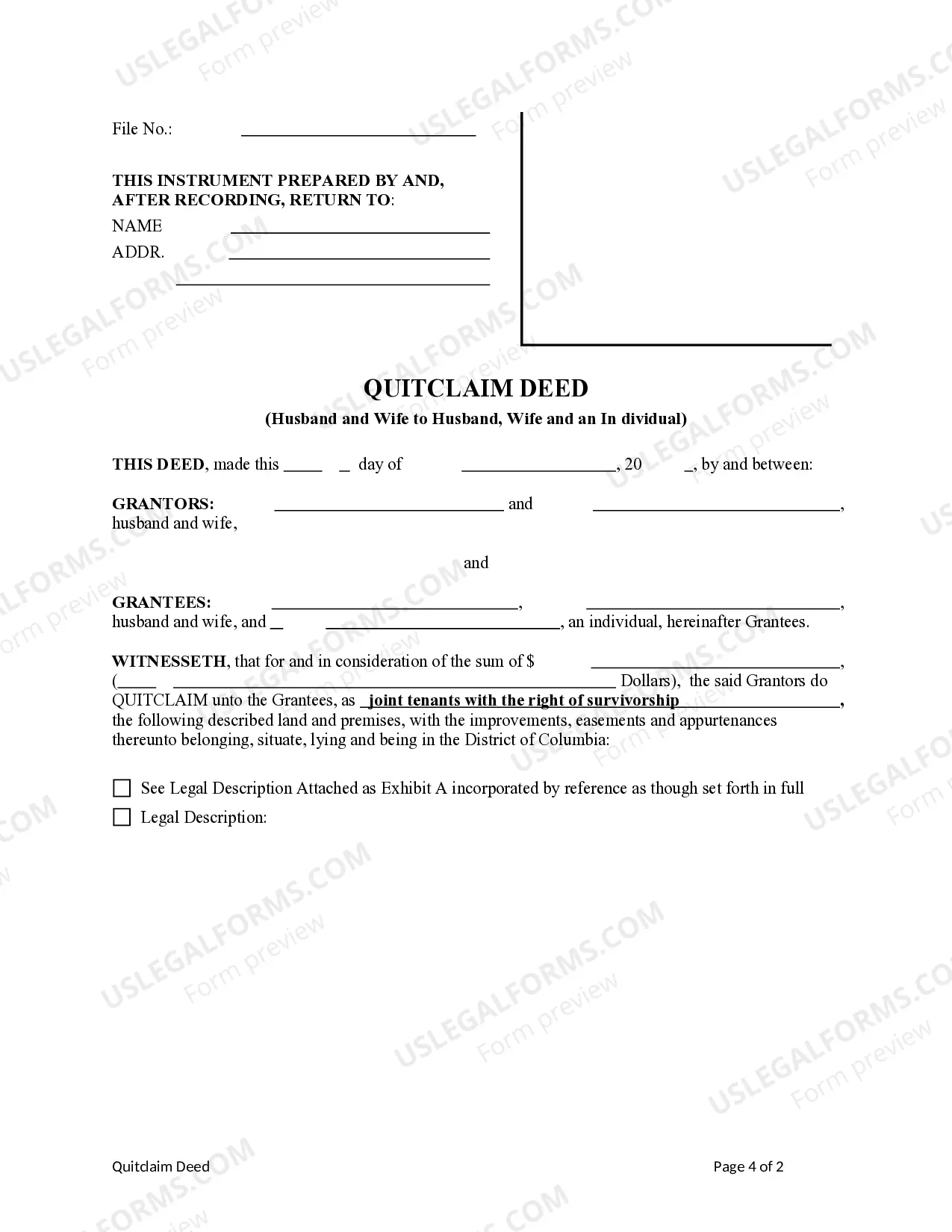
The Quitclaim Deed from Husband and Wife to Husband, Wife, and an Individual is a legal document used to transfer ownership of real property. In this form, the husband and wife, referred to as Grantors, convey their interest in the property to themselves and another individual, known as the Grantees. Unlike warranty deeds, a quitclaim deed does not guarantee that the Grantors hold valid title to the property; it simply transfers their interest, if any. This form is particularly useful for simplifying intra-family property transfers and clarifying ownership interests.
Main sections of this form
- Identification of the Grantors (husband and wife) and Grantees (husband, wife, and an individual).
- Legal description of the property being transferred.
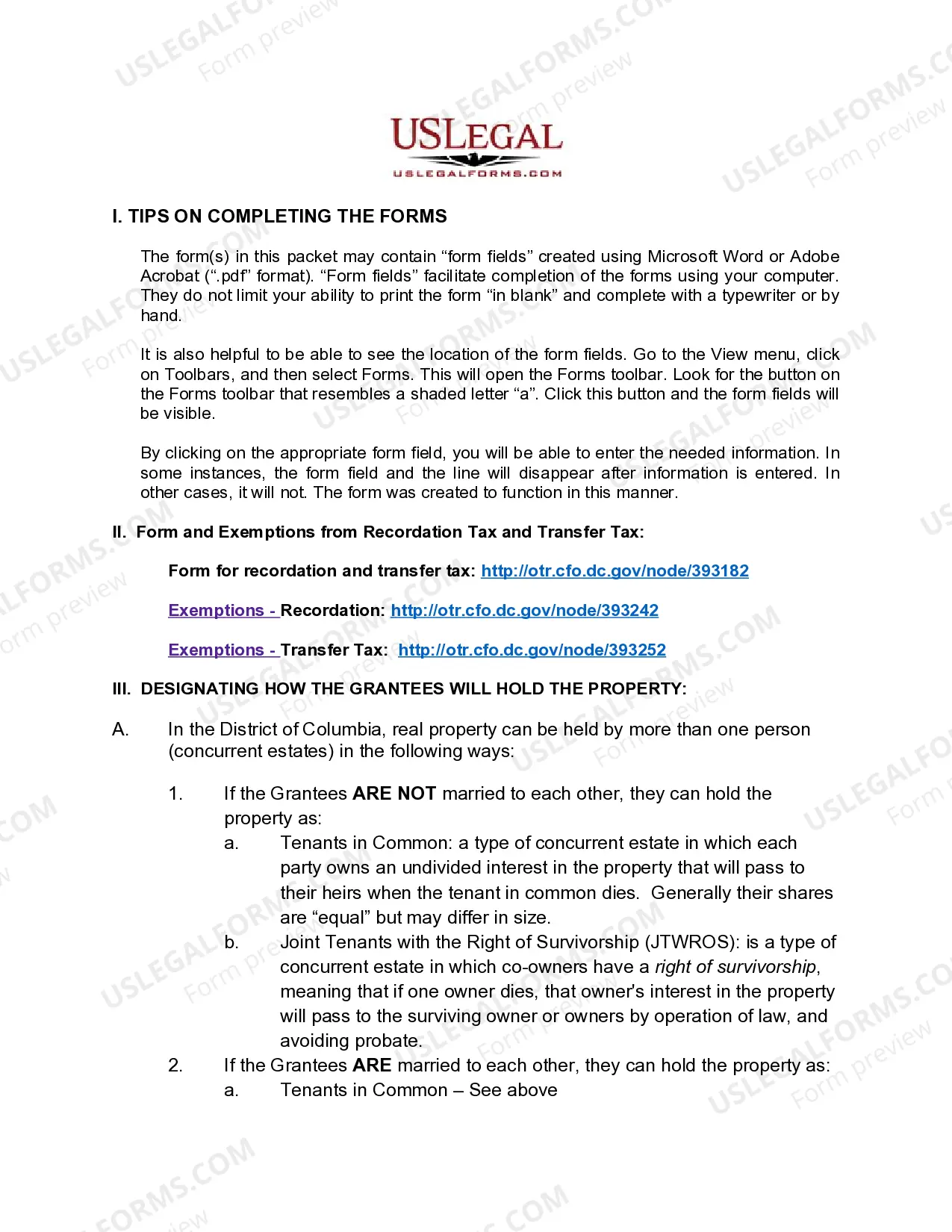
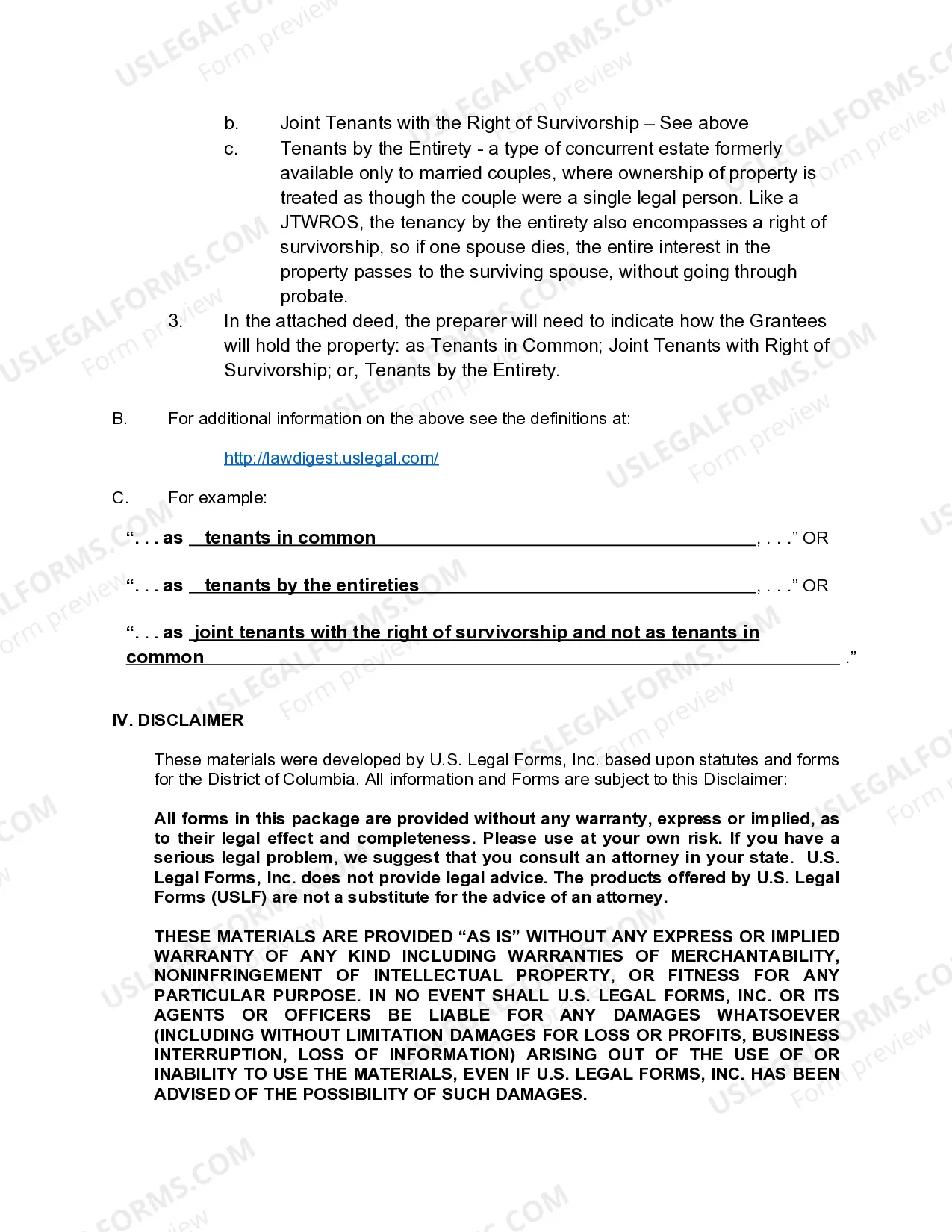
- Designations for how Grantees will hold the property (e.g., tenants in common, joint tenants with right of survivorship, or tenants by the entirety).
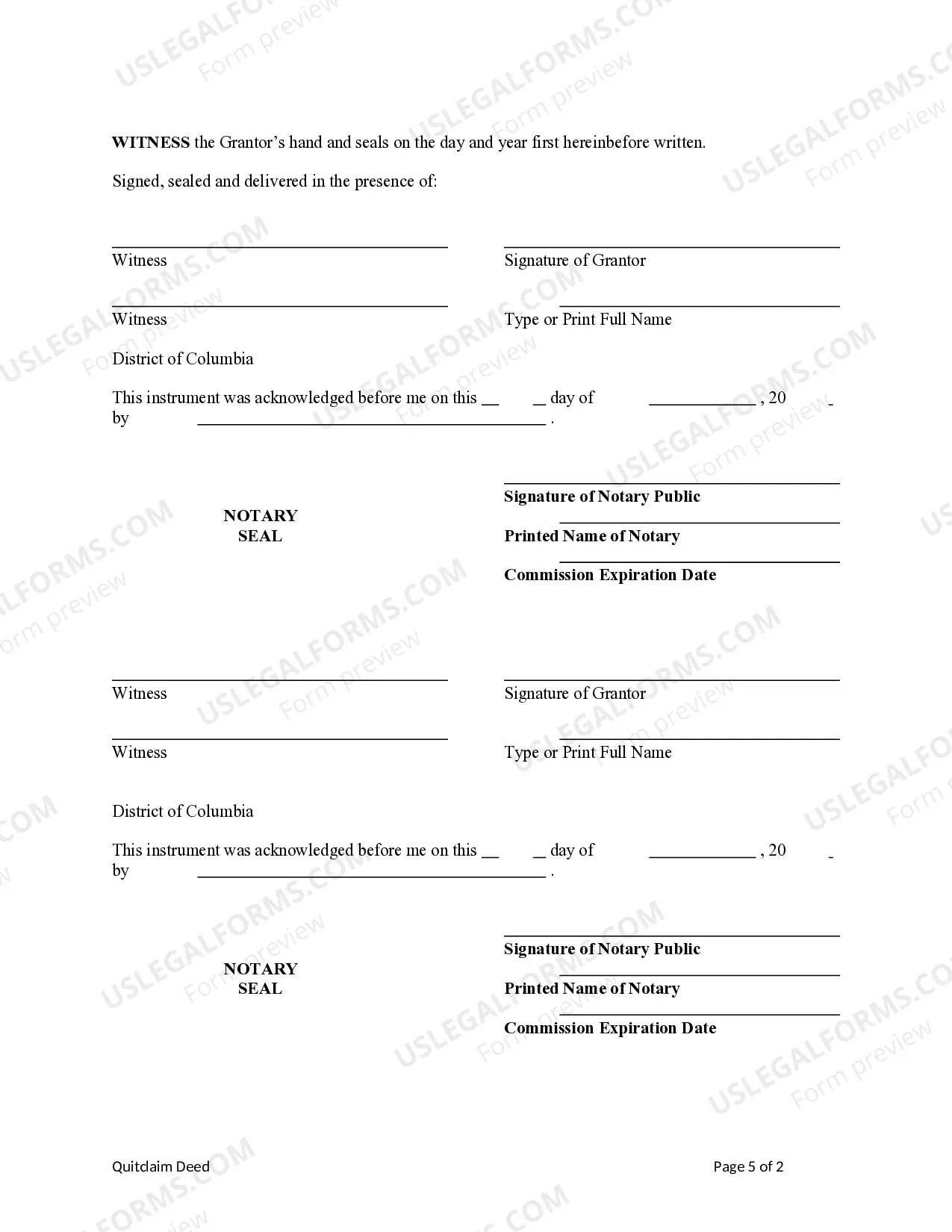
- Signatures of the Grantors to validate the transfer.
- Space for notary acknowledgment, if applicable.






Common use cases
This quitclaim deed form is typically used in situations where a husband and wife wish to transfer property to themselves and another person, such as during estate planning or to clarify ownership after a divorce. It is also appropriate when transferring property as a gift or in family transfers where no financial consideration is involved.
Who this form is for
This form is suitable for:
- Married couples looking to transfer property ownership among themselves and a third party.
- Individuals managing estate settlements or property inheritance.
- Anyone simplifying property transfers within family members or close associates.
Steps to complete this form
- Clearly identify the full names of the Grantors (husband and wife) and the Grantees (husband, wife, and the additional individual).
- Provide the legal description of the property involved in the transfer.
- Designate how the Grantees will hold the property (tenants in common, joint tenants with right of survivorship, or tenants by the entirety).
- Have all Grantors sign the deed in the designated areas.
- If required, obtain notarization to ensure the documentâs validity.
Notarization guidance
This form does not typically require notarization unless specified by local law. However, it is advisable to have the deed notarized to ensure its legal validity and recognition by authorities.
Get your form ready online
Our built-in tools help you complete, sign, share, and store your documents in one place.
Make edits, fill in missing information, and update formatting in US Legal Forms—just like you would in MS Word.
Download a copy, print it, send it by email, or mail it via USPS—whatever works best for your next step.
Sign and collect signatures with our SignNow integration. Send to multiple recipients, set reminders, and more. Go Premium to unlock E-Sign.
If this form requires notarization, complete it online through a secure video call—no need to meet a notary in person or wait for an appointment.
We protect your documents and personal data by following strict security and privacy standards.

Make edits, fill in missing information, and update formatting in US Legal Forms—just like you would in MS Word.

Download a copy, print it, send it by email, or mail it via USPS—whatever works best for your next step.

Sign and collect signatures with our SignNow integration. Send to multiple recipients, set reminders, and more. Go Premium to unlock E-Sign.

If this form requires notarization, complete it online through a secure video call—no need to meet a notary in person or wait for an appointment.

We protect your documents and personal data by following strict security and privacy standards.
Common mistakes to avoid
- Failing to include the legal description of the property.
- Not specifying how the Grantees will hold the property.
- Skipping the signatures of all Grantors.
- Omitting notarization if required in your jurisdiction.
Why use this form online
- Convenience of downloading and completing the form from home.
- Editable fields allow users to enter information accurately.
- Access to templates drafted by licensed attorneys ensures legal compliance.
Legal use & context
- The quitclaim deed effectively transfers any interest in the property held by the Grantors.
- This form is commonly accepted for property transfers in informal settings, such as family transactions.
- It is not a warranty deed; therefore, it does not provide any guarantees regarding title issues.
What to keep in mind
- The Quitclaim Deed is essential for transferring property ownership between family members.
- Understanding how to designate property ownership among Grantees is crucial.
- Including a legal description of the property is necessary for the deed's validity.
Looking for another form?
Form popularity
FAQ
Removing someone from a deed without their consent can be complex, but using a District of Columbia Quitclaim Deed from Husband and Wife to Husband, Wife and an Individual may be an option if you have their cooperation for the signature. In cases where consent isn’t possible, legal action may be necessary, which could involve court proceedings. It’s advisable to consult a legal expert to explore your options and understand the implications of the deed removal. Platforms like US Legal Forms can guide you through the required documentation.
Taking your husband's name off your house typically involves executing a District of Columbia Quitclaim Deed from Husband and Wife to Husband, Wife and an Individual. This deed allows you to convey ownership interests properly. After your husband signs the document, you must file it with the local authorities to finalize the removal of his name. For a smooth process, consider using a reliable platform like US Legal Forms.
To remove your husband's name from the title, you can use a District of Columbia Quitclaim Deed from Husband and Wife to Husband, Wife and an Individual. This legal document effectively transfers the ownership interest to the remaining parties. You will need to complete the quitclaim deed, have it signed by your husband, and then file it with the appropriate local office. Always consider consulting a legal professional to ensure the process meets local requirements.
A quitclaim deed is commonly used to transfer ownership of property between family members. For example, when spouses wish to remove one spouse from the title, a District of Columbia Quitclaim Deed from Husband and Wife to Husband, Wife and an Individual can simplify the process. This type of deed does not guarantee that the title is clear; rather, it conveys whatever interest the grantor has in the property. It is a practical option for straightforward transfers, making it essential in various personal and family situations.
A spouse might execute a quitclaim deed for several reasons, including simplifying a property's title transfer or addressing ownership during a divorce. The District of Columbia Quitclaim Deed from Husband and Wife to Husband, Wife and an Individual facilitates this process without needing a lengthy legal procedure. Additionally, it can be benefitting for estate planning, ensuring that property is transferred according to the wishes of the owners.
A quitclaim deed for a wife allows her to transfer her interest in a property to other parties, which can include her husband and another individual. It serves to clarify ownership, especially in cases of remarriage or divorce. Utilizing a District of Columbia Quitclaim Deed from Husband and Wife to Husband, Wife and an Individual simplifies this process. Overall, it's a legal tool that provides clear documentation of ownership changes.
In the District of Columbia, a quitclaim deed must include essential elements such as the names of the grantors and grantees, a legal description of the property, and must be signed in the presence of a notary. It's important to also state the type of deed being executed, such as a District of Columbia Quitclaim Deed from Husband and Wife to Husband, Wife and an Individual. Additionally, certain taxes and fees may apply when recording the deed.
Filling out a District of Columbia Quitclaim Deed from Husband and Wife to Husband, Wife and an Individual requires some attention to detail. Start by identifying the grantor (the person giving up rights) and the grantee (the person receiving rights). Clearly describe the property, including the legal description and address. Finally, ensure both parties sign and date the deed in front of a notary before filing it with the appropriate office.
To remove your husband's name from the property deed, you will need to create a District of Columbia Quitclaim Deed from Husband and Wife to Husband, Wife and an Individual. This deed will allow you to transfer ownership rights. Typically, both parties should sign this document in front of a notary. After executing the quitclaim deed, file it with the D.C. Recorder of Deeds to ensure it's legally recognized.
While quitclaim deeds offer a fast way to transfer property, they often lack legal protections for the recipient. Without assurance regarding the title or any liabilities, the buyer might face risks if issues arise. To avoid these complications, consider using USLegalForms for guidance and to access forms specific to the District of Columbia Quitclaim Deed from Husband and Wife to Husband, Wife and an Individual.