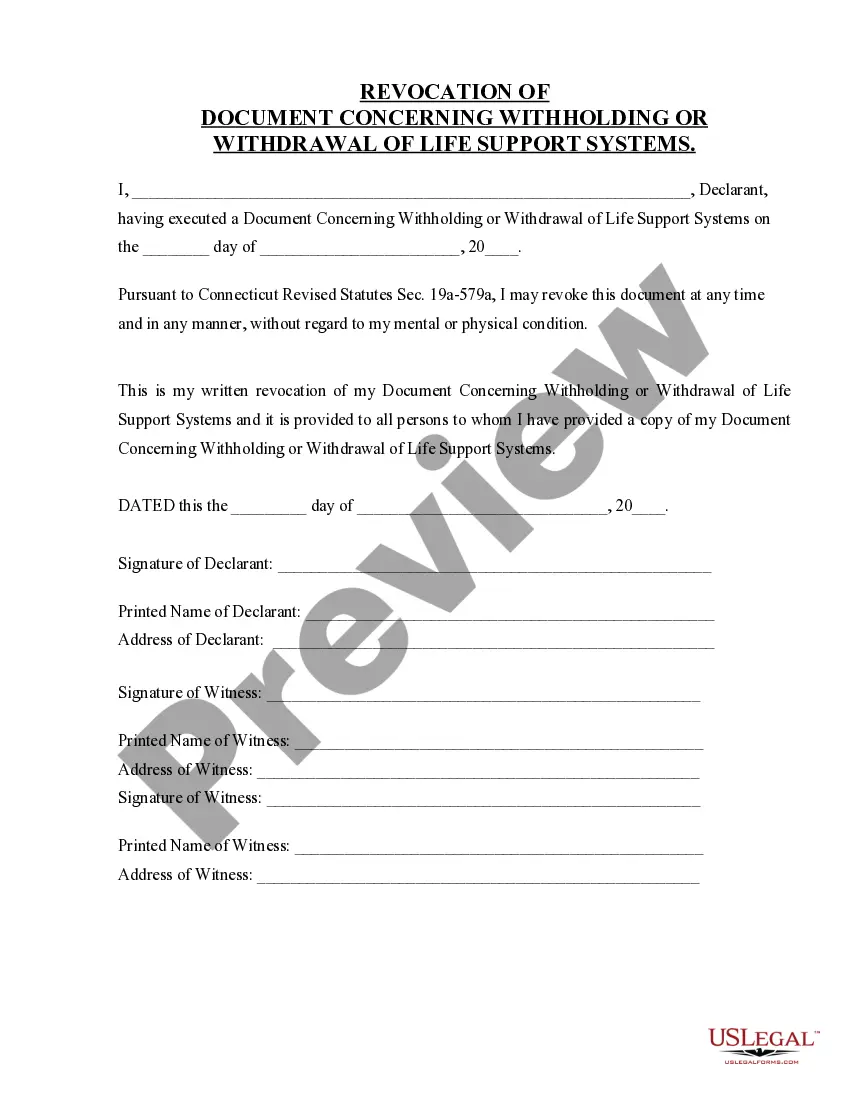
Connecticut Revocation of Statutory Health Care Directive
Understanding this form
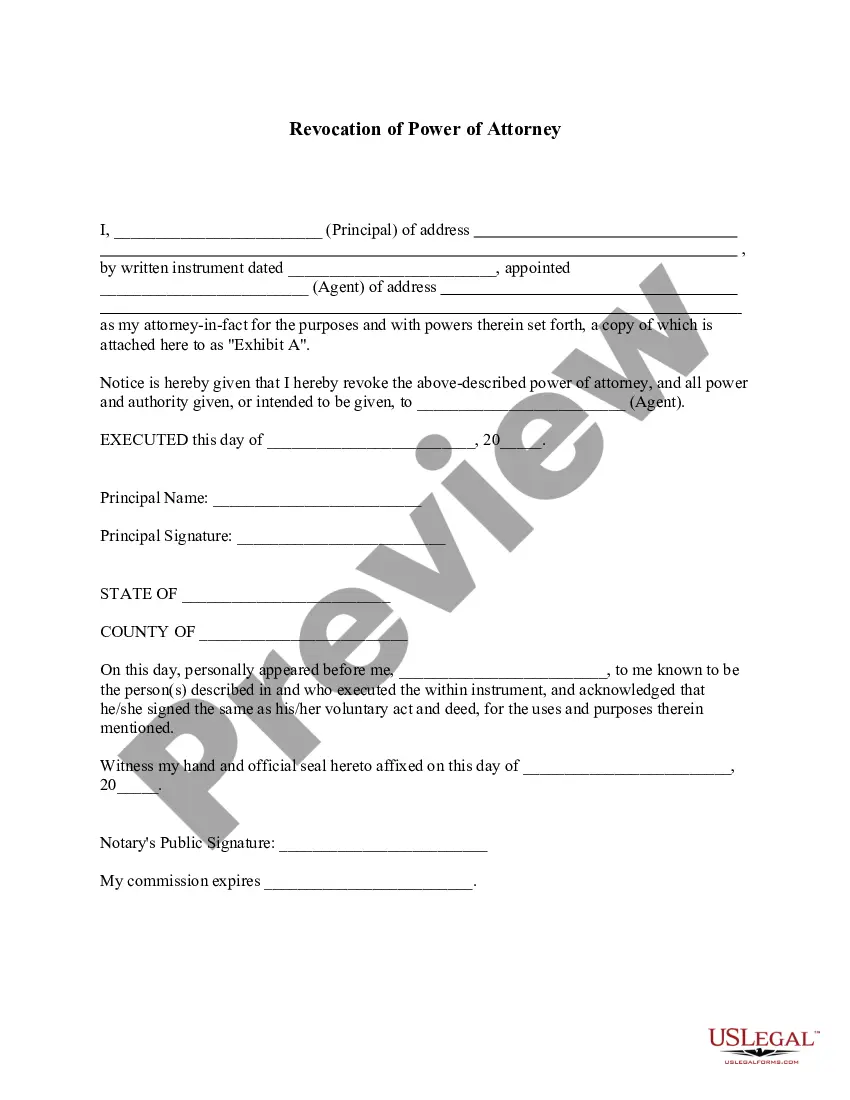
The Revocation of Statutory Health Care Directive is a legal document that allows individuals to revoke their previously made decisions regarding the withholding or withdrawal of life support systems. This form counters a prior directive and enables individuals to change their wishes regarding life-prolonging treatments at any time, regardless of their mental or physical condition. It is essential for individuals who wish to update their health care directives as their circumstances and preferences change.
What’s included in this form
- Declarant's details: The individual revoking the document must provide their name, address, and signature.
- Witness signatures: The form requires two witness signatures to validate the revocation.
- Timestamps: The form includes fields for the date on which the revocation and the original directive were signed.
- Statement of revocation: A clear declaration that the individual is revoking their prior health care directive.
When to use this document
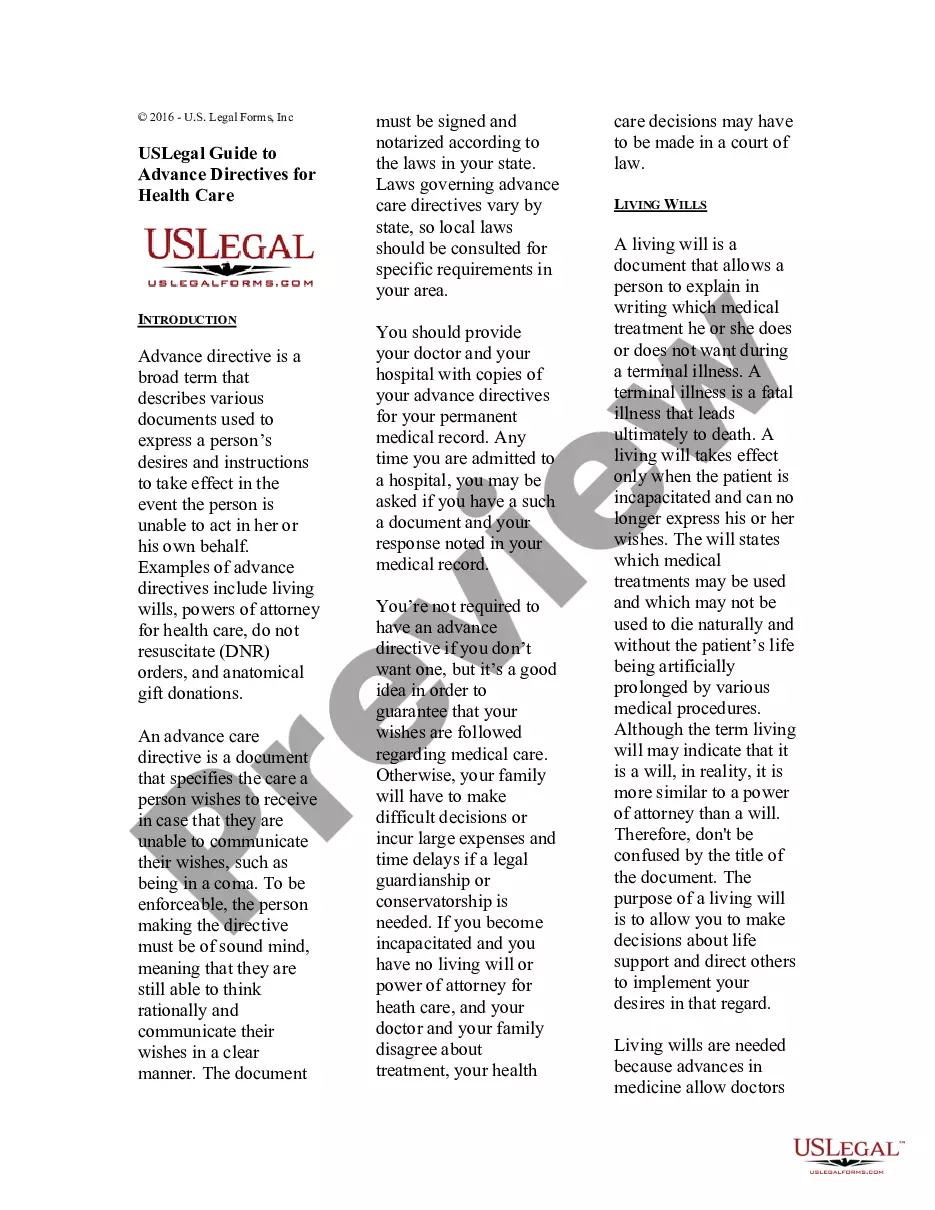
This form is useful when an individual decides they no longer want their medical treatment preferences as outlined in a previous health care directive. Situations may include changes in personal beliefs, family situations, or a desire for different medical options. It is critical for those facing significant health decisions or changing life circumstances.
Who should use this form
- Any individual who has previously executed a Document Concerning Withholding or Withdrawal of Life Support Systems.
- Those who wish to change their medical treatment preferences due to altered circumstances or beliefs.
- People seeking clarity about their current health care directives to better align them with their present wishes.
Completing this form step by step
- Identify yourself: Fill in your name, address, and signature as the Declarant.
- Indicate the date: Write the date you are revoking the previous directive.
- Provide witness information: Obtain signatures from two witnesses, along with their printed names and addresses.
- State the revocation: Clearly state that this document revokes your previous health care directive.
- Ensure copies: Provide copies of the revocation to anyone who received the original directive.
Notarization guidance
Notarization is not commonly needed for this form. However, certain documents or local rules may make it necessary. Our notarization service, powered by Notarize, allows you to finalize it securely online anytime, day or night.
Get your form ready online
Our built-in tools help you complete, sign, share, and store your documents in one place.
Make edits, fill in missing information, and update formatting in US Legal Forms—just like you would in MS Word.
Download a copy, print it, send it by email, or mail it via USPS—whatever works best for your next step.
Sign and collect signatures with our SignNow integration. Send to multiple recipients, set reminders, and more. Go Premium to unlock E-Sign.
If this form requires notarization, complete it online through a secure video call—no need to meet a notary in person or wait for an appointment.
We protect your documents and personal data by following strict security and privacy standards.

Make edits, fill in missing information, and update formatting in US Legal Forms—just like you would in MS Word.

Download a copy, print it, send it by email, or mail it via USPS—whatever works best for your next step.

Sign and collect signatures with our SignNow integration. Send to multiple recipients, set reminders, and more. Go Premium to unlock E-Sign.

If this form requires notarization, complete it online through a secure video call—no need to meet a notary in person or wait for an appointment.

We protect your documents and personal data by following strict security and privacy standards.
Mistakes to watch out for
- Failing to have two witnesses sign the form, which may invalidate the revocation.
- Not dating the revocation, leaving ambiguity about when it became effective.
- Neglecting to inform relevant parties about the revocation, potentially leading to confusion in medical situations.
Benefits of using this form online
- Convenience of downloading and filling out the form at your own pace.
- Easy access to legal guidance through detailed instructions included in the form.
- Ability to edit and customize the form as necessary to reflect your specific preferences.
Main things to remember
- The Revocation of Statutory Health Care Directive allows individuals to change their health care preferences.
- This form empowers you to nullify previous decisions regarding life support systems.
- Ensure to notify all relevant parties of the revocation to avoid confusion.
Looking for another form?
Form popularity
FAQ
Yes, a power of attorney can sometimes override an advance directive, depending on the circumstances and the language of the documents. The legal authority granted to the agent in the power of attorney allows them to make health care decisions that may not align with the advance directive. Therefore, it's essential to clearly outline your wishes in both documents. Familiarizing yourself with the Connecticut Revocation of Statutory Health Care Directive ensures cohesive decision-making.
An advance directive is a broad term that encompasses documents like living wills and powers of attorney. A POLST (Physician Orders for Life-Sustaining Treatment) form, however, is more specific and provides detailed medical orders based on your preferences. While both documents guide health care decisions, they serve different purposes. It's vital to understand these distinctions when discussing the Connecticut Revocation of Statutory Health Care Directive.
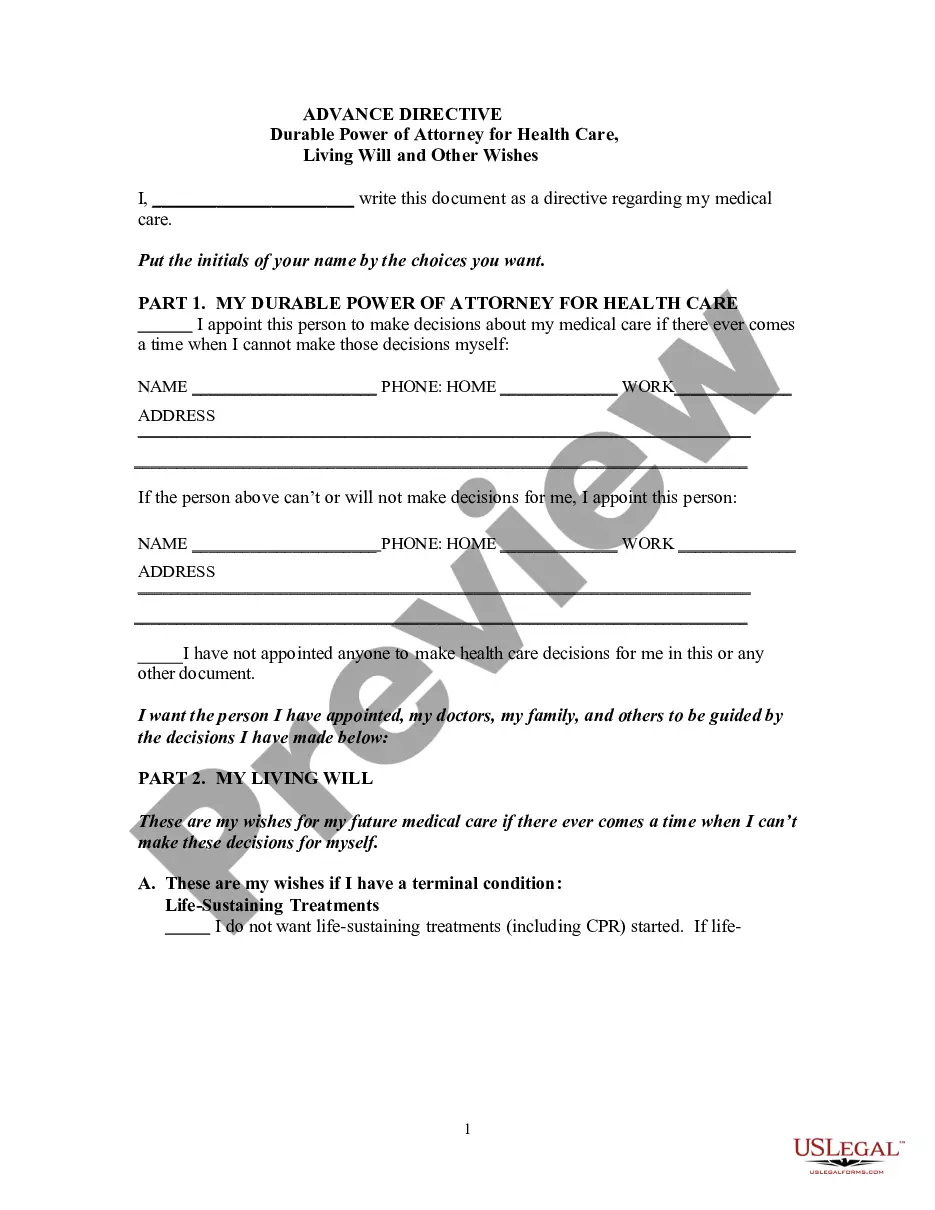
The two main directives in health care planning are the living will and the durable power of attorney. The living will expresses your wishes regarding medical treatment at the end of life. Conversely, the durable power of attorney appoints someone to make health care decisions if you are unable to do so. It's crucial to have these documents in place, especially when considering the Connecticut Revocation of Statutory Health Care Directive.
In the realm of advance directives, you primarily encounter living wills and durable powers of attorney for health care. A living will outlines your medical treatment preferences when you cannot communicate them yourself. On the other hand, a durable power of attorney designates a trusted individual to make health care decisions on your behalf. Understanding these types is essential for effective management of your Connecticut Revocation of Statutory Health Care Directive.
In Connecticut, the two primary types of advance directives are the living will and the durable power of attorney for health care. A living will specifies your medical preferences, while a durable power of attorney allows you to appoint someone to make healthcare decisions for you. Reviewing these options is essential, especially if you are considering the Connecticut Revocation of Statutory Health Care Directive.
A representative usually refers to someone acting on your behalf in specific situations without legal authority, while a power of attorney is a legally recognized agent with the authority to act in various capacities. When thinking about your options for medical directives, it's crucial to understand how the Connecticut Revocation of Statutory Health Care Directive might impact these roles.
While a healthcare power of attorney offers many benefits, there are some disadvantages to consider. For example, if the appointed person does not understand your wishes, it could lead to decisions that do not align with your preferences. Additionally, the Connecticut Revocation of Statutory Health Care Directive needs to be considered to ensure your choices are accurately represented.
Generally, a power of attorney cannot override a health care proxy if the proxy has been properly designated and follows state guidelines. In Connecticut, if you have a statutory health care directive in place, it typically governs your medical decisions. However, it's important to review your specific documents to ensure clarity and compliance with the Connecticut Revocation of Statutory Health Care Directive.
The primary difference lies in their functions. A power of attorney can manage your finances and legal affairs, while a healthcare representative focuses specifically on medical decisions. Understanding this distinction is crucial, especially if you revoke a health care directive in Connecticut and appoint a health care representative.
A health care representative is someone you appoint to make medical decisions on your behalf when you are unable to do so. In contrast, a power of attorney (POA) can grant someone the authority to make financial or legal decisions, including health care matters. It's essential to understand the scope of each role, especially concerning the Connecticut Revocation of Statutory Health Care Directive.