Connecticut Warranty Deed from Individual to Individual
What this document covers
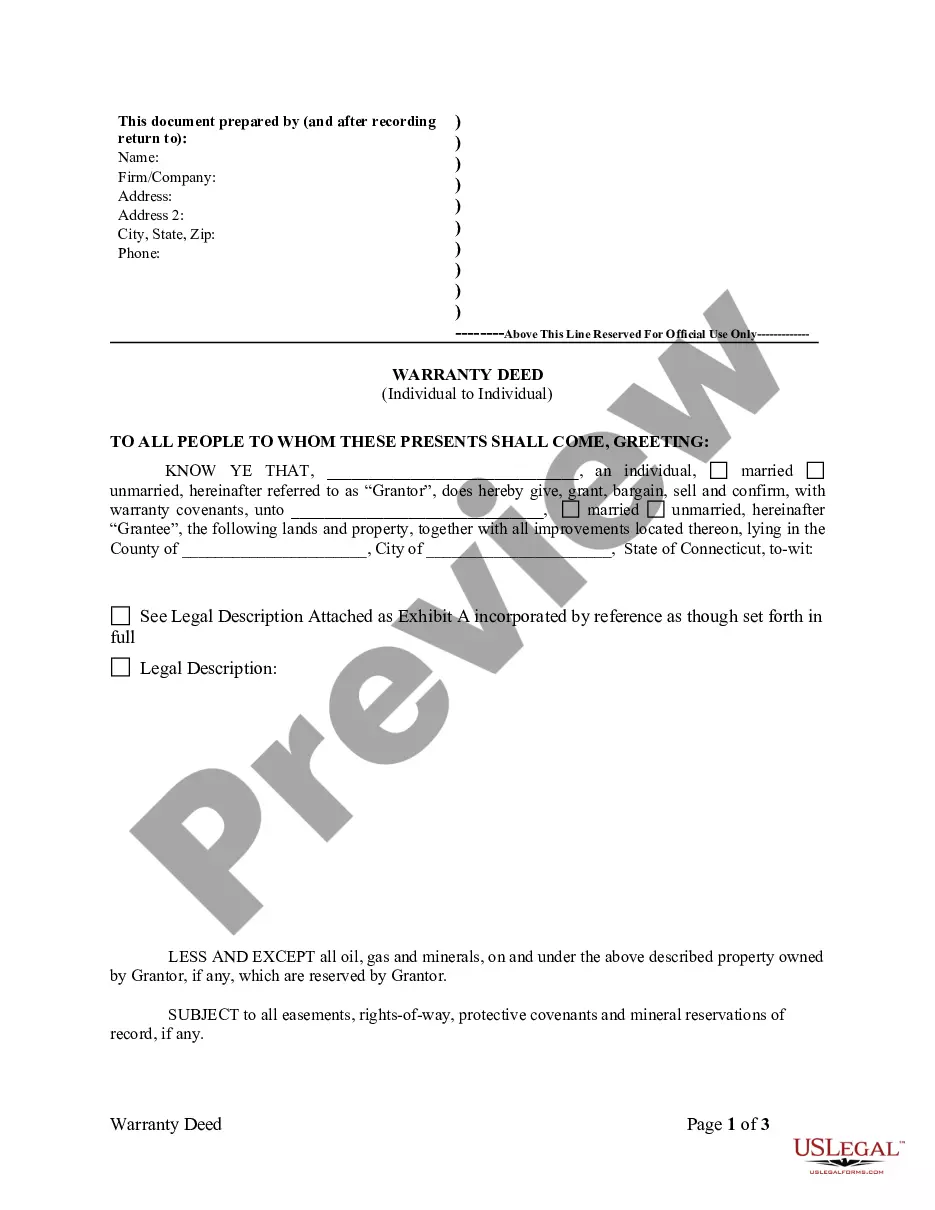
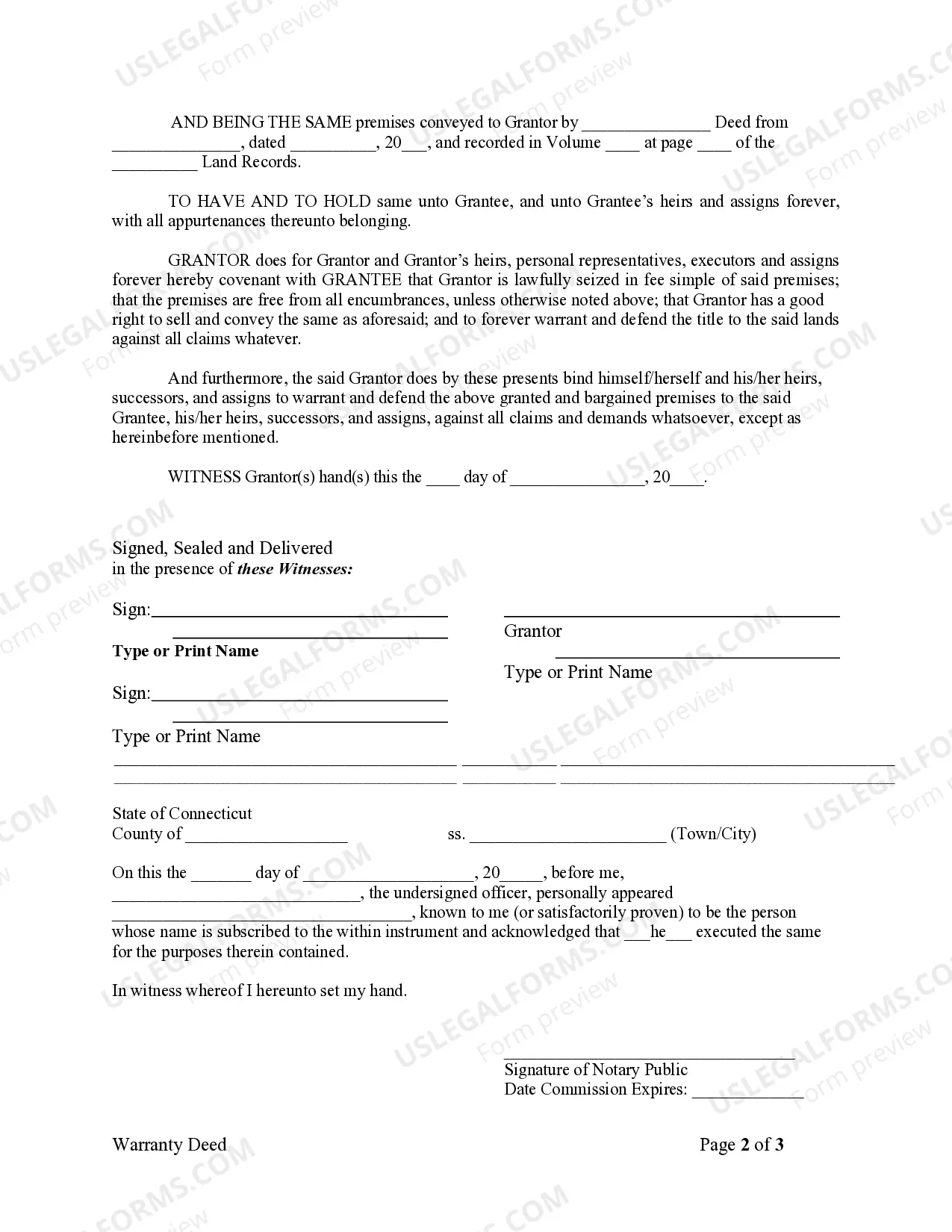
The Warranty Deed from Individual to Individual is a legal document that facilitates the transfer of property ownership from one individual (the Grantor) to another (the Grantee). This deed ensures that the Grantor guarantees the title and conveys the property subject to any reservations like oil, gas, and minerals. It is designed for private transactions between individuals, distinguishing it from similar deeds like quitclaim deeds and special warranty deeds, which serve different legal purposes.
Key components of this form
- Identification of the Grantor (seller) and Grantee (buyer).
- Description of the property being transferred.
- Legal assurances regarding the title, including warranty against encumbrances.
- Specification of any reserved rights, such as mineral rights.
- Signatures of the Grantor and acknowledgment by a notary public.




Common use cases
This Warranty Deed is used when an individual wishes to sell or transfer property ownership to another individual. It is applicable in various scenarios, such as selling a home, transferring a family property, or any situation where personal property transfer is involved. If you want to ensure a secure transfer with legal guarantees on the property title, this deed is the appropriate choice.
Who needs this form
- Individuals transferring property to another individual.
- Homeowners wishing to sell their property.
- Family members wanting to pass on property to relatives.
- Anyone seeking to ensure legal protection of property rights during a transfer.
How to prepare this document
- Identify and enter the names of the Grantor and Grantee.
- Provide a detailed description of the property being conveyed.
- Specify any reservations, such as mineral rights, if applicable.
- Include the date and ensure both parties sign the document.
- Have the document notarized to confirm the identities of the signers.
Notarization requirements for this form
Notarization is required for this form to take effect. Our online notarization service, powered by Notarize, lets you verify and sign documents remotely through an encrypted video session, available 24/7.
Get your form ready online
Our built-in tools help you complete, sign, share, and store your documents in one place.
Make edits, fill in missing information, and update formatting in US Legal Forms—just like you would in MS Word.
Download a copy, print it, send it by email, or mail it via USPS—whatever works best for your next step.
Sign and collect signatures with our SignNow integration. Send to multiple recipients, set reminders, and more. Go Premium to unlock E-Sign.
If this form requires notarization, complete it online through a secure video call—no need to meet a notary in person or wait for an appointment.
We protect your documents and personal data by following strict security and privacy standards.

Make edits, fill in missing information, and update formatting in US Legal Forms—just like you would in MS Word.

Download a copy, print it, send it by email, or mail it via USPS—whatever works best for your next step.

Sign and collect signatures with our SignNow integration. Send to multiple recipients, set reminders, and more. Go Premium to unlock E-Sign.

If this form requires notarization, complete it online through a secure video call—no need to meet a notary in person or wait for an appointment.

We protect your documents and personal data by following strict security and privacy standards.
Avoid these common issues
- Failing to accurately describe the property can lead to legal disputes.
- Omitting signatures or dates may invalidate the deed.
- Not properly indicating any reserved rights or encumbrances can create issues in ownership verification.
- Neglecting notarization if required in your state may render the deed unenforceable.
Advantages of online completion
- Convenience of downloading and filling out forms at any time.
- Editability allows users to customize the form as needed.
- Access to professionally drafted templates ensures legal compliance.
- Time-saving as compared to meeting with legal professionals in person.
Looking for another form?



Form popularity
FAQ
Evicting someone whose name appears on the deed can be complicated. In most cases, you cannot simply remove them without going through the legal process. To proceed, you may need to file a partition action to divide ownership or resolve the issue through negotiation. It is advisable to consult legal resources or services like US Legal Forms for guidance on using a Connecticut Warranty Deed from Individual to Individual in these situations.
Removing someone from a deed in Connecticut involves filing a Connecticut Warranty Deed from Individual to Individual, which serves to officially alter the ownership records. This process requires both parties' consent and should include proper documentation and notarization. Once completed, you must file the new deed with your local land records. By doing this, you ensure the change is recognized legally.
To remove someone's name from a property deed, you typically need to execute a Connecticut Warranty Deed from Individual to Individual. This legal document facilitates the transfer of ownership rights. Typically, both parties must agree to the change, and the deed should be signed and notarized. You may also need to file the new deed with the local land records office for it to take effect.
Transferring a warranty deed involves completing and signing a Connecticut Warranty Deed from Individual to Individual form. Be sure to include all relevant details about both the property and the parties involved. After signing, ensure that the deed is notarized and file it with your local government office to finalize the transfer. Use US Legal Forms to access the necessary templates and step-by-step guidance that simplify this process.
Taking someone off a deed usually involves executing a quitclaim deed or similar documentation. This process should be done with both parties' consent in Connecticut. After creating the appropriate deed, file it with your local land records office to make the change official. US Legal Forms provides you with the needed templates to facilitate this without hassle.
To remove your ex from your property deed, you typically need to create and file a deed that eliminates their name. A Connecticut Warranty Deed from Individual to Individual can serve this purpose, through the use of a quitclaim deed if both parties agree. It’s essential to handle this process correctly to protect your ownership rights. Using US Legal Forms ensures you have the right tools and documentation to complete this task efficiently.
Yes, two or more people can be on a Connecticut Warranty Deed from Individual to Individual. When including multiple names, make sure to clearly indicate how ownership will be held, whether as joint tenants or tenants in common. This distinction affects rights of inheritance and management of the property. Our platform provides templates to assist you in accurately representing multiple owners.
You can transfer a deed without an attorney in Connecticut, but it’s important to understand the legal implications involved. By using a Connecticut Warranty Deed from Individual to Individual form, you can handle the transfer yourself. However, gaining a basic understanding of local property laws is crucial to avoid future complications. US Legal Forms offers user-friendly resources to help you navigate this process.
Yes, you can remove someone's name from a deed, but the process requires legal steps. You may need to execute a quitclaim deed or a similar document, depending on the situation. It’s advisable to consult with a legal professional to ensure the process complies with Connecticut state laws. Using US Legal Forms can help guide you through creating the necessary paperwork.
To fill out a Connecticut Warranty Deed from Individual to Individual, you need to provide specific information. Start by entering the names of the grantor and grantee, along with a clear property description. Make sure to sign the deed in front of a notary public, as notarization is essential for the deed to be valid. You can use our platform, US Legal Forms, to access customizable templates that simplify this process.