Connecticut Quitclaim Deed from Husband to Himself and Wife
What this document covers
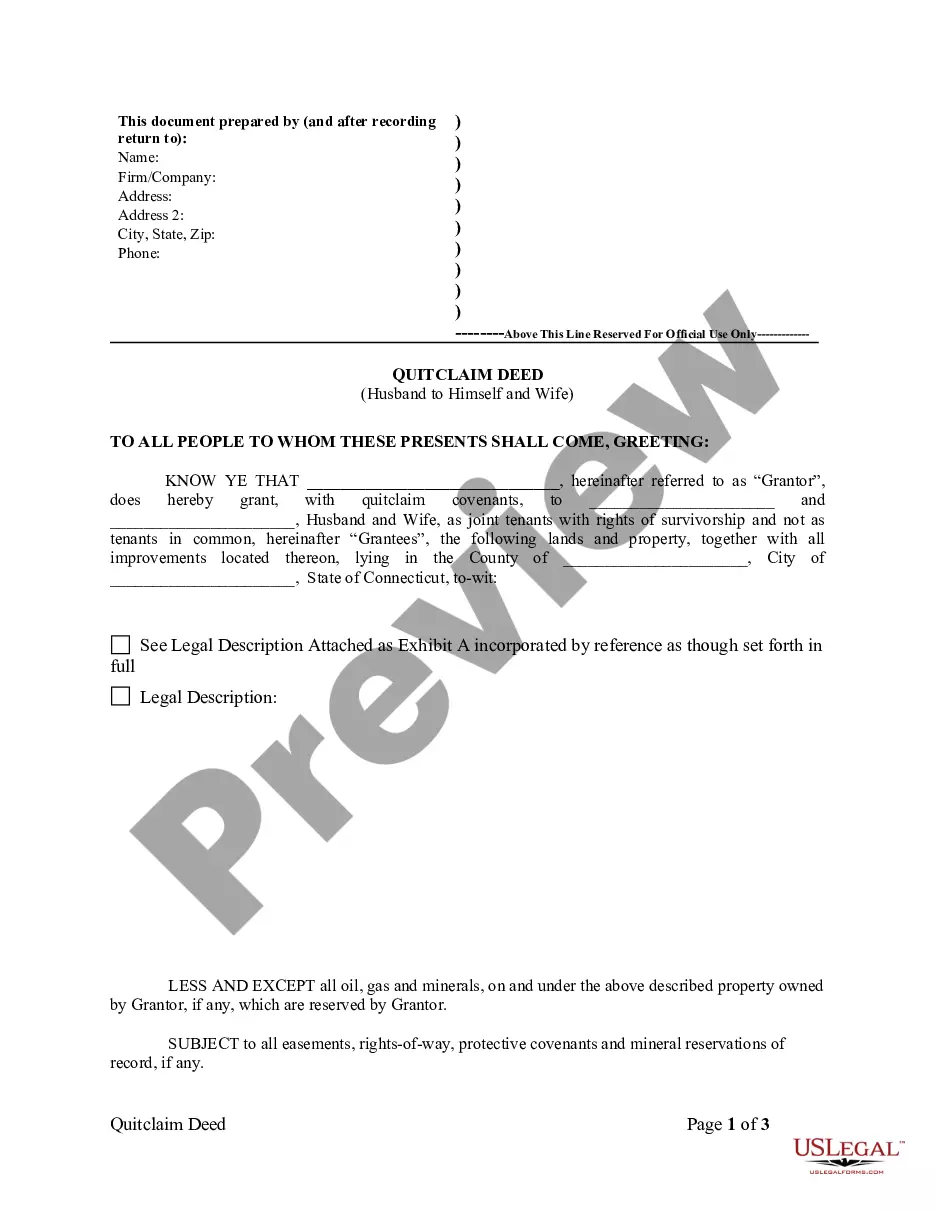
The Quitclaim Deed from Husband to Himself and Wife is a legal document that allows a husband to transfer ownership of property to himself and his wife. This form is distinct from other types of deeds, such as warranty deeds, as it does not provide any guarantees regarding the property title. Instead, it conveys any interest the husband may have in the property, making it a straightforward way to clarify ownership between spouses.
Main sections of this form
- Identification of the Grantor (husband) and Grantees (husband and wife).
- Description of the property being conveyed.
- Reservation clause regarding oil, gas, and minerals.
- Subject to existing easements and rights-of-way.
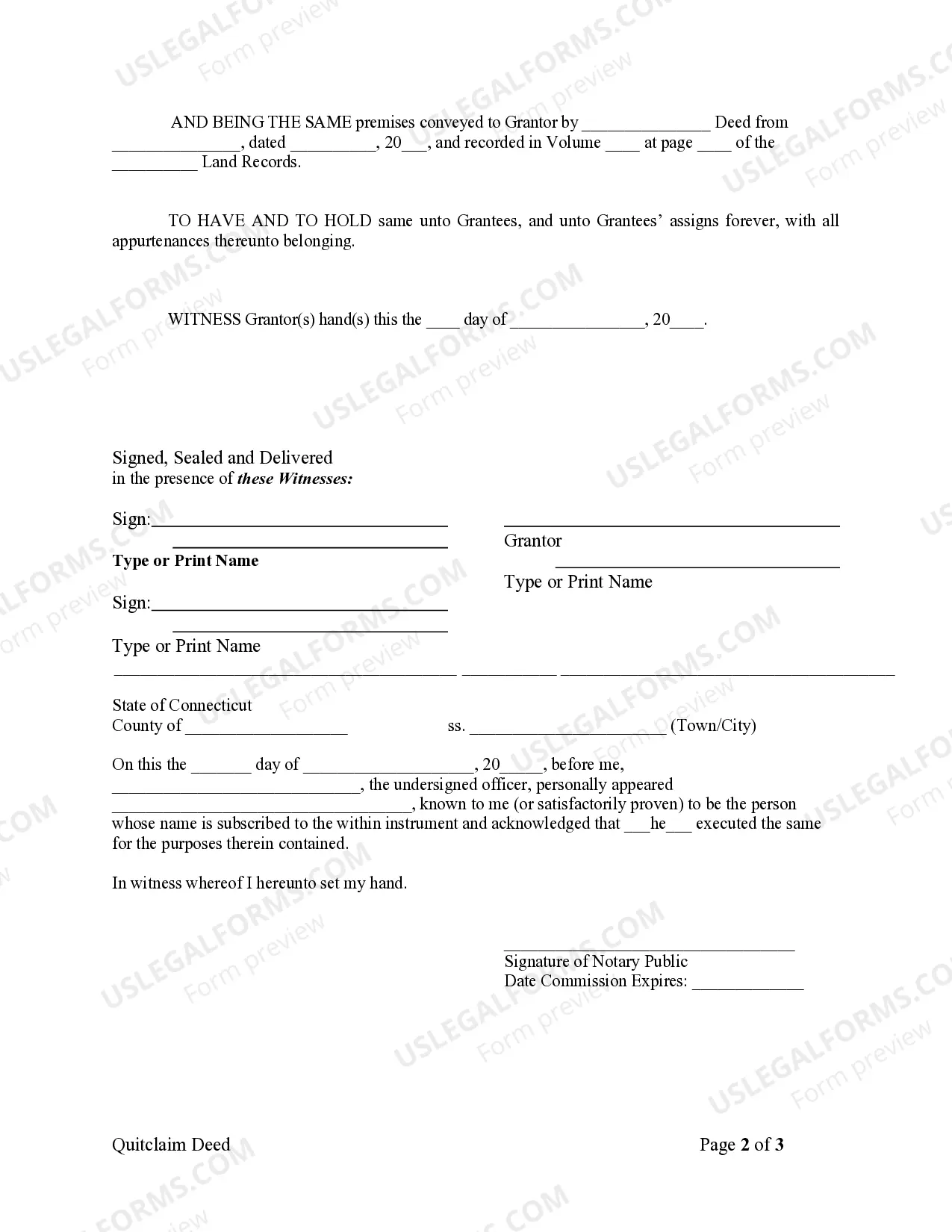
- Signature of the Grantor and witnesses for legal execution.





Situations where this form applies
This form is often used when a husband wants to clarify property ownership by adding his wife to the deed of a property he already owns. It can be useful in various scenarios such as estate planning, marital agreements, or when updating property records after significant life events such as marriage or divorce.
Intended users of this form
- Married couples who want to share ownership of property.
- Individuals involved in estate planning.
- Homeowners looking to update the title after a major life event.
Instructions for completing this form
- Identify the parties involved: the Grantor (husband) and Grantees (husband and wife).
- Specify the property being conveyed, including the property description.
- Include any reservations such as mineral rights.
- Enter the date of execution and secure signatures from the Grantor and witnesses.
- Record the completed deed with the local land records office if required.
Is notarization required?
Notarization is required for this form to take effect. Our online notarization service, powered by Notarize, lets you verify and sign documents remotely through an encrypted video session, available 24/7.
Get your form ready online
Our built-in tools help you complete, sign, share, and store your documents in one place.
Make edits, fill in missing information, and update formatting in US Legal Forms—just like you would in MS Word.
Download a copy, print it, send it by email, or mail it via USPS—whatever works best for your next step.
Sign and collect signatures with our SignNow integration. Send to multiple recipients, set reminders, and more. Go Premium to unlock E-Sign.
If this form requires notarization, complete it online through a secure video call—no need to meet a notary in person or wait for an appointment.
We protect your documents and personal data by following strict security and privacy standards.

Make edits, fill in missing information, and update formatting in US Legal Forms—just like you would in MS Word.

Download a copy, print it, send it by email, or mail it via USPS—whatever works best for your next step.

Sign and collect signatures with our SignNow integration. Send to multiple recipients, set reminders, and more. Go Premium to unlock E-Sign.

If this form requires notarization, complete it online through a secure video call—no need to meet a notary in person or wait for an appointment.

We protect your documents and personal data by following strict security and privacy standards.
Mistakes to watch out for
- Failing to provide a complete and accurate property description.
- Not including a reservation clause for mineral rights when applicable.
- Omitting signatures from necessary witnesses.
- Not recording the deed with local authorities as required.
Advantages of online completion
- Immediate access to a legally vetted form that saves time.
- The ability to easily customize the details specific to your situation.
- Convenient download options for offline use.
What to keep in mind
- The Quitclaim Deed allows for the transfer of property ownership between spouses.
- It is vital for clarifying ownership and addressing potential disputes.
- Complete all sections accurately to ensure the deed is legally binding.
Looking for another form?







Form popularity
FAQ
Yes, you can fill out a Connecticut Quitclaim Deed from Husband to Himself and Wife yourself, but it's important to ensure that you understand the basic requirements. This deed transfers property ownership, so accuracy is crucial. You can find templates and guidance online, including resources on platforms like uslegalforms, which can simplify the process. However, consulting with a legal expert may help you avoid potential pitfalls and ensure everything is completed correctly.
The primary beneficiaries of a Connecticut Quitclaim Deed from Husband to Himself and Wife are typically family members, especially spouses. This deed allows them to simplify the transfer of ownership without the complexities of a traditional sale. It serves as a handy tool for estate planning, helping families maintain property within the family unit. Moreover, it can facilitate smoother transactions during divorce or inheritance situations.
While a Connecticut Quitclaim Deed from Husband to Himself and Wife is generally straightforward, it may carry some risks. One significant concern is that it does not guarantee clear title or protect against claims against the property. This means that if there are unknown liens or issues, the new owner may face complications. Therefore, it’s advisable to have a title search conducted to mitigate any potential problems.
People typically use a Connecticut Quitclaim Deed from Husband to Himself and Wife to transfer property ownership easily and quickly. This type of deed is often used in family situations, such as marriage or divorce, where one spouse wants to give property to the other. Furthermore, it can help simplify the process of updating property titles without the need for extended legal procedures. Overall, it serves as a straightforward method to adjust ownership stakes.
Yes, you can create a Connecticut Quitclaim Deed from Husband to Himself and Wife by yourself. However, it's essential to ensure that you follow the legal requirements for your state, including proper formatting and notarization. If you're unsure about the process, consider using online resources or platforms like USLegalForms to guide you. This can help you avoid mistakes and ensure your deed is valid.
To successfully execute a Connecticut Quitclaim Deed from Husband to Himself and Wife, specific requirements must be met. The deed must include the names of the grantor and grantee, a legal description of the property, and must be signed by the grantor. Additionally, it's important that the deed is notarized and filed with the local land records office for public access.
Yes, you can create a Connecticut Quitclaim Deed from Husband to Himself and Wife on your own if you feel comfortable with the process. However, it's essential to understand all legal requirements to avoid mistakes. If you're unsure, using platforms like USLegalForms can provide templates and guidance to ensure your document is correct and satisfies state laws.
The process for a Connecticut Quitclaim Deed from Husband to Himself and Wife involves several steps. First, you must fill out the quitclaim deed form with accurate information. Next, the document needs to be signed in the presence of a notary. After notarization, you should file the deed with the local land records office to ensure it is legally recognized.
People often view quitclaim deeds with skepticism because they offer limited protection to buyers. Unlike warranty deeds, a Connecticut Quitclaim Deed from Husband to Himself and Wife does not guarantee the absence of liens or claims against the property. This lack of guarantees can lead to potential disputes in the future. Therefore, it is crucial to conduct thorough research before proceeding with such a deed.
In New York, both parties generally need to be present to complete the transfer of a title using a quitclaim deed. However, exceptions can occur if one party provides a power of attorney. For a seamless process, utilizing a Connecticut Quitclaim Deed from Husband to Himself and Wife ensures clarity and legality, making it easier for couples to navigate this transfer. The US Legal Forms platform offers resources and templates to facilitate this deed efficiently.