Connecticut Quitclaim Deed from Corporation to Two Individuals
Overview of this form
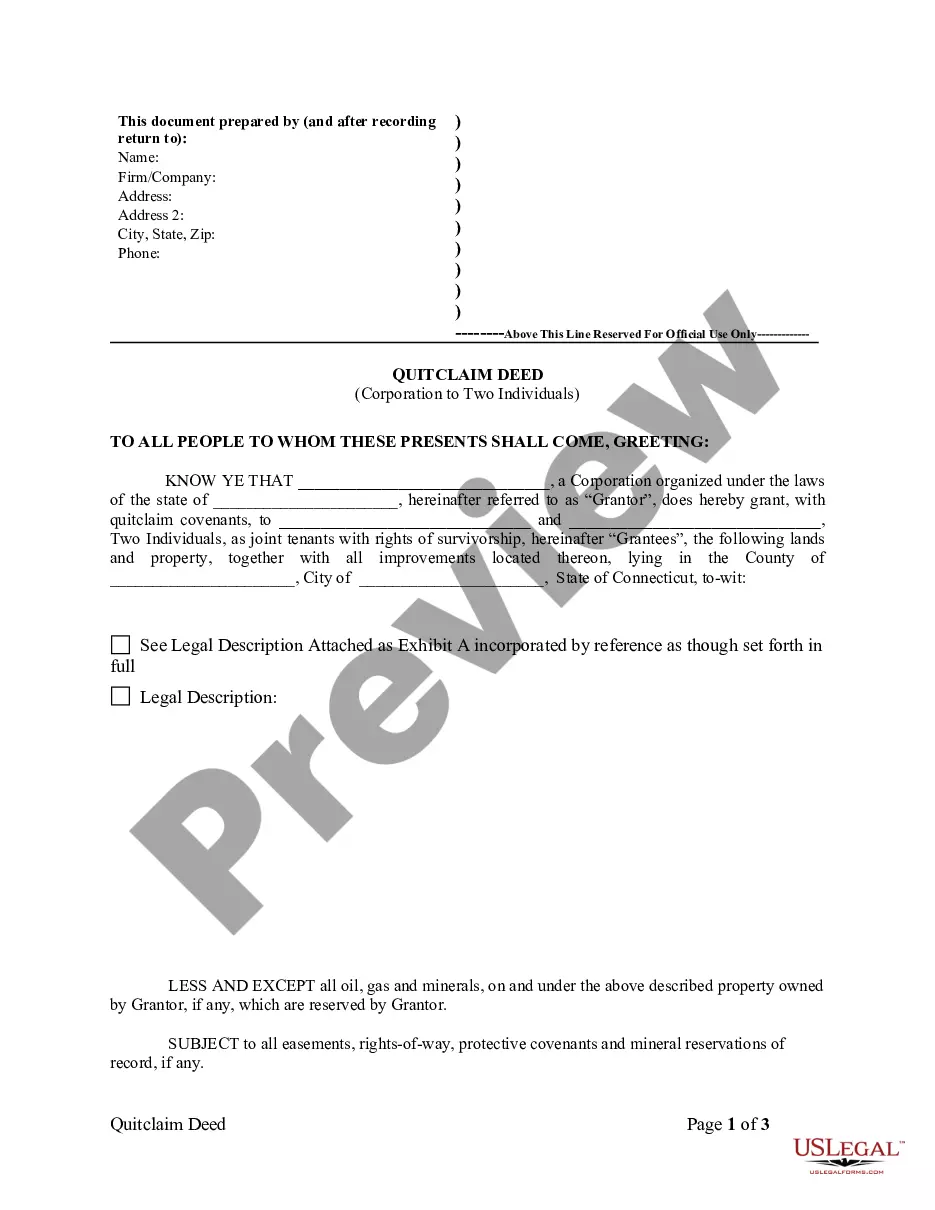
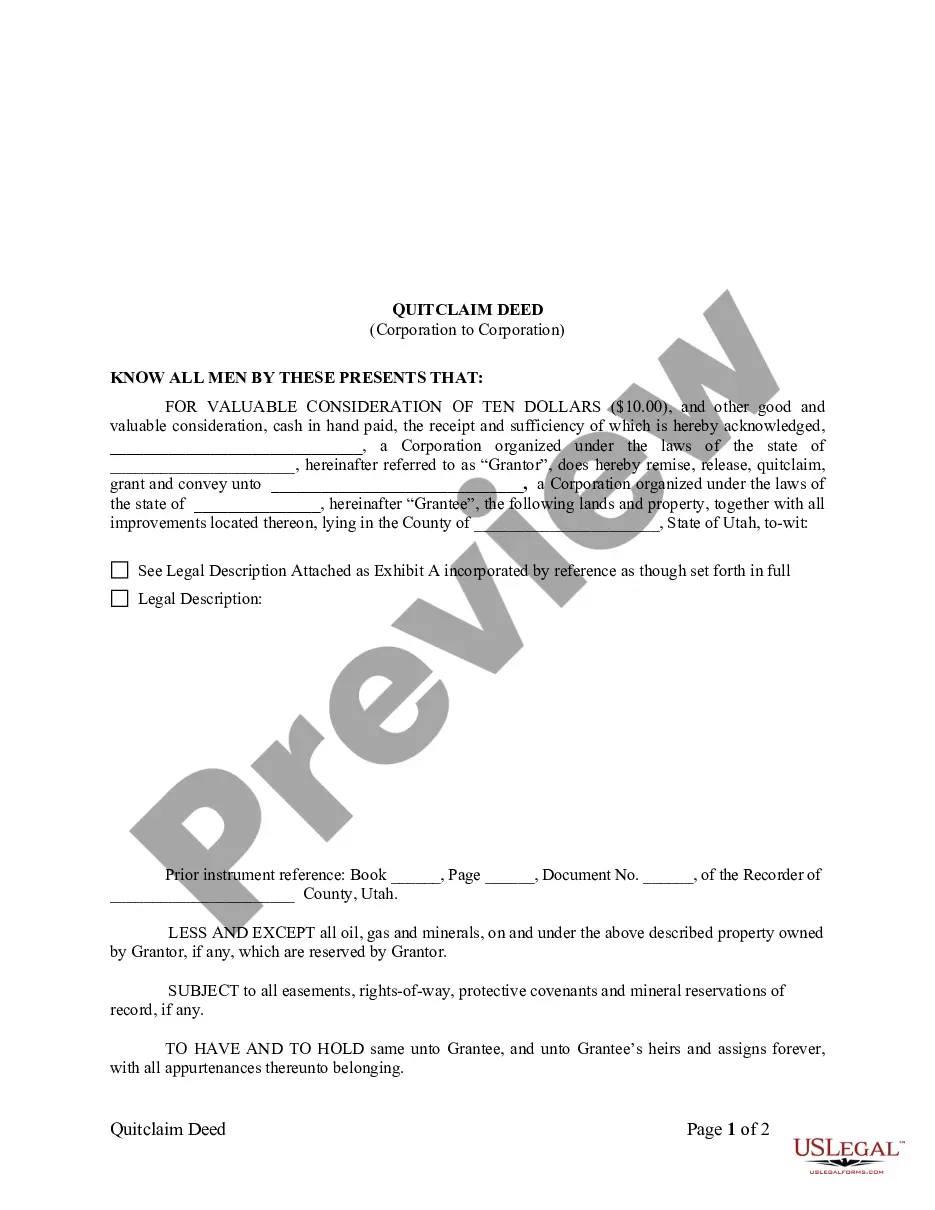
The Quitclaim Deed from Corporation to Two Individuals is a legal document used to transfer property ownership from a corporation to two individuals. Unlike other types of deeds, a quitclaim deed does not guarantee that the corporation holds clear title to the property, but it conveys whatever interest the corporation may have. This form is particularly useful when a corporation wants to give up its interest in the property without making any warranties regarding its title.
Key components of this form
- Grantor and Grantees: Identifies the corporation transferring property and the two individuals receiving it.
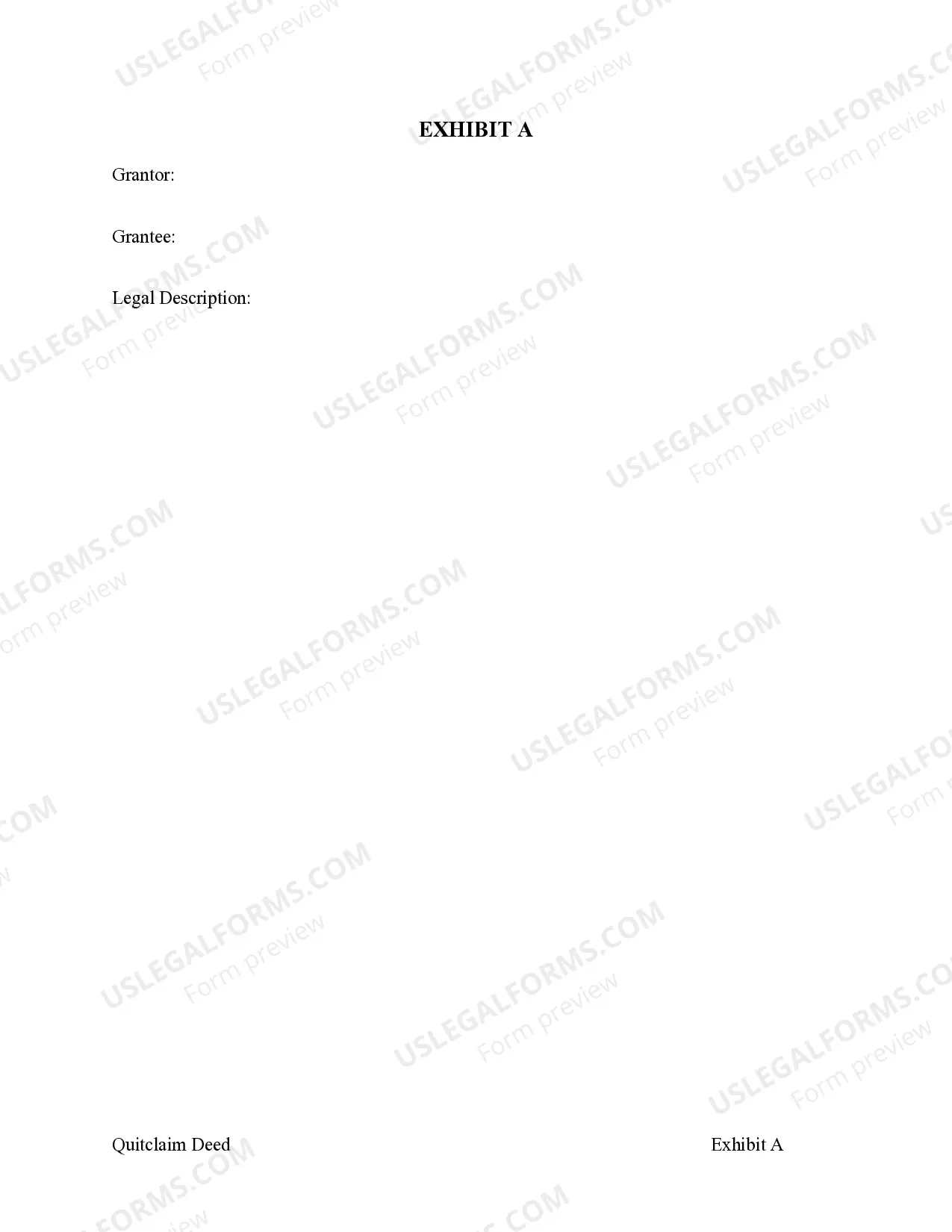
- Property Description: Includes a detailed legal description of the property being transferred.
- Reservation Clause: Specifies that oil, gas, and minerals beneath the property are reserved by the Grantor.
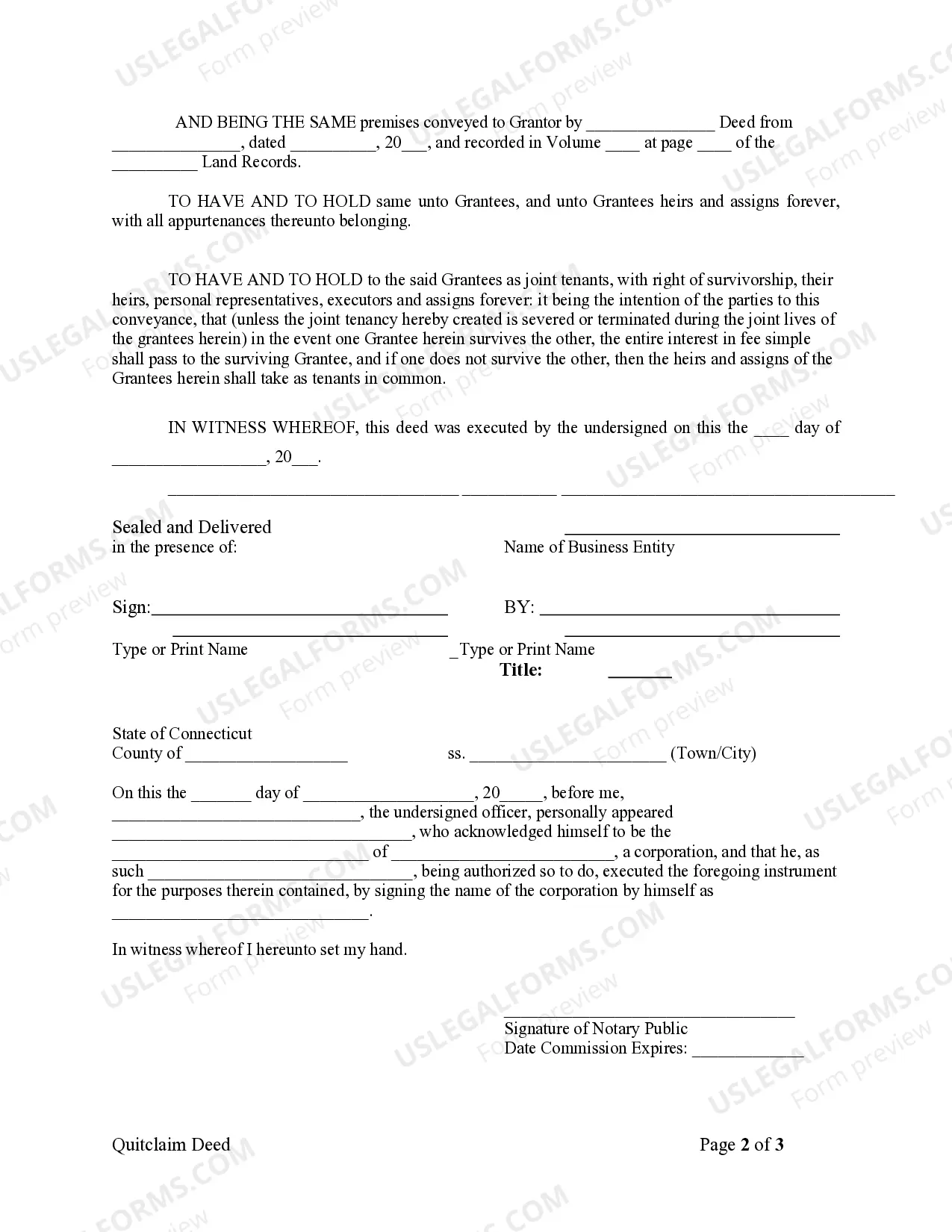
- Joint Tenancy Clause: Establishes that the Grantees will hold the property as joint tenants with rights of survivorship.
- Acknowledgment Section: Requires signatures from the corporation's authorized officer and a notary public.




When to use this document
This form is necessary when a corporation wishes to transfer its ownership interest in real estate to two individuals. Such scenarios might include family property transfers, business asset disposals, or in cases where a corporation is liquidating its assets without warranties on the property's title. It is often used in estate planning or to facilitate personal transactions between responsible parties.
Who should use this form
- Corporations looking to transfer real estate assets to individuals.
- Individuals receiving property from a corporate entity.
- Heirs or beneficiaries involved in real estate transactions where a corporation is the Grantor.
Completing this form step by step
- Identify the parties: Enter the name of the corporation as the Grantor and the names of the two individuals as Grantees.
- Specify the property: Include a detailed legal description of the property being conveyed.
- Fill in reservation details: Indicate any reserved rights to oil, gas, or minerals as applicable.
- Signatures: Ensure the authorized officer of the corporation signs the deed in the presence of a notary public.
- Record the deed: Submit the completed and notarized deed to the appropriate county or local land records office for public record.
Notarization requirements for this form
This form needs to be notarized to ensure legal validity. US Legal Forms provides secure online notarization powered by Notarize, allowing you to complete the process through a verified video call, available anytime.
Get your form ready online
Our built-in tools help you complete, sign, share, and store your documents in one place.
Make edits, fill in missing information, and update formatting in US Legal Forms—just like you would in MS Word.
Download a copy, print it, send it by email, or mail it via USPS—whatever works best for your next step.
Sign and collect signatures with our SignNow integration. Send to multiple recipients, set reminders, and more. Go Premium to unlock E-Sign.
If this form requires notarization, complete it online through a secure video call—no need to meet a notary in person or wait for an appointment.
We protect your documents and personal data by following strict security and privacy standards.

Make edits, fill in missing information, and update formatting in US Legal Forms—just like you would in MS Word.

Download a copy, print it, send it by email, or mail it via USPS—whatever works best for your next step.

Sign and collect signatures with our SignNow integration. Send to multiple recipients, set reminders, and more. Go Premium to unlock E-Sign.

If this form requires notarization, complete it online through a secure video call—no need to meet a notary in person or wait for an appointment.

We protect your documents and personal data by following strict security and privacy standards.
Typical mistakes to avoid
- Failing to include a complete legal description of the property.
- Not obtaining the required notarization of the document.
- Omitting the reservation clause for oil, gas, and minerals if applicable.
- Incorrectly identifying the parties involved, particularly the corporation's legal name.
Key takeaways
- The quitclaim deed allows for the transfer of property from a corporation to two individuals without warranties.
- Ensure that all parties are correctly identified and that the legal property description is accurate.
- Notarization is mandatory for this form to ensure its legality.
- Understand the implications of joint tenancy and how survivorship rights operate.
Looking for another form?
Form popularity
FAQ
A Connecticut Quitclaim Deed from Corporation to Two Individuals can be seen as unfavorable due to its lack of buyer protections. Without warranties, buyers take on risks concerning title defects or liens that may not be disclosed. Moreover, should disputes arise in the future, resolving them can prove difficult without the legal assurances typically offered by other deed types. For those considering such transactions, using a trusted resource like USLegalForms can help clarify the process and ensure all necessary precautions are taken.
Individuals who benefit the most from a Connecticut Quitclaim Deed from Corporation to Two Individuals typically include those looking to simplify property transfer between relatives or business partners. This type of deed is advantageous for parties who trust each other, as it accelerates the transfer process without extensive paperwork. Additionally, it is an efficient way to clear up any uncertainties regarding property ownership among parties. However, both parties should understand the implications of this deed type.
A potential disadvantage of a buyer receiving a Connecticut Quitclaim Deed from Corporation to Two Individuals is the lack of warranty. This means that if there are any unresolved claims or issues with the property, the buyer may have limited recourse. Unlike other deed types, which may offer guarantees about the title, a quitclaim deed provides no assurances. Therefore, it’s essential for buyers to thoroughly investigate the property before proceeding.
A quitclaim deed cannot be used when one party is not willing or able to sign the deed, such as during a divorce settlement where ownership is disputed. Additionally, if a property is subject to a mortgage or lien that needs resolution before transferring ownership, a quitclaim might not be appropriate. For complex situations, consider a more formal method of transfer. USLegalForms provides resources that can guide you through the appropriate steps for various scenarios.
A quitclaim deed can list multiple owners, allowing you to add as many individuals as you wish. In your case, a quitclaim deed can effectively transfer property from a corporation to two individuals, enabling clear ownership rights. Just make sure that all individuals are properly listed on the deed to avoid future disputes. USLegalForms provides templates that accommodate various ownership scenarios.
In Connecticut, a quitclaim deed must include the names of the grantor and grantee, the legal description of the property, and it must be signed by the grantor. It’s important for the document to be properly notarized for it to be valid. If you are transferring property from a corporation to two individuals, ensure that the corporation's representative signs the deed. Using a reliable platform like USLegalForms can help simplify these requirements.
To make a deed valid, certain elements are required, including the names of the parties involved, a clear description of the property, and the signature of the grantor. For a Connecticut Quitclaim Deed from Corporation to Two Individuals, the deed must also be acknowledged before a notary public. Additionally, filing the deed with the local registry ensures that the transfer is recorded publicly, thus protecting all parties involved.
Yes, when a corporation transfers ownership of property, the deed must be signed to be valid. The signature must be from an authorized individual, typically a corporate officer or agent, reflecting the corporation's intent to transfer the property. This signature is critical in the context of a Connecticut Quitclaim Deed from Corporation to Two Individuals as it solidifies the transfer process legally.
The transfer of property without the owner's consent is commonly known as adverse possession or involuntary transfer. This legal concept allows a party to claim ownership if they satisfy certain criteria over a specific time period. However, this is not applicable to a Connecticut Quitclaim Deed from Corporation to Two Individuals, as this deed requires the mutual agreement of both parties for a valid transfer.
In Connecticut, the process for a quitclaim deed begins with drafting the deed to specify the property and the parties involved. Once prepared, the deed must be signed by the grantor, which, in this case, is the corporation. It's important to then record the deed with the local town clerk's office to ensure public notice of the property transfer. Utilizing the Connecticut Quitclaim Deed from Corporation to Two Individuals simplifies this entire process.