Connecticut Quitclaim Deed from Individual to Husband and Wife
About this form
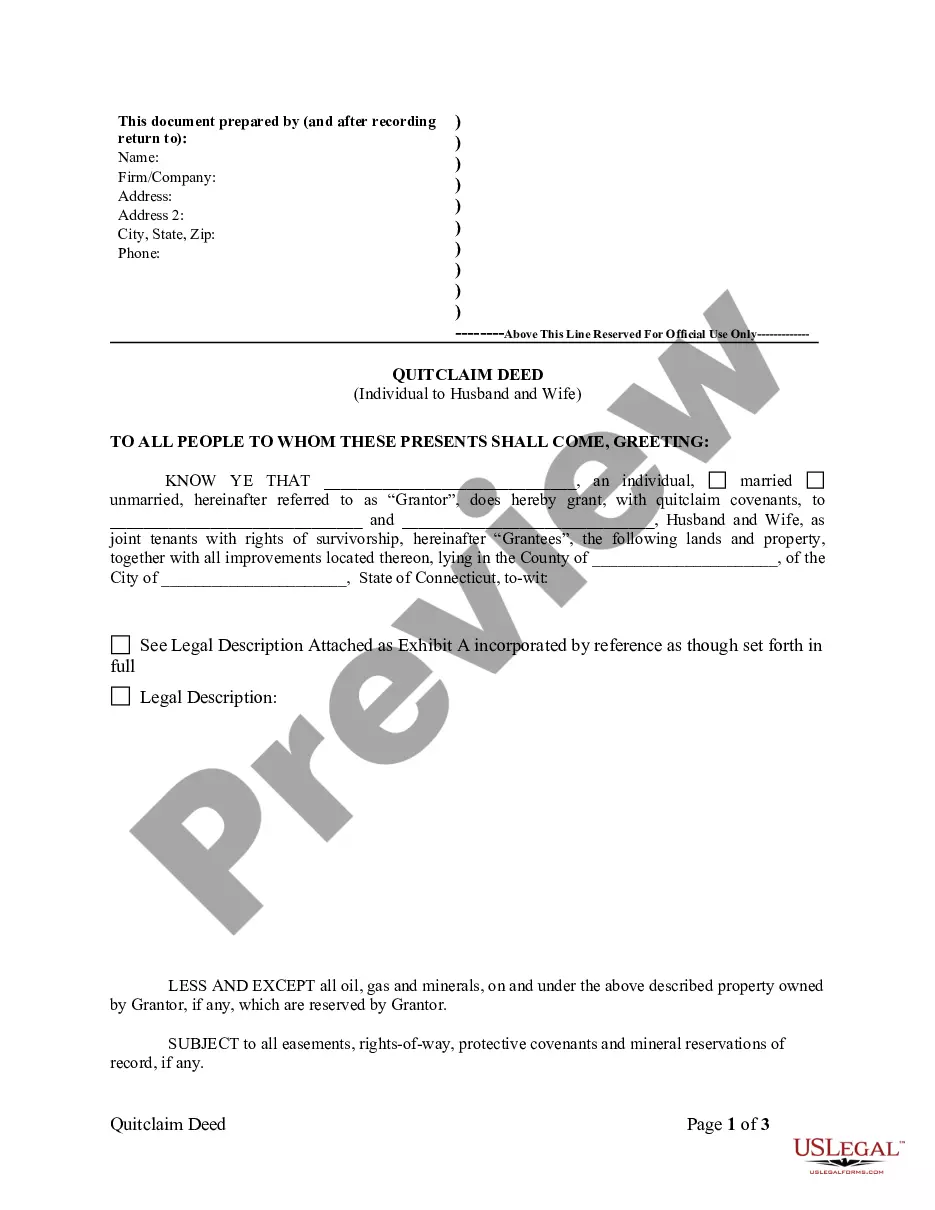
The Quitclaim Deed from Individual to Husband and Wife is a legal document used to transfer property ownership. Unlike a warranty deed, this deed offers no guarantees about the propertyâs title. It simply conveys the interest of the grantor (the individual) to the grantees (the husband and wife), making it essential for couples desiring to jointly own property without the need for extensive legal protections. This deed is compliant with state statutory laws, ensuring that the transfer is valid.
Main sections of this form
- Identification of the Grantor and Grantees, including their names and roles.
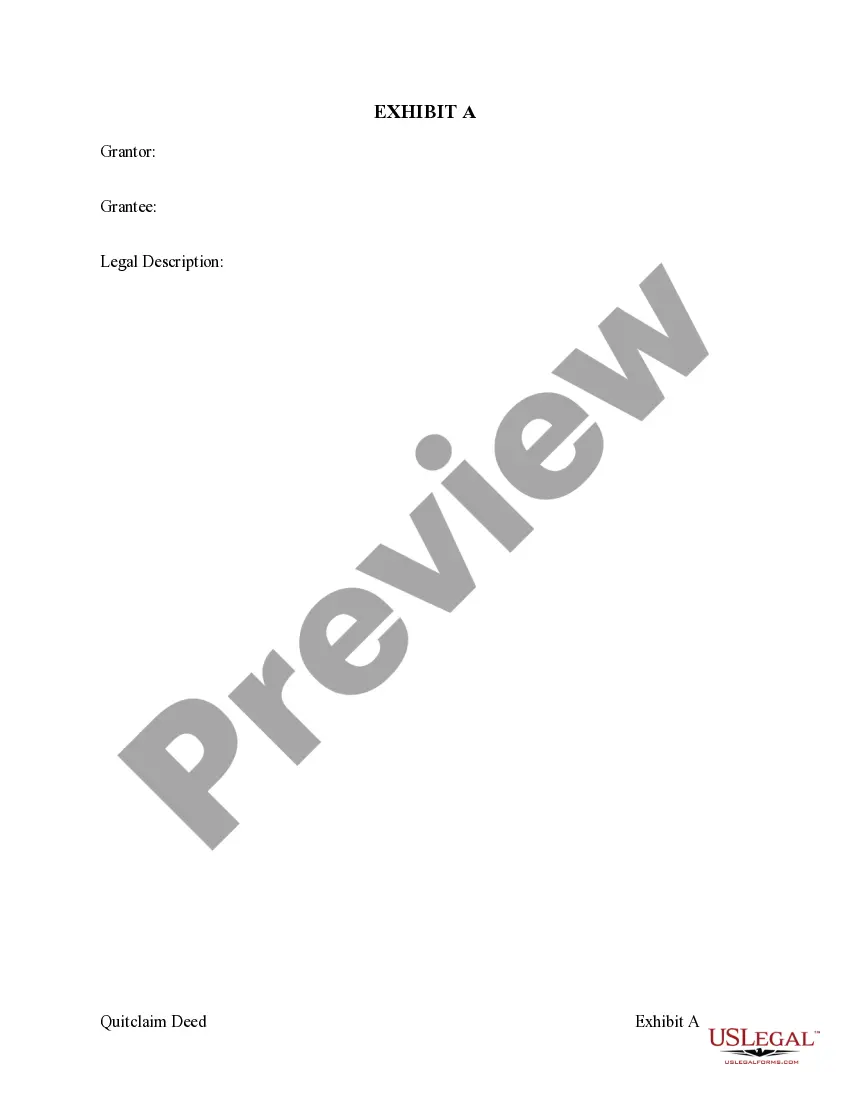
- Description of the property being conveyed.
- Reservations of rights, such as oil, gas, and mineral rights.
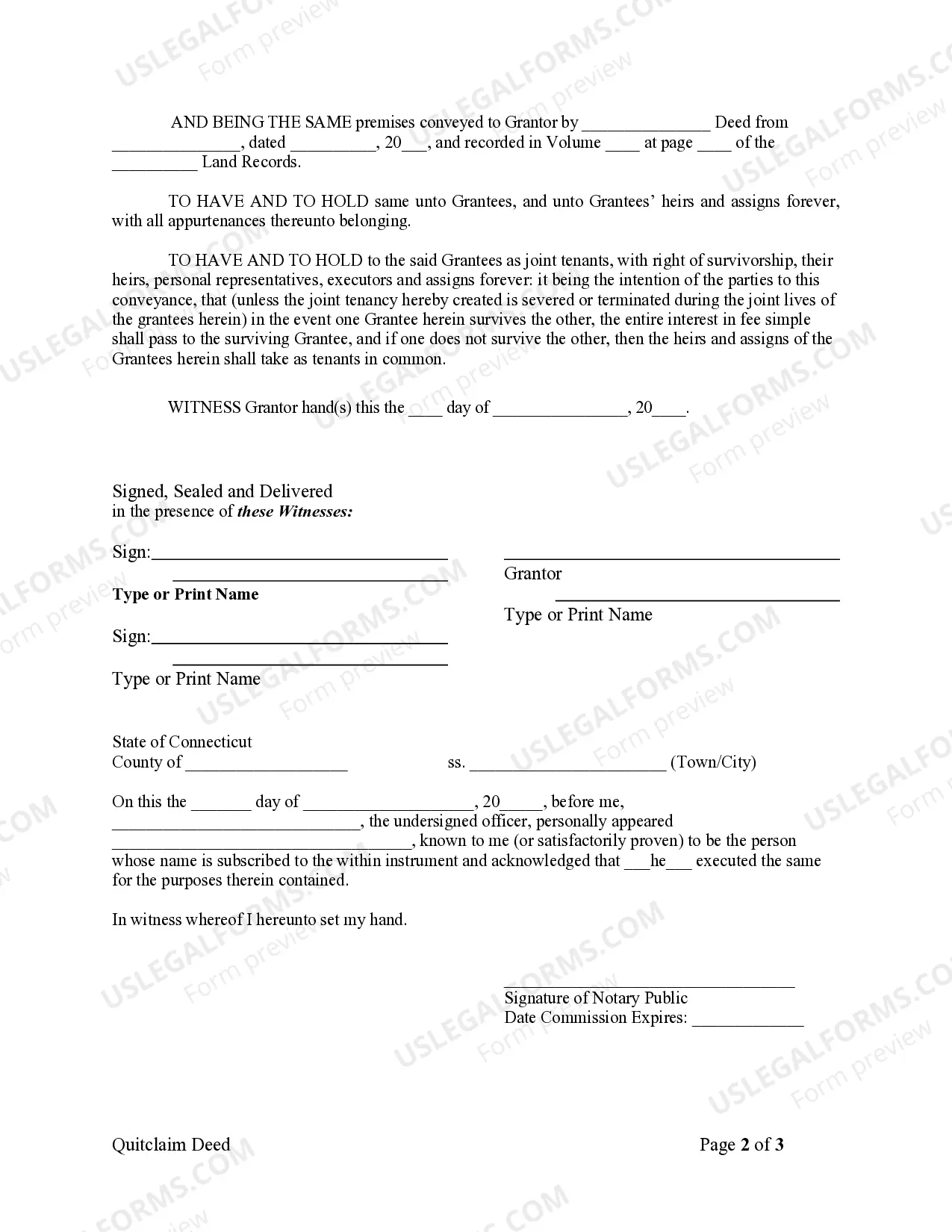
- Statement regarding joint tenancy, including rights of survivorship.
- Signatures of the Grantor and witnesses, along with notarization details.





Situations where this form applies
This deed is commonly used when an individual wants to transfer property to their spouse, allowing both parties to hold the property jointly. It can be useful in scenarios such as marriage, combining assets, or simplifying ownership situations without the complexities of a warranty deed. Additionally, couples may use this form to clarify ownership in community property states where both partners have equal ownership rights.
Intended users of this form
- Married couples seeking to formalize joint ownership of a property.
- Individuals who wish to convey property to their spouse for estate planning purposes.
- People looking to simplify property ownership without the additional complexities of warranty deeds.
Steps to complete this form
- Identify all parties: Enter the names of the Grantor (individual) and the Grantees (husband and wife).
- Specify the property: Clearly describe the property being conveyed, including any applicable identifiers such as a parcel number.
- Complete the reservation clause: Indicate any reserved rights to resources such as oil, gas, or minerals.
- Provide the effective date: Enter the date of the deedâs execution to formalize the transfer.
- Obtain signatures: Have the Grantor sign in front of witnesses and a notary public to finalize the deed.
Does this document require notarization?
Yes, this form must be notarized to be legally valid. The notarization process confirms the identities of the signers and adds an additional layer of authenticity. US Legal Forms offers integrated online notarization, allowing you to complete the process securely via video call, any time of the day, without the need to travel.
Get your form ready online
Our built-in tools help you complete, sign, share, and store your documents in one place.
Make edits, fill in missing information, and update formatting in US Legal Forms—just like you would in MS Word.
Download a copy, print it, send it by email, or mail it via USPS—whatever works best for your next step.
Sign and collect signatures with our SignNow integration. Send to multiple recipients, set reminders, and more. Go Premium to unlock E-Sign.
If this form requires notarization, complete it online through a secure video call—no need to meet a notary in person or wait for an appointment.
We protect your documents and personal data by following strict security and privacy standards.

Make edits, fill in missing information, and update formatting in US Legal Forms—just like you would in MS Word.

Download a copy, print it, send it by email, or mail it via USPS—whatever works best for your next step.

Sign and collect signatures with our SignNow integration. Send to multiple recipients, set reminders, and more. Go Premium to unlock E-Sign.

If this form requires notarization, complete it online through a secure video call—no need to meet a notary in person or wait for an appointment.

We protect your documents and personal data by following strict security and privacy standards.
Common mistakes
- Failing to provide a clear property description, which can lead to disputes.
- Not including vital information regarding reserved rights or easements.
- Missing signatures from witnesses or notary, rendering the deed invalid.
Benefits of completing this form online
- Convenient access to downloadable templates anytime, anywhere.
- Editability allows users to input specific property and party details easily.
- Reliability through forms drafted by licensed attorneys for legal validity.
Quick recap
- The Quitclaim Deed transfers property ownership without guarantees of title.
- It is designed for individuals transferring property to their spouses.
- Proper completion involves clear identification of parties and property description.
Looking for another form?
Form popularity
FAQ
It is a deed that transfers the grantor’s interest from an individual to both spouses, without any warranty of title. Use it when a single person wants the property to be owned jointly by a husband and wife, to simplify ownership and estate planning, while keeping the transfer compliant with Connecticut law.
Married couples use this form to establish joint ownership without title warranties. It allows one spouse to transfer property to both, often for estate planning or asset consolidation, and the included joint tenancy language helps define rights of survivorship between the spouses.
Execute the Connecticut Quitclaim Deed From Individual To Husband And Wife. The main steps include identifying the grantor and grantees, describing the property being conveyed, including a joint tenancy statement, and collecting the grantor's signature with witnesses and a notarization as required.
Common mistakes include failing to clearly identify the grantor and grantees, omitting a precise property description, and neglecting to include or properly record the joint tenancy language. Other issues are missing reservations of rights, and not obtaining the necessary signatures, witnesses, or notarization described in the form components.
Quitclaim deeds offer no title guarantees and transfer only the grantor’s interest, if any. They do not confirm clear title or address liens or encumbrances, and they may expose the grantees to risks if the title is defective. They’re generally best for known parties or intra-family transfers.
This form is designed to transfer to both spouses and typically includes a joint tenancy language with rights of survivorship. A standard quitclaim deed to a single grantee transfers to one person and does not automatically establish joint tenancy or survivorship.