Connecticut Seller's Disclosure of Financing Terms for Residential Property in connection with Contract or Agreement for Deed a/k/a Land Contract
Overview of this form
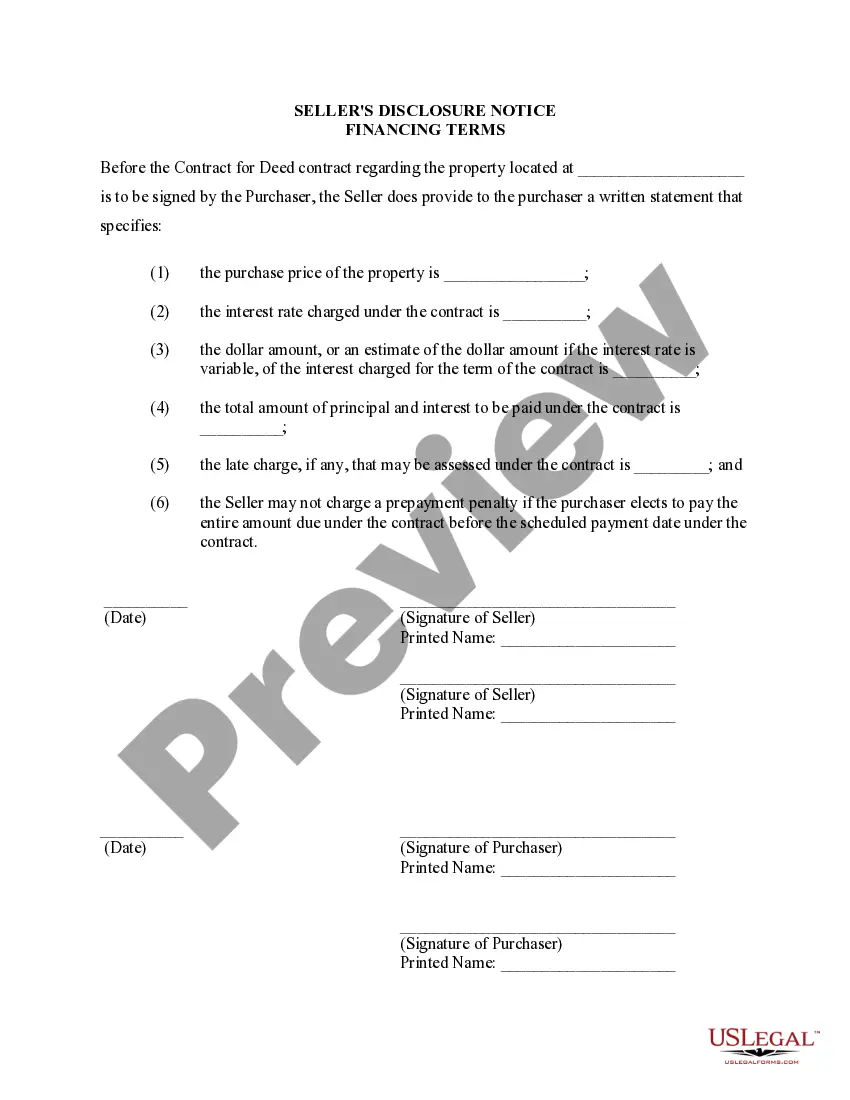
This Seller's Disclosure of Financing Terms for Residential Property serves as a formal notice to the purchaser regarding the purchase price of the property, payment structure, interest rates, and applicable late charges. Unlike other real estate forms, this disclosure is specifically tailored for transactions involving contracts for deed, also known as land contracts. It ensures transparency between the seller and the purchaser before the contract is signed.
Key parts of this document
- Purchase price: Clearly states the overall cost of the property.
- Payment terms: Details the payment schedule and installment amounts.
- Interest charges: Outlines applicable interest rates on the unpaid balance.
- Late charges: Specifies penalties for late payments.
- Seller's name: Identifies the person selling the property.
- Purchaser's name: Identifies the person buying the property.
Situations where this form applies
Who this form is for
- Property sellers who offer financing to buyers
- Buyers entering into a contract for deed arrangement
- Real estate agents involved in transactions using contracts for deed
- Individuals unfamiliar with financing terms and agreements
How to complete this form
- Identify the parties: Enter the names of the seller and purchaser.
- Specify the property: Provide a detailed description of the property being sold.
- Enter the purchase price: State the total amount to be paid for the property.
- Outline payment terms: Detail how payments will be made, including due dates and amounts.
- Include interest charges: Specify any interest that will apply to the financing.
- List late charges: Indicate any penalties for overdue payments.
Notarization requirements for this form
This form does not typically require notarization unless specified by local law. It is advisable to check local regulations or consult with a legal professional to ensure compliance.
Get your form ready online
Our built-in tools help you complete, sign, share, and store your documents in one place.
Make edits, fill in missing information, and update formatting in US Legal Forms—just like you would in MS Word.
Download a copy, print it, send it by email, or mail it via USPS—whatever works best for your next step.
Sign and collect signatures with our SignNow integration. Send to multiple recipients, set reminders, and more. Go Premium to unlock E-Sign.
If this form requires notarization, complete it online through a secure video call—no need to meet a notary in person or wait for an appointment.
We protect your documents and personal data by following strict security and privacy standards.

Make edits, fill in missing information, and update formatting in US Legal Forms—just like you would in MS Word.

Download a copy, print it, send it by email, or mail it via USPS—whatever works best for your next step.

Sign and collect signatures with our SignNow integration. Send to multiple recipients, set reminders, and more. Go Premium to unlock E-Sign.

If this form requires notarization, complete it online through a secure video call—no need to meet a notary in person or wait for an appointment.

We protect your documents and personal data by following strict security and privacy standards.
Avoid these common issues
- Failing to accurately disclose all financing terms.
- Not providing complete information about the property.
- Overlooking the need for both partiesâ signatures.
- Missing details regarding late charges or interest rates.
Benefits of using this form online
- Convenience of accessing and completing the form from anywhere.
- Editability allows for easy adjustments to terms as needed.
- Reliability of using attorney-drafted templates to ensure compliance.
Looking for another form?



Form popularity
FAQ
Who Must Make These Seller Disclosures in California. As a broad rule, all sellers of residential real estate property containing one to four units in California must complete and provide written disclosures to the buyer.
One question all sellers are required by law to answer on the Real Estate Transfer Disclosure Statement is whether there are any neighborhood noise problems or other nuisances. If the answer is yes, the seller must explain that answer in detail.
Real Estate Transfer Disclosure Statement (TDS) The Transfer Disclosure Statement, also known as the TDS, is a form required by California law in most residential real estate transactions pursuant to California Civil Code 1102.
Property disclosure statements essentially outline any flaws that the home sellers (and their real estate agents) are aware of that could negatively affect the home's value. These statements are required by law in most areas of the country so buyers can know a property's good and bad points before they close the deal.
Death in the Home. Neighborhood Nuisances. Hazards. HOA Information. Repairs. Water Damage. Missing Items. Other Possible Disclosures.
If a seller fails to disclose, or actively conceals, problems that affect the value of the property; they are violating the law, and may be subject to a lawsuit for recovery of damages based on claims of fraud and deceit, misrepresentation and/or breach of contract.
In general, as long as any dispute does not affect anything material about the house or property on which it stands, and you're not being asked to disclose information in writing, you shouldn't feel obliged to give a 'warts and all' account of all the problems you've had with a neighbour.
A Seller is not required to provide a PCDS in British Columbia. If a Seller is not willing to provide a PCDS, they may not be disclosing a major issue with the property. The fact a Seller is not willing to provide a PCDS to a potential Buyer should be cause for concern to the Buyer.
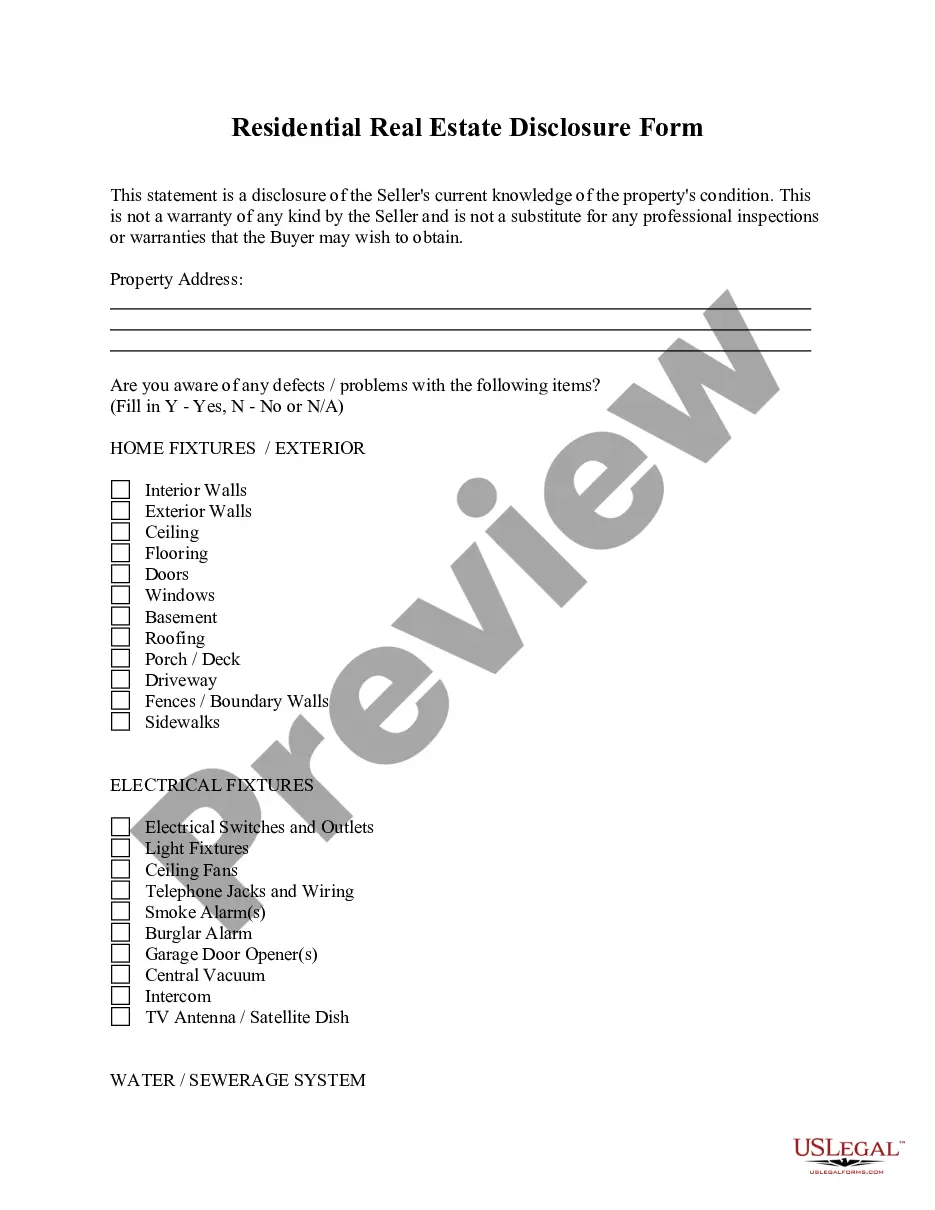
You will need to include information about all appliances in the home, including which are included in the sale as well as whether they are operational. You will also need to disclose any room additions, damage, or neighborhood noise problems.