Colorado Quitclaim Deed - Individual to Husband and Wife
About this form
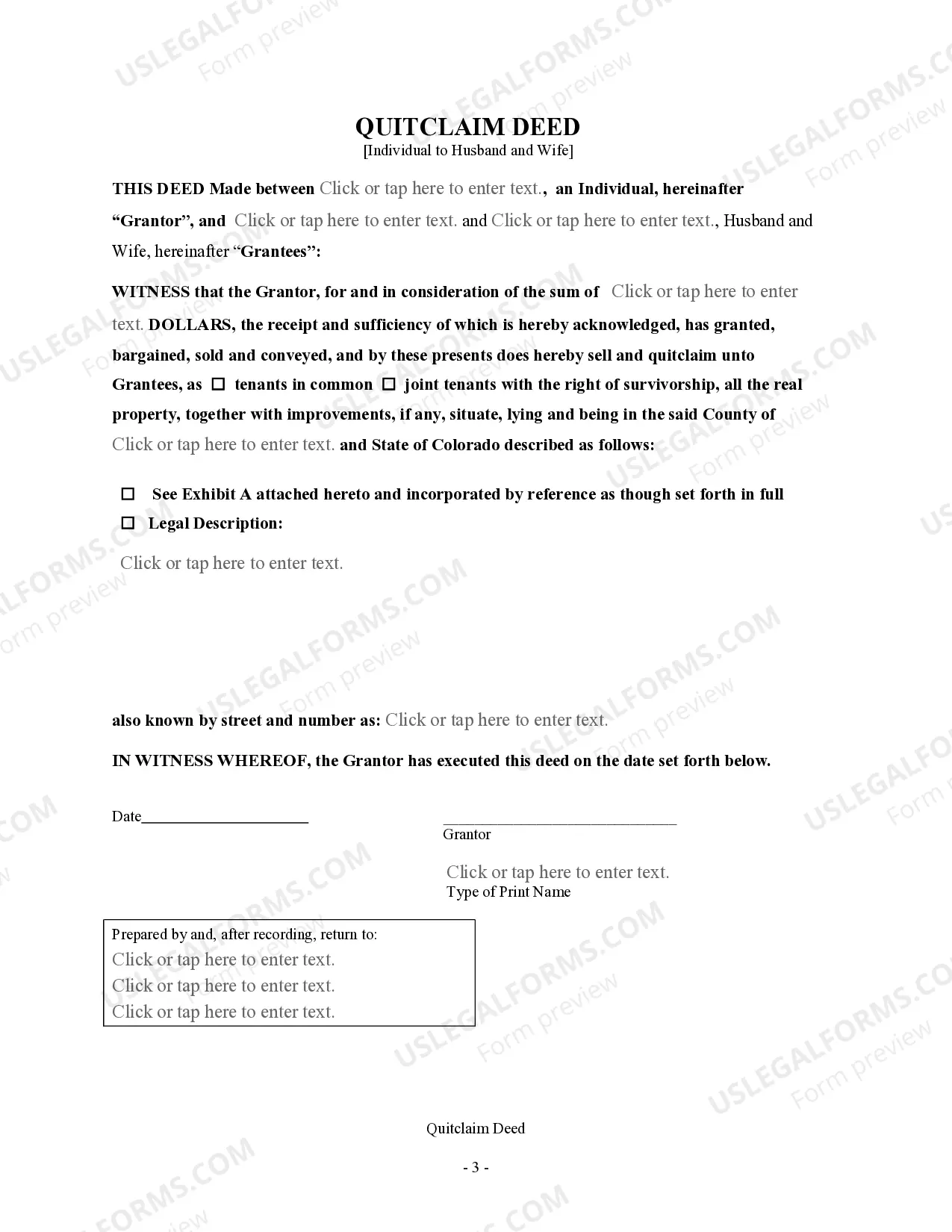
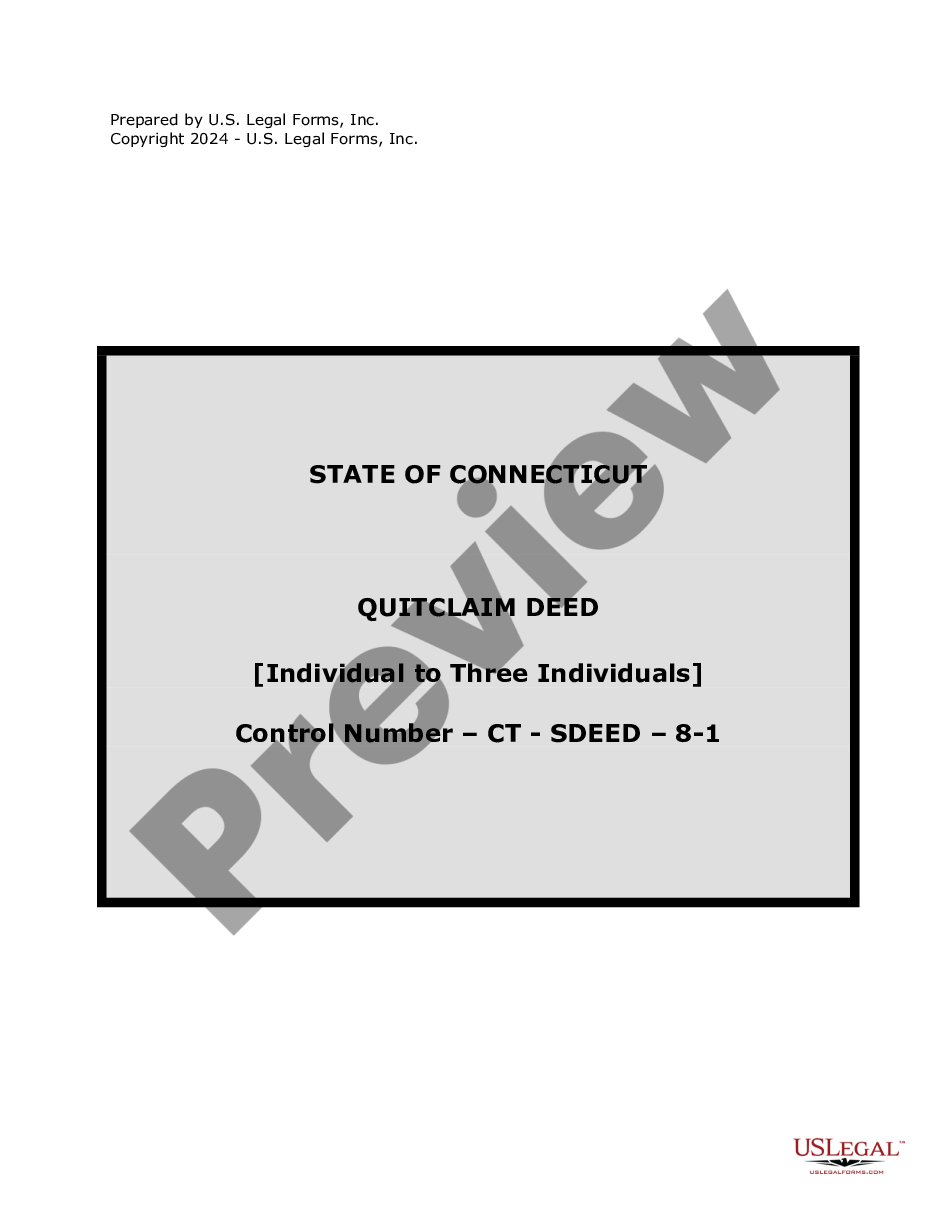
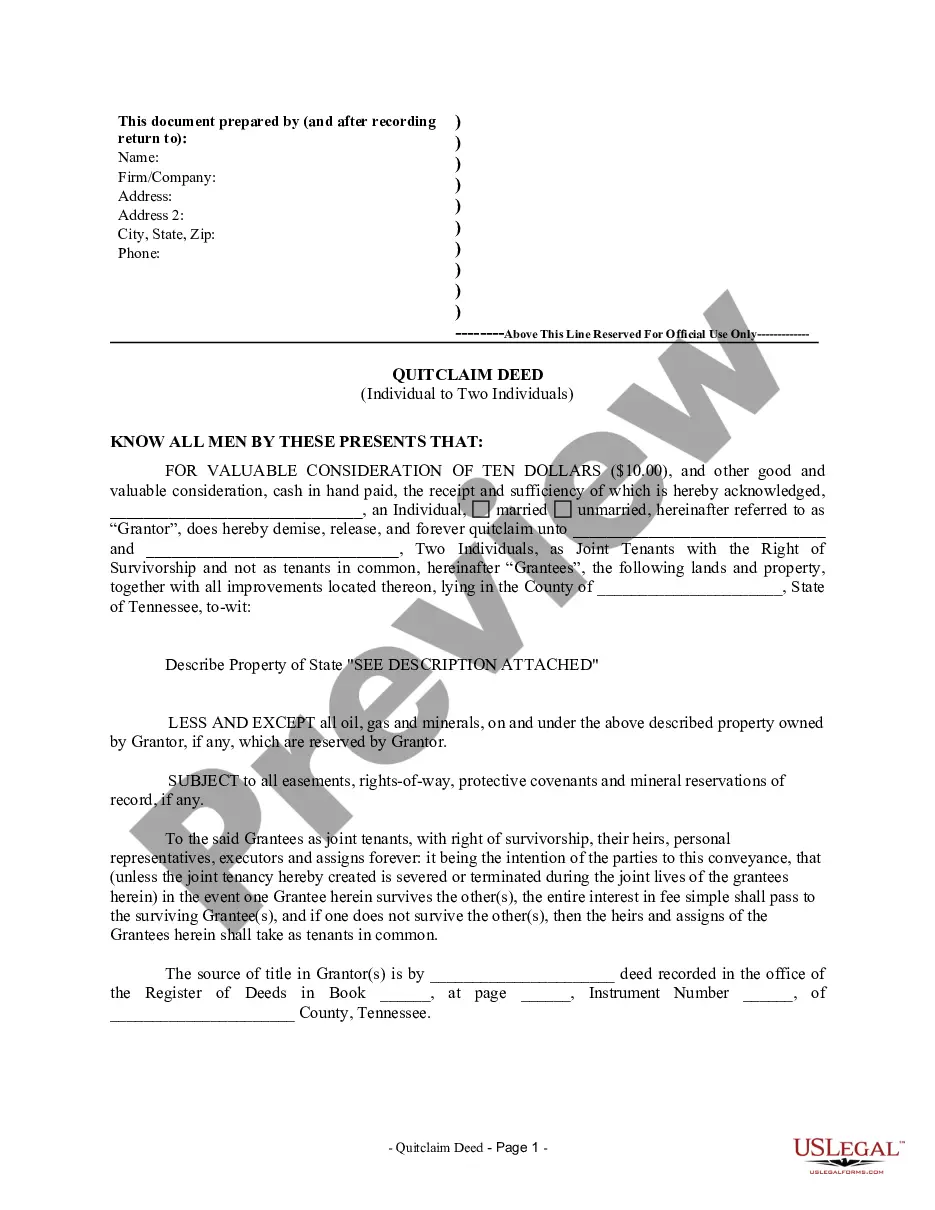
The Quitclaim Deed - Individual to Husband and Wife is a legal document used to transfer property ownership from an individual (the grantor) to a married couple (the grantees). This form effectively conveys the property without guaranteeing that the grantor holds clear title. It distinguishes itself from other types of deeds, like warranty deeds, by not providing any warranty on the property title. The grantees can take ownership either as tenants in common or as joint tenants with the right of survivorship, offering flexibility depending on their needs.
Form components explained
- Identifies the grantor (the individual transferring ownership).
- Lists the grantees (the husband and wife receiving the property).
- Includes a legal description of the property being transferred.
- States the consideration (payment) for the property transfer.
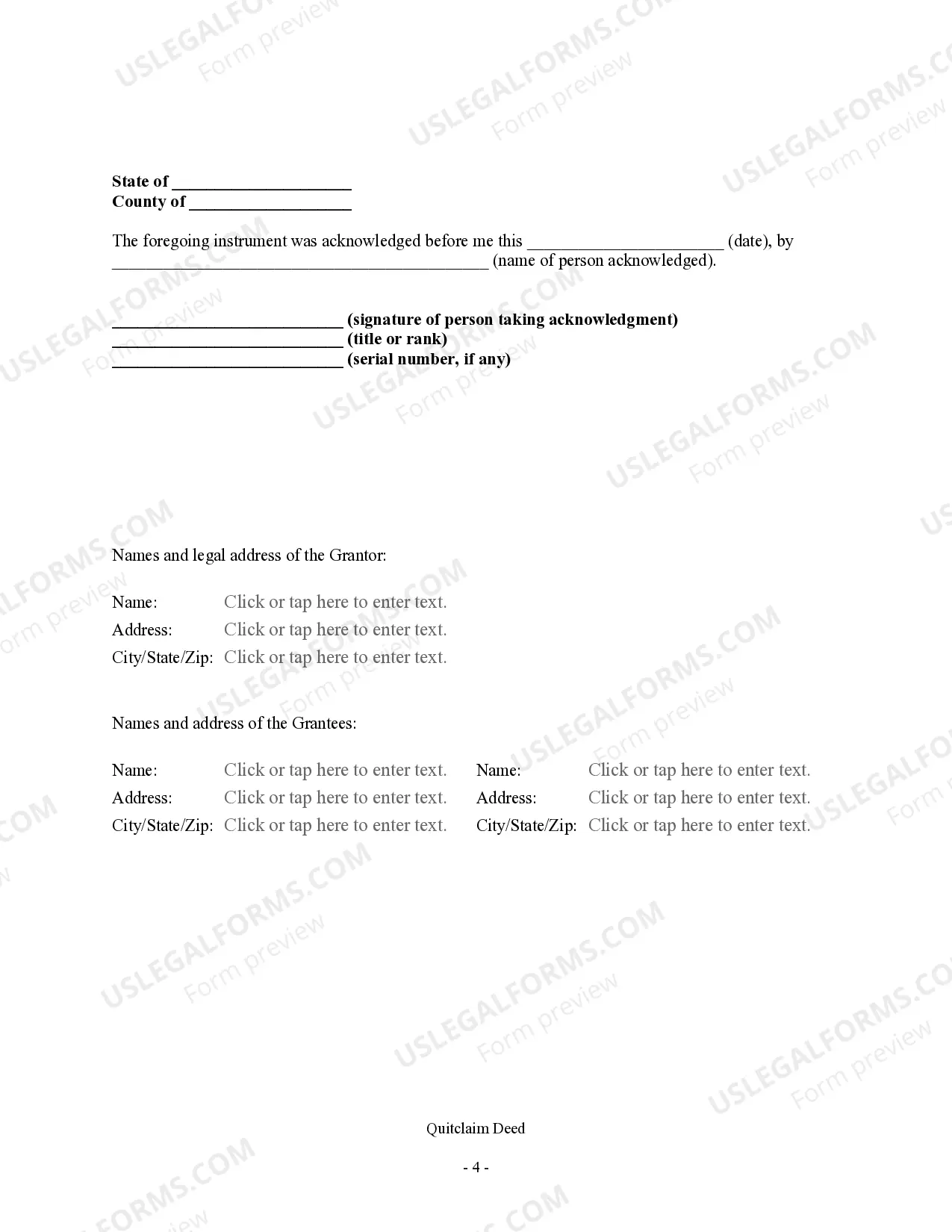
- Incorporates an acknowledgment of signature and notary section (if applicable).






When this form is needed
This form is typically used when an individual wants to transfer ownership of real estate to a husband and wife. Common situations may include gifting property, consolidating ownership for estate planning, or simplifying property ownership arrangements between spouses.
Who can use this document
- Individuals looking to transfer property to a married couple.
- Married couples who become joint owners of a property.
- Homeowners seeking to clarify ownership rights in the event of death or separation.
Instructions for completing this form
- Identify the parties involved: the grantor (individual) and the grantees (husband and wife).
- Specify the property being transferred by providing a detailed legal description.
- Enter the consideration amount that reflects the value exchanged for the property.
- Complete the acknowledgment section to confirm the grantor's signature.
- Ensure all parties sign and date the deed as required.
Does this document require notarization?
This form does not typically require notarization unless specified by local law. However, it's advisable to check local regulations to ensure compliance with state requirements.
Get your form ready online
Our built-in tools help you complete, sign, share, and store your documents in one place.
Make edits, fill in missing information, and update formatting in US Legal Forms—just like you would in MS Word.
Download a copy, print it, send it by email, or mail it via USPS—whatever works best for your next step.
Sign and collect signatures with our SignNow integration. Send to multiple recipients, set reminders, and more. Go Premium to unlock E-Sign.
If this form requires notarization, complete it online through a secure video call—no need to meet a notary in person or wait for an appointment.
We protect your documents and personal data by following strict security and privacy standards.

Make edits, fill in missing information, and update formatting in US Legal Forms—just like you would in MS Word.

Download a copy, print it, send it by email, or mail it via USPS—whatever works best for your next step.

Sign and collect signatures with our SignNow integration. Send to multiple recipients, set reminders, and more. Go Premium to unlock E-Sign.

If this form requires notarization, complete it online through a secure video call—no need to meet a notary in person or wait for an appointment.

We protect your documents and personal data by following strict security and privacy standards.
Common mistakes
- Failing to include a complete legal description of the property.
- Not having the grantor's signature properly notarized (if required by state law).
- Leaving blank fields, especially for essential details like the consideration amount.
Why complete this form online
- Convenience of filling out the form at home using a computer.
- Editability of the document, allowing for corrections before finalization.
- Immediate access to legal forms drafted by licensed attorneys.
Looking for another form?


Form popularity
FAQ
Yes, a Colorado Quitclaim Deed - Individual to Husband and Wife does transfer ownership, but with important caveats. When executed, it relinquishes any interest the grantor has in the property to the grantee. However, since it does not guarantee clean title, it’s essential to investigate the property’s legal status beforehand to mitigate risks.
Many real estate experts view a Colorado Quitclaim Deed - Individual to Husband and Wife with caution due to the absence of warranties. This deed type can lead to uncertainty about ownership, especially if issues arise with the title. Additionally, buyers often prefer more secure methods of transferring property to avoid potential disputes.
In many cases, the grantor, or the person transferring the property, benefits most from a Colorado Quitclaim Deed - Individual to Husband and Wife. This deed allows for quick and uncomplicated transfers without the need for extensive paperwork. It serves individuals who want to finalize ownership changes swiftly, especially in familial situations.
One downside of a Colorado Quitclaim Deed - Individual to Husband and Wife is that it offers no guarantees about the property’s title. Without warranties, the buyer accepts all associated risks, including potential claims from others. This lack of protection can lead to unforeseen legal and financial troubles down the road.
A spouse may execute a Colorado Quitclaim Deed - Individual to Husband and Wife for several reasons, such as simplifying the process of transferring property rights. This deed can help clarify ownership after a marriage or in a situation where one spouse wants to gift their share. Ultimately, it provides a straightforward way to manage property between spouses.
When considering a Colorado Quitclaim Deed - Individual to Husband and Wife, it's important to understand that this type of deed transfers ownership without warranties. This means you take on the risk of undisclosed claims. Therefore, while it's possible to buy a house with a quitclaim deed, thorough due diligence is essential to protect your investment.
Filing a Colorado Quitclaim Deed - Individual to Husband and Wife involves several key steps. First, you must prepare the deed, ensuring all necessary information is included. Next, sign the document before a notary public. Finally, submit the signed deed to your local county clerk's office to make the transfer official. Utilizing platforms like USLegalForms can streamline this process by providing ready-to-use templates and guidance.
To add someone to your deed in Colorado using a Colorado Quitclaim Deed - Individual to Husband and Wife, you must draft the deed to reflect the new ownership structure. This process typically involves providing the full names of both parties and describing the property accurately. Once completed, you need to sign the deed in front of a notary public and file it with the county clerk's office.
Yes, both parties should be present when executing a Colorado Quitclaim Deed - Individual to Husband and Wife. This ensures that both individuals understand the transfer of property rights and consent to the transaction. Moreover, having both parties present helps to avoid potential disputes in the future, ensuring the deed is valid and enforceable.
To properly fill out a quitclaim deed, begin with accurate and clear information. Use a recognized form for a Colorado Quitclaim Deed - Individual to Husband and Wife, ensuring you include all required details such as the parties' names and property description. Sign the deed with a notary present, which is crucial for its legal acceptance. A well-completed quitclaim deed protects both parties involved in the property transfer.