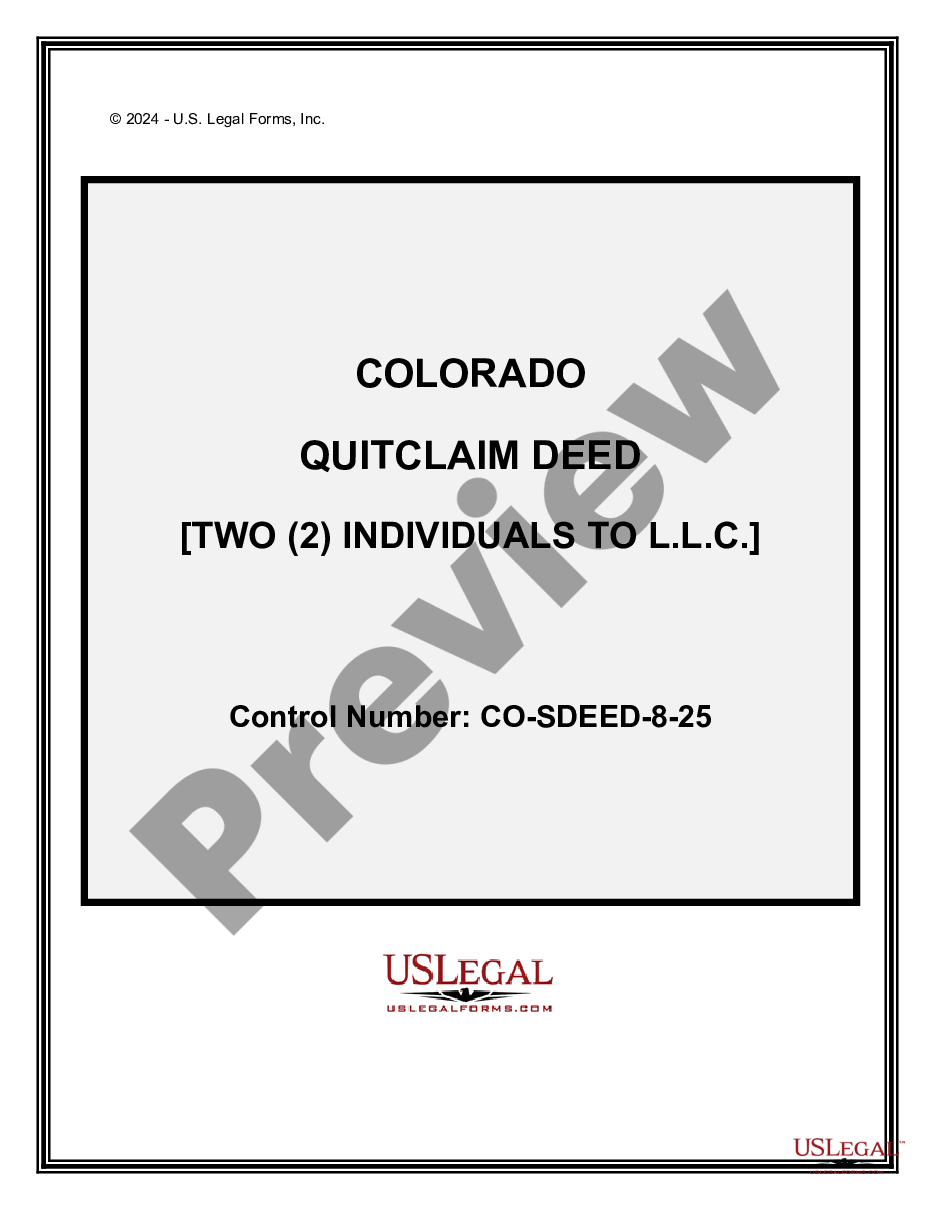
Colorado Quitclaim Deed - Two Individuals or Husband and Wife to Limited Liability Company
What is this form?
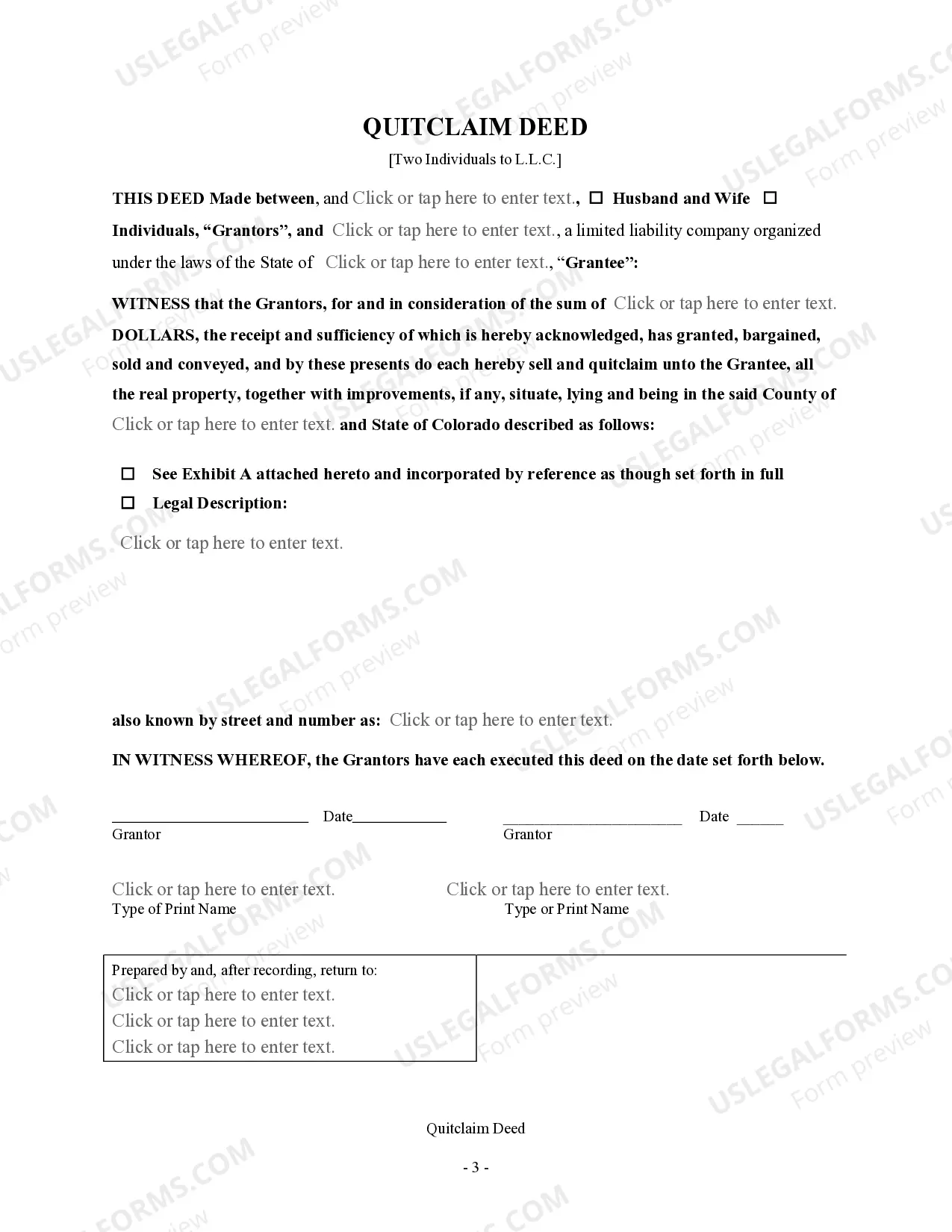
This Quitclaim Deed is a legal document allowing two individuals, or a married couple, to transfer their ownership rights of a property to a Limited Liability Company (LLC). Unlike a warranty deed, a quitclaim deed does not guarantee that the grantors hold a valid title to the property; it simply relinquishes their rights, making it essential when transferring property titles between parties with a pre-existing relationship. This form is ideal for situations where the property is being moved into a business structure like an LLC.
Main sections of this form
- Identification of grantors (the individuals or couple transferring property).
- Detailing the grantee (the Limited Liability Company receiving the property).
- Statement of consideration (the amount being acknowledged for the transfer).
- Legal description of the property being conveyed.
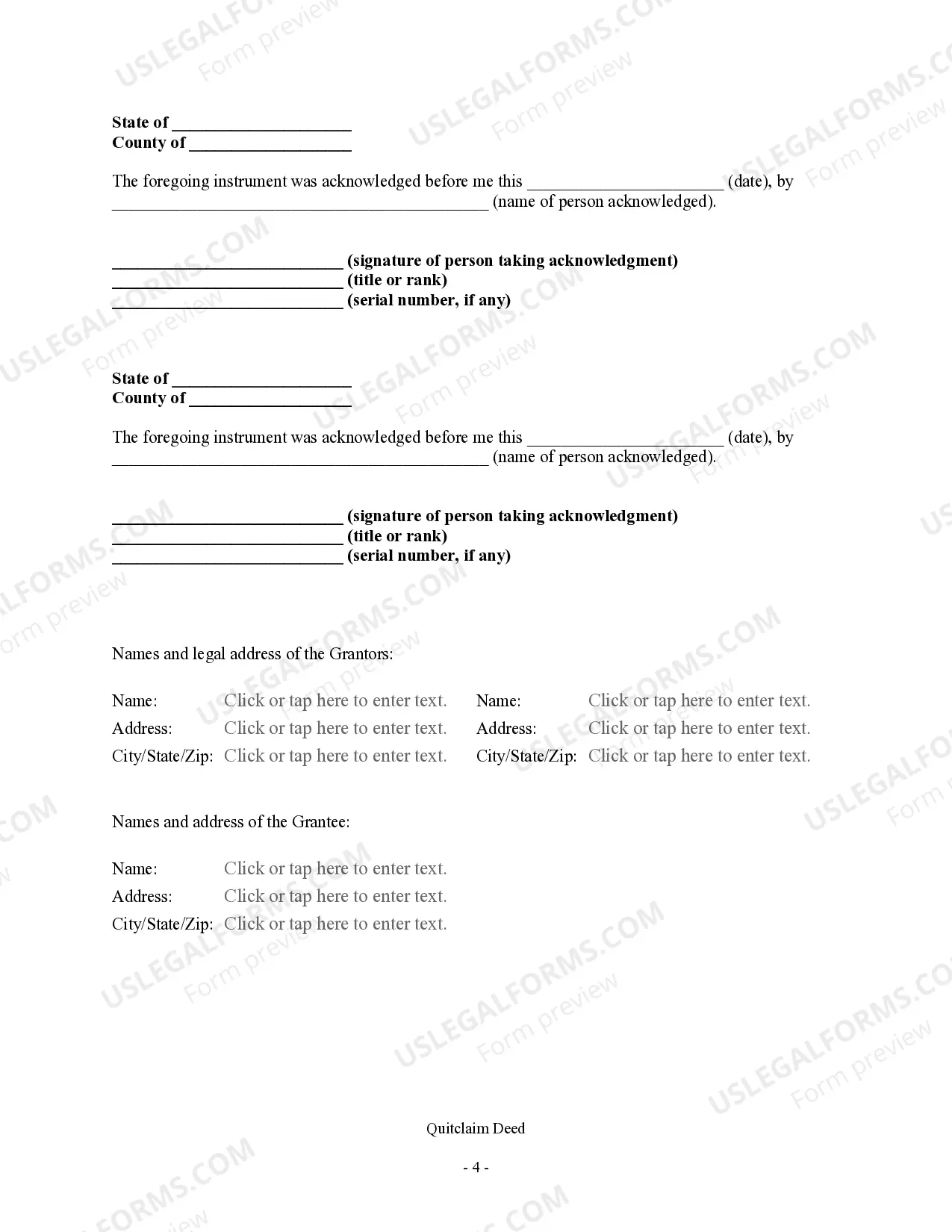
- Space for signatures and acknowledgment by a notary public.





Common use cases
This form is used when two individuals or a married couple wishes to transfer ownership of real property to a Limited Liability Company. Typical scenarios include converting personal property into a business asset, estate planning to protect family assets, or simplifying real estate transactions among partners in an LLC.
Who this form is for
- Individuals or couples looking to transfer real estate ownership to an LLC.
- Members of an LLC seeking to consolidate property ownership.
- Individuals involved in estate planning processes.
How to complete this form
- Identify the grantors by entering the names of the individuals or couple conveying the property.
- Specify the name of the Limited Liability Company receiving the property as the grantee.
- Fill in the consideration amount in the designated field.
- Provide a detailed legal description of the property being transferred.
- Ensure both grantors sign the form in the presence of a notary public.
Notarization requirements for this form
This form needs to be notarized to ensure legal validity. US Legal Forms provides secure online notarization powered by Notarize, allowing you to complete the process through a verified video call, available anytime.
Get your form ready online
Our built-in tools help you complete, sign, share, and store your documents in one place.
Make edits, fill in missing information, and update formatting in US Legal Forms—just like you would in MS Word.
Download a copy, print it, send it by email, or mail it via USPS—whatever works best for your next step.
Sign and collect signatures with our SignNow integration. Send to multiple recipients, set reminders, and more. Go Premium to unlock E-Sign.
If this form requires notarization, complete it online through a secure video call—no need to meet a notary in person or wait for an appointment.
We protect your documents and personal data by following strict security and privacy standards.

Make edits, fill in missing information, and update formatting in US Legal Forms—just like you would in MS Word.

Download a copy, print it, send it by email, or mail it via USPS—whatever works best for your next step.

Sign and collect signatures with our SignNow integration. Send to multiple recipients, set reminders, and more. Go Premium to unlock E-Sign.

If this form requires notarization, complete it online through a secure video call—no need to meet a notary in person or wait for an appointment.

We protect your documents and personal data by following strict security and privacy standards.
Typical mistakes to avoid
- Failing to include the legal description of the property.
- Not signing the form in front of a notary, if required.
- Using incorrect names or details for grantors or grantee.
Benefits of completing this form online
- Convenient access to legal forms from anywhere at any time.
- Editable templates allow for easy completion without printed clutter.
- Reliable format designed by licensed attorneys to ensure compliance.
Looking for another form?


Form popularity
FAQ
Yes, a quit claim deed needs to be notarized in Colorado to be valid. The notary verifies the identities of the signers and ensures the document is executed properly. Without notarization, the deed may not be accepted for recording by the county, which could complicate the transfer process.
Typically, individuals in informal or family-related property transfers benefit the most from a quitclaim deed. For instance, when two individuals or a husband and wife transfer property to a Limited Liability Company, this method minimizes complexity and speeds up the process. Likewise, because quitclaims are simple and direct, they are ideal for clearing up title issues without extensive delays.
To fill out a quit claim deed in Colorado, you should include the grantor's name, the grantee's name, and the exact legal description of the property. It is recommended to use a template or seek professional help to ensure accuracy. After filling it out, both parties must sign and the document should be notarized before submission to the county clerk's office.
Filling out a Colorado Quitclaim Deed - Two Individuals or Husband and Wife to Limited Liability Company requires you to first identify all parties involved in the transfer. Be meticulous with the legal property description, as it must match public records. Lastly, ensure the signatures are witnessed or notarized; this step is crucial for its acceptance in legal proceedings.
When completing a Colorado Quitclaim Deed - Two Individuals or Husband and Wife to Limited Liability Company, start by providing the names of both the grantor and grantee accurately. Ensure you include a thorough legal description of the property, which can usually be found on a previous deed or title report. Don't forget to have the document signed and notarized to make it legally binding.
To create a Colorado Quitclaim Deed - Two Individuals or Husband and Wife to Limited Liability Company, you begin by clearly stating the grantor's and grantee's names and addresses. Include a legal description of the property being transferred. Finally, sign the deed in front of a notary to ensure its validity and legality.
People often use quitclaim deeds for a variety of personal or financial reasons. Commonly, they facilitate property transfers between spouses during divorce proceedings or among family members for estate planning purposes. The Colorado Quitclaim Deed - Two Individuals or Husband and Wife to Limited Liability Company simplifies these transactions by providing a quick method to transfer property rights without the need for a lengthy legal process. Through uslegalforms, you can obtain the appropriate forms tailored to your needs.
Quitclaim deeds are primarily used to transfer ownership of property. They allow one party to convey their interest in the property to another, without making any guarantees regarding the title. This makes the Colorado Quitclaim Deed - Two Individuals or Husband and Wife to Limited Liability Company a practical choice for transferring property between family members or partners. With uslegalforms, you can easily access the necessary documents to complete this process efficiently.
Yes, a Colorado Quitclaim Deed - Two Individuals or Husband and Wife to Limited Liability Company does transfer ownership; however, it only conveys the interest that the grantor holds. This means if the grantor has a partial interest or if there are legal complications, these issues remain. It's wise to consult knowledgeable resources or platforms like uslegalforms for guidance on completing this process safely.
The primary disadvantage of a quitclaim deed, including a Colorado Quitclaim Deed - Two Individuals or Husband and Wife to Limited Liability Company, lies in its lack of legal protections. It does not protect the new owner from potential hidden issues, such as liens or claims on the property. This lack of assurances can lead to disputes down the road, thus making it a riskier option for transferring ownership.