Alabama Warranty Deed for Fiduciary
What this document covers
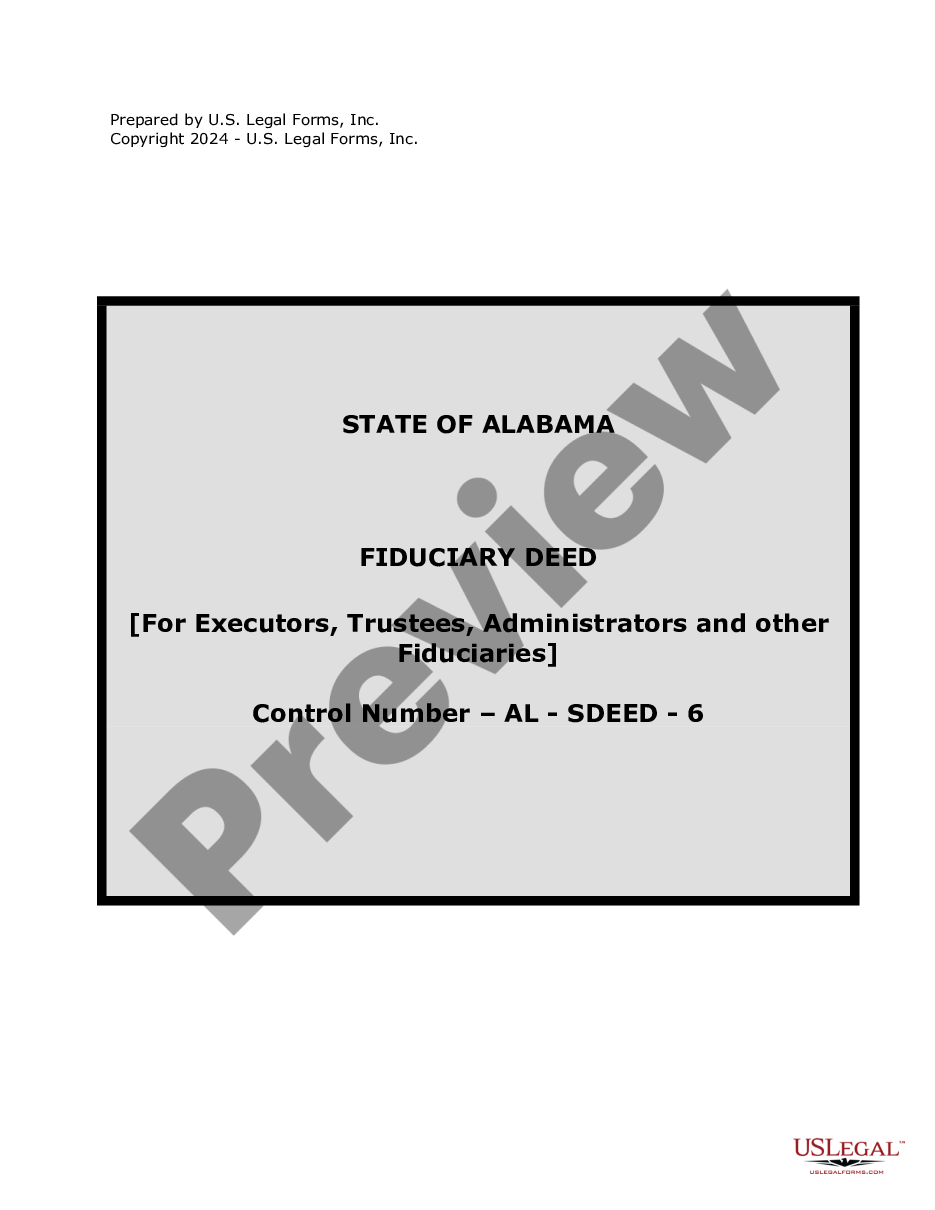
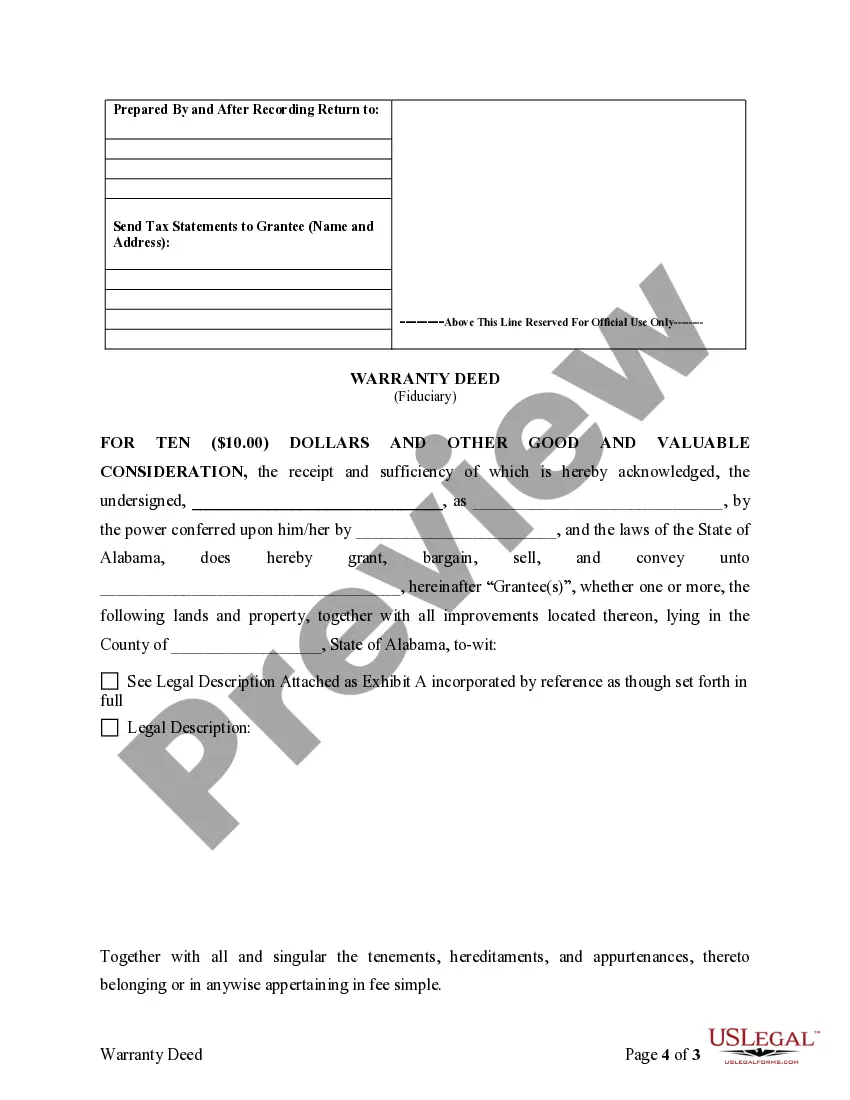
The Warranty Deed for Fiduciary is a legal document used to transfer real estate ownership from a fiduciary, such as an executor, trustee, guardian, or conservator, to another party (the grantee). Unlike a traditional warranty deed, this form is specifically designed for use by individuals acting in a fiduciary capacity, ensuring that the necessary legal authority is indicated. It serves to protect the interests of both the grantor and the grantee by establishing clear ownership rights and responsibilities.
Key parts of this document
- Grantor and grantee identification fields.
- Description of the property being transferred.
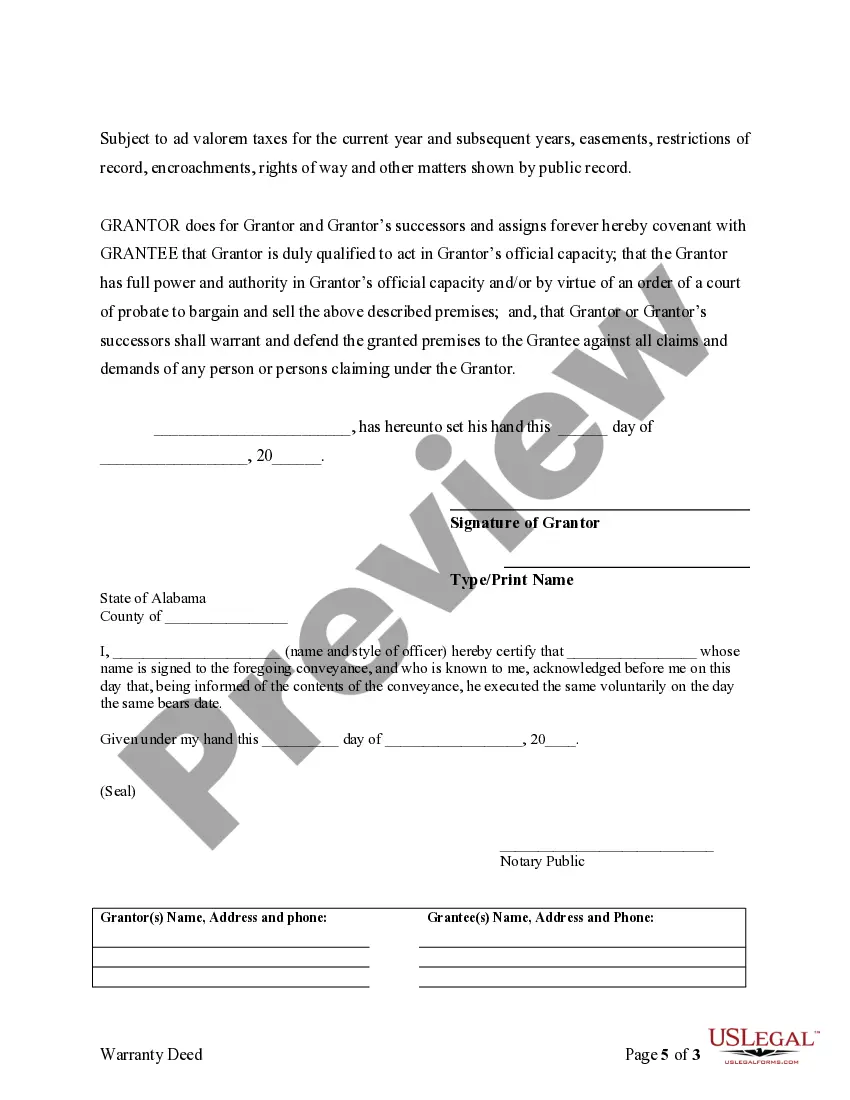
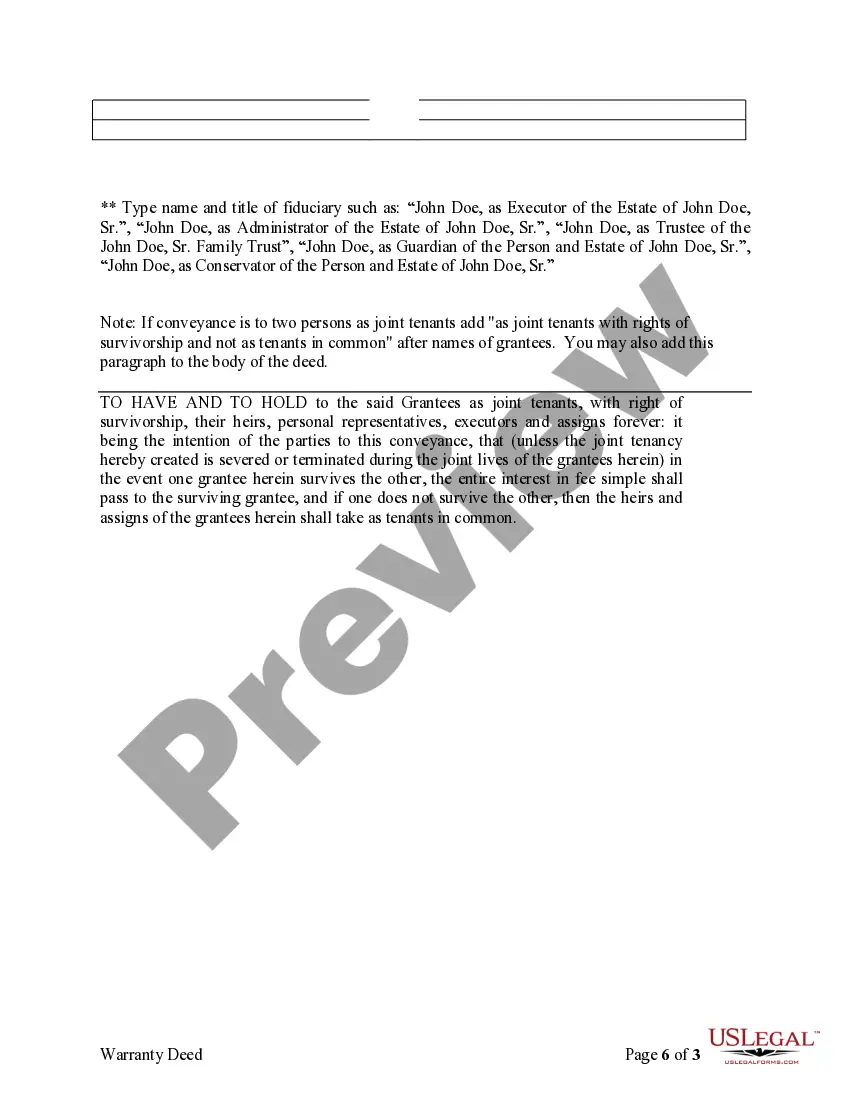
- Legal authority reference, specifying the fiduciary role.
- Signature and date lines for the grantor.
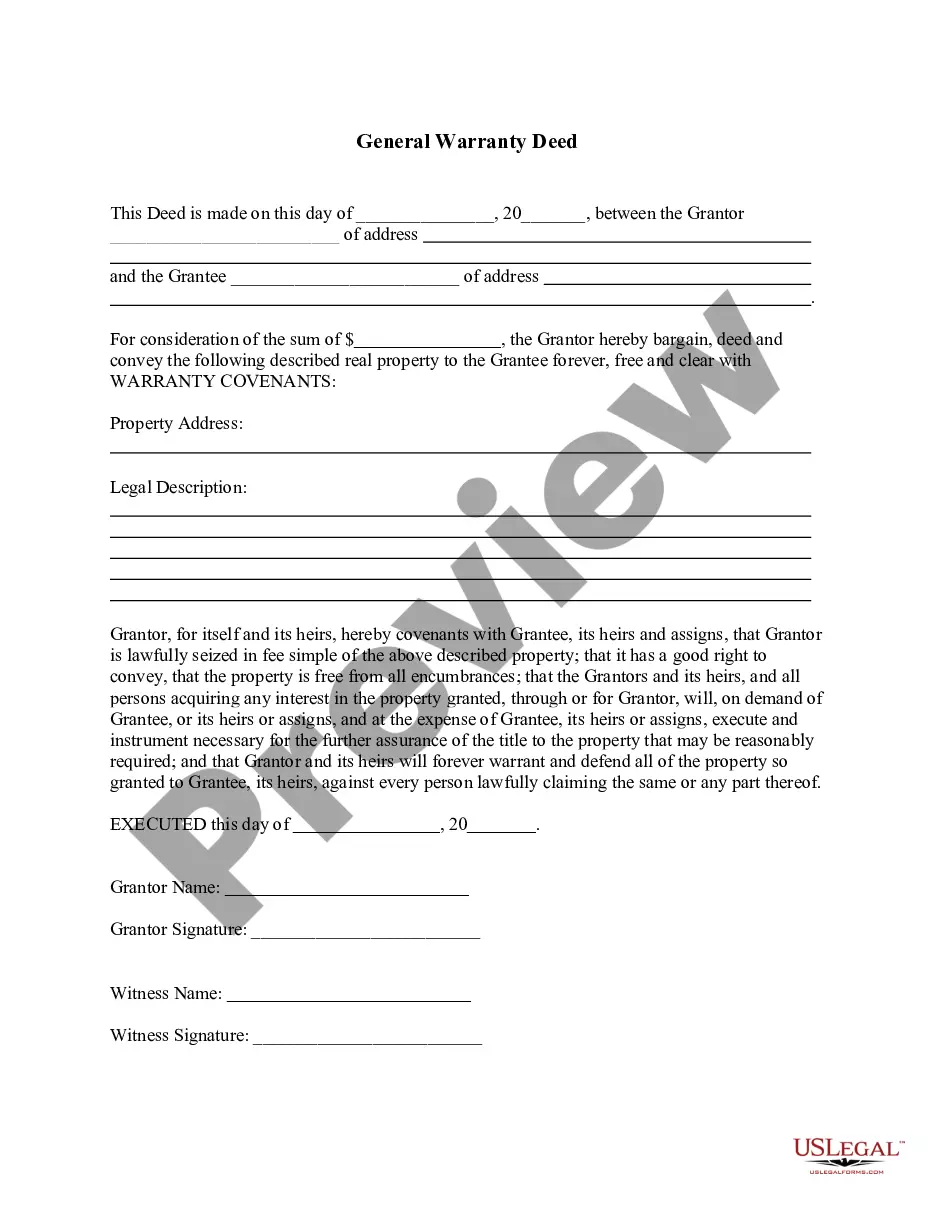
- Warranty clause providing assurances against legal claims.





When to use this document
This form should be used when a fiduciary needs to transfer real property as part of their duties. Common situations include when an executor is distributing an estate per the will, a trustee transferring property for a trust beneficiary, or a guardian managing assets for a minor. It ensures that the transaction is legally valid and recognized by authorities.
Who needs this form
- Executors of estates who need to transfer property according to a will.
- Trustees responsible for distributing trust property.
- Guardians managing property on behalf of minors or incapacitated individuals.
- Conservators acting on behalf of individuals who are unable to manage their own affairs.
How to complete this form
- Identify the grantor's fiduciary role and complete their information.
- Provide full details of the grantee, including names and addresses.
- Describe the property being transferred, including legal descriptions.
- Include the date of the transaction and signatures where required.
- Review the completed document for accuracy before submission.
Does this document require notarization?
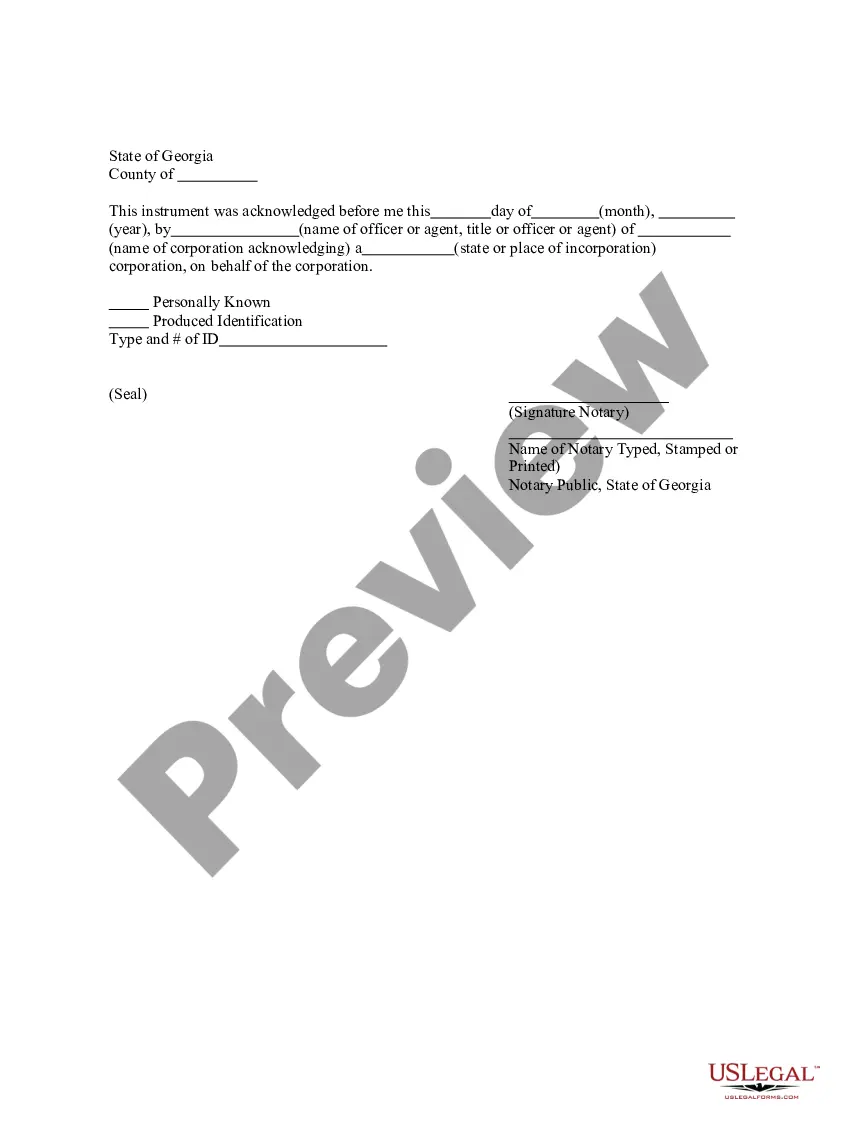
This form needs to be notarized to ensure legal validity. US Legal Forms provides secure online notarization powered by Notarize, allowing you to complete the process through a verified video call, available anytime.
Get your form ready online
Our built-in tools help you complete, sign, share, and store your documents in one place.
Make edits, fill in missing information, and update formatting in US Legal Forms—just like you would in MS Word.
Download a copy, print it, send it by email, or mail it via USPS—whatever works best for your next step.
Sign and collect signatures with our SignNow integration. Send to multiple recipients, set reminders, and more. Go Premium to unlock E-Sign.
If this form requires notarization, complete it online through a secure video call—no need to meet a notary in person or wait for an appointment.
We protect your documents and personal data by following strict security and privacy standards.

Make edits, fill in missing information, and update formatting in US Legal Forms—just like you would in MS Word.

Download a copy, print it, send it by email, or mail it via USPS—whatever works best for your next step.

Sign and collect signatures with our SignNow integration. Send to multiple recipients, set reminders, and more. Go Premium to unlock E-Sign.

If this form requires notarization, complete it online through a secure video call—no need to meet a notary in person or wait for an appointment.

We protect your documents and personal data by following strict security and privacy standards.
Mistakes to watch out for
- Failing to accurately identify the fiduciary's authority.
- Not including a proper description of the property.
- Omitting signatures or dates required by law.
- Using the form without checking for state-specific requirements.
Why use this form online
- Convenience of downloading and completing the form at your pace.
- Editability allows for customizations while maintaining the essential structure.
- Access to accurately drafted forms crafted by licensed attorneys.
- Quick retrieval and printing options for immediate use.
Looking for another form?
Form popularity
FAQ
In Alabama, a warranty deed can be prepared by the property owner, an attorney, or a qualified real estate professional. If you opt to prepare your own, an Alabama Warranty Deed for Fiduciary template can simplify the process. Many individuals rely on platforms like USLegalForms, which provide easy access to templates ensuring that all legal details are addressed correctly. This support can help you with your deed preparation efforts.
Yes, you can file a warranty deed yourself in Alabama. Once you have completed your Alabama Warranty Deed for Fiduciary, you must submit it to the appropriate county office for recording. Filing it yourself can save you some costs, but ensure all details are accurate to avoid complications later. Resources like USLegalForms can help you with guidelines on how to file successfully.
For a deed to be valid in Alabama, it must include essential elements like the names of parties, a legal description of the property, and signatures of the grantor. Additionally, the deed should be acknowledged by a notary public to be recorded. When creating your Alabama Warranty Deed for Fiduciary, ensuring these requirements are met is crucial. Tools like USLegalForms can streamline this process and reduce the risk of errors.
A fiduciary warranty deed is a legal document that transfers property ownership and guarantees that the title is clear. This type of deed is often used by fiduciaries, such as executors or trustees, to convey property on behalf of the owner. Utilizing an Alabama Warranty Deed for Fiduciary provides assurance to the buyer, as it holds the seller liable for any defects in the title. Be sure to follow the guidelines for its preparation to uphold its validity.
Typically, a deed is written up by a property owner, an attorney, or a real estate professional. If you decide to write your own Alabama Warranty Deed for Fiduciary, using easy-to-follow templates can simplify the process. On platforms like USLegalForms, you can find ready-to-use templates that guide you step-by-step. This support can be invaluable in ensuring accuracy.
You do not need a lawyer to prepare a deed in Alabama, but consulting one can be very beneficial. A lawyer can clarify complex legal terms and ensure your Alabama Warranty Deed for Fiduciary meets all requirements. If you’re unsure about any part of the process, consider engaging a professional or looking into USLegalForms for reliable templates.
Yes, you can prepare your own Warranty Deed in Alabama. However, it is essential to understand the legal language and requirements to ensure the deed is valid. Many people choose to use resources like USLegalForms, which offers template forms to help you create an Alabama Warranty Deed for Fiduciary accurately. This way, you stay compliant and protect your interests.
In Alabama, it is not required for an attorney to prepare a deed. However, having an attorney draft your Alabama Warranty Deed for Fiduciary can help ensure that all legal requirements are met. A knowledgeable attorney can guide you through the process, helping to avoid potential pitfalls. Consider using USLegalForms for templates and assistance.
Individuals obtain an Alabama Warranty Deed for Fiduciary to guarantee full ownership rights and protect against future claims. This type of deed provides assurance that no undisclosed issues or liens exist on the property, which is crucial for buyers and sellers alike. Utilizing this legal tool ensures a smooth transaction process and peace of mind, making it an excellent choice for anyone involved in real estate.
The Alabama Warranty Deed for Fiduciary serves as a legal document that transfers property ownership by a fiduciary, such as an executor or trustee. This deed ensures the clear and definitive transfer of property rights while protecting the interests of the beneficiaries involved. By using this deed, fiduciaries can confidently fulfill their responsibilities and uphold their duties in accordance with Alabama law.