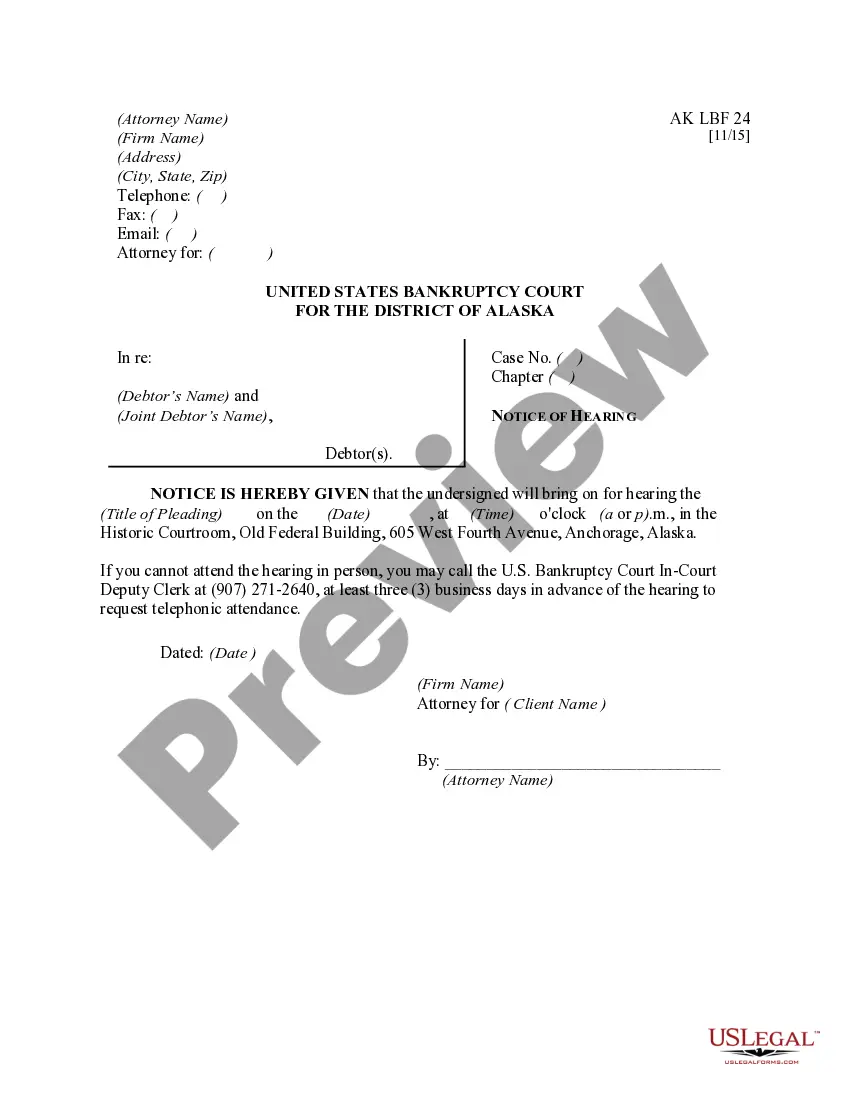
Alaska Letter from Landlord to Tenant for Failure to keep premises as clean and safe as condition of premises permits - Remedy or lease terminates
About this form
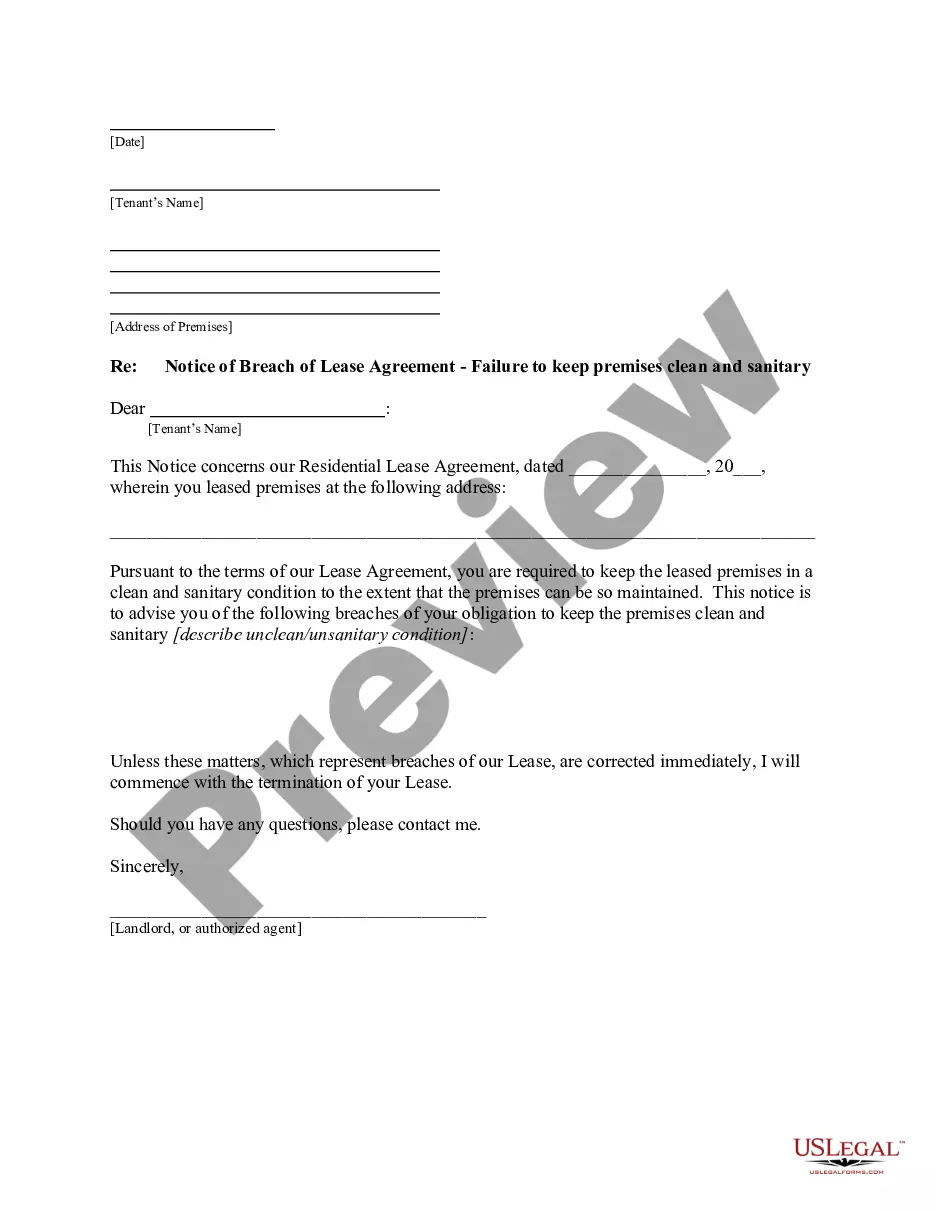
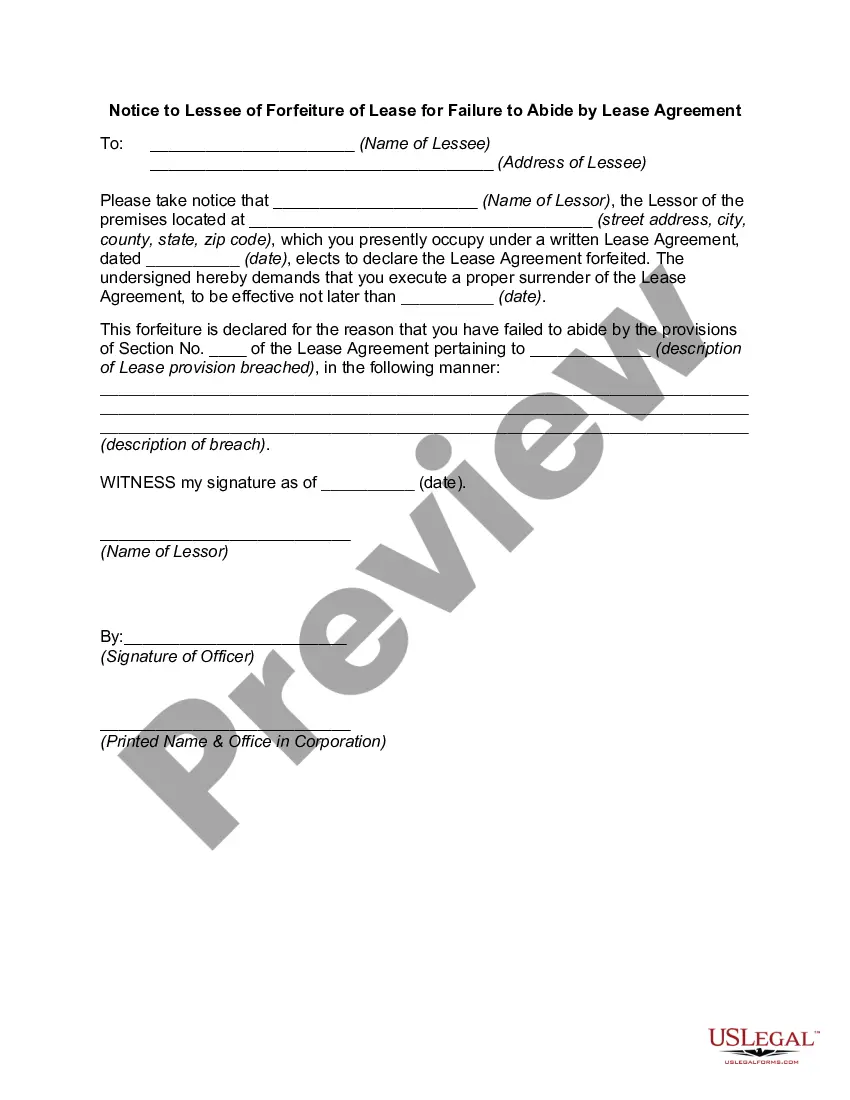
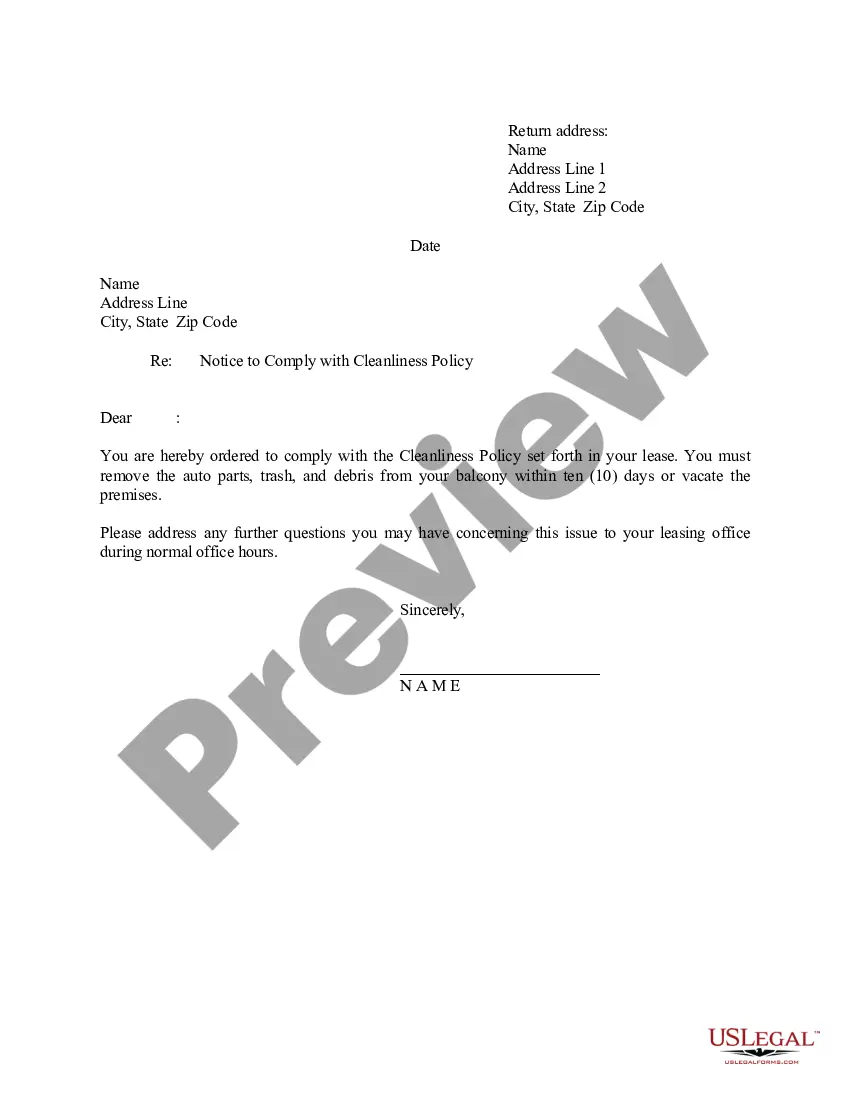
This **Letter from Landlord to Tenant for Failure to Keep Premises Clean and Safe** is a formal notification issued by a landlord to inform a tenant about their obligation to maintain cleanliness and sanitary conditions in the leased property. This form specifically addresses breaches of lease agreements related to the cleanliness and safety of the premises, distinguishing it from other landlord-tenant forms that might focus on different issues, such as eviction notices or lease renewals.
What’s included in this form
- Identification of the parties involved (landlord and tenant)
- Description of the unclean or unsanitary conditions observed
- Reference to the specific lease agreement terms regarding cleanliness
- Notification of potential remedies or lease termination due to non-compliance
- Instructions for the tenant on how to rectify the situation


When to use this form
This form should be used when a landlord needs to notify a tenant about failures to maintain the leased property in a clean and safe condition. Common scenarios include excessive clutter, unsanitary conditions, or failure to uphold basic cleanliness standards, which contravene the lease agreement. This notice can serve as a precursor to further action, such as termination of the lease if the issues are not addressed promptly.
Who can use this document
This form is intended for:
- Landlords or property owners managing residential rental properties
- Tenants who receive an official notice regarding cleanliness issues
- Real estate professionals assisting either landlords or tenants in legal matters related to lease agreements
How to complete this form
- Identify the parties: Enter the names of both the landlord and tenant at the top of the form.
- Specify the property: Clearly identify the property address to which this notice pertains.
- Describe the issues: Detail the specific unclean or unsanitary conditions observed.
- Cite the lease agreement: Reference the exact terms of the lease that require cleanliness maintenance.
- Indicate the required actions: Explain the steps the tenant must take to remedy the situation.
Is notarization required?
This form does not typically require notarization unless specified by local law. However, it is always a good idea to check local requirements to ensure the form's legal validity.
Get your form ready online
Our built-in tools help you complete, sign, share, and store your documents in one place.
Make edits, fill in missing information, and update formatting in US Legal Forms—just like you would in MS Word.
Download a copy, print it, send it by email, or mail it via USPS—whatever works best for your next step.
Sign and collect signatures with our SignNow integration. Send to multiple recipients, set reminders, and more. Go Premium to unlock E-Sign.
If this form requires notarization, complete it online through a secure video call—no need to meet a notary in person or wait for an appointment.
We protect your documents and personal data by following strict security and privacy standards.

Make edits, fill in missing information, and update formatting in US Legal Forms—just like you would in MS Word.

Download a copy, print it, send it by email, or mail it via USPS—whatever works best for your next step.

Sign and collect signatures with our SignNow integration. Send to multiple recipients, set reminders, and more. Go Premium to unlock E-Sign.

If this form requires notarization, complete it online through a secure video call—no need to meet a notary in person or wait for an appointment.

We protect your documents and personal data by following strict security and privacy standards.
Mistakes to watch out for
- Failing to provide specific examples of the unsanitary conditions.
- Not citing the relevant lease agreement terms accurately.
- Neglecting to provide clear instructions on how the tenant can remedy the situation.
Benefits of using this form online
- Convenience of downloading and completing the form from home.
- Editability to make changes easily before finalizing and sending.
- Reliability, as the form is drafted by licensed attorneys to ensure compliance with legal standards.
- This notice is enforceable as long as it complies with state laws governing landlord-tenant relationships.
- Ensure that all allegations regarding cleanliness are factual and documented.
- This form can be used in conjunction with other legal actions if necessary.
What to keep in mind
- This form is essential for addressing cleanliness issues in rental properties.
- Provide clear documentation of the tenant's obligations and breaches.
- Ensure compliance with local laws regarding tenant rights and responsibilities.
- This notice could be the first step in legal action if cleanliness issues are not resolved.
Looking for another form?
Form popularity
FAQ
A premise is a proposition upon which an argument is based or from which a conclusion is drawn.Merriam-Webster gives this example of a major and minor premise (and conclusion): "All mammals are warmblooded major premise; whales are mammals minor premise; therefore, whales are warmblooded conclusion."
In Contract Law, Terms means Terms of a Contract, the conditions and warranties agreed upon between parties to the contract. Contract terms may be verbal or in writing. Conditions are those terms which are so important that one or more of the parties would not enter into the contract without them.
The property refers to the entirety of the land, buildings, structures, equipment, etc., owned by the landowner, while the premises refers to only that portion of the property and/or components of it that are the subject of the lease.
Definitions. The Premises describes what is being leased. At minimum, this means the land, but can also include buildings and other infrastructure such as greenhouses, wells, and fencing. Leased equipment could be part of the Premises, or could be contained in a separate lease.
Premised; premising. Definition of premise (Entry 2 of 2) transitive verb. 1a : to set forth beforehand as an introduction or a postulate. b : to offer as a premise in an argument.
: away from or outside of a building or the area of land that it is on Police escorted her off premises. The printing of the books is done off premises.
: inside a building or on the area of land that it is on The hotel has a restaurant on the premises. No smoking is allowed on the premises.
Premises. n. 1) in real estate, land and the improvements on it, a building, store, shop, apartment, or other designated structure. The exact premises may be important in determining if an outbuilding (shed, cabana, detached garage) is insured or whether a person accused of burglary has actually entered a structure.