Consent to Easement by Mortgagee Or Beneficiary in Deed of Trust
Overview of this form
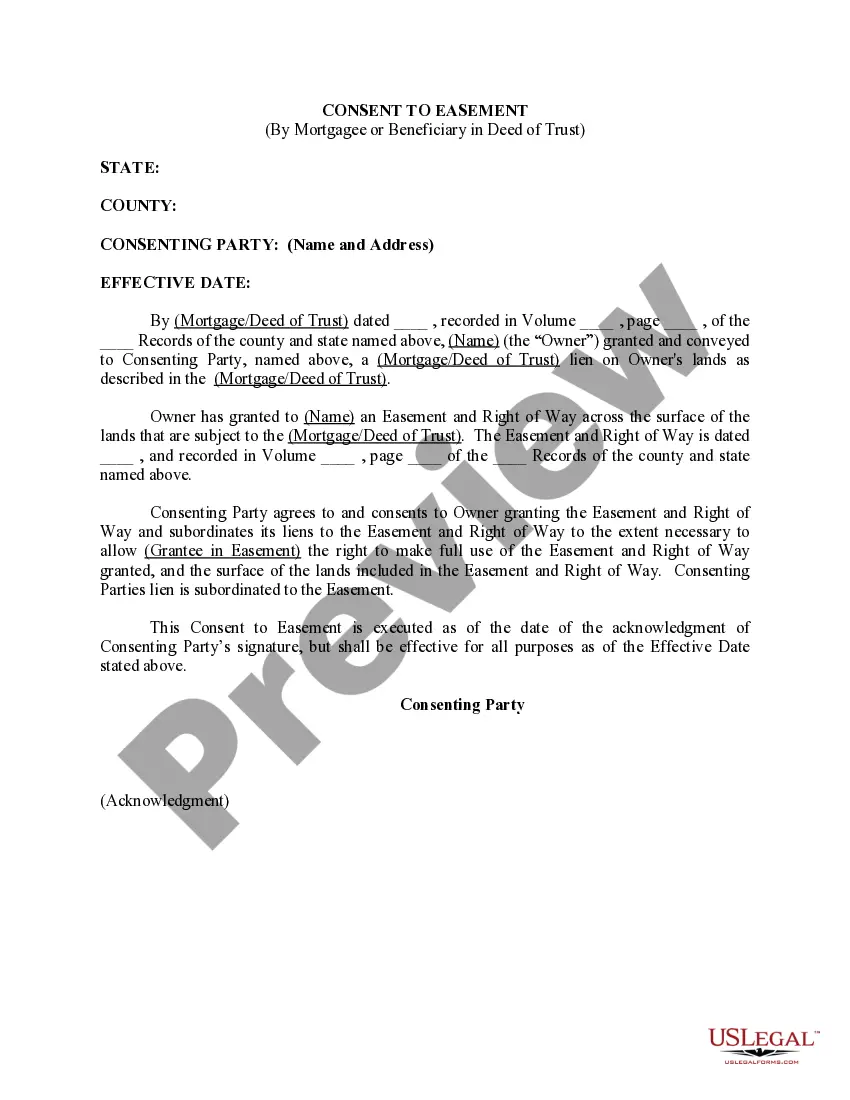
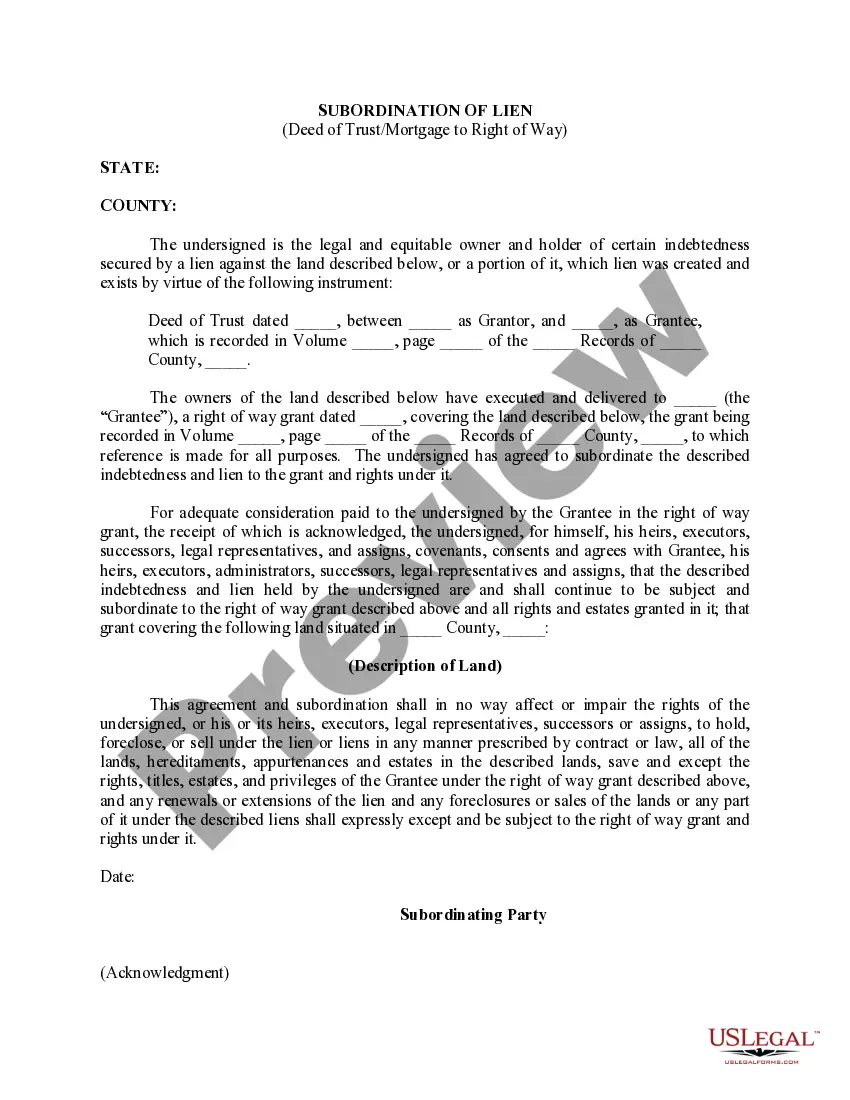
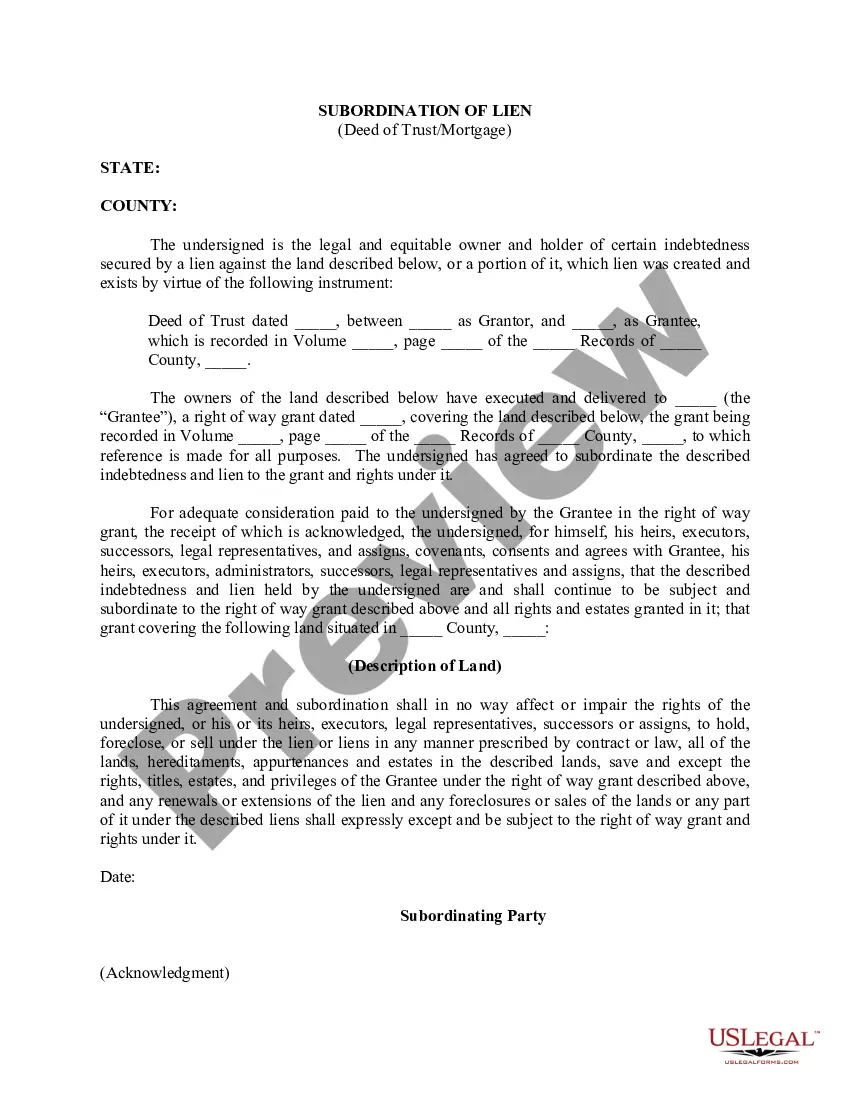
The Consent to Easement by Mortgagee or Beneficiary in Deed of Trust form is a legal document that allows a lender (the consenting party) to give their permission for a property owner to grant an easement and right of way to another party (the grantee). This form is particularly important as it clarifies the relationship between the easement being granted and the existing mortgage or deed of trust, ensuring that the lender's interests are preserved while permitting the grantee's use of the easement.
Key components of this form
- Identifying information about the Consenting Party, including name and address.
- Details of the owner (the grantor) and the mortgage or deed of trust.
- They date and recording details of the easement and right of way.
- Agreement to subordinate the lender's lien to the easement granted.
- Signature acknowledgment from the Consenting Party.

When to use this form
This form is useful when a property owner wishes to grant an easement to a third party, and there is an existing mortgage or deed of trust on the property. It typically arises in scenarios such as allowing utility companies access to install lines or enabling neighbors to cross property for access purposes. The consenting party must agree to the easement's terms to protect their financial interest in the property.
Who this form is for
- Mortgagees or beneficiaries of a deed of trust who need to consent to an easement being granted.
- Property owners planning to grant an easement that could impact existing liens.
- Grantees needing assurance that their rights to utilize the easement are recognized legally.
How to prepare this document
- Identify the parties involved, including the property owner, consenting party, and grantee.
- Specify the legal description of the property affected by the easement.
- Enter the effective date and recording details for the mortgage or deed of trust.
- Include the date and details of the easement and right of way being granted.
- Ensure the Consenting Party signs and dates the form, acknowledging their consent.
Notarization requirements for this form
This form does not typically require notarization unless specified by local law. However, having it notarized can provide an added layer of validity and security for the parties involved.
Get your form ready online
Our built-in tools help you complete, sign, share, and store your documents in one place.
Make edits, fill in missing information, and update formatting in US Legal Forms—just like you would in MS Word.
Download a copy, print it, send it by email, or mail it via USPS—whatever works best for your next step.
Sign and collect signatures with our SignNow integration. Send to multiple recipients, set reminders, and more. Go Premium to unlock E-Sign.
If this form requires notarization, complete it online through a secure video call—no need to meet a notary in person or wait for an appointment.
We protect your documents and personal data by following strict security and privacy standards.

Make edits, fill in missing information, and update formatting in US Legal Forms—just like you would in MS Word.

Download a copy, print it, send it by email, or mail it via USPS—whatever works best for your next step.

Sign and collect signatures with our SignNow integration. Send to multiple recipients, set reminders, and more. Go Premium to unlock E-Sign.

If this form requires notarization, complete it online through a secure video call—no need to meet a notary in person or wait for an appointment.

We protect your documents and personal data by following strict security and privacy standards.
Mistakes to watch out for
- Failing to include complete information about the property owner and consenting party.
- Not recording the easement in the appropriate county records.
- Omitting the date or specific terms of the easement agreement.
- Signing without verifying that all parties have consented to the agreement.
Why complete this form online
- Convenience of downloading the document on-demand.
- Editability allows for customization to fit specific needs.
- Reliability, as the forms are drafted by licensed attorneys with legal expertise.
Legal use & context
- This form is necessary to ensure that the easement granted is legally recognized and enforceable.
- Subordination of a lien to an easement is a standard practice in real estate law.
- Using this form helps avoid potential disputes regarding easements and property rights in the future.
Quick recap
- The form is essential for property owners and lienholders involved in granting easements.
- It protects the interests of all parties by documenting consent and rights clearly.
- Proper completion and acknowledgment are crucial for ensuring enforceability.
Looking for another form?
Form popularity
FAQ
Whether you have a deed of trust or a mortgage, they both serve to assure that a loan is repaid, either to a lender or an individual person. A mortgage only involves two parties the borrower and the lender. A deed of trust adds an additional party, a trustee, who holds the home's title until the loan is repaid.
Party information: names and addresses of the trustor(s), trustee(s), beneficiary(ies), and guarantor(s) (if applicable) Property details: full address of the property and its legal description (which can be obtained from the County Recorder's Office)
Some owners are put off using solicitors duke to the deed of trust cost. Individuals can write out their own, and use someone else as a witness. However, this may have errors or not be a legally binding document. The investment of getting a deed of trust when buying a property is often worth it in the long term.
Yes, there are key differences between the two. With a deed, you transfer the ownership of the property to one party. In contrast, a deed of trust does not mean the holder owns the property. In an arrangement involving a deed of trust, the borrower signs a contract with the lender with details regarding the loan.
The person who owns the property usually signs a promissory note and a deed of trust. The deed of trust does not have to be recorded to be valid.
Some use deeds of trust instead, which are similar documents, but they have some fundamental differences.With a deed of trust, however, the lender must act through a go-between called the trustee. The beneficiary and the trustee can't be the same person or entity.
An easement may be created by express words, either of grant or reservation. Typically, an express grant of easement will be created by deed but may be created by any instrument that transfers an interest or estate in real property.
Nine Essential Property Easement Agreement Considerations. Legal Description of Properties. Depiction of the Easement Area. Covenant Not to Disturb the Use of the Easement. Determination of Maintenance Obligations. Payment of Property Taxes.
There must be a dominant and a servient tenement; The easement must accommodate the dominant tenement, that is, be connected with its enjoyment and for its benefit; The dominant and servient owners must be different persons; The right claimed must be capable of forming the subject-matter of a grant.