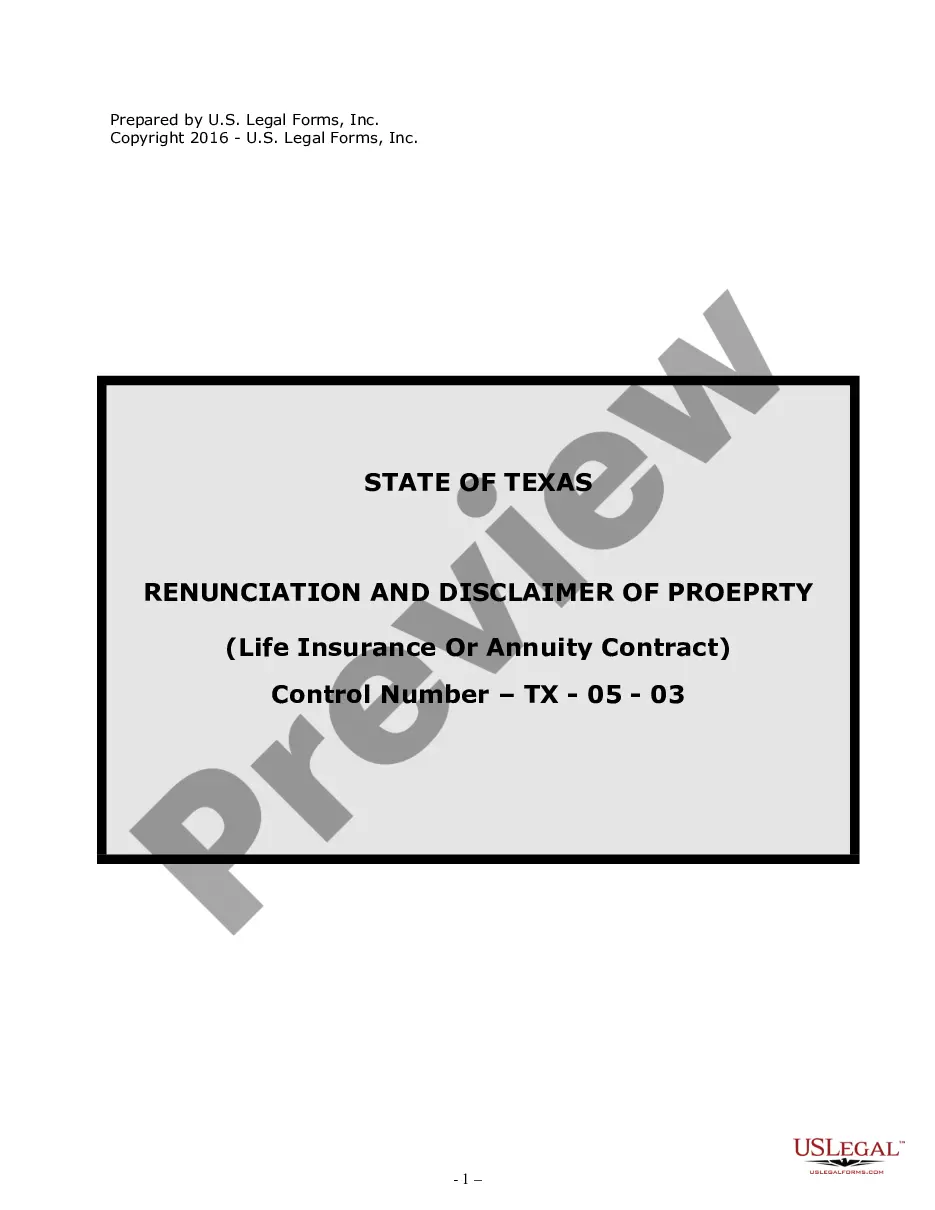
Texas Renunciation And Disclaimer of Property from Life Insurance or Annuity Contract
What this document covers
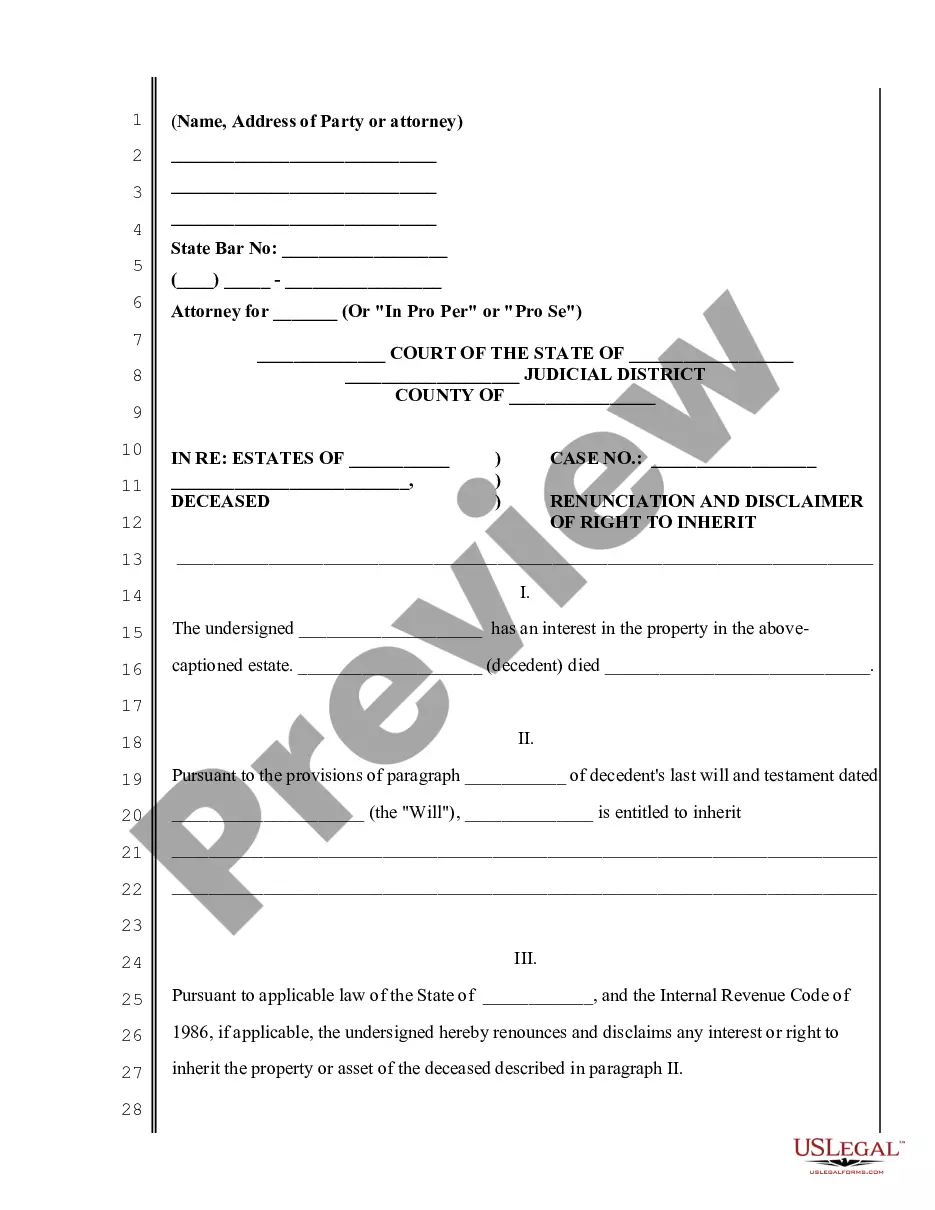
The Renunciation and Disclaimer of Property from Life Insurance or Annuity Contract form allows a beneficiary to officially reject their entitlement to insurance or annuity proceeds following a decedent's death. This legal document is crucial for beneficiaries who wish to renounce their rights to the property and ensure that it is distributed according to the decedent's wishes or applicable state laws. Unlike other legal forms, this one specifically addresses the unique circumstances involved in disclaiming benefits from life insurance and annuity contracts.
Main sections of this form
- Identification of the decedent whose insurance or annuity proceeds are being disclaimed.
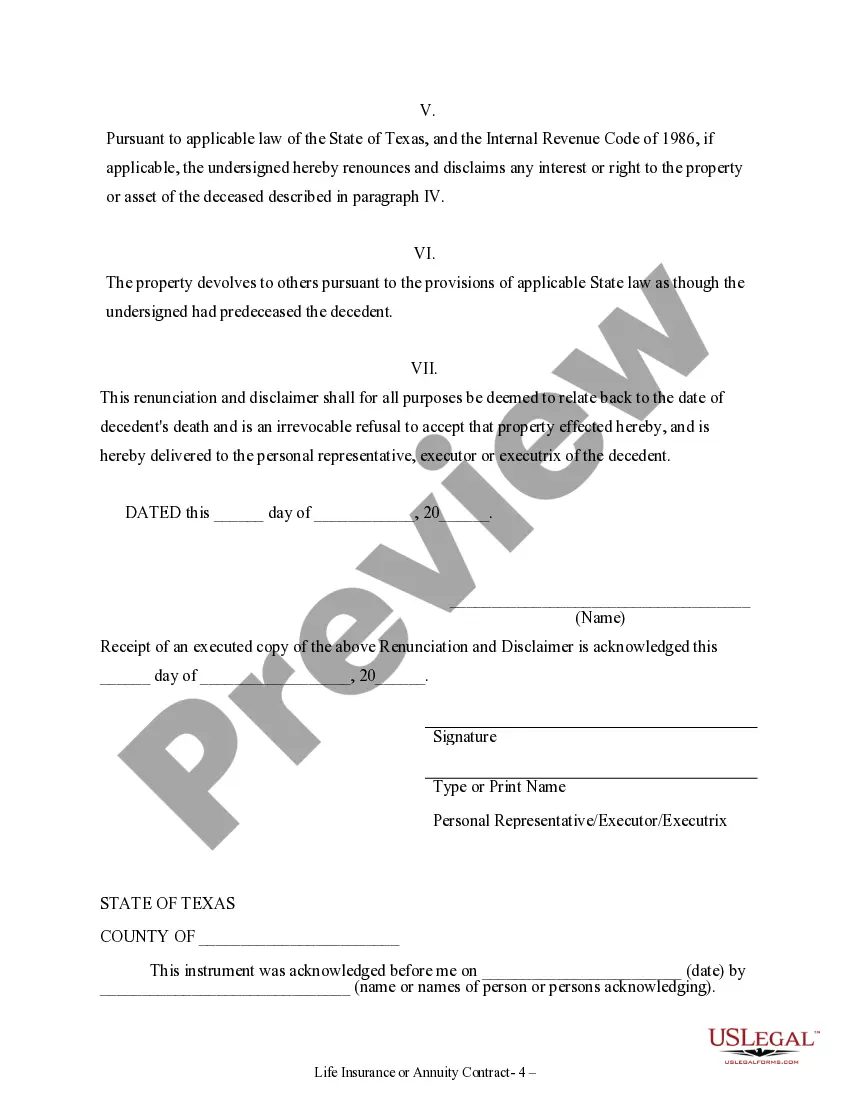
- Declaration of the beneficiary's intent to disclaim the interest in the proceeds.
- Attestation that the disclaimer will be filed within nine months following the decedent's death.
- Legal acknowledgment of the irrevocability of the disclaimer.
- Delivery confirmation to the personal representative or executor of the decedent.



Common use cases
This form is necessary in situations where a beneficiary of a life insurance policy or an annuity contract decides to renounce their rights to the proceeds. This may occur if the beneficiary prefers not to receive the benefits for personal, tax, or estate planning reasons, or if they believe the proceeds would be more beneficial to another party, such as a charity or residual heirs.
Who this form is for
- Beneficiaries named in a life insurance or annuity contract who wish to disclaim their interest.
- Individuals who are legally authorized to act on behalf of the beneficiary.
- Anyone involved in estate planning or handling an estate that includes life insurance or annuity proceeds.
Steps to complete this form
- Identify the decedent by providing their name and date of death.
- Fill in your name as the beneficiary exercising the right to disclaim.
- Specify whether you are disclaiming the entire or a partial interest in the proceeds.
- Enter the date when the disclaimer is executed.
- Sign the form and ensure it is delivered to the personal representative or executor of the estate.
Notarization guidance
This form does not typically require notarization to be legally valid. However, some jurisdictions or document types may still require it. US Legal Forms provides secure online notarization powered by Notarize, available 24/7 for added convenience.
Get your form ready online
Our built-in tools help you complete, sign, share, and store your documents in one place.
Make edits, fill in missing information, and update formatting in US Legal Forms—just like you would in MS Word.
Download a copy, print it, send it by email, or mail it via USPS—whatever works best for your next step.
Sign and collect signatures with our SignNow integration. Send to multiple recipients, set reminders, and more. Go Premium to unlock E-Sign.
If this form requires notarization, complete it online through a secure video call—no need to meet a notary in person or wait for an appointment.
We protect your documents and personal data by following strict security and privacy standards.

Make edits, fill in missing information, and update formatting in US Legal Forms—just like you would in MS Word.

Download a copy, print it, send it by email, or mail it via USPS—whatever works best for your next step.

Sign and collect signatures with our SignNow integration. Send to multiple recipients, set reminders, and more. Go Premium to unlock E-Sign.

If this form requires notarization, complete it online through a secure video call—no need to meet a notary in person or wait for an appointment.

We protect your documents and personal data by following strict security and privacy standards.
Avoid these common issues
- Failing to file the disclaimer within nine months of the decedent's death.
- Not signing or dating the form properly.
- Confusing disclaimers with assignments, which serve different legal purposes.
- Leaving out necessary beneficiary information or incorrect property details.
Benefits of using this form online
- Convenience of completing the form from home at any time.
- Editability allows users to easily correct errors before submission.
- Reliable source based on legal standards and reviewed by licensed attorneys.
Looking for another form?
Form popularity
FAQ
In New South Wales, the Registrar General is able record the State of New South Wales as the proprietor of disclaimed land. The land will remain subject to any charges and mortgages despite the change in proprietor.
Disclaim, in a legal sense, refers to the renunciation of an interest in, or an acceptance of, inherited assets, such as property, by way of a legal instrument.A gift, bequest, or other interest or obligation may be disclaimed via a written disclaimer of interest.
Be in writing; Declare the refusal to accept an interest in or power over the property; Describe the interest or power disclaimed; Be signed by the person making a disclaimer;
A qualified disclaimer is a part of the U.S. tax code that allows estate assets to pass to a beneficiary without being subject to income tax. Legally, the disclaimer portrays the transfer of assets as if the intended beneficiary never actually received them.
The disclaimer must be in writing: A signed letter by the person doing the disclaiming, identifying the decedent, describing the asset to be disclaimed, and the extent and amount, percentage or dollar amount, to be disclaimed, must be delivered to the person in control of the estate or asset, such as an executor,
In the law of inheritance, wills and trusts, a disclaimer of interest (also called a renunciation) is an attempt by a person to renounce their legal right to benefit from an inheritance (either under a will or through intestacy) or through a trust.A disclaimer of interest is irrevocable.
Put the disclaimer in writing. Deliver the disclaimer to the person in control of the estate usually the executor or trustee. Complete the disclaimer within nine months of the death of the person leaving the property. Do not accept any benefit from the property you're disclaiming.
1) To refuse or give away a claim or a right to something. For example, if your aunt leaves you a white elephant in her will and you don't want it, you can refuse the gift by disclaiming your ownership rights.
If you refuse to accept an inheritance, you will not be responsible for inheritance taxes, but you'll have no say in who receives the assets in your place. The bequest passes either to the contingent beneficiary listed in the will or, if that person died without a will, according to your state's laws of intestacy.