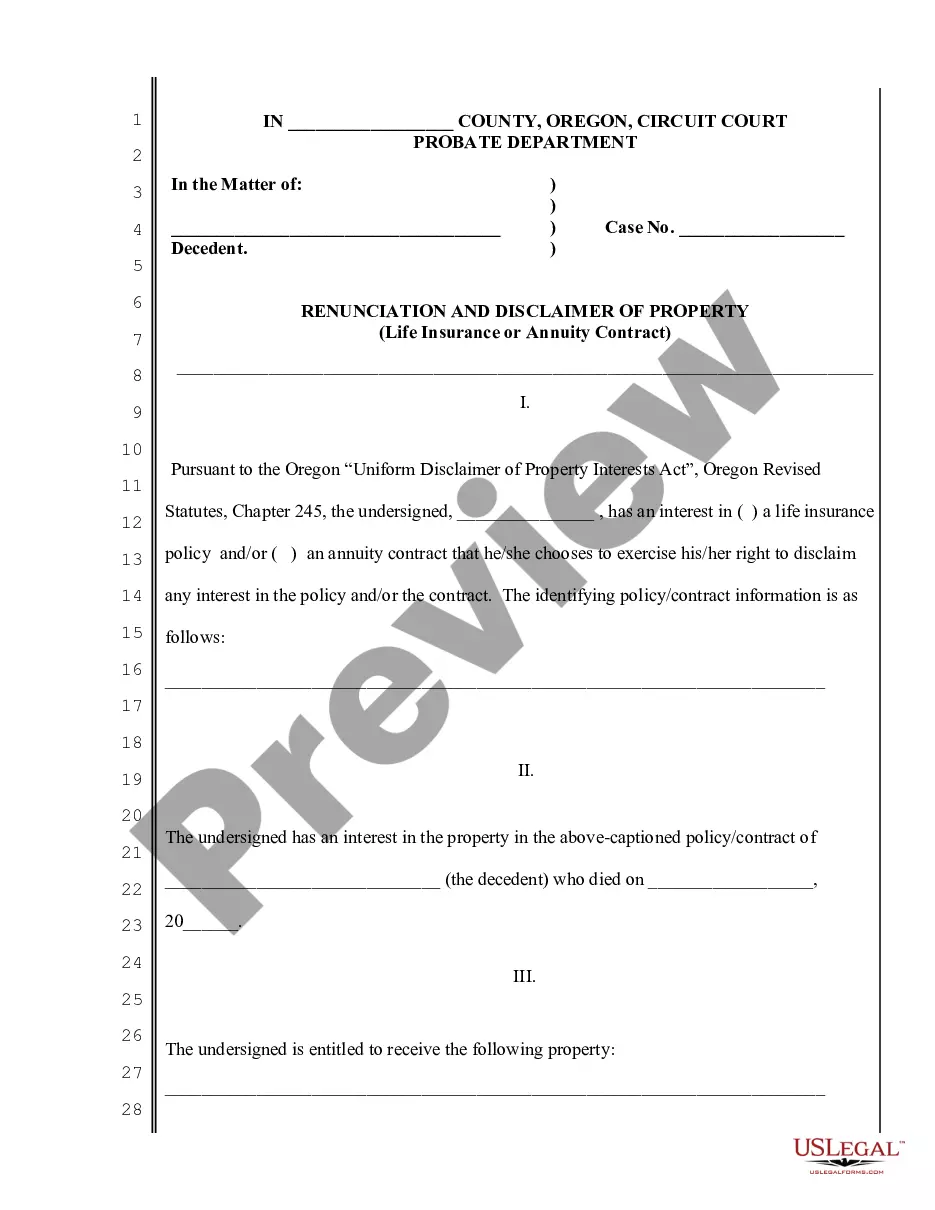
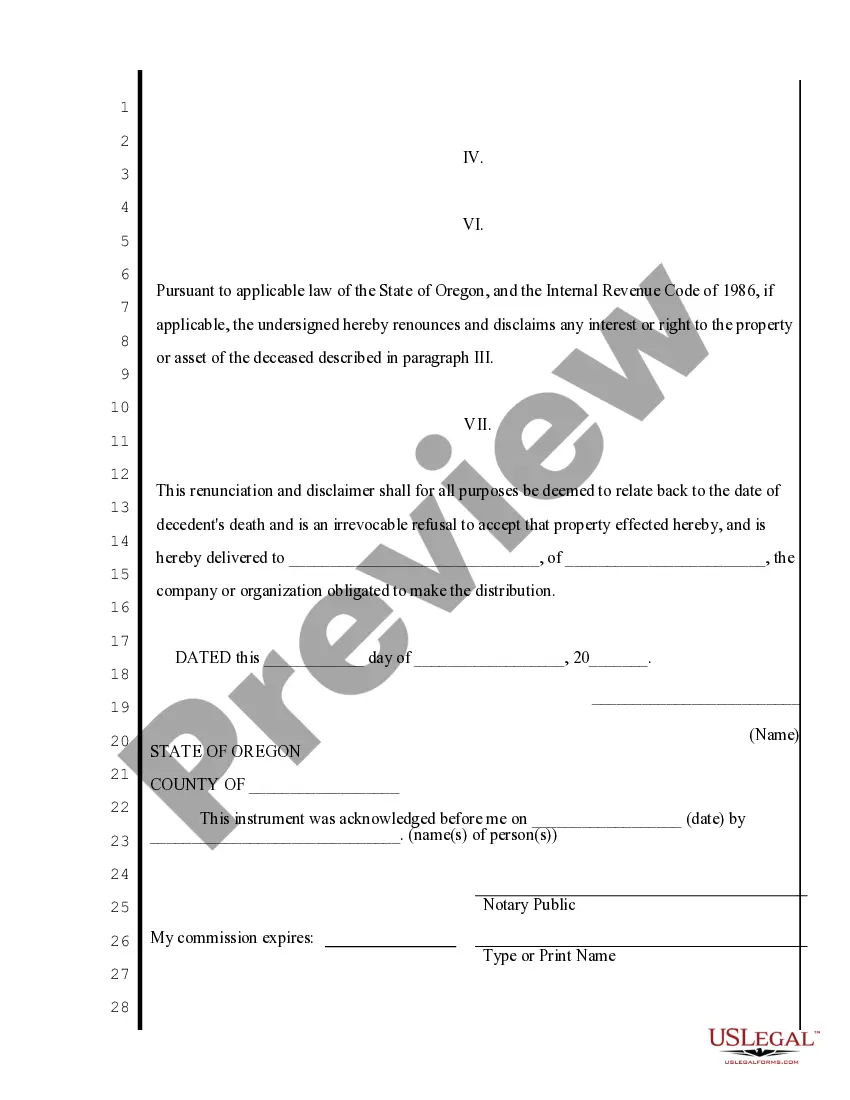
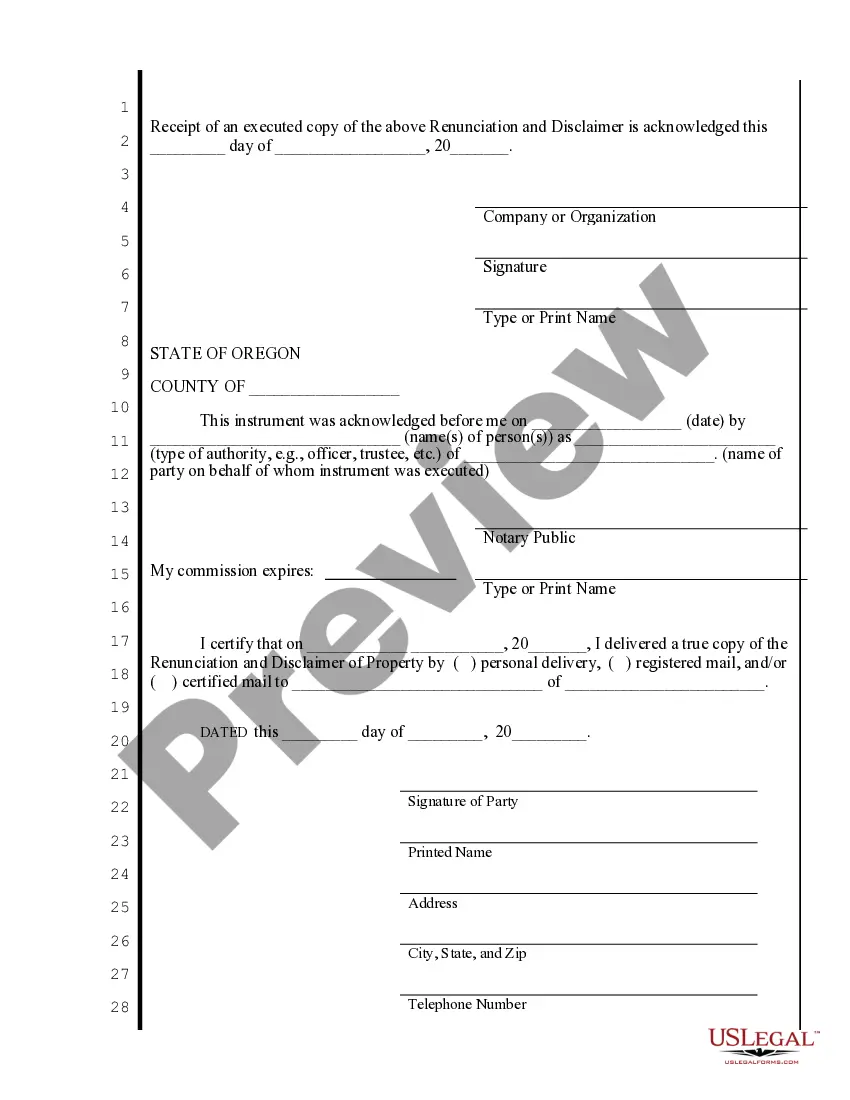
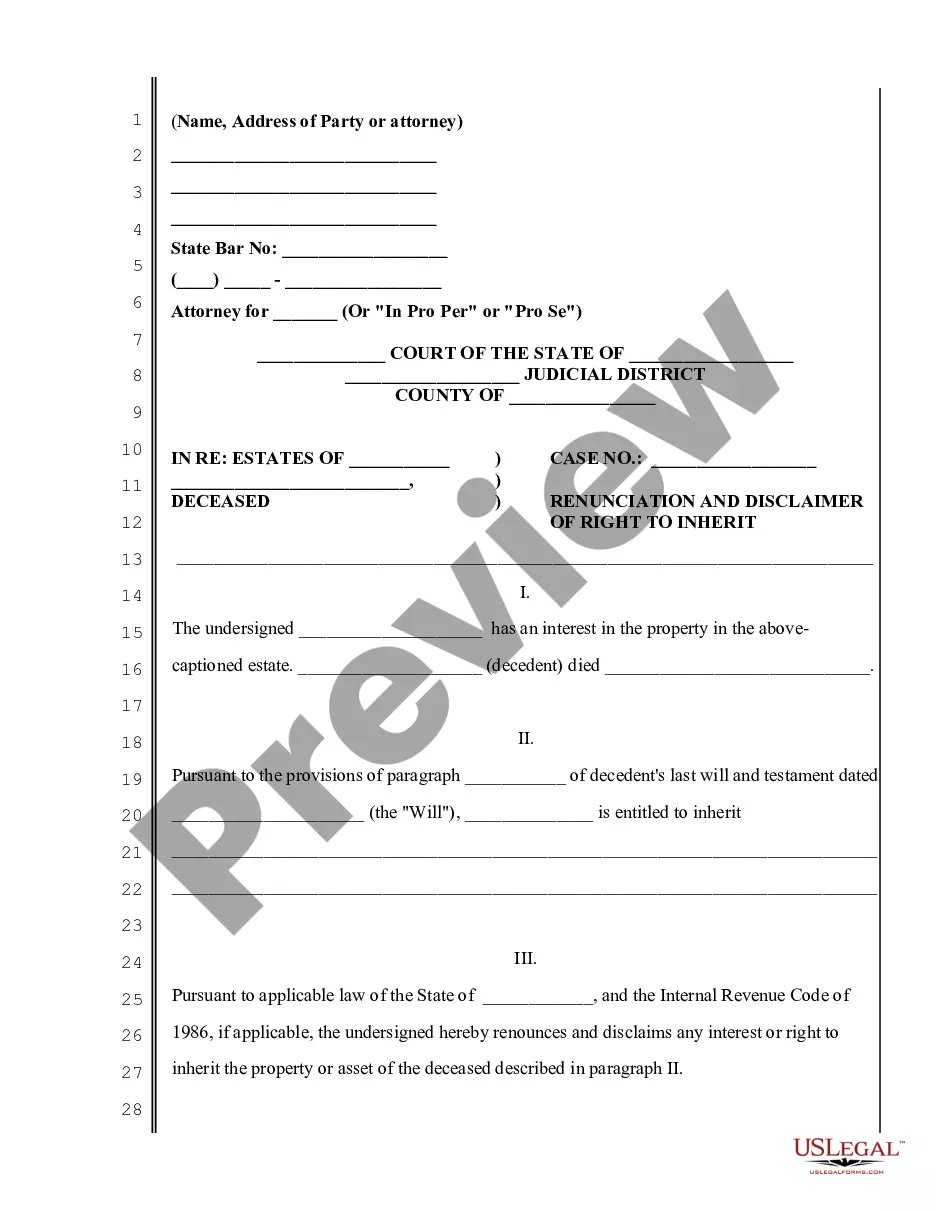
Renunciation And Disclaimer of Property from Life Insurance or Annuity Contract
Disclaimer of Property Interest-Oregon
Oregon Revised Statutes
Chapter 245 Intestate Succession and Wills
Uniform Disclaimer of Property Interests Act
Effective date January 1, 2002
Short Title:
Sections 1 to 18 may be cited as the Uniform Disclaimer of Property
Interests Act. Chapter 245, §1
Definitions:
As used in sections 1 to 18 of this 2001 Act:
(1) "Disclaimant" means the person to whom a disclaimed
interest or power would have passed had the disclaimer not been made.
(2) "Disclaimed interest" means the interest that would have passed
to the disclaimant had the disclaimer not been made.
(3) "Disclaimer" means the refusal to accept an interest in property
or a power over property.
(4) "Fiduciary" means a personal representative, trustee, agent
acting under a power of attorney or other person authorized to act as a
fiduciary with respect to the property of another person.
(5) "Jointly held property" means property held in the name of
two or more persons under an arrangement pursuant to which:
(6) "Person" means an individual, corporation, business trust, estate,
trust, partnership, limited liability company, association, joint venture,
government, governmental subdivision, agency, public corporation or any
other legal or commercial entity.
(7) "State" means a state of the United States, the District of
Columbia, Puerto Rico, the United States Virgin Islands or any territory
or insular possession subject to the jurisdiction of the United States.
The term includes an Indian tribe or band, or Alaskan native village, recognized
by federal law or formally acknowledged by another state.
(8) "Trust" means:
(a) A charitable or noncharitable express trust, including
any additions made to the trust, whenever and however created; and
(b) A trust created pursuant to a statute, judgment or decree that
requires the trust to be administered in the same manner as an express
trust. Chapter 245, §2
Scope:
Sections 1 to 18 of this 2001 Act apply to disclaimers of any interest
in or power over property without regard to when the interest or power
that is disclaimed was created. Chapter 245, §3
Effect on other law:
(1) Unless displaced by a provision of sections 1 to 18
of this 2001 Act, the principles of law and equity supplement sections
1 to 18 of this 2001 Act.
(2) Sections 1 to 18 of this 2001 Act do not limit any right of
a person to waive, release, disclaim or renounce an interest in property,
or power over property, under a law other than sections 1 to 18 of this
2001 Act. Chapter 245, §4
Power to disclaim; general requirements; when irrevocable:
(1) A person may disclaim, in whole or part, any interest
in property or any power over property, including a power of appointment.
A person may disclaim the interest or power even if the person who created
the interest or power imposed a spendthrift provision or similar restriction
on transfer or imposed a restriction or limitation on the right to disclaim.
(2) Except to the extent that a fiduciary's right to disclaim is
expressly restricted or limited by another statute of this state or by
the instrument creating the fiduciary relationship, a fiduciary may disclaim,
in whole or part, any interest in property or power over property, including
a power of appointment, without regard to whether the fiduciary is acting
in a personal or representative capacity. A fiduciary may disclaim the
interest or power even if the creator of the interest or power imposed
a spendthrift provision or similar restriction on transfer or a restriction
or limitation on the right to disclaim, or an instrument other than the
instrument that created the fiduciary relationship imposed a restriction
or limitation on the right to disclaim.
(3) To be effective, a disclaimer must:
(a) Be in writing or otherwise recorded by inscription
on a tangible medium or by storage in an electronic or other medium in
a manner that allows the disclaimer to be retrieved in perceivable form;
(4) A partial disclaimer may be expressed as a fraction, percentage,
monetary amount, term of years, limitation of a power or as any other interest
or estate in the property.
(5) A disclaimer is irrevocable when the disclaimer is delivered
or filed pursuant to section 12 of this 2001 Act or when the disclaimer
becomes effective as provided in sections 6 to 11 of this 2001 Act, whichever
occurs later.
(6) A disclaimer made under sections 1 to 18 of this 2001 Act is
not a transfer, assignment or release. Chapter 245, §5
Disclaimer of interest in property:
(1) For the purposes of this section:
(a) "Time of distribution" means the time when a disclaimed interest
would have taken effect through possession or enjoyment.
(b) "Future interest" means an interest that takes effect through
possession or enjoyment, if at all, at a time later than the time that
the interest is created.
(2) Except for a disclaimer governed by section 7 or 8 of this
2001 Act, the following rules apply to a disclaimer of an interest in property:
(a) The disclaimer takes effect when the instrument creating the
interest becomes irrevocable or, if the interest arises under the law of
intestate succession, when the decedent dies.
(b) The disclaimed interest passes according to any provision in
the instrument creating the interest providing for the disposition of the
specific interest in the event the interest is disclaimed, or according
to any provision in the instrument creating the interest providing for
the disposition of interests in general in the event the interests created
by the instrument are disclaimed.
(c) If the instrument creating the interest does not contain a
provision described in subsection (2) of this section, the following rules
apply:
(A) If the disclaimant is an individual, the disclaimed interest
passes as if the disclaimant had died immediately before the time of distribution.
However, if by law or under the instrument the descendants of the disclaimant
would share in the disclaimed interest by any method of representation
had the disclaimant died before the time of distribution, the disclaimed
interest passes only to the descendants of the disclaimant who survive
the time of distribution.
(d) Upon the disclaimer of a preceding interest, a future interest
held by a person other than the disclaimant takes effect as if the disclaimant
had died or ceased to exist immediately before the time of distribution,
but a future interest held by the disclaimant is not accelerated in possession
or enjoyment. Chapter 245, §6
Disclaimer of rights of survivorship in jointly held property:
(1) Upon the death of a holder of jointly held property,
a surviving holder may disclaim, in whole or part, the greater of:
(a) A fractional share of the property determined by dividing
the number one by the number of joint holders alive immediately before
the death of the holder to whose death the disclaimer relates; or
(b) All of the property except that part of the value of the entire
interest attributable to the contribution furnished by the disclaimant.
(2) A disclaimer under subsection (1) of this section takes effect
upon the death of the holder of jointly held property to whose death the
disclaimer relates.
(3) An interest in jointly held property disclaimed by a surviving
holder of the property passes as if the disclaimant predeceased the holder
to whose death the disclaimer relates. Chapter 245, §7
Disclaimer of interest by trustee:
If a trustee disclaims an interest in property that otherwise would
have become trust property, the interest does not become trust property.
Chapter 245, §8
Disclaimer of power of appointment or other power not held in
fiduciary capacity:
If a holder disclaims a power of appointment or other power
not held in a fiduciary capacity, the following rules apply:
(1) If the holder has not exercised the power, the disclaimer
takes effect as of the time the instrument creating the power becomes irrevocable.
(2) If the holder has exercised the power and the disclaimer is
of a power other than a presently exercisable general power of appointment,
the disclaimer takes effect immediately after the last exercise of the
power.
(3) The instrument creating the power is construed as if the power
expired when the disclaimer became effective. Chapter 245, §9
Disclaimer by appointee, object or taker in default of exercise
of power of appointment:
(1) A disclaimer of an interest in property by an appointee
of a power of appointment takes effect as of the time the instrument by
which the holder exercises the power becomes irrevocable.
(2) A disclaimer of an interest in property by a person who is
an object of an exercise of a power of appointment, or by a person who
is a taker in default of an exercise of a power of appointment, takes effect
as of the time the instrument creating the power becomes irrevocable.
Chapter 245, §10
Disclaimer of power held in fiduciary capacity:
(1) If a fiduciary disclaims a power held in a fiduciary
capacity that has not been exercised, the disclaimer takes effect as of the time the instrument creating the power becomes
irrevocable.
(2) If a fiduciary disclaims a power held in a fiduciary capacity
that has been exercised, the disclaimer takes effect immediately after
the last exercise of the power.
(3) A disclaimer under this section applies to another fiduciary
if the disclaimer so provides and the fiduciary disclaiming has the authority
to bind the estate, trust or other person for whom the fiduciary is acting.
Chapter 245, §11
Delivery or filing:
(1) As used in this section, "beneficiary designation"
means an instrument, other than an instrument creating a trust, naming
the beneficiary of:
(d) A pension, profit-sharing, retirement or other employment-related
benefit plan; or
(2) Subject to subsections (3) to (12) of this section, delivery of
a disclaimer may be made by personal delivery, first class mail or any
other method likely to result in receipt of the disclaimer.
(3) If the interest to be disclaimed is created under the law of
intestate succession or an interest created by will, other than an interest
in a testamentary trust:
(b) If a personal representative is not serving at the time the
disclaimer is made, the disclaimer must be filed with a court having authority
to appoint the personal representative.
(4) In the case of an interest in a testamentary trust:
(b) If a trustee is not serving at the time the disclaimer is made
but a personal representative for the decedent's estate is serving, the
disclaimer must be delivered to the personal representative; or
(c) If neither a trustee nor a personal representative is serving
at the time the disclaimer is made, the disclaimer must be filed with a
court having authority to enforce the trust.
(5) In the case of an interest in an inter vivos trust:
(b) If a trustee is not serving at the time the disclaimer is made,
the disclaimer must be filed with a court having authority to enforce the
trust; or
(c) If the disclaimer is made before the time the instrument creating
the trust becomes irrevocable, the disclaimer must be delivered to the
settlor of a revocable trust or the transferor of the interest.
(6) In the case of an interest created by a beneficiary designation
made before the time the designation becomes irrevocable, a disclaimer
must be delivered to the person making the beneficiary designation.
(7) In the case of an interest created by a beneficiary designation
made after the time the designation becomes irrevocable, a disclaimer must
be delivered to the person obligated to distribute the interest.
(8) In the case of a disclaimer by a surviving holder of jointly
held property, the disclaimer must be delivered to the person to whom the
disclaimed interest passes.
(9) In the case of a disclaimer by a person who is an object of
an exercise of a power of appointment or a taker in default of an exercise
of a power of appointment at any time after the power was created:
(a) The disclaimer must be delivered to the holder of the
power or to the fiduciary acting under the instrument that created the
power; or
(b) If a fiduciary is not serving at the time the disclaimer is
made, the disclaimer must be filed with a court having authority to appoint
the fiduciary.
(10) In the case of a disclaimer by an appointee of a nonfiduciary
power of appointment:
(a) The disclaimer must be delivered to the holder of the
power, the personal representative of the holder's estate or to the fiduciary
under the instrument that created the power; or
(b) If a fiduciary is not serving at the time the disclaimer is
made, the disclaimer must be filed with a court having authority to appoint
the fiduciary.
(11) In the case of a disclaimer by a fiduciary of a power over a trust
or estate, the disclaimer must be delivered as provided in subsection (3),
(4) or (5) of this section as if the power disclaimed were an interest
in property.
(12) In the case of a disclaimer of a power by an agent, the disclaimer
must be delivered to the principal or the principal's representative.
Chapter 245, §12
When disclaimer barred or limited:
(1) A disclaimer is barred by a written waiver of the right
to disclaim.
(2) A disclaimer of an interest in property is barred if any of
the following events occurs before the disclaimer becomes effective:
(b) The disclaimant voluntarily assigns, conveys, encumbers, pledges
or transfers the interest sought to be disclaimed or contracts to do so;
or
(3) A disclaimer, in whole or part, of the future exercise of a power
held in a fiduciary capacity is not barred by the previous exercise of
the power.
(4) A disclaimer, in whole or part, of the future exercise of a
power not held in a fiduciary capacity is not barred by its previous exercise
unless the power is exercisable in favor of the disclaimant.
(5) A disclaimer is barred or limited if so provided by a law other
than sections 1 to 18 of this 2001 Act.
(6) A disclaimer of a power over property that is barred under
this section is ineffective. A disclaimer of an interest in property that
is barred under this section takes effect as a transfer of the interest
disclaimed to the persons who would have taken the interest under sections
1 to 18 of this 2001 Act had the disclaimer not been barred. Chapter
245, §13
Tax qualified disclaimer:
Notwithstanding any other provision of sections 1 to 18 of this
2001 Act, if as a result of a disclaimer or transfer the disclaimed or
transferred interest is treated pursuant to the provisions of the Internal
Revenue Code and the regulations promulgated under that code, as in effect
on the effective date of this 2001 Act, as never having been transferred
to the disclaimant, then the disclaimer or transfer is effective as a disclaimer
under sections 1 to 18 of this 2001 Act. Chapter 245, §14
Recording of disclaimer:
If an instrument transferring an interest in property or a power over property that is subject to a disclaimer
is required or permitted by law to be filed, recorded or registered, the
disclaimer may be so filed, recorded or registered. Failure to file, record
or register the disclaimer does not affect the validity of the disclaimer
as between the disclaimant and persons to whom the property interest or
power passes by reason of the disclaimer. Chapter 245, §15
Application to existing relationships:
Except as otherwise provided in section 13 of this 2001 Act, an interest in property or power
over property existing on the effective date of this 2001 Act may be disclaimed
in the manner provided by sections 1 to 18 of this 2001 Act after the effective
date of this 2001 Act unless the time for delivering or filing a disclaimer
had expired under law in effect immediately before the effective date of
this 2001 Act. Chapter 245, §16
Note:
Sections 1 to 18 of this 2001 Act do not allow
any person to disclaim an interest in property, including any jointly held
property, if the purpose or effect of the disclaimer is to prevent recovery
of money or property under ORS 411.620. Chapter 245, §17
Uniformity of application and construction:
In applying and construing sections 1 to 18 of this 2001 Act, consideration must be given
to the need to promote uniformity of the law with respect to disclaimers
among states that enact versions of the Uniform Disclaimer of Property
Interests Act. Chapter 245, §18
Repeals:
ORS 105.625, 105.627, 105.630, 105.632, 105.635,
105.637, 105.640, 112.650, 112.652, 112.655, 112.657, 112.660, 112.662,
112.665 and 112.667 are repealed. Chapter 245, §19
Applicability:
Sections 1 to 18 of this 2001 Act apply only
to disclaimers made on or after the effective date of this 2001 Act.
Chapter 245, §20