Nebraska Renunciation And Disclaimer of Property from Life Insurance or Annuity Contract
Understanding this form
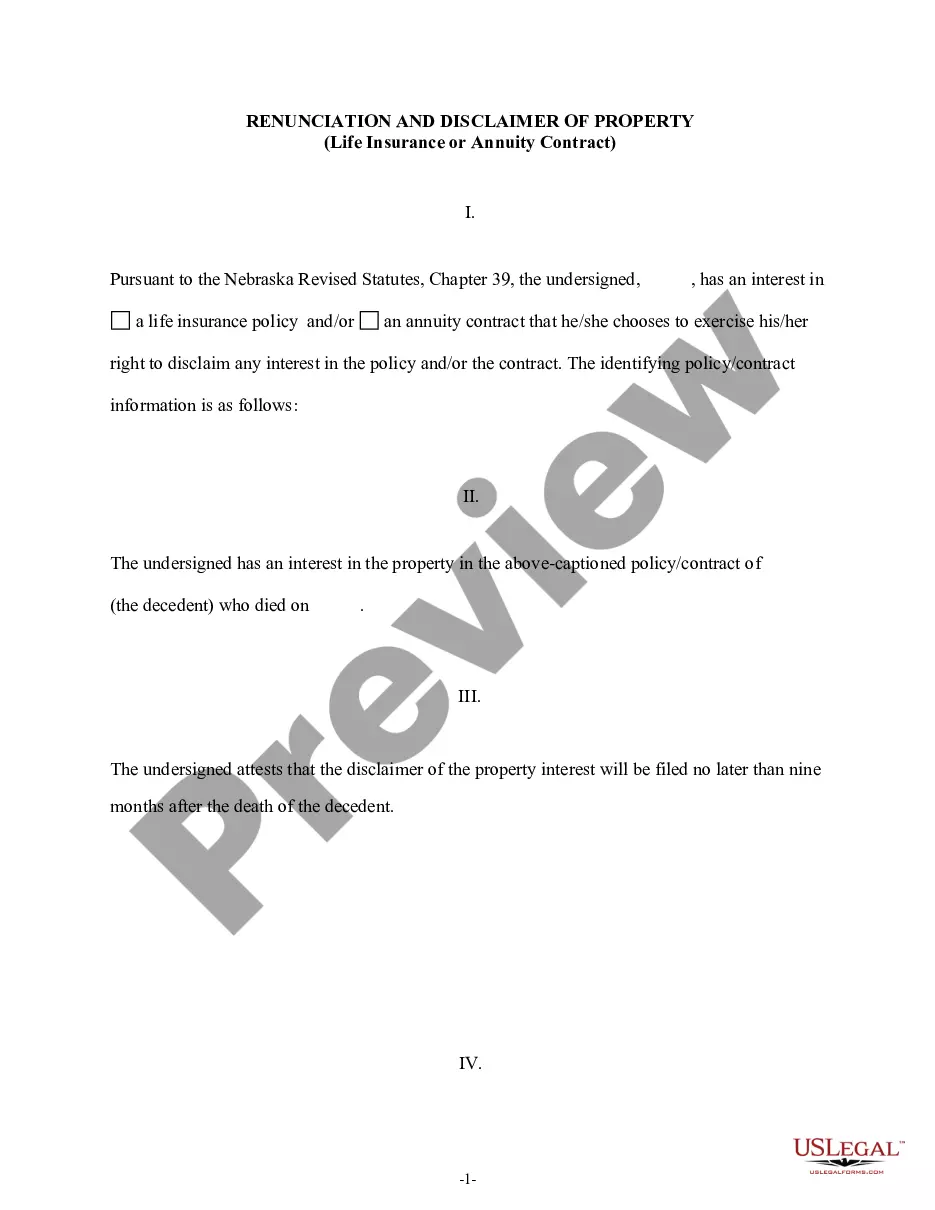
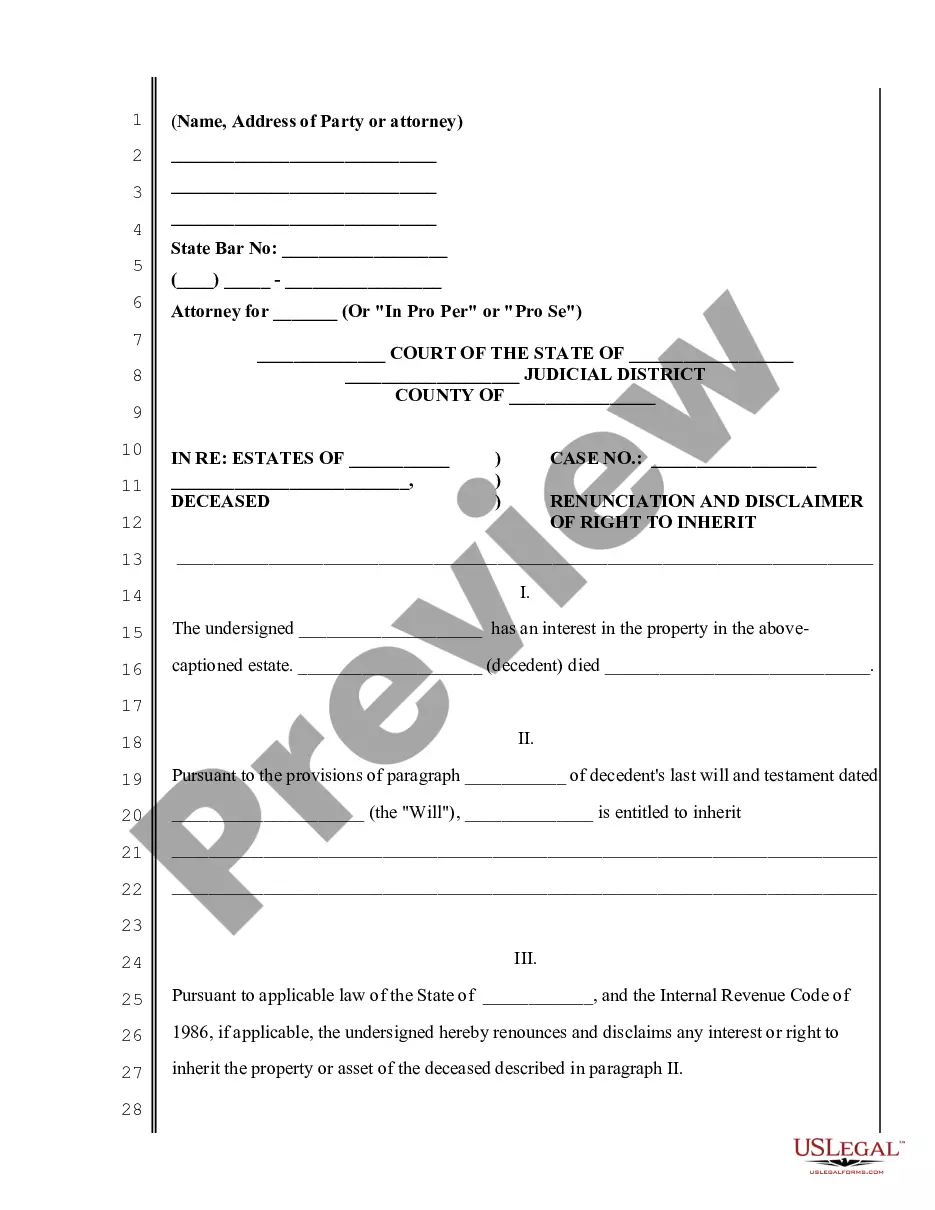
The Renunciation and Disclaimer of Property from Life Insurance or Annuity Contract is a legal document that allows a beneficiary to formally refuse any interest in proceeds from a life insurance policy or annuity following the death of the insured. This form is crucial for ensuring that the beneficiary legally disclaims the inheritance of funds, thereby preventing any potential tax implications or disputes related to the estate. Unlike other beneficiary designation forms, this specific disclaimer must be filed in accordance with Nebraska law, providing a clear record of the beneficiary's intentions.
What’s included in this form
- Identification of the decedent and the beneficiary.
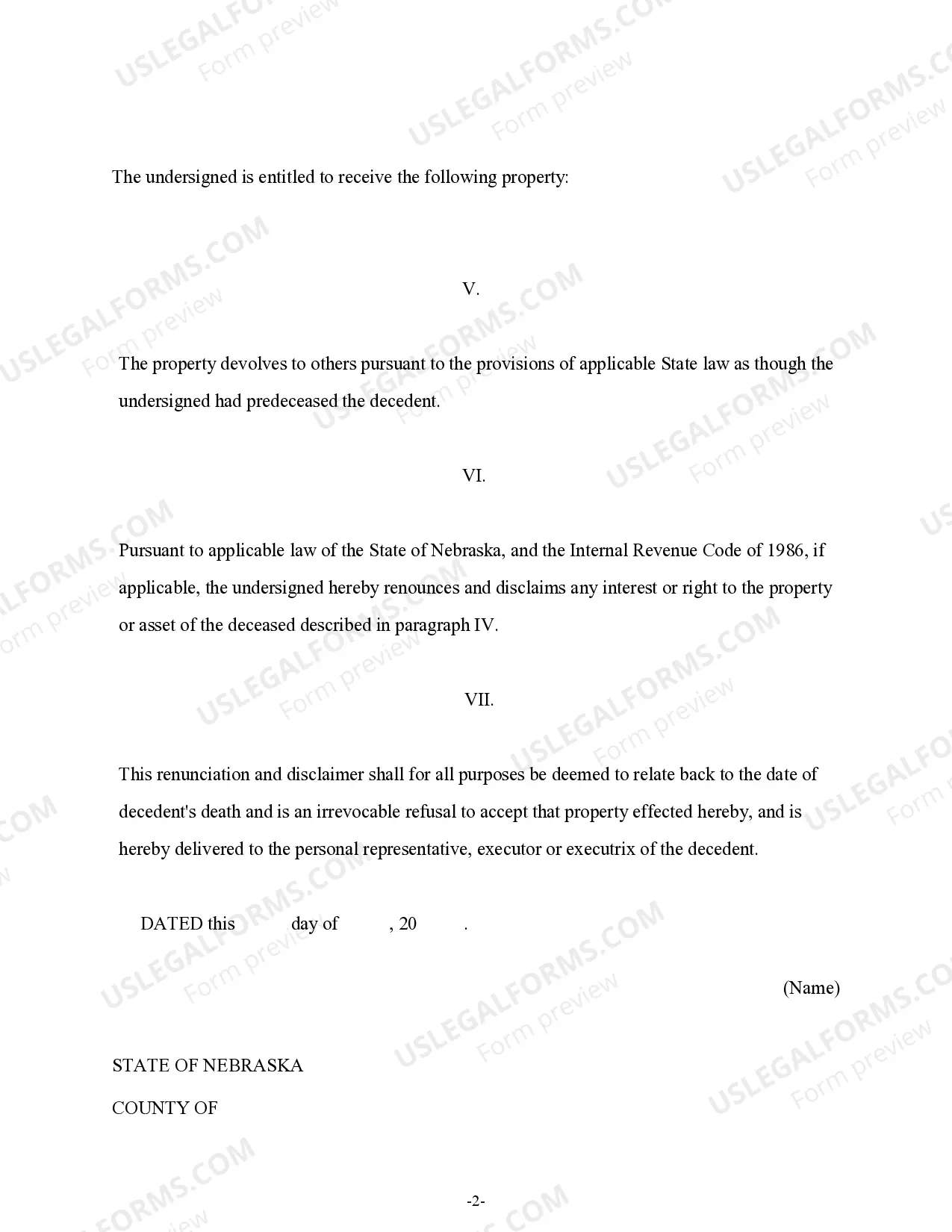
- Explicit renunciation and disclaimer of interest in the insurance proceeds.
- Affirmation of the disclaimer's timely filing within nine months of the decedent's death.
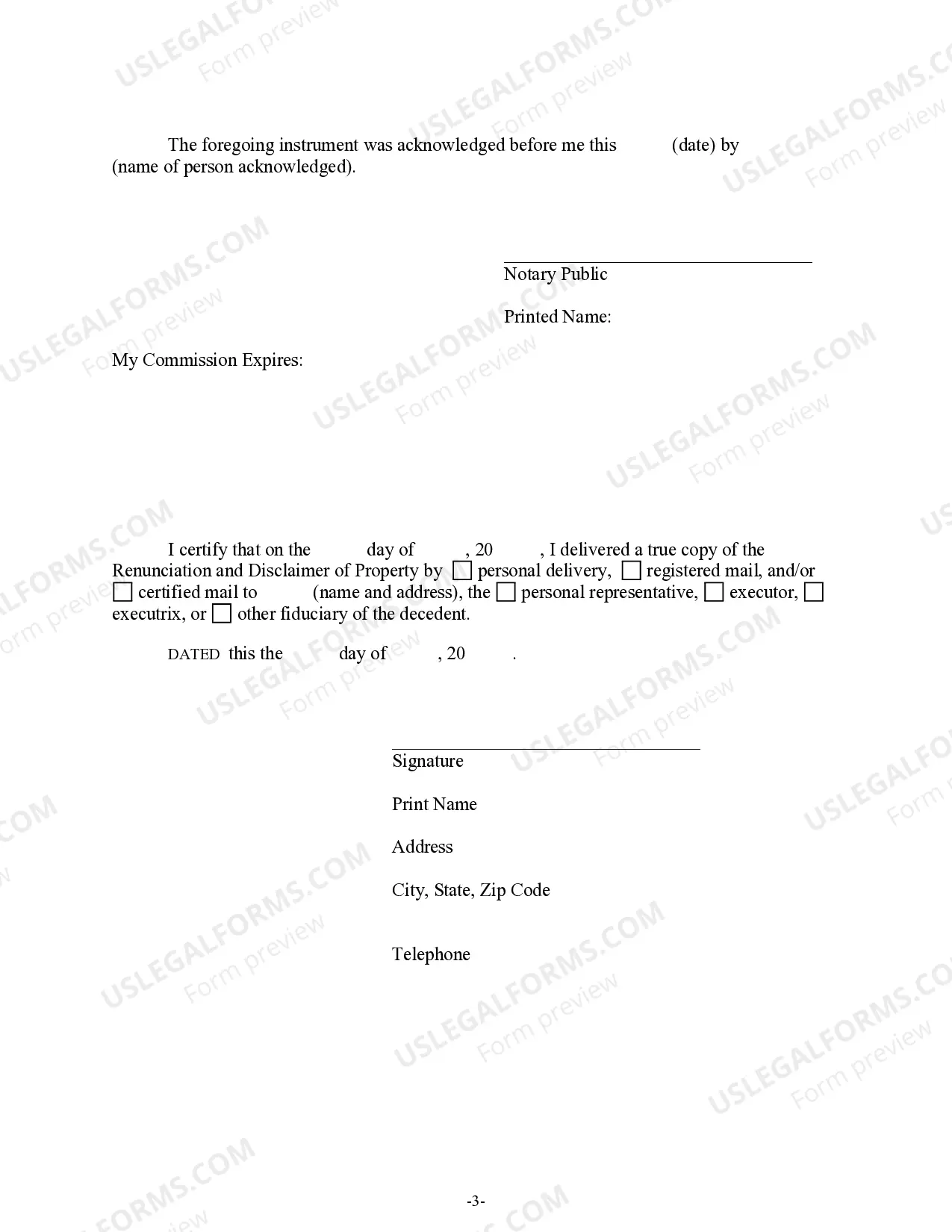
- Acknowledgment section that may require the presence of a witness or notary.
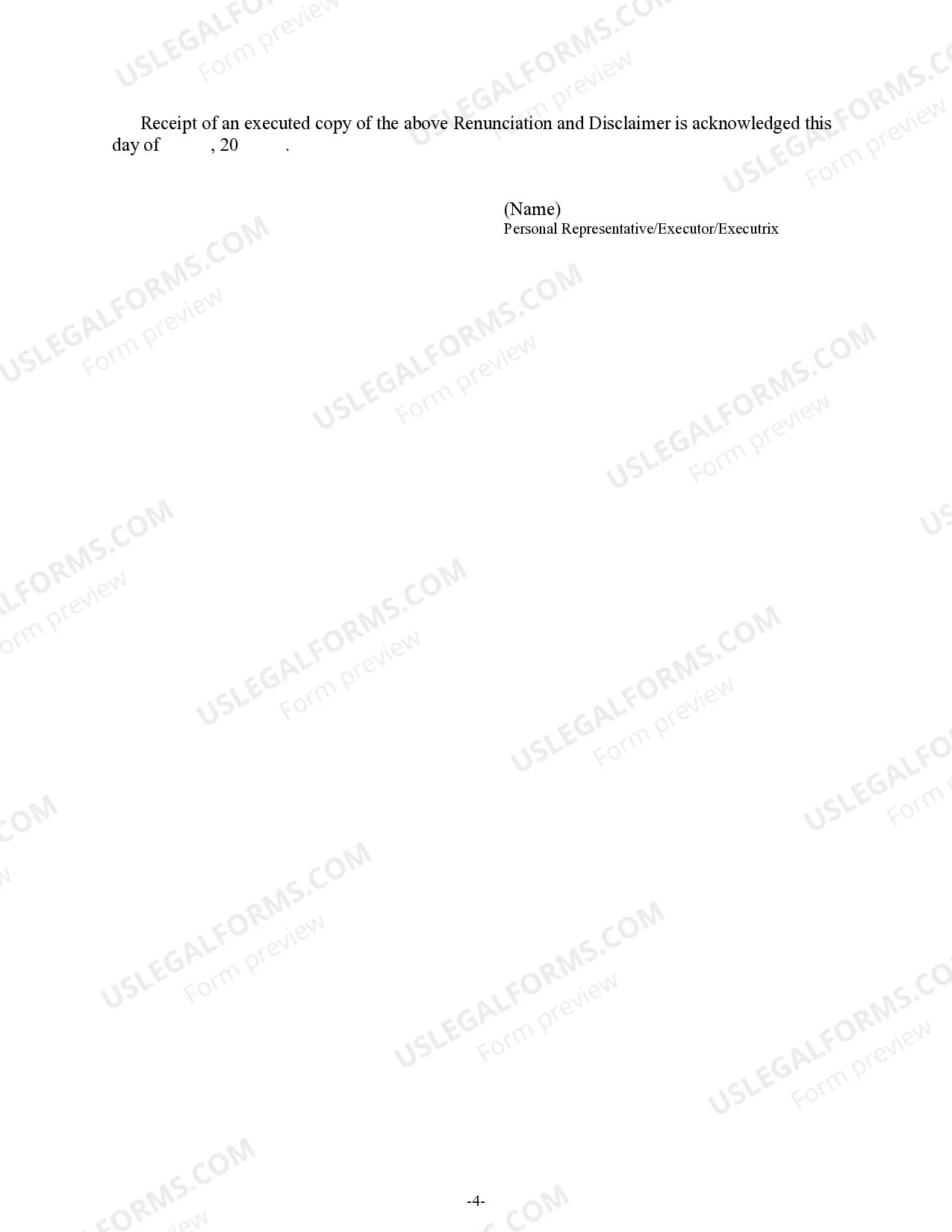
- Certificate verifying the delivery of the document.
Common use cases
This form should be used when a beneficiary of a life insurance policy or annuity wishes to renounce their right to the proceeds following the death of the policyholder. Situations may arise when the beneficiary believes it is more beneficial for the proceeds to go to another party, or wishes to avoid estate taxes or other legal complications. Additionally, if the beneficiary is unable to manage the funds responsibly, this form would facilitate their disclaimer of interest.
Who can use this document
- Individuals designated as beneficiaries on life insurance or annuity contracts.
- Beneficiaries who wish to refuse their right to the proceeds.
- Individuals seeking to minimize tax liabilities related to inherited assets.
- Those who wish to clarify their legal standing concerning the deceased's estate.
Steps to complete this form
- Identify the decedent by providing their full name and date of death.
- Enter your details as the beneficiary disclaiming the interest.
- Clearly state your intent to renounce your interest in the insurance proceeds.
- Sign and date the form in the presence of a witness, if required.
- Submit the completed form to the necessary legal or estate management authority within the specified timeframe.
Notarization requirements for this form
This form usually doesn’t need to be notarized. However, local laws or specific transactions may require it. Our online notarization service, powered by Notarize, lets you complete it remotely through a secure video session, available 24/7.
Get your form ready online
Our built-in tools help you complete, sign, share, and store your documents in one place.
Make edits, fill in missing information, and update formatting in US Legal Forms—just like you would in MS Word.
Download a copy, print it, send it by email, or mail it via USPS—whatever works best for your next step.
Sign and collect signatures with our SignNow integration. Send to multiple recipients, set reminders, and more. Go Premium to unlock E-Sign.
If this form requires notarization, complete it online through a secure video call—no need to meet a notary in person or wait for an appointment.
We protect your documents and personal data by following strict security and privacy standards.

Make edits, fill in missing information, and update formatting in US Legal Forms—just like you would in MS Word.

Download a copy, print it, send it by email, or mail it via USPS—whatever works best for your next step.

Sign and collect signatures with our SignNow integration. Send to multiple recipients, set reminders, and more. Go Premium to unlock E-Sign.

If this form requires notarization, complete it online through a secure video call—no need to meet a notary in person or wait for an appointment.

We protect your documents and personal data by following strict security and privacy standards.
Common mistakes
- Failing to submit the disclaimer within the nine-month period.
- Not adequately identifying the decedent or the policy involved.
- Neglecting to sign the document where required.
- Using an incorrect form tailored for a different state without accounting for local laws.
- Failing to seek legal advice in complex situations that may affect the disclaimer.
Why complete this form online
- Convenient access to legal forms from home or office at any time.
- Easy to edit and customize to fit personal circumstances.
- Forms are drafted by licensed attorneys, ensuring legal reliability.
- Streamlined process to ensure all necessary disclosures are included.
- Paperwork can be filed digitally, saving time and resources.
Legal use & context
- This form is legally designed to assist beneficiaries in formally disclaiming their interest in life insurance proceeds.
- Failure to properly complete this form could result in the beneficiary being held liable for tax implications on the proceeds.
- It is important to ensure that this disclaimer is filed correctly to avoid any complications regarding estate distribution.
Quick recap
- The Renunciation and Disclaimer form is critical for beneficiaries wishing to refuse life insurance or annuity contract proceeds.
- It must be filed within nine months following the decedent's death for validity.
- Ensure all required details are provided to prevent legal issues down the line.
Looking for another form?
Form popularity
FAQ
Disclaim, in a legal sense, refers to the renunciation of an interest in, or an acceptance of, inherited assets, such as property, by way of a legal instrument.A gift, bequest, or other interest or obligation may be disclaimed via a written disclaimer of interest.
A disclaimer trust is a clause typically included in a person's will that establishes a trust upon their death, subject to certain specifications. This allows certain assets to be moved into the trust by the surviving spouse without being subject to taxation.
The beneficiary can avoid receiving the trust assets through a disclaimer. A disclaimer is a legal act where the beneficiary instructs the trustee to disregard the beneficiary as though he was dead, as though he predeceased the trust's intended end.
Put the disclaimer in writing. Deliver the disclaimer to the person in control of the estate usually the executor or trustee. Complete the disclaimer within nine months of the death of the person leaving the property.
Any disclaimer of an interest in a trust by a trust beneficiary must be made to the trustee of that trust. For a disclaimer to be valid, it must be supported by some evidence that the beneficiary is disclaiming their interest. Silence or otherwise passive behaviour will not suffice.
A qualified disclaimer is a part of the U.S. tax code that allows estate assets to pass to a beneficiary without being subject to income tax. Legally, the disclaimer portrays the transfer of assets as if the intended beneficiary never actually received them.
Yes, you can relinquish your inheritance. Put it in writing and submit it to the probate court.
Yes, a fiduciary can disclaim an interest in property if the will, trust or power of attorney gives the fiduciary that authority or if the appropriate probate court authorizes the disclaimer.The primary reason an executor or trustee might disclaim property passing to an estate or trust is to save death taxes.
A qualified disclaimer is a refusal to accept property that meets the provisions set forth in the Internal Revenue Code (IRC) Tax Reform Act of 1976, allowing for the property or interest in property to be treated as an entity that has never been received.