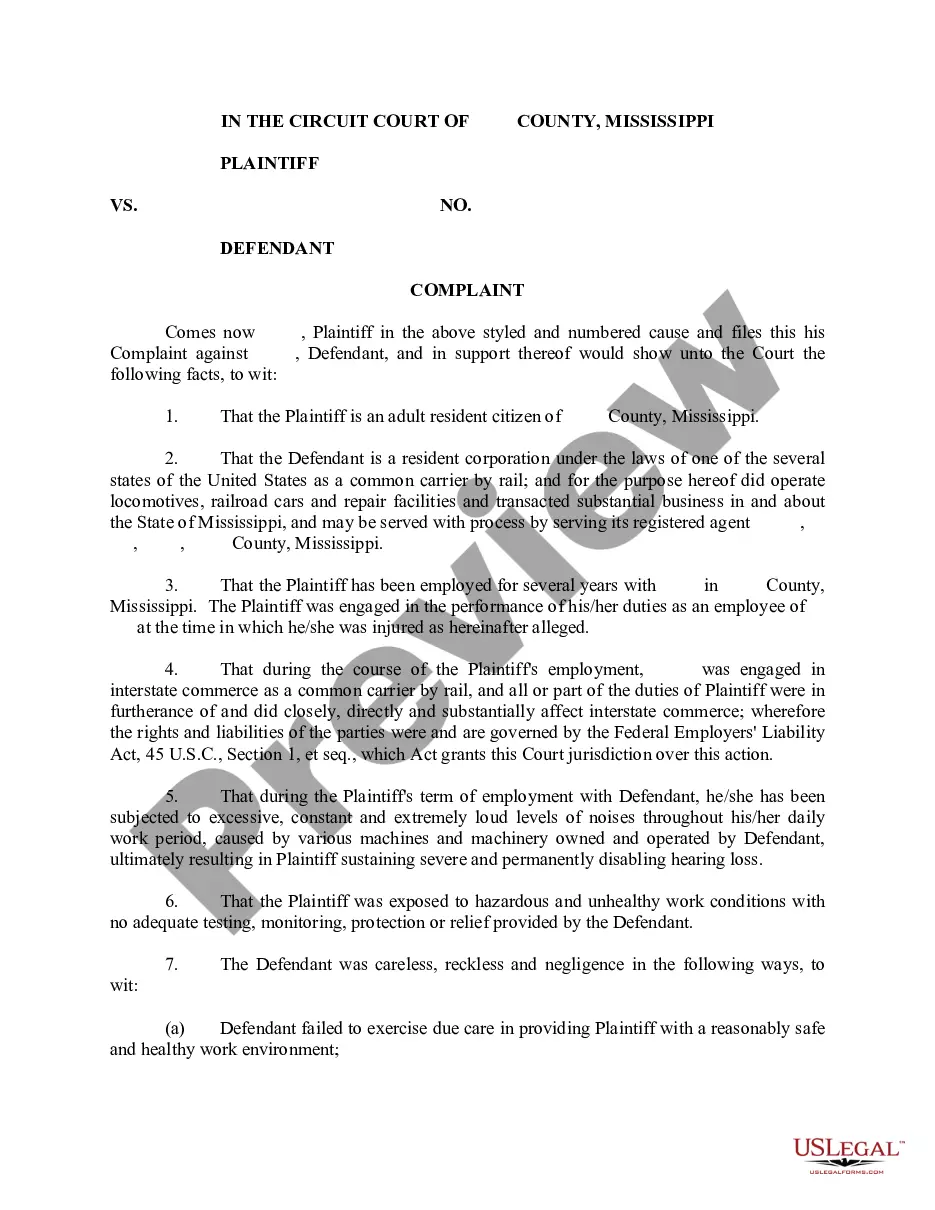
North Dakota Renunciation And Disclaimer of Property received by Intestate Succession
About this form
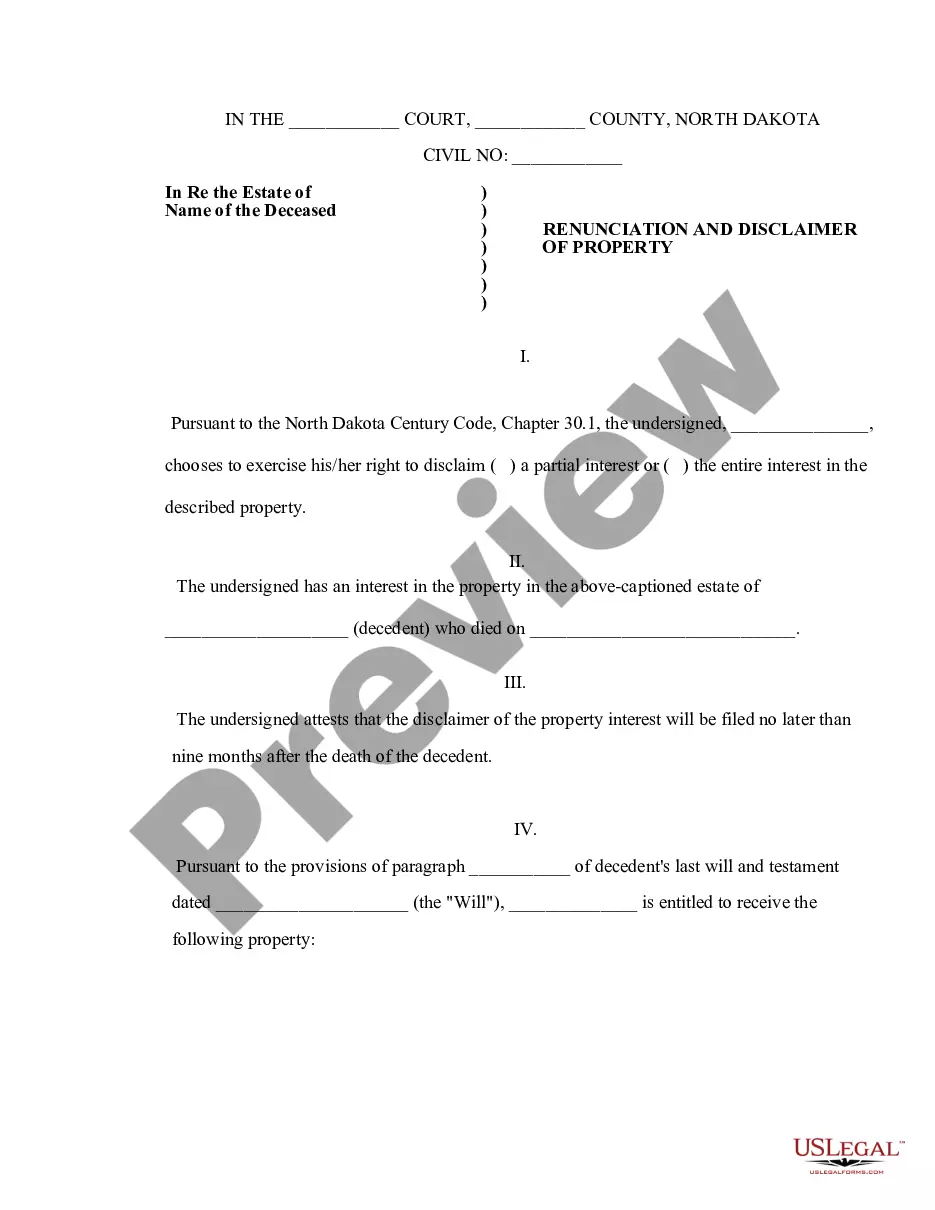
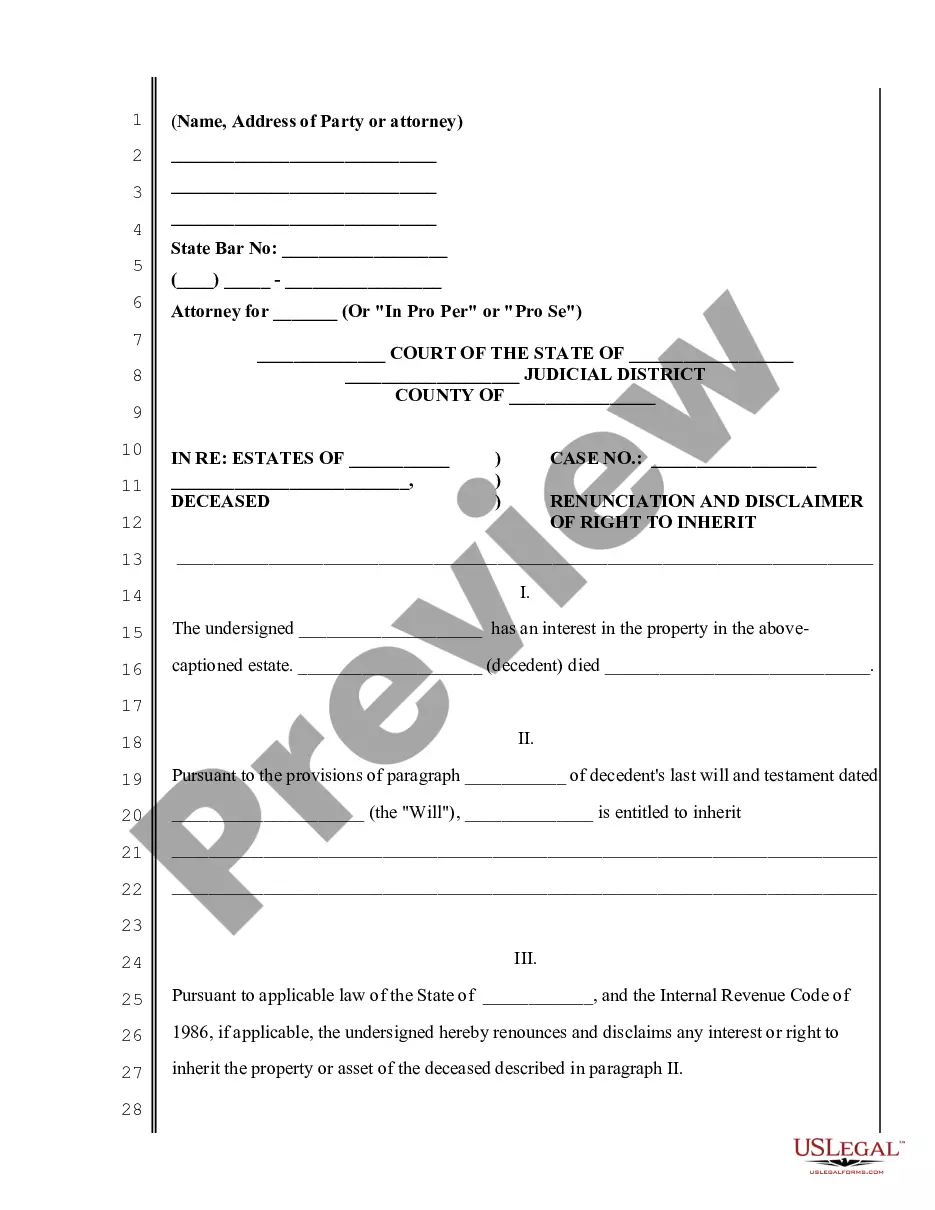
The Renunciation and Disclaimer of Property received by Intestate Succession is a legal form used by an individual to disclaim an inheritance received due to the death of a decedent who died without a will (intestate). By completing this form, a beneficiary can renounce their interest in the property, allowing it to pass to other heirs as if the disclaimant had predeceased the decedent. This form is crucial for estate planning, as it ensures the proper distribution of assets according to state laws and provides clarity for future beneficiaries.
Main sections of this form
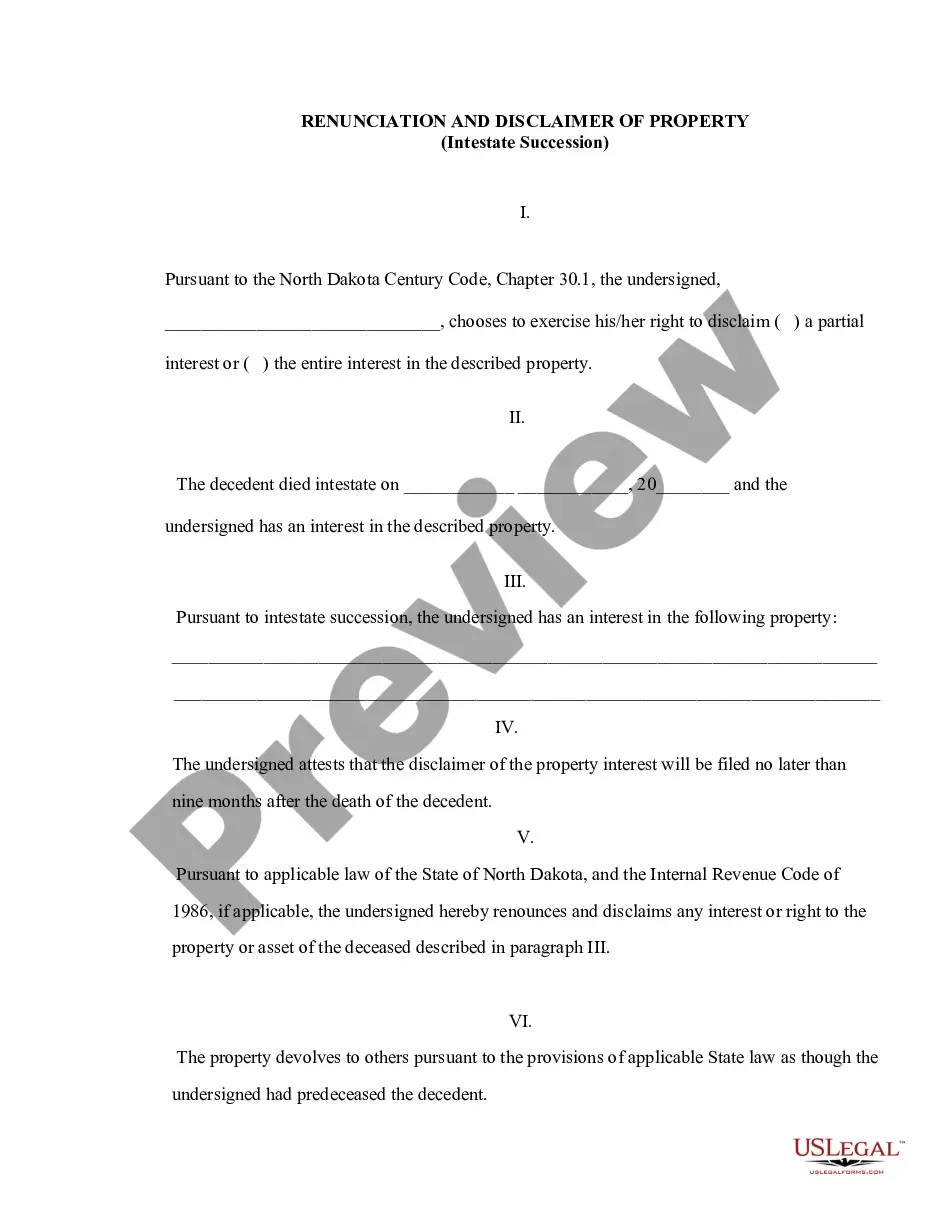
- Identification of the disclaimant, allowing them to declare their choice to disclaim a partial or entire interest in the property.
- Details of the decedentâs death, confirming the date and intestate status.
- A description of the property being disclaimed, ensuring clarity on what is being renounced.
- Filing deadline confirmation that the disclaimer must be filed within nine months of the decedent's death.
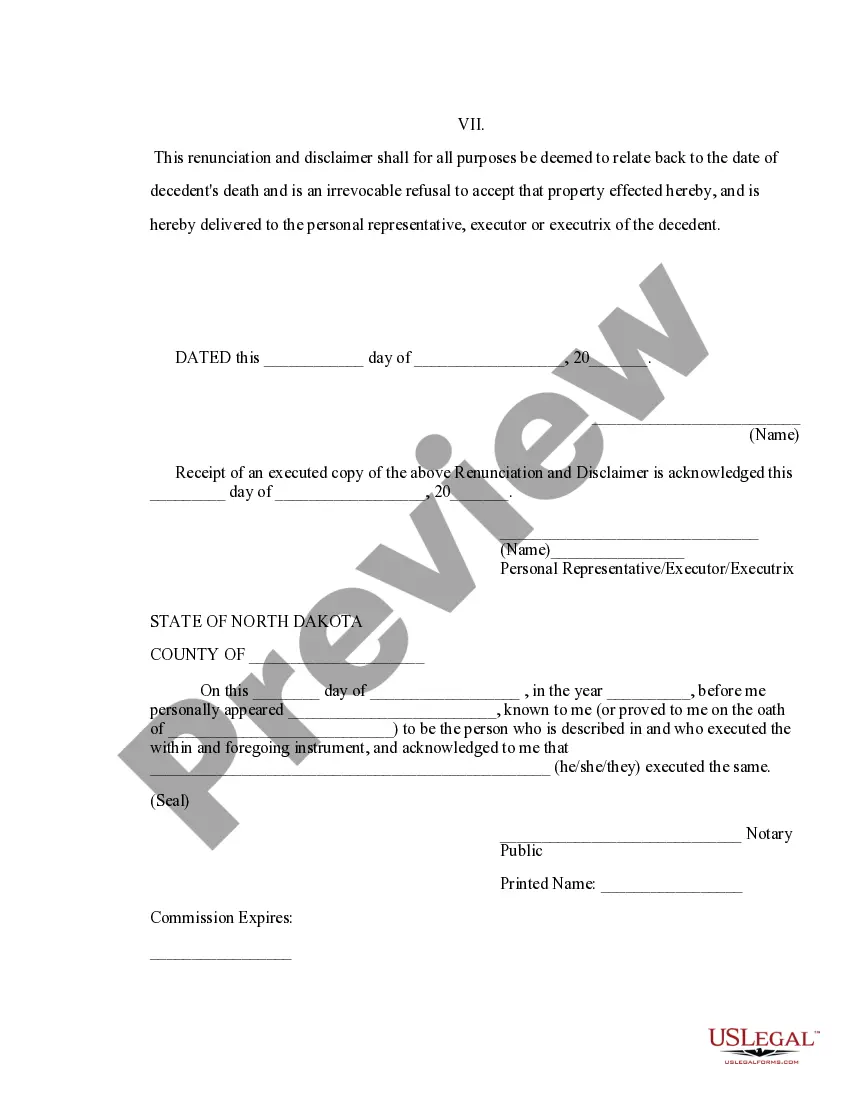
- A legal statement affirming the irrevocable nature of the disclaimer and its relation back to the decedentâs date of death.
- A section for notarization to verify the authenticity of the document and signatures.
When to use this document
This form is needed in situations where a beneficiary of an intestate estate wishes to renounce their inheritance. Common scenarios include when the beneficiary believes the property will impose unnecessary tax burdens or when they prefer that the property passes to other identifiable heirs. It is also useful if the individual wants to avoid complexities associated with managing the property.
Who should use this form
- Individuals who have received an inheritance from a decedent who died intestate.
- Beneficiaries looking to disclaim their interest in property for personal or financial reasons.
- Those who wish to clarify their intentions regarding the distribution of an estate.
Instructions for completing this form
- Identify and fill in the name of the person disclaiming their interest in the property.
- Enter the date of the decedent's death.
- Clearly describe the property you are renouncing.
- Ensure to sign and date the form, affirming the irrevocable nature of the disclaimer.
- Provide details for notarization to validate your signature and the delivery of the document to the personal representative.
Notarization guidance
Yes, this form must be notarized to be legally valid. Notarization ensures that the signatures are authentic and that the form is executed under proper legal procedures. US Legal Forms provides integrated online notarization services, allowing you to connect with a licensed notary via a secure video call at your convenience.
Get your form ready online
Our built-in tools help you complete, sign, share, and store your documents in one place.
Make edits, fill in missing information, and update formatting in US Legal Forms—just like you would in MS Word.
Download a copy, print it, send it by email, or mail it via USPS—whatever works best for your next step.
Sign and collect signatures with our SignNow integration. Send to multiple recipients, set reminders, and more. Go Premium to unlock E-Sign.
If this form requires notarization, complete it online through a secure video call—no need to meet a notary in person or wait for an appointment.
We protect your documents and personal data by following strict security and privacy standards.

Make edits, fill in missing information, and update formatting in US Legal Forms—just like you would in MS Word.

Download a copy, print it, send it by email, or mail it via USPS—whatever works best for your next step.

Sign and collect signatures with our SignNow integration. Send to multiple recipients, set reminders, and more. Go Premium to unlock E-Sign.

If this form requires notarization, complete it online through a secure video call—no need to meet a notary in person or wait for an appointment.

We protect your documents and personal data by following strict security and privacy standards.
Common mistakes to avoid
- Failing to file the disclaimer within nine months of the decedent's death.
- Not providing a complete and accurate description of the property being disclaimed.
- Omitting necessary signatures or failing to have the document notarized.
- Misunderstanding the implications of disclaiming property, leading to unintended consequences for estate distribution.
Advantages of online completion
- Convenient access to a legally vetted document that adheres to North Dakota laws.
- The ability to easily edit and customize the form as needed before finalizing.
- Secure and efficient method of obtaining necessary legal documentation without needing to visit an office.
Key takeaways
- The form allows for the renunciation of property inherited through intestate succession.
- It is essential to comply with North Dakota laws regarding disclaiming property interests.
- Be mindful of filing deadlines and notarization requirements.
Looking for another form?
Form popularity
FAQ
The laws are different in every state, but if you're married and die without a will, your estate will probably go to your spouse if you both own it.If he passes away without a will, the law says his surviving spouse will inherit the first $50,000 of his personal assets (not any shared assets) plus half the balance.
Children - if there is no surviving married or civil partnerIf there is no surviving partner, the children of a person who has died without leaving a will inherit the whole estate. This applies however much the estate is worth. If there are two or more children, the estate will be divided equally between them.
Who Gets What: The Basic Rules of Intestate Succession.Generally, only spouses, registered domestic partners, and blood relatives inherit under intestate succession laws; unmarried partners, friends, and charities get nothing. If the deceased person was married, the surviving spouse usually gets the largest share.
Children - if there is no surviving married or civil partner If there is no surviving partner, the children of a person who has died without leaving a will inherit the whole estate. This applies however much the estate is worth. If there are two or more children, the estate will be divided equally between them.
4. Siblings If the person who died had no living spouse, civil partner, children or parents, then their siblings are their next of kin.
If one dies, the other partner will automatically inherit the whole of the money. Property and money that the surviving partner inherits does not count as part of the estate of the person who has died when it is being valued for the intestacy rules.
In North Dakota, you can make a living trust to avoid probate for virtually any asset you ownreal estate, bank accounts, vehicles, and so on. You need to create a trust document (it's similar to a will), naming someone to take over as trustee after your death (called a successor trustee).
Who Inherits When There's No Will? Intestate succession laws determine how to distribute assets among them when no will is in place. This varies between states. Generally, a spouse receives most of the assets and property, followed by children, parents, grandparents, and other blood relatives of the deceased.
Many married couples own most of their assets jointly with the right of survivorship. When one spouse dies, the surviving spouse automatically receives complete ownership of the property. This distribution cannot be changed by Will.