Colorado Renunciation And Disclaimer of Property from Will by Testate
Overview of this form
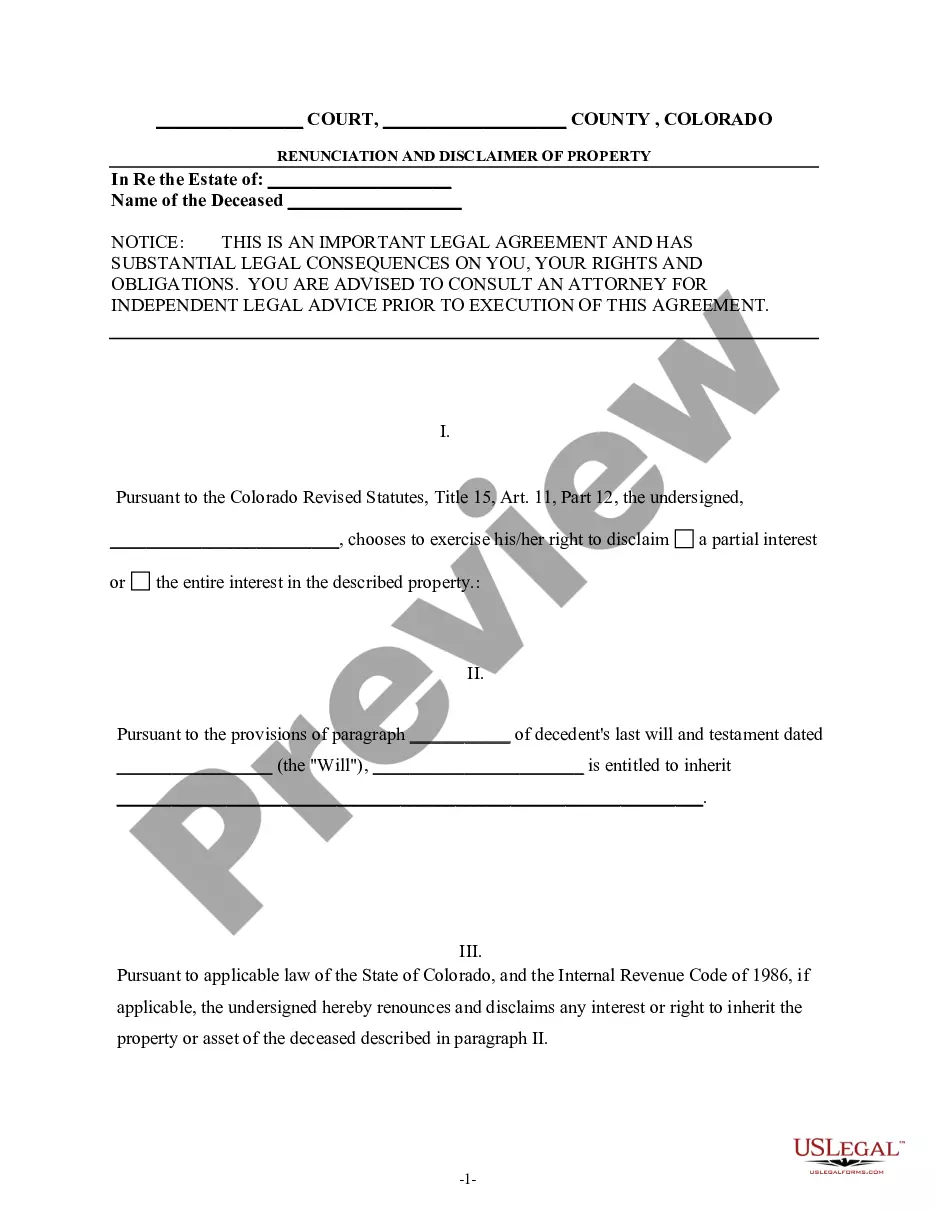
The Colorado Renunciation and Disclaimer of Property from Will by Testate is a legal document used by beneficiaries to formally decline their right to inherit property as outlined in a decedent's will. This form allows beneficiaries in Colorado to disclaim their interests, either partially or entirely, ensuring that these assets are distributed according to state laws as if the disclaiming beneficiary had predeceased the decedent. This form is distinct from other estate planning documents, focusing specifically on the renunciation of inheritances.
What’s included in this form
- Identification of the decedent and the inheriting beneficiary.
- Specification of the property the beneficiary wishes to disclaim.
- Clear declaration of the beneficiary's intent to renounce their inheritance.
- Legal acknowledgment of the renunciation's effect as of the decedent's date of death.
- Details for the personal representative regarding the filing process.


When this form is needed
This form should be used when a beneficiary of a will wishes to renounce their interest in any property inherited from the decedent. Situations may include cases where the beneficiary is facing potential liability from the inherited assets, or they may simply wish to allow the estate to pass to another designated heir or beneficiary. It is important to act in a timely manner, as the disclaimer must be filed within a specific timeframe after the decedent's passing.
Who this form is for
This form is suitable for:
- Beneficiaries named in a will who wish to decline their inheritance.
- Individuals seeking to ensure their inheritance is redirected according to their intentions or family dynamics.
- Persons involved in estate planning or estate management who need to relinquish interests in an estate.
How to complete this form
- Identify the decedent by entering their full name at the top of the document.
- Fill in your name as the beneficiary who is renouncing the property.
- Specify the property or interest you wish to disclaim, using the language from the will if applicable.
- Sign and date the document, affirming your decision to renounce the inheritance.
- Ensure the form is properly acknowledged by a notary public if required.
Is notarization required?
Yes, this form must be notarized to be legally valid. It is crucial to have the signature acknowledged by a notary public who can confirm the identity of the parties involved. US Legal Forms offers secure online notarization services, ensuring availability and legal equivalency without the need for travel.
Get your form ready online
Our built-in tools help you complete, sign, share, and store your documents in one place.
Make edits, fill in missing information, and update formatting in US Legal Forms—just like you would in MS Word.
Download a copy, print it, send it by email, or mail it via USPS—whatever works best for your next step.
Sign and collect signatures with our SignNow integration. Send to multiple recipients, set reminders, and more. Go Premium to unlock E-Sign.
If this form requires notarization, complete it online through a secure video call—no need to meet a notary in person or wait for an appointment.
We protect your documents and personal data by following strict security and privacy standards.

Make edits, fill in missing information, and update formatting in US Legal Forms—just like you would in MS Word.

Download a copy, print it, send it by email, or mail it via USPS—whatever works best for your next step.

Sign and collect signatures with our SignNow integration. Send to multiple recipients, set reminders, and more. Go Premium to unlock E-Sign.

If this form requires notarization, complete it online through a secure video call—no need to meet a notary in person or wait for an appointment.

We protect your documents and personal data by following strict security and privacy standards.
Common mistakes to avoid
- Not filling out the specific property to be disclaimed clearly.
- Failing to sign and date the form, which may invalidate the disclaimer.
- Incorrectly assuming notarization is unnecessary without confirming local requirements.
- Missing the deadline for filing the disclaimer after the decedent's death.
Benefits of using this form online
- Convenience of downloading and printing the form at your own pace.
- Access to templates drafted by licensed attorneys for accuracy and compliance.
- Ability to easily edit and complete the form before finalizing.
- Secure handling of sensitive legal documents online.
Main things to remember
- The form allows beneficiaries in Colorado to officially renounce their inheritance.
- Renunciation is irrevocable and relates back to the date of the decedentâs death.
- Complete the form accurately and ensure notarization for it to be valid.
Looking for another form?
Form popularity
FAQ
The Colorado Renunciation and Disclaimer of Property from Will by Testate lets a beneficiary formally decline their right to inherit property named in a decedent’s will. It requires identifying the decedent and beneficiary, specifying the property being disclaimed, a declaration of intent to renounce, that the renunciation takes effect as of the decedent’s death, and filing instructions for the personal representative.
Yes. The form is designed for beneficiaries named in a will who wish to decline their inheritance. It collects the decedent and beneficiary information, names the disclaimed property, includes a declaration of renunciation, notes the effect as of the decedent’s death, and provides filing instructions to the personal representative.
Yes. This form enables a beneficiary to renounce an inheritance under a testate estate. It provides a formal declaration of renunciation, identifies the decedent and the property being disclaimed, and records that the renunciation is effective as of the decedent’s death, guiding the personal representative in disposition or transfer of assets.
The form notes there is a deadline to file but does not specify the exact time limit. In Colorado practice, a disclaimer generally must be filed within a certain period after death. For the precise deadline, consult a Colorado probate attorney or verify local probate rules.
The form itself does not determine probate status. It is used within the context of a will and the probate process to renounce an inheritance. Whether probate is required depends on the estate and Colorado law; consult a licensed attorney to understand how filing this form interacts with probate proceedings.
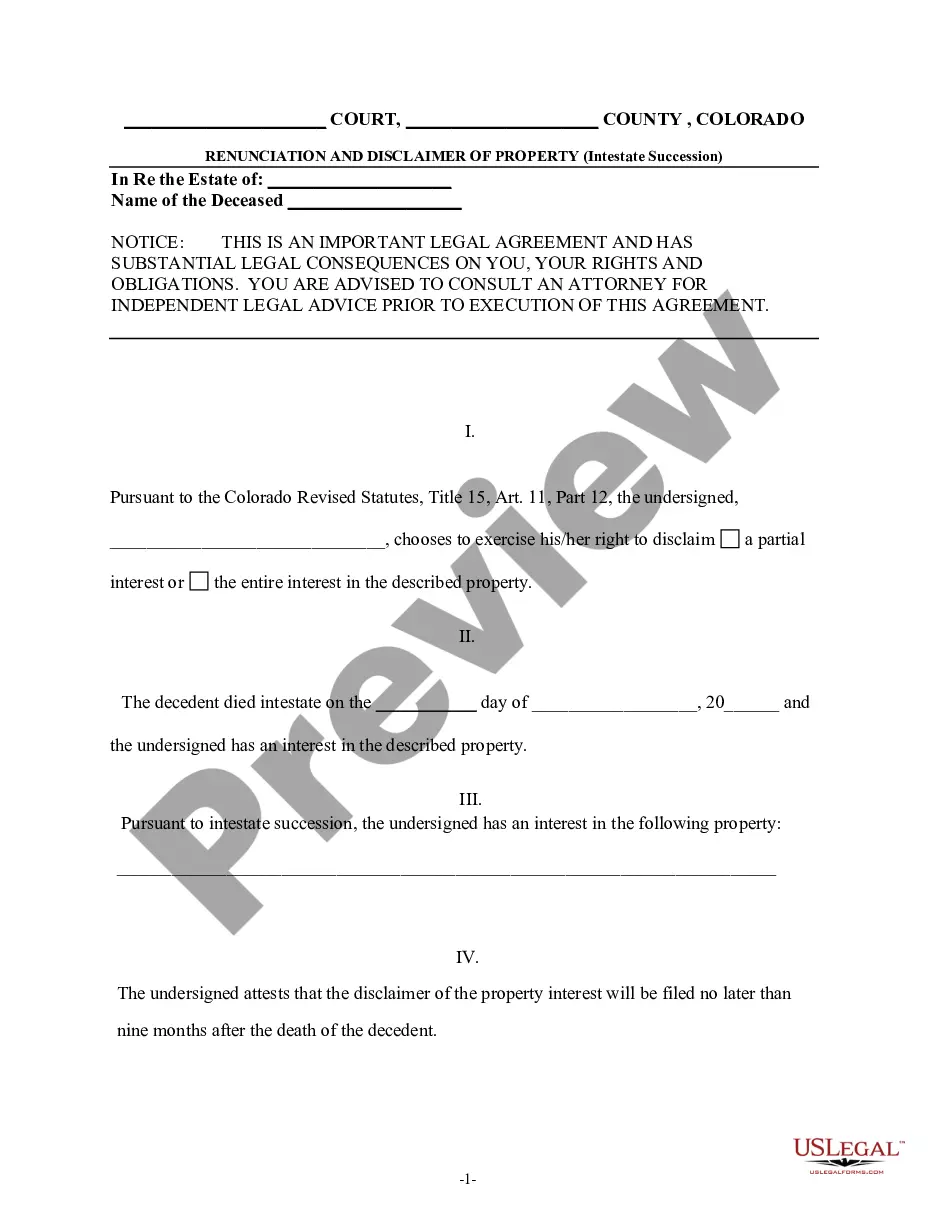
This form is specific to property dispositions under a decedent’s will (testate). An intestate disclaimer would apply when there is no will. The form’s features—identifying the decedent and beneficiary, listing the disclaimed property, and recording that the renunciation takes effect on the death date—reflect its testate focus and guidance for the personal representative’s filing.