Arkansas Assignment of Mortgage by Corporate Mortgage Holder
Overview of this form
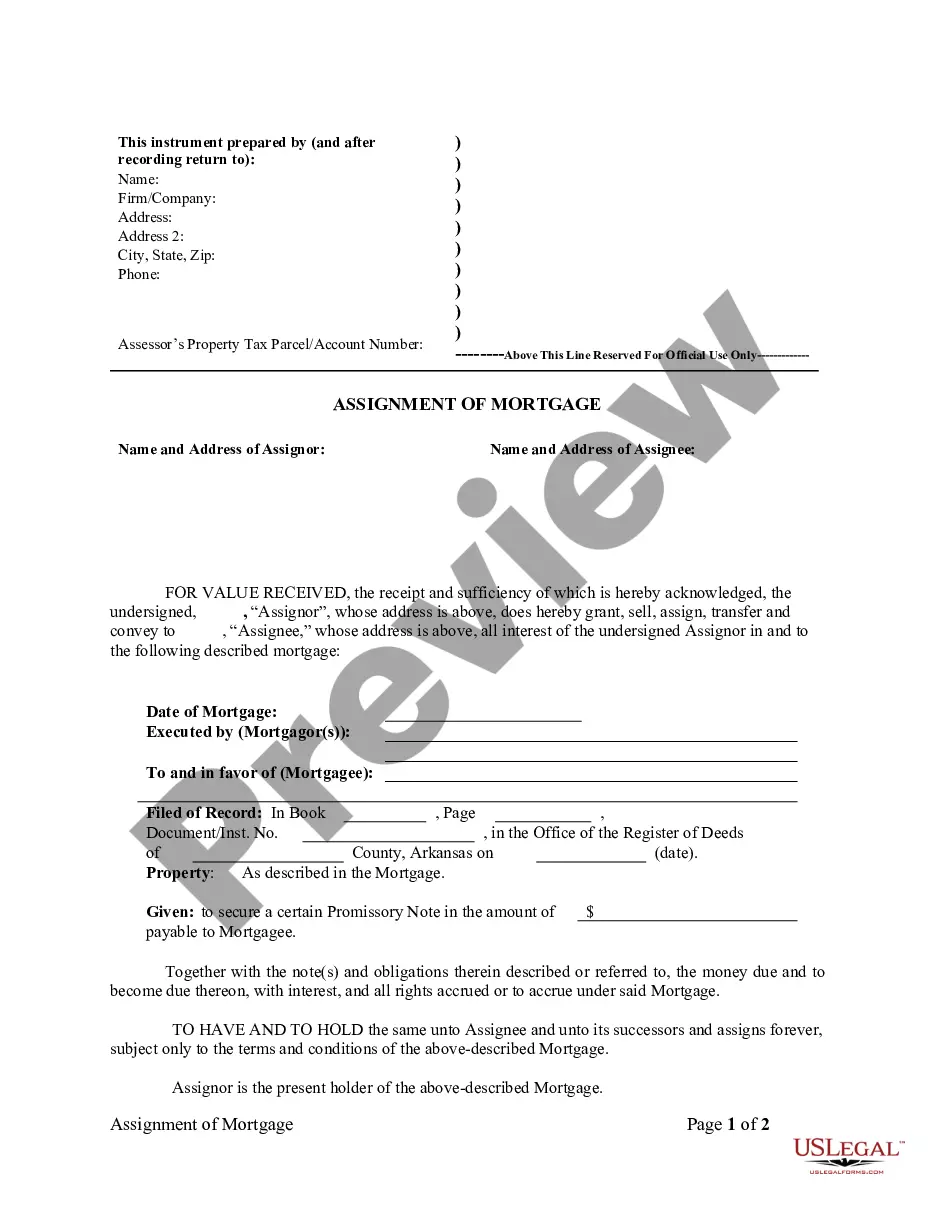
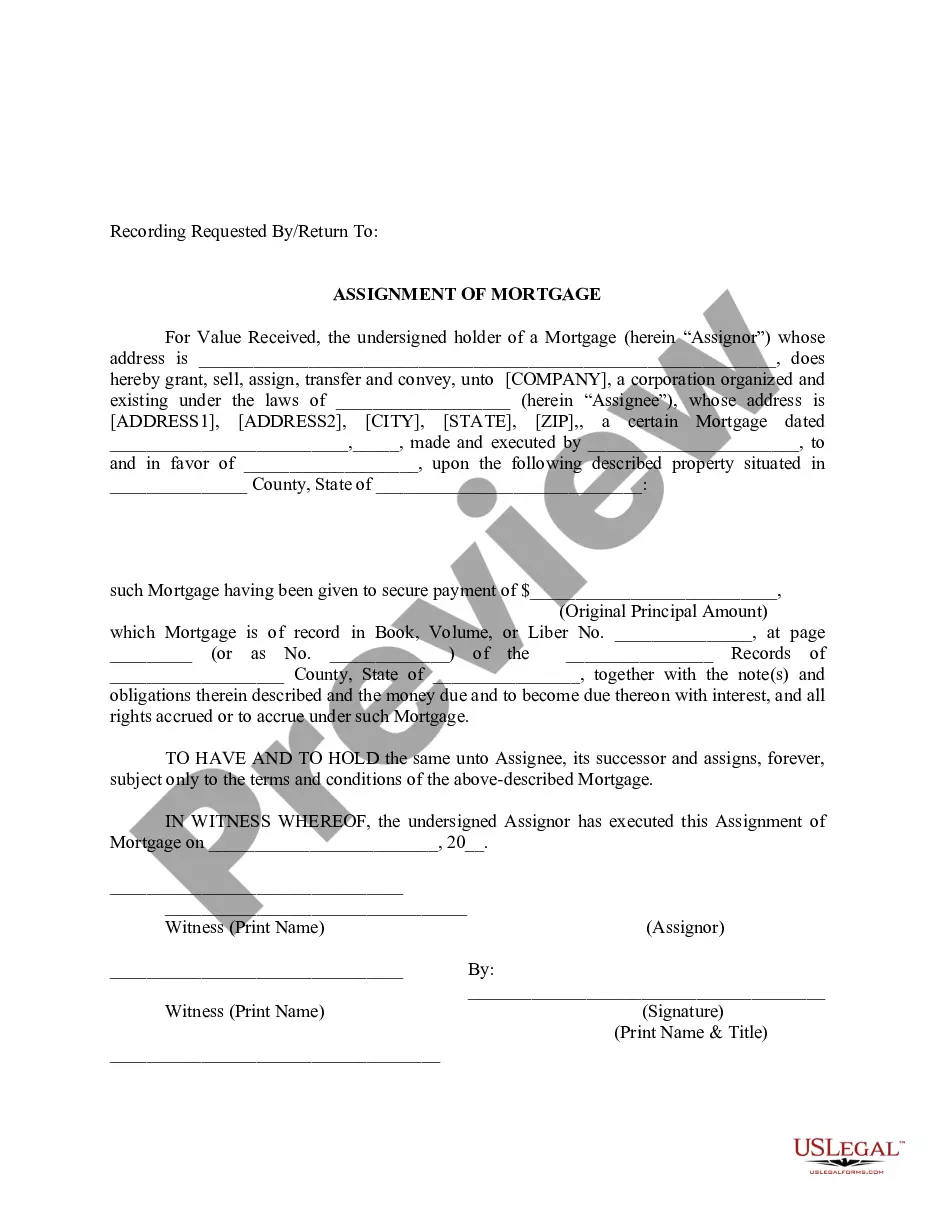
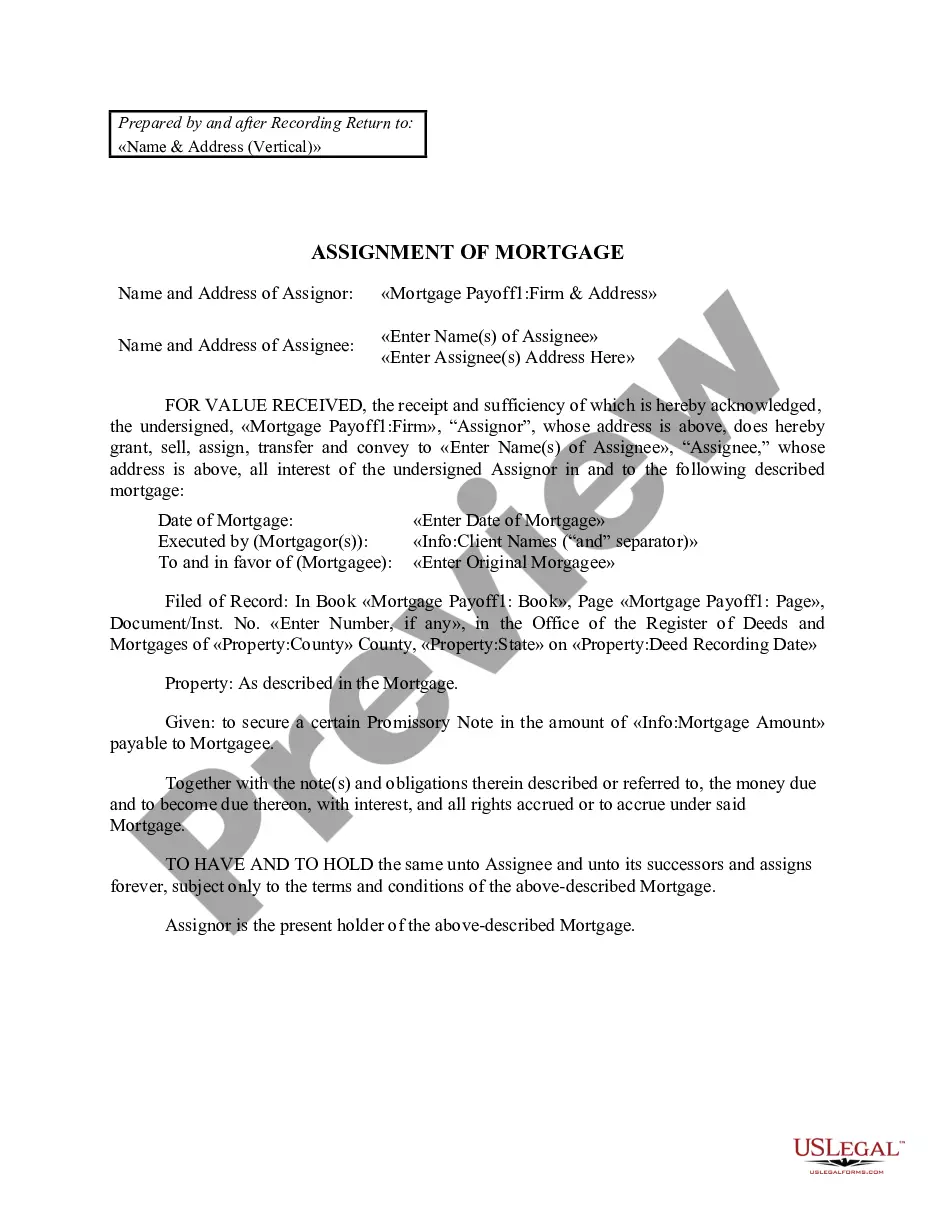
The Assignment of Mortgage by Corporate Mortgage Holder is a legal document that enables a corporation holding a mortgage or deed of trust to assign its interest in that mortgage to another party. This form differs from other transfer documents as it specifically involves corporate entities, ensuring clear ownership transfer and protecting the rights of all involved parties.
Main sections of this form
- Date of the mortgage execution.
- Details of the mortgagor(s) and mortgagee.
- Property description as stated in the original mortgage.
- Amount secured by the promissory note.
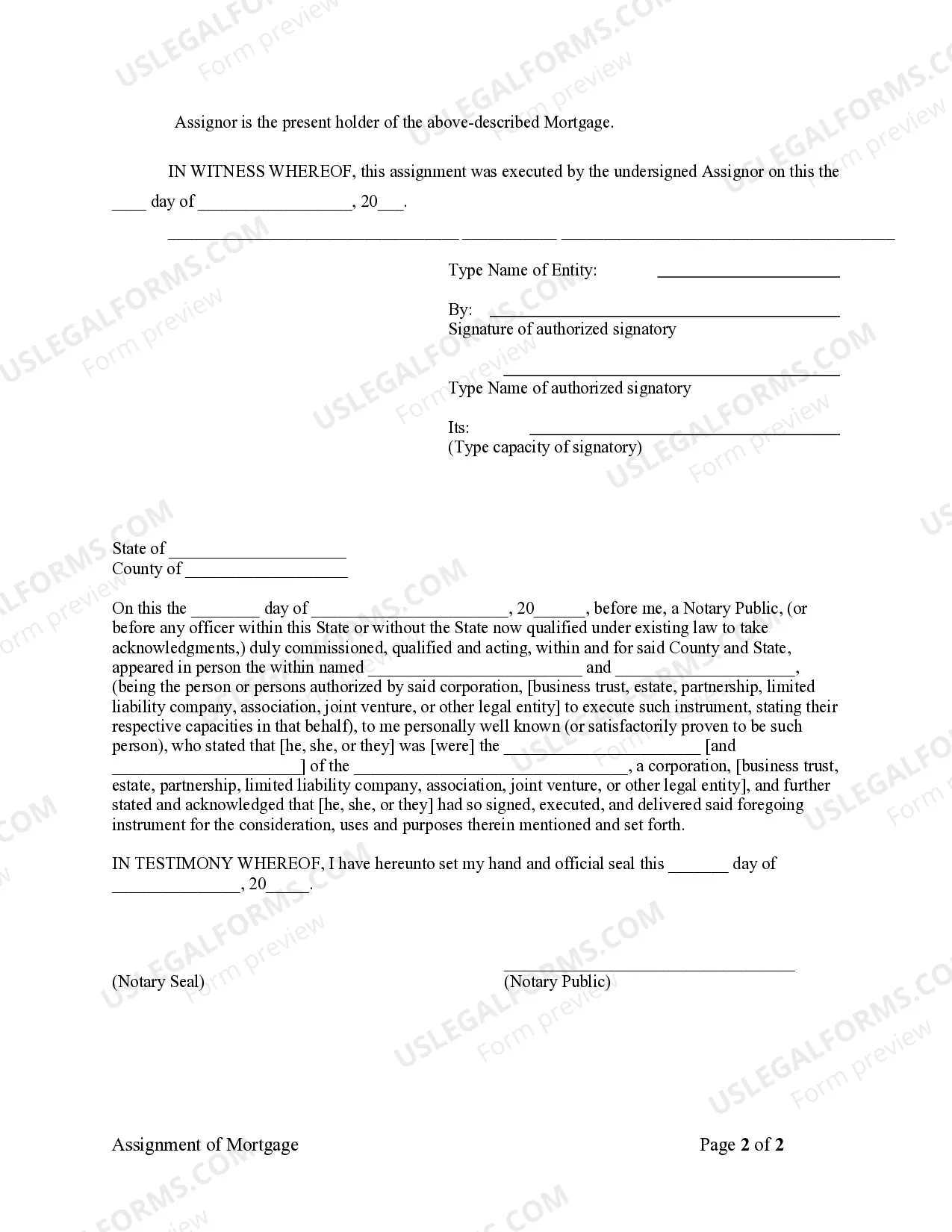
- Signatures of the assignor and date of execution.
Situations where this form applies
This form is used when a corporation that holds a mortgage wishes to transfer its interest to another party. This scenario often arises in real estate transactions where the original lender sells its rights to collect payments, or in cases of corporate restructuring.
Who should use this form
This form is intended for:
- Corporations holding a mortgage or deed of trust.
- Entities or individuals who are receiving the assignment of the mortgage.
- Real estate professionals handling corporate mortgage assignments.
How to prepare this document
- Identify the parties involved: the assignor (current mortgage holder) and the assignee (new mortgage holder).
- Provide the date of the original mortgage execution.
- Fill in the property details as described in the original mortgage.
- Specify the amount secured by the promissory note.
- Sign and date the form to finalize the assignment.
Does this document require notarization?
This form does not typically require notarization unless specified by local law. However, consulting with a legal professional may be advisable to confirm the requirements in your jurisdiction.
Get your form ready online
Our built-in tools help you complete, sign, share, and store your documents in one place.
Make edits, fill in missing information, and update formatting in US Legal Forms—just like you would in MS Word.
Download a copy, print it, send it by email, or mail it via USPS—whatever works best for your next step.
Sign and collect signatures with our SignNow integration. Send to multiple recipients, set reminders, and more. Go Premium to unlock E-Sign.
If this form requires notarization, complete it online through a secure video call—no need to meet a notary in person or wait for an appointment.
We protect your documents and personal data by following strict security and privacy standards.

Make edits, fill in missing information, and update formatting in US Legal Forms—just like you would in MS Word.

Download a copy, print it, send it by email, or mail it via USPS—whatever works best for your next step.

Sign and collect signatures with our SignNow integration. Send to multiple recipients, set reminders, and more. Go Premium to unlock E-Sign.

If this form requires notarization, complete it online through a secure video call—no need to meet a notary in person or wait for an appointment.

We protect your documents and personal data by following strict security and privacy standards.
Common mistakes to avoid
- Not providing complete information about the property.
- Failing to sign the document or include the date of execution.
- Incorrectly identifying the parties involved in the assignment.
Why use this form online
- Easy access to legal forms drafted by licensed attorneys.
- Convenient download and edit options to fit specific needs.
- Reliable templates that comply with legal standards.
Summary of main points
- The Assignment of Mortgage by Corporate Mortgage Holder facilitates the transfer of mortgage interest by a corporation.
- It is important to ensure all information is accurately filled out to avoid legal complications.
- Confirm state-specific requirements to ensure compliance with local laws.
Looking for another form?
Form popularity
FAQ
An assignment of a mortgage involves transferring the rights and responsibilities tied to a mortgage from one lender to another. This means the new lender assumes the terms of the mortgage, while the borrower continues making payments as before. Understanding the Arkansas assignment of mortgage by corporate mortgage holder is crucial for homeowners and lenders. Our services provide comprehensive information and resources to guide you through the entire process.
To release an assignment of a mortgage, you must file a document known as a release or reconveyance. This document should clearly state that the assignment is being terminated and provide the necessary details of the original mortgage. By using our platform, you can easily access templates for the release of an assignment of mortgage by corporate mortgage holder in Arkansas. Ensuring proper documentation keeps your records clear and legally sound.
Corporate assignment of a mortgage refers to the situation where a mortgage lender, often a financial institution, transfers their rights and responsibilities under a mortgage to another party. In the context of the Arkansas Assignment of Mortgage by Corporate Mortgage Holder, this means that a corporation, such as a bank or mortgage company, assigns the mortgage to another corporate entity. The process is crucial for companies to manage their assets effectively, allowing a smoother transfer of ownership in the mortgage market.
Failing to record an assignment of a mortgage creates risks for your legal rights. You may find yourself at a disadvantage should disputes arise regarding ownership or lien priority. Moreover, an unrecorded assignment may lead to misunderstandings when properties change hands. For peace of mind and clarity, ensure your Arkansas Assignment of Mortgage by Corporate Mortgage Holder is recorded.
If you do not record the assignment of the mortgage, there can be significant repercussions. For instance, you may lose priority over other claims in case of foreclosure. Additionally, if the borrower defaults, proving your interest might become complicated. It is important to complete the recording of your Arkansas Assignment of Mortgage by Corporate Mortgage Holder to avoid such complications.
Completing an assignment of mortgage involves a few simple steps. First, draft the assignment document, including necessary details such as the original mortgage and the parties involved. Next, sign the document in the presence of a notary public, and then record it to ensure it is officially recognized. Using a streamlined platform like USLegalForms can simplify this process for your Arkansas Assignment of Mortgage by Corporate Mortgage Holder.
Yes, recording a mortgage in Arkansas enhances its enforceability. It ensures that your deed is acknowledged and recognizable during legal proceedings. When you complete an Arkansas Assignment of Mortgage by Corporate Mortgage Holder, recording it helps protect your rights effectively. Without this step, challenges could arise regarding the priority of claims.
In Arkansas, a mortgage lien does not need to be recorded to be valid. However, recording it provides public notice and protects your interests. Without recording, potential buyers or creditors may not be aware of the lien. Thus, it is wise to record your Arkansas Assignment of Mortgage by Corporate Mortgage Holder.
In the context of an Arkansas Assignment of Mortgage by Corporate Mortgage Holder, the assignment is generally signed by an authorized representative of the corporate lender. This person acts on behalf of the institution and has the legal authority to execute such documents. Their signature legitimizes the transfer, allowing the new mortgage holder to assume the rights and responsibilities associated with the mortgage.
Upon receiving an Arkansas Assignment of Mortgage by Corporate Mortgage Holder, the purchaser typically obtains the assignment document and the promissory note. The assignment document formally transfers the rights of the mortgage while the promissory note details the repayment obligations of the borrower. Together, these documents ensure that the purchaser has the legal authority to enforce the mortgage terms.